The allure of owning a cask of maturing Scotch whisky-a tangible piece of heritage slowly appreciating in a quiet Scottish warehouse-is undeniable. Yet, for many aspiring collectors, this ambition is clouded by uncertainty. Navigating a market filled with complex valuations, opaque fees, and the ever-present risk of fraudulent brokers can feel overwhelming. This is where the dream of a successful whisky investment often meets a daunting reality, preventing many from taking the first step toward building a truly unique legacy.
This definitive guide is designed to provide that missing clarity and confidence. We will demystify the entire journey, from understanding the intrinsic value of different casks to curating a sophisticated portfolio with clear provenance. Within this guide, you will discover a trusted, step-by-step process for getting started, learn how to identify a reputable partner for sourcing and management, and gain a transparent understanding of the path to realizing your profits. Prepare to transform your passion for fine spirits into an intelligent, tangible asset. Your liquid legacy awaits.
Why Invest in Whisky Casks? The Allure of a Tangible Asset
In a world of volatile digital markets, discerning investors are increasingly turning to tangible assets that offer both stability and the potential for significant appreciation. Premium whisky cask investment has emerged as a premier alternative asset class, prized for its low correlation with traditional financial markets like stocks and bonds. This unique characteristic means that the value of maturing whisky is driven by its own distinct factors-age, rarity, and craftsmanship-rather than the fluctuations of the global economy.
Historically, the Scotch whisky market has demonstrated remarkable resilience and growth, fueled by unwavering global demand for a product that cannot be rushed. This is an investment you can see, touch, and understand. It represents the perfect union of financial pragmatism and a deep appreciation for heritage, offering a journey that is as rewarding emotionally as it is financially.
The Financial Case for Whisky Investment
A properly curated cask of whisky introduces a powerful element of diversification to any portfolio. The core value proposition is rooted in simple, compelling economics: the finite supply of aged spirit versus ever-increasing global demand. As the whisky matures in the cask, its character deepens and its rarity increases, naturally driving its value upwards. For many, this unique asset class also offers the potential for tax-efficient returns, though we always recommend seeking professional financial advice relevant to your jurisdiction.
Beyond the Balance Sheet: Building a Personal Legacy
Owning a cask of premium whisky is more than a line item on a spreadsheet; it is an opportunity to own a piece of distilling history. This is a passion investment that connects you directly to the time-honoured craftsmanship of a celebrated distillery. For many of our members, cask ownership is about building a legacy-a tangible asset that can be passed down through generations, creating a story and a tradition for their family. It is also an entry into an exclusive community of connoisseurs and like-minded investors.
Understanding the Inherent Risks
Like any serious financial undertaking, whisky investment requires careful consideration and a long-term perspective. It is essential to be aware of the inherent risks, which include:
- Market Fluctuations: While historically stable, the market is not immune to shifts in consumer trends and demand.
- Liquidity: Cask whisky is not as liquid as stocks. Planning a clear exit strategy is a fundamental part of the investment process.
- Provenance and Storage: The risks of poor cask selection or improper storage within a government-regulated bonded warehouse can significantly impact the spirit’s quality and final value. Expertise is paramount.
The Fundamentals: How Whisky Casks Appreciate in Value
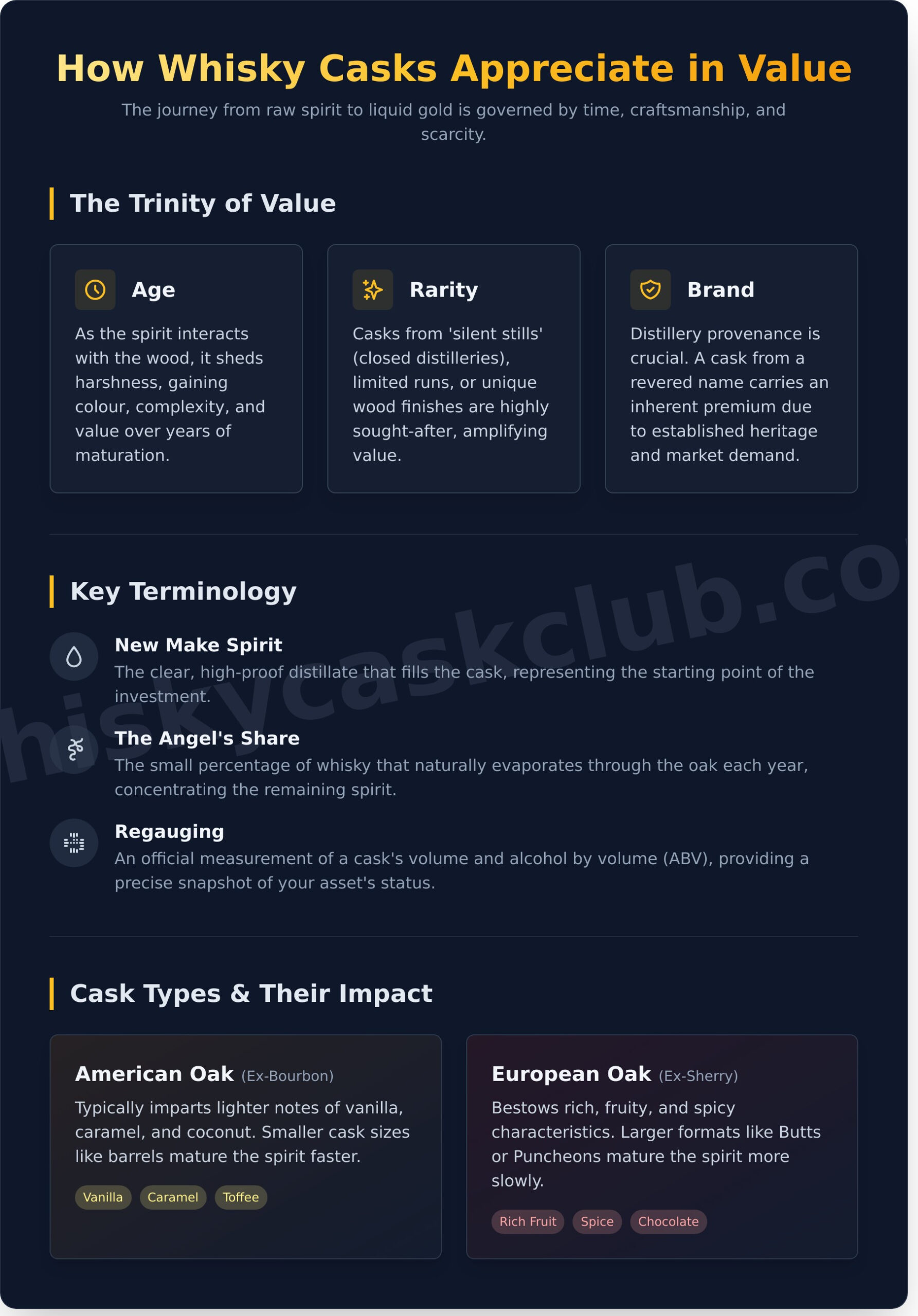
A foundational principle underpins all successful whisky investment: the spirit matures exclusively within the oak cask. Once decanted into a bottle, its development ceases. This simple fact is what transforms a cask from a mere container into a dynamic, appreciating tangible asset. Understanding the mechanics of this appreciation is paramount for any discerning investor looking to build a legacy, as is being aware of the potential risks of whisky investment without expert guidance. The journey from raw spirit to liquid gold is a carefully managed process governed by time, craftsmanship, and scarcity.
The Trinity of Value: Age, Rarity, and Brand
A cask’s worth is determined by a powerful trinity of factors. Age is the most direct driver; as the spirit interacts with the wood over years, it sheds its harshness, gaining colour, complexity, and value. Rarity amplifies this value exponentially-casks from ‘silent stills’ (closed distilleries), limited experimental runs, or those with unique wood finishes are highly sought-after. Finally, Brand or distillery provenance is crucial. A cask from a globally revered name like Macallan or Dalmore carries an inherent premium due to its established heritage and insatiable market demand.
Key Terminology for the Discerning Investor
To navigate the market with confidence, one must understand its language.
- New Make Spirit: The clear, high-proof distillate that fills the cask, representing the starting point of your investment.
- The Angel’s Share: The small percentage of whisky that naturally evaporates through the porous oak each year. This is a romantic term for a natural process that concentrates the remaining spirit.
- Regauging: An official measurement of a cask’s volume and alcohol by volume (ABV), providing a precise snapshot of your asset’s status.
Cask Types and Their Impact on Flavour & Value
The cask itself is not a passive vessel; it is the most crucial ingredient after the spirit. The two primary types are American Oak (typically ex-Bourbon), which imparts notes of vanilla and caramel, and European Oak (often ex-Sherry), which bestows rich, fruity, and spicy characteristics. Cask size also matters-smaller formats like Barrels mature the spirit faster than larger Butts due to a higher wood-to-liquid ratio. This choice of wood and size profoundly shapes the final character, influencing both its future flavour profile and its ultimate market value.
Acquiring Your First Cask: A Step-by-Step Process
Embarking on your whisky investment journey is a deliberate and rewarding process. It transforms an abstract interest into the ownership of a tangible, maturing asset. This path, from initial consideration to holding the legal title, requires a clear strategy and a trusted partner to navigate the intricacies of the market. Here, we outline the essential steps to acquiring your first premium cask with confidence and clarity.
Step 1: Defining Your Investment Strategy
The foundation of any successful whisky investment is a well-defined strategy. Begin by establishing your budget and desired holding period-whether a 5-10 year term for capital growth or a 20+ year plan to build a true legacy. Your goals will inform your choice of distillery or region. An investor seeking stability might select a cask from a renowned Speyside distillery, while one with a higher risk appetite may explore a promising new make spirit. This is the moment to decide if your approach is purely growth-focused or led by a passion for a particular marque’s heritage and craftsmanship.
Step 2: Sourcing and Due Diligence
Your choice of partner is paramount. Seek out reputable brokers and cask suppliers with a proven track record, transparent processes, and deep industry connections. Before committing, ask critical questions: Where will the cask be stored? What are the annual fees for insurance and warehousing? Can you provide a full history of the cask? Understanding fair market value is crucial, especially when understanding the risks of an unregulated market. A trustworthy advisor will offer transparent pricing and guide you toward a cask with genuine provenance and potential.
Step 3: Securing Legal Ownership
True ownership is proven through meticulous documentation. The transfer process culminates in two key documents: a Delivery Order, which instructs the bonded warehouse to transfer the cask to your name, and a Certificate of Ownership, which serves as your title deed. It is absolutely essential that the cask, identified by its unique number, is officially registered under your name at an HMRC-regulated bonded warehouse. This is the definitive, non-negotiable confirmation of your ownership. Once these documents are in hand, you are the legal owner. Request a consultation to discuss your investment strategy.
Portfolio Management: Secure Storage and Active Maturation
Acquiring a premium whisky cask is the first step in building a legacy. The second, equally crucial step, is ensuring its professional management. Your tangible asset requires a secure environment and expert oversight to mature to its full potential, transforming from a promising spirit into a rare and valuable commodity. This phase of your whisky investment journey is where diligence and expertise protect and enhance its value.
The Critical Role of HMRC Bonded Warehouses
By law, all Scotch whisky must mature in a government-regulated HMRC bonded warehouse in Scotland. This provides more than just security; it is a critical financial tool. Storing your cask ‘in bond’ defers all VAT and Excise Duty payments until it is removed for bottling. This enhances the efficiency of your investment, ensuring your capital is focused on the asset itself, while it rests in a highly secure, climate-controlled facility.
Insuring Your Liquid Asset Against All Risks
A tangible asset of this calibre demands comprehensive protection. Every cask managed through our club is insured at its full replacement value from the moment of purchase. This policy provides complete peace of mind, typically covering:
- Theft and accidental damage
- Fire and flooding
- Warehouse structural failure
Crucially, as your cask appreciates in value, its insurance coverage is updated annually to reflect its growing market worth, ensuring your asset is always fully protected.
Monitoring Your Cask’s Journey
Active management involves more than just storage. We provide our members with regular valuation reports and updates on their portfolio. For those wishing to track the evolving character of their spirit, periodic sampling can be arranged. Our experts help you understand the nuances of maturation, advising on the optimal time to bottle or sell-the peak maturation window-to realise the greatest potential from your cask.
The complexities of storage, insurance, and maturation management are precisely why a trusted partner is essential. Our role is to handle every detail with meticulous care, allowing you to enjoy the prestige of ownership without the logistical burden. We provide the expertise and oversight necessary to steward your cask, ensuring your investment is not only secure but is actively managed for optimal appreciation. Discover the confidence that comes with professional cask management.
The Exit Strategy: Realising Your Investment’s Potential
A successful whisky investment is defined not just by a wise acquisition but by a meticulously planned exit. This final step is where the patient maturation of your capital and spirit culminates. Knowing when and how to liquidate your tangible asset is paramount to realising its full potential. Market conditions, the cask’s age, and the distillery’s growing reputation all influence the optimal moment to sell. A trusted broker is your indispensable partner in this final stage, navigating the market with expertise to secure the most profitable outcome for your prized possession.
Option 1: Selling Your Cask to Another Investor
The most common and liquid exit route is selling your cask on the secondary market to another private investor. This is the cornerstone of the cask investment ecosystem, facilitated through exclusive broker networks and specialised auction platforms where demand for mature, high-provenance casks is consistently strong. Your cask’s value is determined by a clear set of metrics: its age, rarity, wood type, and the prestige of the distillery. This ensures a transparent, market-driven valuation for your asset, often yielding significant returns over the holding period.
Option 2: Selling to an Independent Bottler
Independent bottlers are the artisans of the whisky world, constantly seeking unique, mature casks to create their own exclusive, often award-winning, releases. They represent a significant and discerning market for private cask owners. Your broker can discreetly present your cask’s credentials-its detailed history and tasting notes-to a curated list of these companies. The subsequent negotiation is based on the quality and irreplaceable character of your aged spirit, allowing your whisky to become part of a celebrated, limited-edition bottling with a story to tell.
Option 3: Bottling Your Own Whisky
For the ultimate personal legacy, you can choose to bottle the contents of your cask. This creates an exceptionally rare, private-label whisky for personal enjoyment, milestone celebrations, corporate gifting, or a family heirloom to be passed down through generations. While this path involves additional logistics and costs-including bottling, bespoke labelling, and alcohol duties-it offers an unparalleled connection to your investment. It transforms a financial asset into a deeply personal and tangible piece of craftsmanship. Explore your exit opportunities with the Whisky Cask Club.
Secure Your Legacy in Liquid Gold
Embarking on the journey of whisky investment is to embrace both the art of maturation and the science of portfolio diversification. As we have explored, a cask of fine Scotch is a tangible asset with a proven ability to appreciate in value, transforming time itself into tangible returns. Understanding the fundamentals of acquisition, the critical importance of active maturation in a secure environment, and a clear strategy for a successful exit are the cornerstones of building a truly remarkable collection.
The path from aspiration to acquisition is one we navigate alongside our clients every day. At Whisky Cask Club, we provide the discreet expertise and unparalleled access required for this exclusive pursuit. We offer our members exclusive access to premium, off-market Scotch whisky casks, backed by expert portfolio management and the assurance of secure storage in fully insured, accredited bonded warehouses. Your legacy is too important to leave to chance.
Take the definitive step from enthusiast to investor. Request a private consultation to begin building your whisky legacy. The story of your collection is waiting to be written.
Frequently Asked Questions
How much capital do I need to start investing in whisky casks?
The entry point for a premium cask investment typically begins around £5,000 to £10,000. This allows for the acquisition of a quality new-fill cask from a distillery with strong provenance. For those looking to build a more diversified portfolio, a capital commitment of £25,000 or more provides access to a curated selection of casks with varying age profiles and characteristics. Our advisors can help tailor a strategy to your specific financial goals and legacy ambitions.
What are the typical annual costs for storage and insurance?
Annual costs for fully managed storage and comprehensive insurance are surprisingly modest, typically ranging from £150 to £300 per cask. This fee ensures your tangible asset is kept in a government-bonded warehouse under optimal maturation conditions. It covers all aspects of care, from regular sampling to protection against theft and damage, providing complete peace of mind for the duration of your ownership. This is a crucial, yet manageable, part of protecting your investment.
Is whisky cask investment tax-free?
In the UK, whisky casks are generally considered a “wasting asset” by HMRC, meaning they are exempt from Capital Gains Tax (CGT) upon sale. This provides a significant advantage for investors. However, tax laws are complex and can change. We strongly recommend that all clients seek independent financial advice to understand the specific implications for their personal circumstances and jurisdiction, ensuring their investment strategy is structured in the most efficient manner possible.
How do I protect myself from whisky investment scams?
Protecting your capital is paramount. Always insist on proof of ownership, including a unique cask number and a delivery order confirming your title, stored in a government-bonded warehouse. Partner with a reputable firm that offers transparency and has a long-standing history in the industry. Be wary of unsolicited offers and promises of guaranteed high returns. A credible whisky investment is built on provenance, patience, and professional guidance, not on high-pressure sales tactics.
What is the average return on a whisky cask investment?
While past performance is not a guarantee of future results, well-chosen whisky casks have historically shown average annual returns of 8-12%. Returns are driven by the spirit’s maturation, the distillery’s brand prestige, and overall market demand for rare, aged whisky. The key to maximising potential is selecting casks with excellent provenance and allowing them the necessary time to mature, transforming them from a new spirit into a highly sought-after tangible asset.
How long should I plan to hold a whisky cask before selling?
Whisky cask ownership is a long-term strategy, not a short-term trade. We typically advise clients to plan for a holding period of at least 5 to 10 years to allow for significant maturation and appreciation in value. For casks from truly premium distilleries, holding for 15, 20, or even 25 years can yield exceptional results. Patience is fundamental; the magic of maturation is what unlocks the cask’s ultimate potential and builds a true legacy asset.
Can I invest in casks from distilleries other than Scottish ones, like Bourbon or Japanese?
While Bourbon and Japanese whiskies are exceptional spirits, the secondary market for cask investment is most mature and liquid for Scotch whisky. The global demand, clear regulations, and established auction market provide a robust framework for investors. Our expertise is curated specifically around premium Scotch casks, as this segment offers the most established track record and transparent exit strategies for a tangible asset portfolio. We focus on providing our clients with access to this premier market.