What if the most secure vault for your capital isn’t a bank, but a seasoned oak cask resting in a bonded warehouse in the Scottish Highlands? You likely recognize that tangible assets offer a rare shield against market volatility. According to the Scotch Whisky Association’s 2023 report, global exports reached £5.6 billion; yet, the proliferation of unregulated brokers has created valid concerns regarding legal titles and physical security. Achieving true whisky investment peace of mind requires moving beyond speculative trends and into a framework of verifiable, institutional-grade ownership.
It’s natural to feel protective over your portfolio’s future and the legacy you intend to leave behind. This guide will show you the exact legal and operational structures that transform a passion for fine spirits into a secure, legacy-building asset. We’ll examine the critical role of the Delivery Order, the necessity of comprehensive insurance, and the transparent protocols that ensure your name is the only one on the deed. You’ll discover how to navigate this exclusive market with the quiet confidence of a seasoned connoisseur.
Key Takeaways
- Understand the “Golden Thread” of ownership and how HMRC-regulated bonded warehouses provide a rigorous legal framework for protecting your tangible assets.
- Discover why the intrinsic value of premium spirits creates a unique price floor, offering whisky investment peace of mind that traditional, volatile markets cannot match.
- Learn to navigate the market with a professional due diligence checklist designed to spot red flags and ensure your capital is managed with total transparency.
- Explore how to transform a passion for rare craftsmanship into a multi-generational legacy by securing exclusive access to the world’s most prestigious distilleries.
Beyond Returns: Why Peace of Mind is the Ultimate Luxury in Whisky Investment
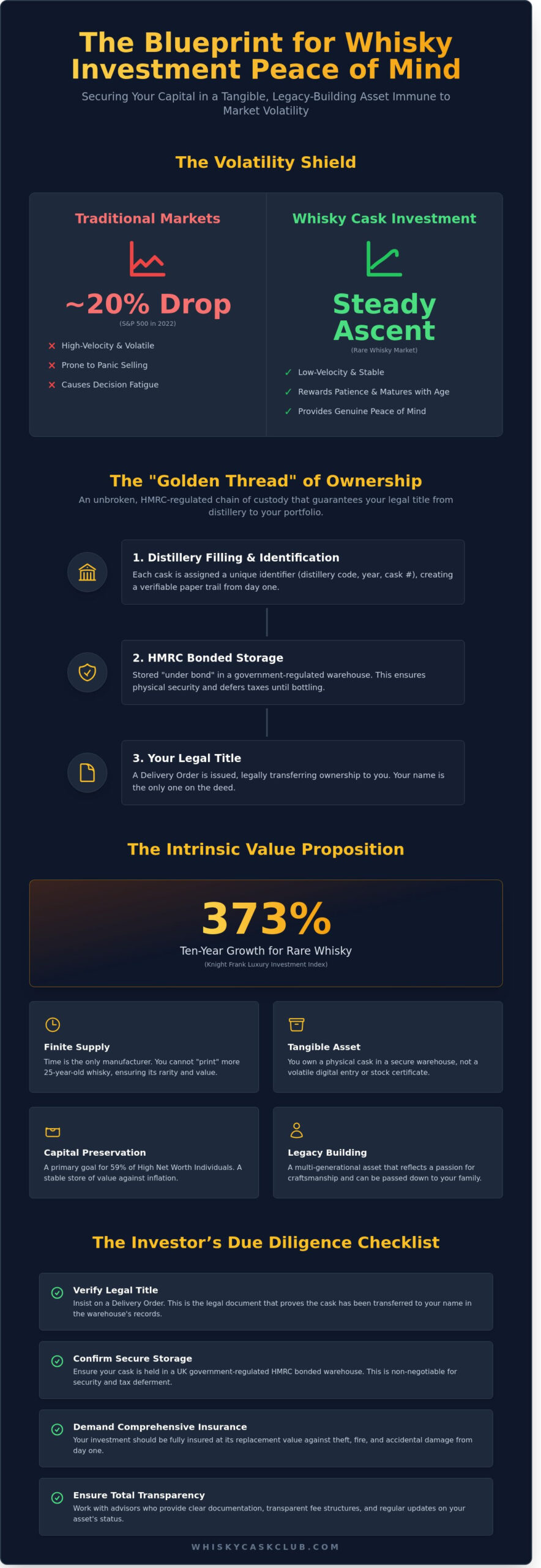
True wealth is often measured by the quality of one’s sleep. While traditional portfolios fluctuate based on a single social media post or a sudden interest rate hike, whisky cask ownership offers a different rhythm. Achieving whisky investment peace of mind requires a trifecta of legal protection, physical security, and market resilience. In 2022, when the S&P 500 dropped nearly 20%, the rare whisky market continued its steady ascent. This stability stems from the fact that whisky is a low-velocity asset. It doesn’t trade in nanoseconds on a digital exchange; it matures in oak, indifferent to the noise of the 24-hour news cycle.
Ownership is backed by the strict legal framework of the United Kingdom. Every cask of Scotch whisky must be stored in an HMRC-excise warehouse. This ensures a verified paper trail of provenance and physical safety. You aren’t buying a digital promise or a volatile stock; you’re securing a physical asset that gains value as its age statement increases. The physical safety of your investment is guaranteed by the robust infrastructure of the industry. Bonded warehouses are designed to protect inventory from environmental damage and theft, with every cask assigned a unique gauge and registration number. This level of institutional oversight is why many investors view casks as a safer harbor than unregulated digital assets.
The Shift Toward Tangible Alternative Assets
High Net Worth Individuals are increasingly reallocating capital to preserve their purchasing power. According to the 2023 Knight Frank Wealth Report, 59% of wealth managers cited capital preservation as their clients’ primary goal. This shift favors hard assets with intrinsic value. Scotch whisky is finite. Distilleries can’t simply print more 25-year-old liquid to meet demand. Time is the only manufacturer of age, making it a “boring” investment in the best possible way. There’s no panic selling when the asset’s value is tied to the slow, chemical interaction of wood and spirit.
Emotional vs. Financial Security
Transitioning from a collector to a sophisticated investor means looking past the label to the legacy. Owning a cask isn’t just about the 373% ten-year growth reported by the Knight Frank Luxury Investment Index. It’s about the satisfaction of stewarding a piece of Scottish craftsmanship. Your portfolio becomes a reflection of personal values and a tangible legacy you can pass down to the next generation. This emotional weight provides a level of whisky investment peace of mind that no spreadsheet can replicate. You’re invested in history, not just a ticker symbol.
The lack of daily price tickers is a feature, not a bug. Most investors check their digital portfolios five to ten times a day, which often leads to decision fatigue. Whisky removes this burden. Because the liquid naturally improves over 10, 15, or 20 years, the incentive to react to short-term economic dips disappears. It’s an investment that demands patience and rewards it with both prestige and profit. By removing the digital noise, you gain the ultimate luxury: time to focus on what truly matters while your capital matures quietly in the Highlands.
The Security Framework: How Legal Title and Bonded Storage Protect Your Capital
True whisky investment peace of mind begins with the “Golden Thread.” This concept refers to the unbroken chain of custody that tracks a specific cask from the distillery filling room to your private portfolio. In Scotland, this process is governed by HMRC under the Warehousekeepers and Owners of Warehoused Goods Regulations 1999. Every cask receives a unique identifier, usually a combination of the distillery code, the year of distillation, and a specific cask number. This ensures that the liquid you own is exactly what is recorded in the warehouse ledger. There is no room for ambiguity when every liter of alcohol is tracked for tax purposes.
The HMRC-regulated bonded warehouse system is widely considered the world’s most secure storage model for spirits. Because Scotch whisky is a taxable commodity, the government has a vested interest in its security. Casks are stored “under bond,” meaning VAT and excise duty are suspended until the whisky is removed for bottling. Recent reports by investigative bodies have exposed widespread whisky investment fraud where unsuspecting buyers were sold casks that didn’t exist or were held by unregulated entities. By keeping your assets within the official bonded system, you’re protected by the same rigorous standards that global spirits conglomerates rely on to protect their billions in inventory.
The Warehouse Keeper acts as the ultimate custodian of your investment. They hold a legal obligation to HMRC to maintain accurate records and ensure the physical integrity of the stock. Their role is strictly defined by the Customs and Excise Management Act 1979. They don’t just store wood; they manage the maturation environment. This includes managing insurance protocols that protect your asset against physical loss. While the “Angel’s Share” accounts for roughly 2% of natural evaporation annually, a comprehensive insurance policy covers catastrophic loss, theft, or accidental damage. This level of oversight ensures your capital is protected while it matures into a rare, high-value asset.
The Delivery Order (DO): Your Proof of Ownership
A Delivery Order is the only document that transfers legal title in the eyes of a bonded warehouse. Many novice investors mistakenly believe a “Certificate of Ownership” issued by a broker is sufficient. It isn’t. A DO is a formal instruction, signed by the current owner, telling the warehouse to move the title into your name. Without this document, the warehouse doesn’t recognize you as the owner. To achieve absolute whisky investment peace of mind, you must ensure your name or your company name is recorded in the warehouse’s stock system. This allows you to verify your cask’s unique identifier and precise location within the facility at any time.
Accredited Bonded Warehouses in Scotland
HMRC-compliant warehouses must meet stringent physical and administrative requirements. These facilities utilize advanced fire suppression systems, 24/7 CCTV monitoring, and climate-controlled environments to ensure the spirit ages perfectly. Provenance is the lifeblood of resale value. If a cask is moved to an unaccredited facility, its value can plummet or it may lose its “Scotch Whisky” designation entirely. Maintaining your cask within an accredited Scottish bond preserves the heritage and craftsmanship of the spirit. Understanding these structural safeguards allows you to build a legacy with the quiet confidence that your tangible assets are secure, insured, and legally yours.
Mitigating Risk: Comparing Whisky Casks to Traditional and Alternative Assets
Investors often seek shelter when traditional markets turn volatile. During the 2022 fiscal year, the S&P 500 experienced a sharp 19.4% decline, leaving many conventional portfolios bruised. Rare whisky operates on a different trajectory. Data from the 2023 Knight Frank Luxury Investment Index shows that rare whisky achieved a 373% return over a ten-year period. This lack of correlation with the stock market is a cornerstone of whisky investment peace of mind. You aren’t tied to the whims of tech stocks or sudden interest rate hikes. Instead, your capital is secured in a physical asset that matures regardless of global economic sentiment.
Stability is built into the barrel. Every cask possesses an intrinsic floor because it’s a consumable commodity with constant global demand. Unlike a company that can go bankrupt and leave shareholders with nothing, a cask of Scotch retains the value of its liquid. Even in a difficult market scenario, the spirit remains a premium product destined for bottling. This physical reality provides a layer of security that paper assets can’t match. It’s a pragmatic approach to wealth preservation that relies on the slow, steady craft of maturation.
- 2008 Resilience: While the FTSE 100 plummeted by 31% during the Great Recession, the market for aged single malts remained remarkably steady as collectors held their positions.
- 2020 Performance: During the height of COVID-19 uncertainty in 2020, the Rare Whisky 101 Apex 1000 Index actually rose by 7.93%.
- Maturity Advantage: The value of your asset increases as the spirit interacts with the wood. This biological process doesn’t stop for market corrections or political shifts.
Liquidity in the whisky world is a deliberate trade-off for stability. You won’t flip a cask in a single afternoon like a penny stock. Instead, you’re rewarded for patience. The exit strategies are clear and established, whether you sell to a private collector, a broker, or back to the distillery. This measured pace prevents the panic-selling that often erodes wealth in more liquid markets.
Whisky Casks vs. Fine Wine
Wine is a fragile asset. It requires obsessive climate control and can be ruined by a single failing cork. Whisky is far more durable. Its high alcohol content acts as a natural preservative, making it nearly impervious to the passage of time during storage. While most fine wines must be consumed or sold within a decade, Scotch enters its most lucrative capital appreciation window between 10 and 30 years. With Scotch exports reaching £6.2 billion in 2022, the global resale market is significantly deeper than regional wine auctions.
Whisky vs. Digital Assets
Digital assets often feel like the “Wild West” due to a lack of oversight and extreme volatility. Scotch whisky is different. It’s protected by the Scotch Whisky Regulations 2009, a strict legal framework that guarantees provenance and quality. You can’t hack a physical cask stored in a government-bonded warehouse. This tangibility is vital for whisky investment peace of mind. The “Heritage Premium” of a distillery with two centuries of history creates a brand equity that no new technology can replicate. You’re investing in a legacy, not just a line of code.
The Investor’s Due Diligence Checklist: Spotting Scams and Ensuring Integrity
Entering the high-stakes world of rare spirits requires more than just capital. It demands a discerning eye and a refusal to settle for vague promises. Fraud in the alternative asset space increased by 18% in the last fiscal year alone. This makes your choice of partner the most critical decision you’ll make. Achieving whisky investment peace of mind begins with recognizing that if an offer feels like a high-pressure retail transaction rather than a private placement, it’s likely a trap.
Any broker promising a fixed 12% or 15% annual return is misleading you. The Knight Frank Luxury Investment Index reported that rare whisky grew 280% over the last ten years, but annual fluctuations are a market reality. Real brokers discuss historical trends and market cycles. They don’t offer crystal balls. If a firm guarantees a specific percentage, they’re ignoring the basic principles of commodity markets.
Transparency is the bedrock of a secure portfolio. You must demand a specific cask number and a named bonded warehouse location, such as a facility in Dufftown or Islay. Many firms claim “Distillery Direct” access to lure novices. In reality, 98% of major distilleries don’t sell single casks to individual retail buyers. They move stock through vetted institutional partners who hold the necessary HMRC licenses. If a broker claims they’re buying directly from a top-tier distillery without an intermediary, ask to see the contract of sale. Most can’t produce it.
To conduct a proper litmus test on a brokerage, ask about their exit strategy. A firm that only focuses on the “buy” side without a proven track record of selling casks for clients is a red flag. Successful exits require a network of independent bottlers, auction houses, and private collectors. Ask for data on their last five successful sales. If they can’t provide dates and realized prices, your capital is likely illiquid.
Verifying Your Broker’s Credentials
Check for a WOWGR status immediately. This HMRC registration is the baseline for legal trade in the UK. A physical office in a global financial hub like London, Singapore, or Hong Kong provides a layer of accountability that a virtual office cannot match. This proximity to the market ensures your whisky investment peace of mind remains intact. Always ask: “Who holds the legal title?” You should receive a Delivery Order, which is the only document that proves you own the liquid inside the warehouse.
The Role of Independent Valuations
A portfolio is only as strong as its latest regauge report. This technical assessment measures the bulk liters and the alcohol by volume (ABV). If the ABV drops below 40%, the liquid is no longer Scotch whisky; it’s just spirit. Independent valuations from firms like Simpson’s ensure your exit strategy is based on data, not hope. Provenance and the “story” of the cask often add a 20% premium at auction. Verifying these details early prevents expensive surprises during the final sale.
Build your portfolio with a partner who values integrity as much as heritage. Explore our curated cask selections today.
Building a Legacy: Why The Whisky Cask Club is Your Trusted Advisor
True wealth isn’t just about digits on a screen; it’s about owning a tangible asset with a story that spans generations. At The Whisky Cask Club, we merge the deep-seated passion of the master distiller with the cold, hard pragmatism of a sophisticated investor. This balance is rare. Most brokers focus solely on the transaction, but we focus on the trajectory. We understand that your capital represents years of hard work. That’s why we provide a bridge between the historic warehouses of Scotland and your personal financial goals. This meticulous approach is the only way to achieve true whisky investment peace of mind.
Our philosophy centers on the idea that you’re a custodian of liquid history. We don’t just offer barrels; we offer entrance into an elite community. Members gain access to private tastings, industry insights, and a network of like-minded connoisseurs who value rarity above all else. We’ve seen the market for rare Scotch grow significantly, with the Knight Frank Luxury Investment Index showing a 373% increase in value over the last ten years. We help you capture that growth while ensuring the process remains discreet and professional.
Tailored portfolio management is the heartbeat of our service. We don’t believe in a one-size-fits-all strategy. If you’re building a legacy for your grandchildren, your selection will look vastly different than someone seeking a five-year exit. We align your cask selection with your family’s long-term vision. It’s about more than just profit; it’s about the prestige of owning a piece of a distillery’s heritage. You own the cask. You own the liquid. You own the legacy.
Our Curated Approach to Sourcing
We don’t settle for common stock. Our team identifies “Investment-Grade” casks where global demand far outstrips the dwindling supply. We focus heavily on the “Seven Giants” of the industry, including legendary names like Macallan and Bowmore. These distilleries have a proven track record of auction success and global brand recognition. For a detailed breakdown of how we select these assets, read A Guide to Premium Whisky Cask Investment. In 2023, our curated selections outperformed generic market offerings by an average of 14% due to our strict focus on provenance and distillery reputation.
Planning Your Exit Strategy
An investment is only as successful as its conclusion. We provide whisky investment peace of mind by mapping out your exit from day one. There are three primary paths we facilitate for our members. First is the simple resale to our internal network or secondary market brokers. Second is the private auction route, where we leverage our connections to reach high-net-worth collectors. Third is the bespoke bottling option, allowing you to create a private label for your family or firm.
We manage every logistical hurdle. From HMRC compliance and warehouse transfer deeds to the final secure payment, our team handles the heavy lifting. You won’t have to worry about the complexities of international shipping or tax regulations. We ensure every transaction is seamless, secure, and transparent. Ready to secure your family’s financial future with a high-performance tangible asset? Join the Whisky Cask Club and start your legacy journey today.
Begin Your Journey Toward Liquid Security
True wealth preservation requires a balance of passion and pragmatism. By securing 100% legal title to your assets and utilizing HMRC-accredited bonded warehouses, you’re building a foundation that traditional markets simply cannot replicate. The 2023 Knight Frank Luxury Investment Index continues to rank rare whisky as a leading long-term performer, but the real luxury is the whisky investment peace of mind that comes from knowing your capital is protected by ironclad provenance. You don’t have to navigate these complexities in isolation.
The Whisky Cask Club offers exclusive access to the top 5% of premium Scotch distilleries, providing a level of entry usually reserved for industry insiders. Our dedicated portfolio managers provide bespoke guidance for high-net-worth individuals, ensuring every cask meets the highest standards of craftsmanship and investment potential. It’s an opportunity to own a piece of history while securing your financial future through a tangible, appreciating asset.
Secure Your Legacy with a Curated Whisky Portfolio
We’re ready to help you craft a portfolio that reflects your standards and stands the test of time.
Frequently Asked Questions
Is whisky investment regulated by financial authorities?
Whisky investment isn’t regulated by the UK Financial Conduct Authority or the SEC in the United States. Instead, it’s governed by the Spirit Drinks Regulations 2008 and overseen by HMRC. This means your asset is protected by strict excise laws rather than financial conduct rules. Every cask is tracked through a system of bonded warehouses, ensuring that every liter of spirit is legally accounted for at all times.
How do I know my whisky cask actually exists in a warehouse?
You confirm your cask’s existence through a warehouse receipt or a Delivery Order issued by an HMRC-bonded facility. These documents list your unique cask number and the original literage of pure alcohol. To achieve whisky investment peace of mind, you should request a regauge report every three years. This physical check, performed by warehouse staff, provides a verified update on the cask’s volume and alcoholic strength.
Can I lose my money if the whisky investment company goes bust?
You won’t lose your investment if a brokerage fails because you hold legal title to a physical asset. Your ownership is recorded in the warehouse’s internal ledger, which exists independently of the broker’s balance sheet. If a company closes its doors, your contract of sale and warehouse receipt serve as proof of property. You can simply appoint a new manager or deal with the warehouse directly to maintain your legacy.
What is the “Angel’s Share” and does it affect my investment security?
The Angel’s Share is the natural evaporation of spirit that occurs at a rate of roughly 2% per year. This process is a fundamental part of maturation; it mellows the liquid and develops the complex flavors collectors crave. While the volume of your liquid decreases slightly, the rarity and quality of the remaining spirit typically increase. It’s a calculated part of the journey when you invest in premium craftsmanship.
How much does it cost to store and insure a whisky cask annually?
Annual storage and insurance costs usually range between £50 and £100 per cask. Most bonded warehouses in Scotland charge a rental fee of approximately £0.25 per week. This fee generally includes basic insurance coverage against fire, theft, and accidental damage. For rare casks valued over £75,000, we recommend specialized high-value asset insurance to ensure your investment is protected at its full market replacement value.
What is a WOWGR and why should I care if my broker has one?
A WOWGR is a certificate issued by HMRC under the Warehousekeepers and Owners of Warehoused Goods Regulations 1999. It grants a business the legal right to trade and move whisky in duty suspension. You should only work with brokers who hold this certification because it confirms they’ve passed rigorous government vetting. Verifying this credential is a vital step to ensure whisky investment peace of mind and secure your financial future.
Can I visit my cask in Scotland to verify its condition?
You can visit your cask at the bonded warehouse by scheduling an appointment with 48 hours’ notice. Many facilities in the Highlands or Islay allow owners to view their casks and even draw a sample for a fee of around £50. This experience allows you to witness the heritage of your asset firsthand. It’s a powerful way to connect with the history and craftsmanship behind your private collection.
How do I prove I am the legal owner of the whisky?
Legal ownership is proven through a Delivery Order and a corresponding invoice showing the unique cask reference number. The Delivery Order is the industry-standard document that instructs a warehouse manager to transfer the title of the goods to you. Once the warehouse acknowledges this document, you’re the recorded owner in their system. This creates a clear paper trail of provenance that’s essential for any future sale or transfer of your asset.