For the discerning investor, a cask of rare single malt is a tangible asset building a legacy. Yet, navigating its true market worth requires more than passion-it demands a clear whisky cask valuation guide. The world of valuations can feel frustratingly opaque, filled with inconsistent reports, complex jargon, and the potential for biased advice that can cloud your investment strategy, leaving you to question the right moment to act.
In the following chapters, we demystify the entire process. We will illuminate the key factors that dictate your cask’s value-from distillery provenance and age to wood type and fill level. Our goal is to empower you with the knowledge to critically assess any valuation, understand the market’s nuances, and make confident, strategic decisions about your prized asset. Consider this your definitive map to navigating the world of whisky investment with clarity and authority.
Key Takeaways
- Discover the core pillars of cask valuation, from distillery provenance to wood type, to understand what truly drives the worth of your tangible asset.
- Learn to interpret critical metrics like Re-gauged Litres of Alcohol (RLA) and ABV, the hard data that forms the foundation of any credible cask appraisal.
- This whisky cask valuation guide demystifies the process, explaining the methods experts use to translate raw data and market intelligence into a confident valuation.
- Understand the crucial difference between a cask’s current valuation and its ultimate exit value to set realistic expectations for turning your asset into capital.
Why Whisky Casks are Valued Differently Than Other Assets
Unlike stocks, bonds, or commodities, a cask of maturing whisky is a living, tangible asset with a unique identity. It does not trade on a public exchange with a ticker symbol; its value is not determined by the second-to-second whims of the market. Instead, it represents a long-term investment in craftsmanship and provenance. Understanding this fundamental difference is the first step in this comprehensive whisky cask valuation guide. The process is less about reading a market report and more about appreciating a bespoke creation.
The valuation of a cask is an expert assessment, a meticulous calculation that balances empirical data with an appreciation for the spirit’s singular character. It acknowledges that you are not merely investing in a commodity, but acquiring a piece of heritage with the potential to build a lasting legacy.
The Uniqueness of Each Cask
No two casks of whisky mature in precisely the same way. Even casks filled from the same still on the same day and laid to rest side-by-side will evolve differently. The subtle variations in the oak, the specific location within the dunnage warehouse, and the ambient temperature all contribute to a unique alchemical process. This interaction between spirit and wood creates a one-of-a-kind flavour profile-a liquid story that cannot be replicated. This inherent rarity is a cornerstone of its value; you own a piece of singular craftsmanship.
Understanding Market Illiquidity
The world of whisky cask investment operates without a central exchange. There is no FTSE or S&P 500 for single malt casks. Transactions are conducted privately, often through trusted brokers and specialists, creating a market defined by discretion and expertise. While industry bodies like the Scotch Whisky Association (SWA) provide essential governance and protect the heritage of Scotch, they do not operate a trading floor. This illiquid nature means that real-time price data is not readily available, making a direct comparison to more conventional, liquid assets impossible.
The Core Pillars of Cask Valuation: Deconstructing the Price
Determining the precise value of a whisky cask is not a matter of applying a simple formula. It is a multi-faceted analysis, blending art with financial science. A cask’s worth is built upon a foundation of core pillars, each contributing to its current market price and future potential. For the discerning investor, understanding these elements is the first step in building a premium portfolio. This section of our whisky cask valuation guide deconstructs these fundamental drivers.
Pillar 1: Distillery Provenance and Reputation
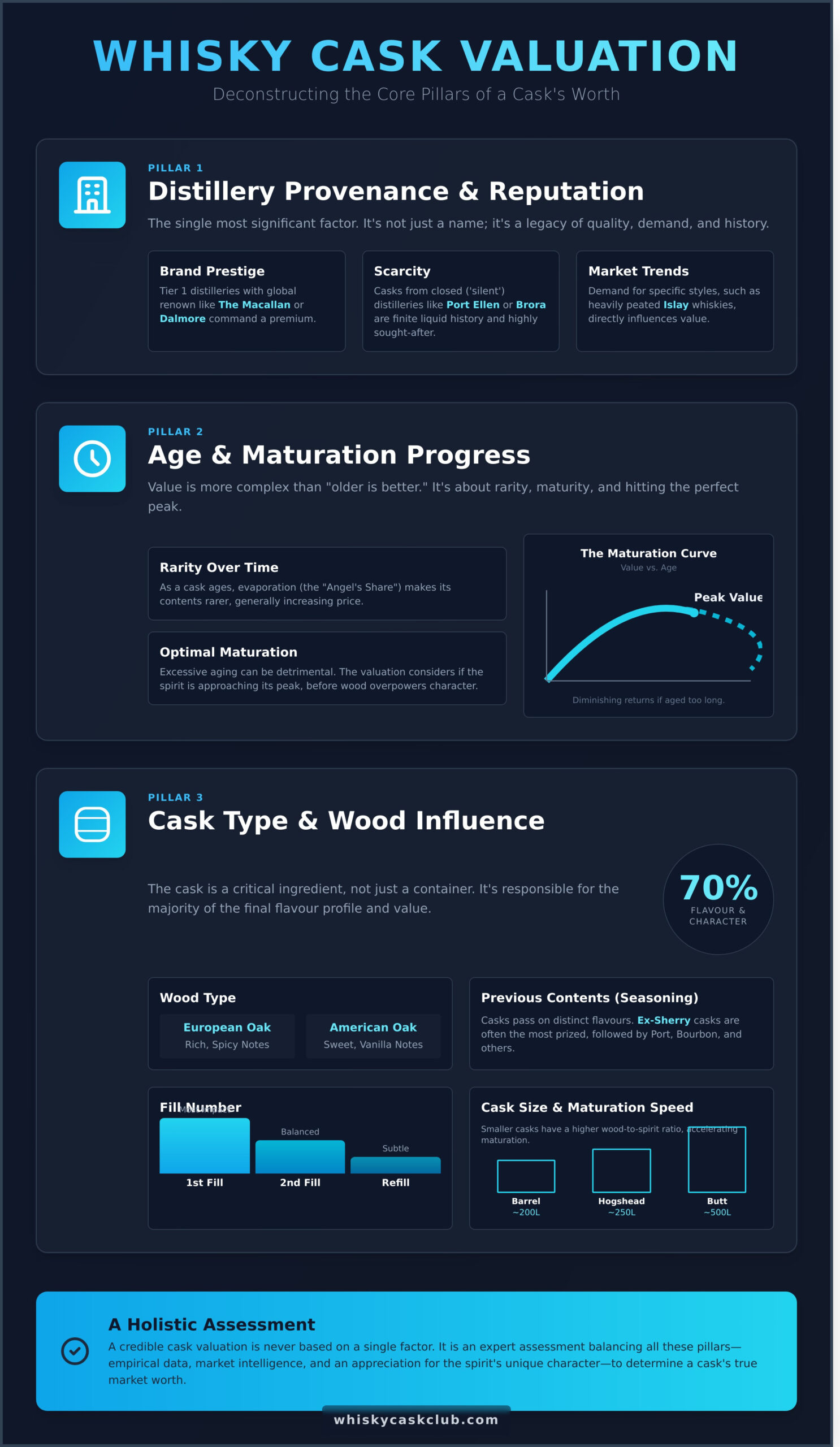
The distillery’s name is the single most significant factor influencing a cask’s value. A cask from a Tier 1 distillery with global renown, such as The Macallan or Dalmore, will always command a premium. Beyond brand prestige, scarcity plays a crucial role. Casks from closed or ‘silent’ distilleries like Port Ellen or Brora are finite, transforming them into highly sought-after liquid history. Market trends and demand for specific styles-such as heavily peated Islay whiskies-also directly influence value, a factor that can be tracked through official industry data and auction results.
Pillar 2: Age and Maturation Progress
While age is a primary driver of value, the relationship is more complex than “older is better.” As a cask matures, its contents become rarer due to evaporation (the ‘Angel’s Share’) and the simple fact that fewer old casks exist. This rarity generally increases its price. However, every spirit has an optimal maturation curve. An expert valuation considers whether the whisky is approaching its peak. Excessive aging can sometimes be detrimental, allowing the wood to overpower the spirit’s delicate character and diminishing its ultimate value.
Pillar 3: Cask Type and Wood Influence
The cask is not merely a vessel; it is a critical ingredient responsible for up to 70% of the whisky’s final flavour profile. Several factors are at play:
- Wood Type: European Oak (often from Spain) imparts rich, spicy notes, while American Oak provides sweeter, vanilla-like characteristics.
- Previous Contents: A cask that previously held Sherry, Port, or Bourbon will pass on those distinct flavours, with ex-Sherry casks often being the most prized.
- Fill Number: A ‘first-fill’ cask, used for the first time to mature Scotch, will have the most profound impact on the spirit and is therefore more valuable than a second or third-fill ‘refill’ cask.
- Cask Size: Smaller casks like Barrels and Hogsheads offer a higher wood-to-spirit ratio, accelerating maturation compared to larger Butts.
Together, these pillars provide a robust framework for any comprehensive whisky cask valuation guide, allowing investors to look beyond a simple age statement and assess the true, intrinsic value of a tangible asset.
The Numbers Game: Re-Gauging, ABV, and The Angel’s Share
While a distillery’s provenance and the cask’s wood type provide the narrative of your investment, the hard data provides its physical proof. We now move from the qualitative to the quantitative-the meticulous measurements that form the bedrock of any credible valuation. This crucial information is captured in a warehouse re-gauging report, a definitive statement on the cask’s current state. Without this data, any valuation is purely speculative; with it, you have a precise foundation for understanding your tangible asset. This is a non-negotiable step in any professional whisky cask valuation guide.
Understanding the ‘Angel’s Share’
The ‘Angel’s Share’ is the poetic term for the natural, evaporative loss of spirit from the cask over time. As the oak breathes, a small amount of alcohol and water permeates the wood and escapes into the warehouse. This is not merely a loss; it is a vital part of maturation. This process concentrates the remaining spirit, deepening its colour and intensifying its flavour profile. While the annual loss is typically 1-2%, this rate varies based on warehouse temperature and humidity. This gradual reduction in volume is a critical factor that directly impacts the cask’s final yield and, therefore, its ultimate value.
Decoding the Re-Gauging Report: OLA, RLA, and ABV
The re-gauging report provides the three most important metrics for determining the liquid volume and potential bottle yield of your cask. Understanding these figures is essential for any serious investor.
- OLA (Original Litres of Alcohol): This is the volume of pure alcohol recorded when the cask was first filled. It serves as the baseline for tracking the cask’s maturation journey.
- RLA (Re-gauged Litres of Alcohol): This is the current volume of pure alcohol in the cask. The difference between the OLA and RLA represents the total ‘Angel’s Share’ lost to date.
- ABV (Alcohol By Volume): This measures the spirit’s current alcoholic strength. Critically, for a spirit to be legally sold as Scotch Whisky, its ABV must remain above 40%. This is not merely a guideline but a legal mandate enshrined in The Scotch Whisky Regulations 2009. A cask falling below this threshold suffers a dramatic loss in value.
Together, these three metrics-OLA, RLA, and ABV-allow us to calculate precisely how many bottles a cask will yield. This calculation transforms an abstract asset into a quantifiable investment, providing the empirical data needed to complete a thorough and accurate valuation.
The Valuation Process in Practice: Methods and Sources
Determining the precise value of a maturing whisky cask is a meticulous process, blending empirical data with the nuanced insights of seasoned experts. The ultimate goal is to establish a Fair Market Value (FMV)-the price at which the asset would change hands between a willing buyer and a seller, neither being under compulsion to act. This is not guesswork; it is a calculated assessment grounded in market reality, forming a critical component of any investor’s portfolio strategy. A robust whisky cask valuation guide must distinguish between different valuation approaches.
Indicative vs. Independent Valuations
As a cask owner, you will encounter two primary types of valuation. An indicative valuation is a swift, informal estimate, often provided by brokers to give you a snapshot of your cask’s potential worth. Its primary advantage is speed and cost-effectiveness, offering a quick health check on your investment. However, it lacks formal standing and may carry inherent bias. Conversely, an independent valuation is a comprehensive, formal report prepared by a specialist for a fee. This detailed analysis is essential for official purposes such as insurance, inheritance planning, or securing financing against your tangible asset, providing an impartial and defensible figure.
The Role of Market Data and Auction Results
A credible valuation is always anchored in recent, verifiable market activity. Professional valuers meticulously analyse data from a range of sources to create a complete picture of your cask’s worth, removing speculation and grounding the figure in real-world transactions. Key data points include:
- Comparable Cask Sales: Private sales data of casks with similar provenance, age, and wood type provide the most direct benchmarks for value.
- Auction Results: Public auction prices for both casks and rare bottled whiskies serve as a powerful barometer of market sentiment and brand prestige.
- Distillery Performance: The rising or falling reputation and output of the source distillery directly impacts the future value of its maturing spirit.
This data-driven methodology transforms valuation from an abstract exercise into a pragmatic assessment of your investment’s current standing. At the Whisky Cask Club, our experts leverage exclusive access to global market data to deliver assessments of unparalleled accuracy, ensuring you have the clarity needed to make informed decisions about your legacy. Request a valuation today.
How to Read a Valuation Report: Key Metrics and Red Flags
A valuation report is more than a number; it is a testament to the current state and future potential of your tangible asset. For the discerning investor, the ability to critically assess this document is paramount to protecting and maximising the value of their portfolio. A credible valuation provides clarity and confidence, while a poor one can obscure risk and lead to misguided decisions.
This section of our whisky cask valuation guide is designed to empower you with the knowledge to distinguish a professional assessment from a speculative sales pitch.
What to Look For in a Credible Valuation
A professional valuation is built on a foundation of verifiable data and transparent methodology. When reviewing a report, ensure it contains these essential elements:
- Clear Cask Identification: The report must meticulously detail the cask’s provenance, including its unique cask number, the distillery of origin, the original fill date, and the wood type. This confirms you are assessing the correct asset.
- Recent Re-gauging Data: The lifeblood of an accurate valuation. This includes the current Regauged Litres of Alcohol (RLA) and Alcohol by Volume (ABV). Without this recent data, any valuation is merely an estimate based on outdated information.
- Reference to Market Data: A credible valuation is grounded in reality, not fantasy. The report should reference comparable, recent sales of similar casks to justify its figures. This demonstrates a data-driven approach.
- Wholesale and Retail Values: There is a significant difference between the price a private collector might pay (retail) and what a blender or independent bottler would offer (wholesale). A transparent report will provide both, giving you a realistic view of your exit strategies.
Common Red Flags to Avoid
Equally important is the ability to recognise indicators of a less-than-reputable valuation. Be wary of reports or brokers that exhibit the following traits:
- Guaranteed Future Projections: The whisky market is dynamic. While historical data can inform potential growth, any promise of guaranteed or overly optimistic future returns is a hallmark of speculation, not a sound investment strategy.
- Valuations Without a Re-gauge: A valuation provided without recent physical analysis of the cask’s contents is fundamentally flawed and should not be trusted for serious financial decisions.
- High-Pressure Tactics: Your journey in cask ownership should be measured and deliberate. A valuation linked to immediate, high-pressure sales tactics is often designed to serve the broker, not the investor.
- Lack of Transparency: If a valuer is unwilling or unable to explain their methodology and the data sources used, consider it a significant red flag. A trusted partner, such as the Whisky Cask Club, will always be transparent about the process, empowering you to build your legacy with confidence.
Valuation vs. Exit Value: Turning Your Asset into Capital
An expert valuation provides a sophisticated and data-driven estimate of your cask’s worth in the current market. However, it is crucial for a discerning investor to distinguish between this valuation and the final exit value. The valuation is a measure of potential; the exit value is the tangible capital realised when the asset is sold. This distinction is the cornerstone of a pragmatic investment approach, turning a passion asset into a successful financial outcome.
As this whisky cask valuation guide has detailed, understanding the metrics of your cask is only the first step. The true art lies in navigating the market to transform that appraised value into a realised return.
The Broker’s Role in Realizing True Value
A valuation is the essential starting point for a bespoke sales strategy. At Whisky Cask Club, we leverage this data to connect your asset with our exclusive, global network of collectors, investors, and independent bottlers. Our role is to act as your discreet advisor, using our market expertise and relationships to facilitate a sale that aligns closely with the cask’s appraised potential. We manage the entire process, ensuring a seamless and profitable transaction.
Strategic Timing and Exit Opportunities
The exit value of your cask is influenced by market dynamics, demand for its specific age and distillery profile, and your chosen exit route. A successful strategy requires patience and precision. The primary routes to liquidity include:
- Private Brokerage Sale: The preferred method for most investors, offering discretion and access to a curated list of qualified buyers willing to pay a premium for casks with excellent provenance.
- Auction: A viable option for exceptionally rare or highly sought-after casks, where competitive bidding can drive the price significantly above its initial valuation.
- Sale to an Independent Bottler: Ideal for mature casks that are ready for bottling, appealing to brands seeking unique, high-quality single-cask expressions.
The optimal path depends entirely on the unique characteristics of your cask and your personal investment goals. Crafting the right exit strategy is as vital as the initial purchase. Let us help you build your exit strategy. Contact our advisors.
Securing Your Legacy Through Expert Cask Valuation
Mastering the nuances of cask valuation is the cornerstone of a successful whisky investment portfolio. As this whisky cask valuation guide has demonstrated, true value is a complex tapestry woven from distillery provenance, the science of maturation metrics like ABV and fill level, and the foresight to distinguish current worth from future exit potential.
Knowledge, however, is only the first step. To truly capitalise on your tangible asset, you need a partner with precision and insight. Our team of trusted specialists provides transparent valuations, leveraging unparalleled access to global secondary market data and offering expert portfolio management to craft your ideal exit strategy.
Ready to build your legacy? Request a complimentary, data-driven valuation for your cask portfolio.
Your journey into the world of premium cask ownership is a significant one. Let us provide the clarity and confidence you need to turn passion into a lasting legacy.
Frequently Asked Questions
What is the difference between a whisky cask valuation and a firm offer?
A valuation is an expert, data-driven estimate of your cask’s current market worth, essential for portfolio management and insurance. It is an informed opinion. A firm offer, however, is a concrete, actionable price a specific buyer is prepared to pay at this moment. While a valuation provides a sophisticated benchmark of your asset’s value, a firm offer represents a tangible opportunity to liquidate. Both are critical tools for the discerning investor.
How often should I have my whisky cask portfolio valued?
For the serious investor building a legacy portfolio, an annual valuation is the recommended cadence. This practice provides a clear and consistent measure of your asset’s performance against the market. Furthermore, a current valuation is prudent prior to considering a sale or upon the renewal of your insurance policy. Regular assessments ensure you are always equipped to make strategic, well-informed decisions regarding your premium casks, protecting and enhancing their long-term value.
Can I get my whisky cask valued for free, and what’s the catch?
While complimentary valuations are available, they are typically offered by brokers as a means to encourage a sale. The potential “catch” is that such an appraisal may not be entirely impartial. For a truly objective assessment of your tangible asset, a professional, independent valuation provides unparalleled accuracy-a cornerstone of any credible whisky cask valuation guide. This ensures the figure you receive is based on pure market data, providing the confidence required for strategic planning.
Why is a cask from a closed ‘silent’ distillery potentially so valuable?
The value of a cask from a silent distillery is rooted in one fundamental principle: finite rarity. With production permanently ceased, the existing stock is an irreplaceable, dwindling resource. This scarcity creates exceptional demand among collectors and connoisseurs worldwide. Owning a cask from a legendary name like Port Ellen or Rosebank is not merely an investment; it is the stewardship of a piece of liquid history, a legacy asset whose provenance commands a significant premium.
Does a higher ABV (alcohol strength) always guarantee a higher cask value?
A higher ABV is advantageous but not an absolute guarantee of higher value. It signifies greater potential, allowing for longer maturation or a larger outturn of bottles, as the spirit must remain above 40% ABV to be legally classified as Scotch whisky. However, a cask’s ultimate worth is a synthesis of multiple factors. The distillery’s prestige, the age of the spirit, and the quality of the wood are equally crucial in determining the final valuation of this premium asset.
How does the insurance value of my cask differ from its market valuation?
The insurance value is fundamentally a replacement cost. It is the calculated sum required to purchase a cask of comparable age, provenance, and character in the event of a total loss. Conversely, a market valuation reflects the price your cask could command in a sale between a willing buyer and seller today. This figure is more dynamic, influenced by current auction results and investor sentiment, whereas the insurance value is a more stable figure designed for asset protection.