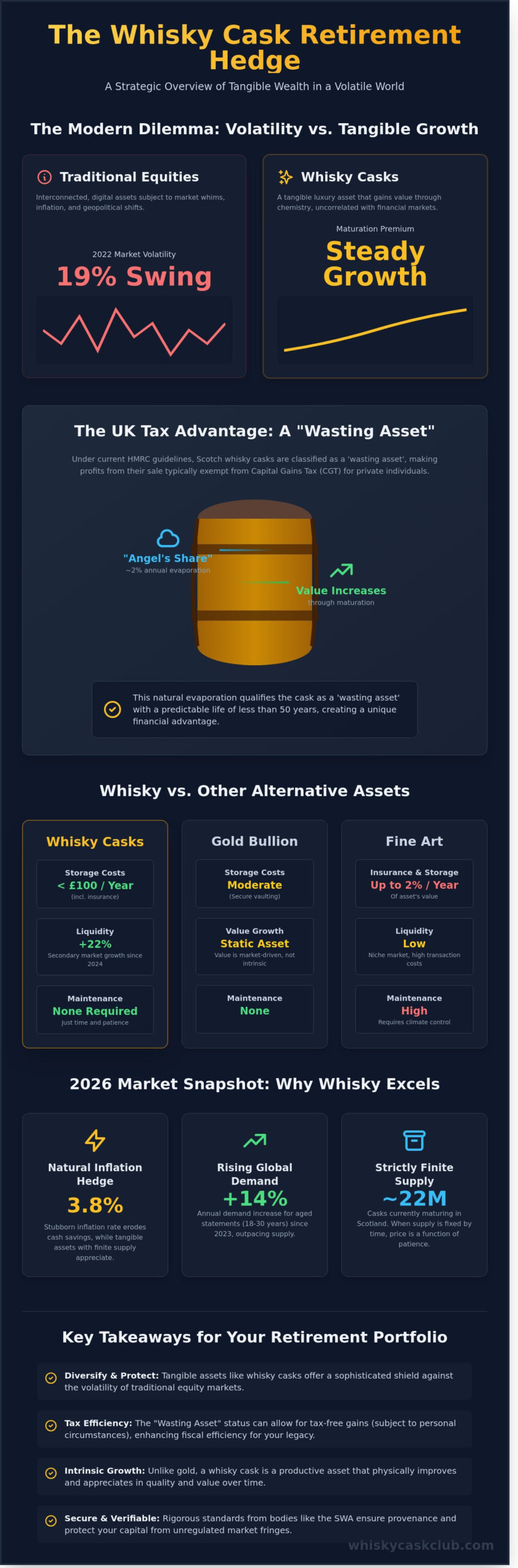
While traditional equities experienced a 19% volatility swing in 2022, a maturing barrel of Highland single malt quietly gained value through the simple, unstoppable chemistry of oak and time. You’ve likely spent decades building a portfolio, only to worry that inflation and rising taxes will erode your legacy before you can enjoy it. It’s a valid concern in an era where digital assets often feel disconnected from reality. This guide demonstrates why a whisky cask investment for retirement is the ultimate hedge, offering a tangible, prestigious asset that matures in both character and financial weight.
We’ll show you how to leverage the unique tax advantages of Scotch, specifically how its classification as a wasting asset can lead to tax-free gains under current HMRC guidelines. You’ll discover our verified 2026 method for ensuring asset provenance via the Scotch Whisky Association’s rigorous standards, protecting your capital from the unregulated fringes of the market. Whether you’re planning for a 10 or 20 year horizon, this strategic overview outlines three clear exit paths to convert your liquid gold into a secure, sophisticated retirement legacy.
Key Takeaways
- Discover why diversifying into tangible luxury assets offers a sophisticated shield against the volatility of traditional equity markets.
- Uncover the strategic tax advantages of the “Wasting Asset” status, allowing you to build a legacy with enhanced fiscal efficiency.
- Learn the essential steps for verifying provenance and securing legal title to ensure your portfolio remains both prestigious and protected.
- Identify the Tier 1 distilleries that serve as the cornerstone of a high-value portfolio, balancing heritage with consistent appreciation.
- Develop a precise exit roadmap for your whisky cask investment for retirement, ensuring your tangible wealth is realized with confidence and grace.
Why Alternative Assets are Redefining Retirement Portfolios in 2026
The financial landscape of 2026 has forced a total re-evaluation of traditional wealth management. For decades, the 60/40 portfolio of stocks and bonds was the gold standard for long-term security. That era ended when global market volatility in 2024 and 2025 proved that traditional assets are too interconnected. Today, sophisticated investors are turning toward “tangible luxury” to anchor their futures. This shift isn’t a trend; it’s a strategic migration toward assets that exist outside the digital flicker of a stock ticker.
Whisky maturation offers a unique advantage because it’s entirely uncorrelated with global equity markets. The liquid inside a barrel doesn’t care about interest rate hikes or geopolitical shifts in the Pacific. It follows the laws of chemistry, not the whims of high-frequency trading algorithms. As the spirit interacts with the wood, it gains complexity, character, and value. This predictable physical progression provides a level of security that paper assets simply can’t match. For those planning a whisky cask investment for retirement, this lack of correlation is the ultimate defensive play.
There’s also a profound psychological benefit to owning a physical asset with inherent utility. Owning a 200-liter cask of Scotch whisky provides a sense of control that a diversified index fund lacks. You own the cask. You own the liquid. It’s a legacy asset designed to outlive the investor. Many of our club members view their portfolio as more than just a balance sheet; it’s a curated collection of history and craftsmanship that can be passed down through generations. This is how you build wealth that carries a name, not just a number.
The 2026 Economic Climate and Tangible Wealth
In early 2026, inflation settled at a stubborn 3.8%, eroding the purchasing power of cash savings. Premium spirits act as a natural hedge because their value is tied to a finite, depleting supply. There are currently only about 22 million casks maturing in Scottish warehouses, and demand for aged statements from 18 to 30 years has increased by 14% annually since 2023. The “Connoisseur Investor” understands that “rare” and “limited supply” are the most powerful keywords in any retirement strategy. When supply is fixed by time, price becomes a function of patience.
Whisky vs. Gold and Fine Art
While gold and fine art are classic alternatives, they carry different burdens. Gold is static; a kilogram of bullion today is the same kilogram in twenty years. Fine art requires expensive climate control and astronomical insurance premiums that can eat 2% of the asset’s value annually. Whisky is different. It’s the only asset that possesses a “maturation premium,” meaning it physically improves while it’s stored.
- Storage Costs: Bonded warehouse fees typically average less than £100 per year, including insurance.
- Liquidity: The secondary market for casks has grown 22% since 2024, making it more liquid than high-end real estate.
- Maintenance: Unlike property, a cask requires no repairs, just the quiet passage of time in a cool Scottish cellar.
Choosing a whisky cask investment for retirement allows you to benefit from the natural appreciation of the spirit’s quality. You aren’t just waiting for the market to go up; you’re waiting for the whisky to get better. In a world of digital uncertainty, the slow, silent aging of a premium cask is the most sophisticated way to secure your financial legacy.
The “Wasting Asset” Advantage: Tax Efficiency for Retirees
HMRC classifies Scotch whisky held in a cask as a “wasting asset” because the spirit is expected to have a predictable life of less than 50 years due to natural evaporation. This specific classification is the cornerstone of why a whisky cask investment for retirement offers such compelling tax advantages compared to traditional portfolios. While equities and second homes face Capital Gains Tax (CGT) rates that shifted significantly in the April 2024 budget, profits from the sale of a private whisky cask typically remain exempt from CGT in the UK. This exemption remains a pillar of the fiscal outlook leading into 2026, providing a stable environment for those looking to protect their wealth from the eroding effects of taxation.
The “Angel’s Share” is the natural evaporation of roughly 2% of the whisky’s volume annually through the oak staves, a process that ensures the spirit matures while technically qualifying the cask as a wasting asset with a finite lifespan. This physical reality creates a unique financial loophole. Since the asset is technically “wasting away,” HMRC doesn’t view it as a standard investment vehicle subject to growth taxes. For an investor on a 15-year retirement horizon, this means the compounding value of the maturing spirit isn’t diminished by annual tax hits. If you invest £50,000 today and the value doubles over a decade, you’d keep the entirety of that growth; compare this to a stock portfolio where anything above the current £3,000 CGT allowance is taxed at up to 20%.
Understanding HMRC Rules on Whisky Maturation
HMRC’s Capital Gains Manual (CG76901) clarifies that tangible moveable property with a predictable life of 50 years or less is exempt from CGT. To maintain this status, your casks must be stored in government-regulated bonded warehouses. This oversight ensures the provenance of your asset while avoiding investment scams that often involve unverified storage or “guaranteed” returns. Bonded warehouses act as the legal safeguard for your tax-exempt status, as they’re the only locations where whisky can legally mature without duty being paid immediately.
Strategic Tax Planning with Casks
Sophisticated investors use casks to balance a wealth management strategy that’s often restricted by SIPP or ISA limits. Since whisky sits outside these traditional structures, it doesn’t count towards your pension lifetime allowances. It also offers unique Inheritance Tax (IHT) considerations. If managed through certain corporate structures, casks may qualify for Business Relief, potentially reducing IHT liability to 0% after just two years of ownership. It’s a powerful way to build a legacy for the next generation without the taxman taking a significant share.
While the UK offers these generous exemptions, international regulations vary. For example, US-based investors are generally taxed on whisky as a “collectible” at a flat 28% rate, while Singaporean investors benefit from no capital gains tax on such assets. Understanding these nuances is vital for global citizens. The goal is always to ensure your whisky cask investment for retirement remains as lean and efficient as the spirit itself. By leveraging the wasting asset status, you’re not just buying whisky; you’re securing a tax-advantaged future that traditional markets simply cannot replicate.
Mitigating Risk: Provenance, Verification, and Fraud Prevention
In early 2023, industry analysis highlighted a cautionary trend regarding the rise of unregulated cask brokers. Expert observations identified a 25% increase in firms offering “guaranteed” returns of 10% to 15% annually. These figures are a significant red flag. Real scotch maturation is a biological process, not a fixed-income bond. A sophisticated approach to **whisky cask investment for retirement** requires a focus on tangible verification rather than glossy brochures. You must look for transparency in every transaction to protect your capital.
Legal ownership is often misunderstood by new entrants. Many investors believe a “Certificate of Ownership” issued by a broker is a legal title. It isn’t. In the eyes of HMRC and the Scotch Whisky Association (SWA), the only document that carries legal weight is the Delivery Order (DO). This document, signed by the warehouse manager, officially transfers the title of the liquid within the bonded facility. Without a DO, you’re merely a creditor of the brokerage firm, not the owner of the asset. Own the cask. Own the liquid.
The Warehousekeepers and Owners of Warehoused Goods Regulations (WOWGR) provides the ultimate layer of protection for your **whisky cask investment for retirement**. This HMRC certification ensures that the entity handling your cask is vetted and authorized to hold duty-suspended goods. If a broker cannot provide proof of their WOWGR status or the specific warehouse account details, the risk of fraud increases exponentially. Secure retirement planning demands this level of institutional rigor and attention to detail.
The Anatomy of a Secure Cask Transaction
Protecting your legacy starts with a three-step verification process. First, the cask must be physically located in a Scottish bonded warehouse. Second, a “regauging” report is essential. This involves “dipping” the cask to measure the current alcohol by volume (ABV) and the bulk liters remaining. In 2023, the SWA noted that accurate regauging is the only way to verify the health of the spirit. Finally, ensure the warehouse keeper acknowledges your ownership in their internal ledger through a formal letter of sub-account.
Choosing a Trusted Partner
Evaluating a potential partner requires looking past the sales pitch. A reputable firm operates as a discreet advisor, prioritizing your long-term goals over immediate commissions. They should provide a full history of the cask’s provenance and clear exit strategies. If you’re seeking a tailored approach to asset allocation, learn more about our curated portfolio management. We focus on rare, high-provenance casks that offer genuine scarcity value. Our process is built on transparency, ensuring every client has direct access to their warehouse records and regauging data.
Selecting Distilleries: Tier 1 Blue Chips vs. Emerging Legends
Distillery provenance acts as the primary engine for your portfolio’s growth. It’s the most critical factor when considering a whisky cask investment for retirement because the name on the cask dictates the liquid’s future floor price. Much like blue-chip stocks, certain distilleries carry a historical weight that protects against market volatility. A Macallan or Dalmore cask isn’t just a container of spirit; it’s a piece of a global luxury brand with a track record of decades of appreciation.
Tier 1 “Blue Chip” distilleries offer a lower risk profile and steady, predictable gains. These brands have already secured their place in the hearts of collectors in Hong Kong, Singapore, and New York. According to the Knight Frank Rare Whisky Index, top-tier Scotch has seen a 373% value increase over the last ten years. While the entry price for these casks is higher, the exit strategy is often simpler because the demand for these names is constant and global.
Smart investors often balance these giants with a “Hidden Gem” strategy. Sourcing undervalued casks from specific regions like Speyside or Islay can yield higher percentage returns. Distilleries such as Bunnahabhain or Glenrothes often trade at a fraction of Macallan’s price but possess the same quality of spirit and aging potential. These emerging legends are the “growth stocks” of the whisky world, offering a path to significant capital gains as their brand prestige catches up to their liquid quality.
Age statements serve as the critical milestones for your exit strategy. You should focus on three specific windows of maturity:
- 12 Years: The point where young spirit transitions into a “standard” premium product; liquidity is high at this stage.
- 18 Years: A major value jump occurs here, as the supply of 18-year-old Scotch is significantly lower than younger expressions.
- 25 Years: The threshold for ultra-premium status. At this age, evaporation (the “Angel’s Share”) has reduced the volume, making the remaining liquid exceptionally rare and expensive.
The Power of the Brand: Macallan, Bowmore, and Beyond
Brand strength is the ultimate safeguard for a whisky cask investment for retirement. Macallan and Bowmore consistently break auction records, which trickles down to the value of every cask bearing their name. In 2023, Scotch exports to the Asia Pacific region reached £1.8 billion, driven largely by a thirst for these heritage brands. “Ghost Distilleries” like Port Ellen or Rosebank represent the ultimate rarity play; since these distilleries were closed in the 1980s or 90s, the supply is finite and shrinking every year, creating an absolute price floor based on scarcity.
Cask Types and Their Impact on Value
The wood is the silent architect of your investment’s final value. Sherry Hogsheads are generally the most coveted, often commanding a 20% to 30% premium over ex-bourbon barrels. This is because sherry wood imparts the deep colors and rich, dried-fruit flavors that the high-end market demands. However, high-quality ex-bourbon casks from reputable American distilleries shouldn’t be overlooked, as they offer a lighter, floral profile that’s essential for many blending houses. You can explore our current distillery spotlight features to see which wood profiles are currently trending with international buyers.
Building a retirement portfolio requires a blend of security and growth. Contact our advisors to build your bespoke cask portfolio today.
The Retirement Exit Roadmap: Realizing Your Gains
The final stage of your investment journey is the transition from curator to beneficiary. Success in whisky cask investment for retirement depends on a disciplined exit strategy. You shouldn’t wait until your retirement date to consider your options. Instead, begin the planning process 24 to 36 months before you require your first capital drawdown. This lead time allows you to monitor market cycles and select the most lucrative path for your specific holdings. Whether you own a single rare Macallan or a diversified portfolio of Highland malts, the method of sale dictates your final net return.
The Private Treaty Sale remains the preferred route for many high-net-worth investors. This involves selling your cask directly to another private investor or a specialized fund. These transactions are discreet and often yield 5% to 8% higher returns than public sales because they bypass the heavy commissions of auction houses. It’s a sophisticated exchange that relies on the provenance and documented history of your asset.
If your goal is immediate liquidity, the auction path provides access to a global network of collectors. By 2026, digital platforms have made this process more transparent, yet it requires careful timing. You must account for seller premiums and the logistical costs of moving your cask between bonded warehouses. For those seeking the highest possible valuation, independent bottling offers a retail-focused exit. By turning one cask into roughly 250 to 300 individual bottles, you capture the retail margin. This turns your “tangible asset” into a liquid legacy that can be sold through boutique channels or kept as a family heirloom.
Liquidation Timelines and Expectations
In the 2026 market, expect a standard cask sale to take between 6 and 12 weeks from initial listing to the settlement of funds. This timeline accounts for regauging the spirit, verifying the alcohol by volume (ABV), and completing the legal transfer of ownership within the bonded warehouse system. You should anticipate transaction fees ranging from 10% to 15% if using an auction house. A well-structured retirement portfolio uses staggered exit dates; selling casks in intervals prevents you from being forced to sell during a temporary market dip.
Closing the Legacy: From Cask to Bottle
There is an undeniable prestige in bottling your own “Founder’s Reserve” as you enter retirement. It represents the culmination of years of patience and craftsmanship. However, the logistics of bottling, labeling, and paying the necessary excise duties are complex. The Whisky Cask Club simplifies this final chapter by managing every technical detail on your behalf. We ensure your transition from investor to connoisseur is seamless and rewarding. To begin structuring your own departure from the market, Request a bespoke retirement portfolio consultation and secure the lifestyle you’ve earned.
Secure Your Future with a Maturing Legacy
The 2026 financial landscape proves that tangible assets are no longer optional for a sophisticated portfolio. You’ve explored how the “Wasting Asset” classification offers a rare path to tax efficiency, allowing your capital to compound without the typical burdens of capital gains. By securing casks from Tier 1 distilleries like Macallan and Highland Park, you’re investing in proven blue-chip excellence. Every cask comes with full legal title and warehouse-verified ownership, ensuring your whisky cask investment for retirement is anchored in absolute transparency. Our experts in Singapore, Hong Kong, and Melbourne manage your assets with the discretion and precision that global investors demand. You aren’t just buying liquid; you’re acquiring a piece of Scottish heritage that gains value through the simple, unstoppable passage of time. It’s a pragmatic yet passionate approach to wealth that yields results long after the initial purchase. Your journey toward a more resilient and prestigious retirement starts with a single, well-placed cask.
Join the Exclusive Whisky Cask Club and Build Your Legacy
Frequently Asked Questions
Is whisky cask investment for retirement regulated by the FCA?
Whisky cask investment for retirement isn’t regulated by the Financial Conduct Authority (FCA) because casks are physical commodities rather than financial securities. Instead, the industry adheres to strict HMRC regulations under the Warehousekeepers and Owners of Casks Regulations (WOWGR). You don’t have protection from the Financial Services Compensation Scheme; therefore, working with a reputable broker who provides transparent provenance and legal title is vital for your security.
How much does it cost to store and insure a whisky cask annually?
You’ll typically pay between £50 and £100 per year to store and insure a single cask in a bonded warehouse. This fee covers professional climate control and “all-risks” insurance based on the asset’s current market value. For instance, a standard 200-litre barrel usually costs about £0.20 per day to house. Most investors simplify this by paying for five or ten years of storage upfront during the initial purchase.
What is the minimum investment required for a premium Scotch cask?
A premium Scotch cask from a prestigious, top-tier distillery generally requires a minimum investment of £15,000. While entry-level “new make” spirit from smaller distilleries can be found for £3,000, the secondary market prioritizes established names with historical pedigree. Rare casks from blue-chip distilleries like Macallan or Bowmore often exceed £50,000. Investing at this level ensures your portfolio contains a tangible asset with high global demand and significant heritage.
Can I lose money on a whisky cask investment?
You can lose money if the market value of your specific distillery declines or if the spirit’s alcohol by volume (ABV) drops below 40%. If the ABV falls below this legal limit, the liquid can’t be sold as Scotch whisky, which reduces its value by over 80%. While the Knight Frank Rare Whisky Index showed a 373% return over the last decade, you must manage the 2% annual evaporation known as the Angels’ Share.
What happens if the distillery goes out of business?
Your investment remains secure because you own the physical cask, not shares in the distillery company. If a distillery closes, your cask stays in its government-bonded warehouse under the supervision of the warehouse keeper. Historical data shows that “silent distillery” casks, such as those from Port Ellen which closed in 1983, often become more valuable due to their absolute rarity. You can choose to move your asset or sell it to private collectors.
How do I prove I own the cask if the broker disappears?
You prove ownership through a Delivery Order (DO) or a Warehouse Receipt issued directly by the HMRC-bonded facility. This document confirms the specific cask number and its unique filling date are registered in your name. A legitimate broker must provide a countersigned DO within 28 days of your purchase. This legal title ensures the warehouse recognizes you as the sole owner, regardless of the broker’s status or future business operations.
Is it better to invest in a single cask or a diversified portfolio?
A diversified portfolio is the superior strategy for a whisky cask investment for retirement because it spreads your capital across different ages and regions. While one rare cask might offer high growth, holding a mix of “new make” spirits and 12-year-old casks provides multiple exit points over a 20-year period. For example, balancing Islay malts with Speyside classics protects your legacy against shifting consumer tastes and ensures more consistent long-term liquidity.
Can I actually drink my investment if I decide not to sell it?
You can certainly bottle your cask for personal use, provided you pay the required UK excise duty and VAT. In 2024, the duty on a 70cl bottle at 40% ABV is £9.27, and you’ll also need to cover bottling and labeling costs which average £5 per bottle. Many of our clients choose to bottle a few cases for family milestones while selling the remaining stock. It’s a sophisticated way to enjoy the fruits of your long-term patience.