The world of rare whisky is alluring, but for the discerning investor, the path to ownership can seem shrouded in mystery and risk. Navigating tales of remarkable returns while avoiding the pitfalls of overpayment or outright scams is a significant challenge. This is where the true potential of whisky cask investment is often misunderstood. It is not a speculative gamble, but a considered acquisition of a tangible, appreciating asset-a piece of liquid heritage that matures in both character and value over time.
This definitive guide is crafted to provide you with clarity and confidence. We will illuminate the entire journey, from understanding the fundamentals of provenance and costs to selecting a reputable partner to manage your portfolio. You will gain a clear framework for distinguishing genuine opportunity from marketing hype, understanding the realistic risks and rewards, and developing a tangible exit strategy. Consider this your essential resource for building an exceptional and lasting legacy, one cask at a time.
Key Takeaways
- Learn why a cask’s maturation process is the fundamental driver of its value as a tangible, appreciating asset.
- Gain a balanced perspective on potential returns by understanding the real-world risks often overlooked in headlines.
- Discover the essential steps for a successful whisky cask investment, including a powerful checklist for vetting potential partners.
- Frame your investment strategy beyond simple financial gains to craft a lasting portfolio that truly builds a legacy.
The Fundamentals: What is Whisky Cask Investment?
At its core, whisky cask investment is the act of purchasing and owning a cask of maturing spirit. This is not about collecting rare bottles; it is about acquiring a tangible, appreciating asset while it undergoes the transformative journey from raw spirit to fine single malt. The foundational principle is simple yet profound: whisky only ages and develops its complex character inside an oak cask. Understanding this process is central to appreciating the fundamentals of whisky and its investment potential. For the discerning investor, it offers a unique opportunity to diversify a portfolio with an asset class driven by age, rarity, and the impeccable provenance of world-renowned distilleries.
Why a Cask of Whisky Appreciates in Value
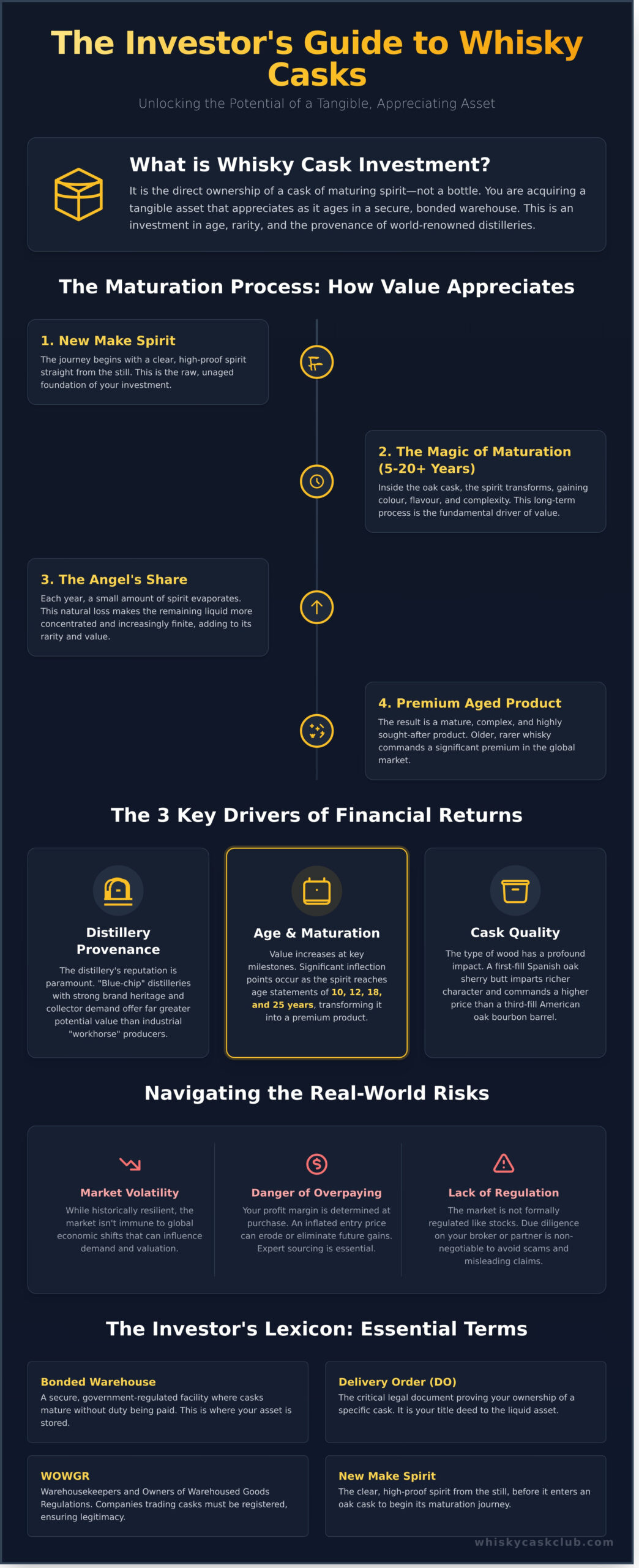
The value of a cask is intrinsically linked to the magic of maturation. Over years, the spirit interacts with the oak, drawing out colour, aroma, and layers of flavour. Simultaneously, a small amount of liquid evaporates annually-the revered ‘Angel’s Share’-concentrating the remaining spirit and making it increasingly finite. This natural reduction, combined with the consistent global demand for premium aged single malt Scotch, creates a powerful dynamic where older, rarer whisky commands a significant premium.
Key Terminology for the Aspiring Investor
Navigating the world of cask ownership requires familiarity with its unique lexicon. These are the essential terms every new investor should know to build a legacy with confidence:
- New Make Spirit: The high-proof, clear spirit straight from the still, before it begins its maturation journey in the cask. This is the foundation of your investment.
- Bonded Warehouse: A secure, government-regulated facility where casks are stored without duty being paid. This is where your asset will mature under expert care.
- WOWGR: The Warehousekeepers and Owners of Warehoused Goods Regulations. Companies that own and trade casks in bond must be registered, ensuring legitimacy and compliance.
- Delivery Order (DO): A critical legal document that proves your ownership of a specific cask stored within a bonded warehouse. This is your title deed to the liquid.
Understanding the Potential Returns and Real-World Risks
The allure of whisky cask investment is often fuelled by headlines celebrating extraordinary returns. While such gains are possible, a discerning investor approaches this tangible asset with a pragmatic, long-term perspective. Skepticism encountered in various financial commentaries and online discussions is not unfounded; it highlights an industry where expertise and transparency are paramount. It is crucial to understand that, like any alternative investment, past performance is not a reliable indicator of future results. This is not a get-rich-quick scheme but a patient endeavour, with maturation cycles typically planned for 5, 10, or even 20 years to unlock true value.
What Drives Financial Returns?
The appreciation of a whisky cask is a nuanced process, driven by a confluence of key factors. A successful whisky cask investment strategy depends on understanding this interplay:
- Distillery Provenance: The reputation of the distillery is paramount. Casks from celebrated “blue-chip” distilleries with strong brand heritage and collector demand inherently possess greater potential value than those from more industrial, “workhorse” producers.
- Age and Maturation: Value does not increase linearly. Significant value inflection points occur as the spirit reaches key age statements-such as 10, 12, 18, and 25 years-transforming it into a premium, more desirable product.
- Cask Quality: The type of wood has a profound impact. A first-fill Spanish oak sherry butt will impart a richer character and command a higher price than a third-fill American oak bourbon barrel, directly influencing the final liquid’s quality and rarity.
Navigating the Risks: A Transparent Overview
Building a legacy through whisky requires a clear-eyed view of the associated risks. A trusted partner will always provide a transparent overview of the challenges:
- Market Volatility: While historically resilient, the whisky market is not immune to global economic shifts that can influence demand and valuation.
- The Danger of Overpaying: Your potential profit is largely determined by your entry price. An inflated initial purchase can erode or eliminate future gains, making expert sourcing and valuation essential.
- Lack of Regulation: The market’s relative lack of formal regulation means due diligence on your broker is critical. Reputable advisors will operate with transparency, aligning with principles outlined in the UK advertising regulations for whisky to avoid misleading claims.
- Liquidity and Exit Strategy: Selling a cask is not instantaneous. It requires access to a network of buyers, bottlers, and auction houses. A well-defined exit strategy, planned from the outset, is the hallmark of a serious investor.
The Investor’s Journey: A Step-by-Step Process
Embarking on a whisky cask investment journey is a meticulously managed process, transforming a passion for the spirit into a tangible asset. Far from being opaque, the lifecycle is a clear, four-stage progression guided by experts. Your broker acts as your personal advisor, liaising with renowned distilleries and secure bonded warehouses to ensure your asset is sourced, stored, and managed with unparalleled care.
Step 1: Sourcing and Acquisition
Your journey begins with defining your ambition. Whether you seek long-term capital growth or wish to acquire a rare cask with specific provenance, your goals and budget dictate the strategy. A trusted broker provides exclusive access to curated casks from Scotland’s finest distilleries, sourcing options that align with your portfolio objectives. The initial acquisition price is comprehensive, typically including the cask, the new-make spirit, and the first term of bonded storage and insurance.
Step 2: Ownership, Storage, and Insurance
Upon acquisition, your ownership is legally solidified through critical documentation. You will receive:
- A Certificate of Ownership: Your legal title deed to the cask.
- A Delivery Order: The official instruction for the warehouse to hold the cask under your name.
This ensures your asset is held securely within a government-regulated bonded warehouse, legally registered to you and fully insured against theft and damage. It is your cask, your liquid.
Step 3: Maturation and Portfolio Management
As your whisky matures, its character and value evolve. We provide periodic updates and market valuations, allowing you to track your asset’s performance. For a precise health check, a re-gauging service can measure the cask’s exact volume and alcohol by volume (ABV). Many astute investors build a portfolio of several casks-diversifying by age, distillery, and wood type-to mitigate risk and enhance potential returns.
Step 4: The Exit Strategy
Realising the value of your asset is the final, crucial step. A well-defined exit strategy is key to a successful whisky cask investment. Your broker will help identify the optimal time to sell, connecting you with a network of potential buyers, including other private investors, independent bottlers, and even the original distilleries. Alternatively, you may choose the ultimate reward: bottling the mature spirit for your own private collection, creating a truly personal legacy.
How to Choose a Reputable Partner and Avoid Scams
In the world of tangible assets, your success is intrinsically linked to the expertise and integrity of your partners. This is especially true for whisky cask investment, where the right advisor acts as your guide to building a legacy, while the wrong one can lead to significant loss. Your most critical decision is not which distillery to choose, but which firm to trust. A reputable partner welcomes scrutiny and operates with complete transparency.
Essential Due Diligence Checks
A credible firm operates in the open, with a verifiable history and regulatory compliance. Before committing capital, an astute investor should perform these fundamental checks. The information should be publicly available and easily provided upon request.
- Company Registration: Verify the company’s legitimacy and director history through official channels, such as the UK’s Companies House.
- Physical Presence: Look for a registered physical office address and a team that is directly contactable. A lack of a tangible location is a significant red flag.
- HMRC Approval: Ensure the firm holds a valid Warehousekeepers and Owners of Warehoused Goods Regulations (WOWGR) registration with HMRC.
Transparency in Costs and Returns
Vague promises and hidden fees are hallmarks of a fraudulent operation. A trustworthy partner provides absolute clarity on the financial aspects of your investment. Be wary of any firm that promises ‘guaranteed’ or unrealistically high returns; the market, by nature, has fluctuations. Demand a clear, itemised breakdown of all potential fees, including storage, insurance, and eventual sales commissions. Furthermore, insist on receiving the cask’s full history and provenance-its story is integral to its value.
Absolute Proof of Ownership
Ownership is not a promise; it is a legal fact. You must have irrefutable proof that the cask belongs to you and you alone. The most vital document is a Delivery Order (DO), which transfers ownership to you. Insist that your name, not the broker’s, is listed as the owner with the bonded warehouse. You should be able to contact the warehouse directly to verify this at any time.
A distinguished partner will not only tolerate these questions but welcome them as the mark of a serious investor. To understand our meticulous and open process, we invite you to schedule a consultation and experience the standard of care your investment deserves.
Building a Legacy: Crafting Your Whisky Cask Portfolio
Beyond the spreadsheets and performance charts, a truly successful whisky cask investment is an exercise in curation and foresight. It’s about transitioning from a purely financial mindset to that of a collector and custodian. You are not merely acquiring a tangible asset; you are assembling a collection with a unique character, a story, and a future. This is the art of crafting a portfolio that reflects both your investment goals and your personal passion for the spirit.
Diversification Strategies
A robust portfolio is a balanced one. By carefully selecting a range of casks, you mitigate risk and create a collection with depth and distinction. Key strategies include:
- Spreading Provenance: Acquiring casks from different distilleries and regions, from the peated malts of Islay to the elegant spirits of Speyside, captures a breadth of character and market appeal.
- Balancing Maturity: Combine the high-growth potential of younger, new-fill casks with the stability and established character of more mature stock.
- Varying the Wood: Utilise different cask types-such as sherry butts, bourbon barrels, and wine barriques-to cultivate a truly unique and complex flavour profile across your holdings.
From Tangible Asset to Family Heirloom
A cask of maturing whisky is a living piece of distilling history. It represents generations of craftsmanship, slowly evolving in a quiet warehouse. This emotional connection transforms the asset into something far more profound-a legacy. Imagine passing down a maturing cask, an inheritance that grows not only in value but in character with each passing year.
The ultimate expression of this journey is the decision to bottle your own single cask whisky. This is the moment your investment becomes a deeply personal statement-a rare, exclusive spirit to be shared, savoured, and remembered. It is the culmination of patience and passion. Begin building your whisky legacy with us.
Crafting Your Liquid Legacy
Embarking on your journey into cask ownership is more than a financial decision; it is the beginning of a lasting legacy. As we have explored, this tangible asset offers a unique union of passion for craftsmanship and the potential for significant returns. True success in whisky cask investment, however, hinges on diligent research and choosing a partner with unimpeachable expertise. This ensures your portfolio transforms from a simple collection of assets into a personal story, carefully curated to mature over time.
At the Whisky Cask Club, we provide the guidance and access necessary to build your collection with confidence. We offer our members exclusive access to premium Scotch whisky casks, secure storage in accredited bonded warehouses, and expert portfolio management to guide your exit strategy. Your legacy deserves nothing less than the finest foundation. The first step in this distinguished journey begins with knowledge and a trusted advisor by your side.
Ready to begin? Request our guide and start your cask ownership journey.
Frequently Asked Questions
How much does a whisky cask cost to buy?
The entry point for a premium cask varies significantly based on its provenance, age, and the distillery’s prestige. A newly filled cask from a respected producer may be acquired for £3,000 to £7,000. Conversely, a rare, aged cask from a silent (closed) distillery represents a far more substantial investment, often commanding six-figure sums. Our role is to source opportunities that align with your specific portfolio goals and legacy ambitions.
What are the ongoing ‘hidden’ costs of cask ownership?
Transparency is paramount in cask ownership. The primary ongoing costs are for professional storage and insurance within a secure, government-bonded warehouse. This typically amounts to a modest annual fee, often between £50 and £100 per cask, ensuring your tangible asset is expertly managed and protected. These are not hidden fees but essential components of responsible stewardship, safeguarding the integrity and value of your investment for its entire maturation journey.
Is whisky cask investment tax-free?
In the UK, Scotch whisky is typically considered a ‘wasting asset’ by HMRC as it has a predictable life of less than 50 years, meaning it is often exempt from Capital Gains Tax upon sale. This tax efficiency is a significant advantage of a whisky cask investment portfolio. However, tax regulations are subject to change and can depend on individual circumstances. We strongly advise consulting with a qualified financial advisor to understand the specific implications for your portfolio.
How do I actually sell my cask when it has matured?
When your cask reaches its optimal maturation, we facilitate a seamless and profitable exit. There are several established routes to market: selling to other private collectors, transferring ownership to independent bottlers seeking rare single-cask expressions, or offering it back to the original distillery. Our extensive network and market expertise ensure we can position your asset to achieve its maximum potential value, managing the entire transaction on your behalf with complete discretion and professionalism.
Can I visit my cask in the bonded warehouse?
Absolutely. We believe in the tangible nature of this asset and encourage owners to connect with their investment. Visits to the bonded warehouse where your cask is securely maturing can be arranged by appointment. Due to the strict HMRC regulations governing these secure facilities, all visits must be scheduled in advance. This ensures the highest levels of security and integrity for all the rare and valuable casks under management, including your own personal legacy.
How long should I hold a whisky cask before selling?
Whisky cask ownership is a long-term pursuit, mirroring the patient maturation of the spirit itself. While significant value appreciation can occur after 5-7 years, we typically advise a holding period of at least 8 to 12 years to allow the whisky to develop sufficient complexity and character. The most profound returns are often realised over longer periods, with casks aged 15 to 20 years commanding premium prices due to their exceptional rarity and depth of flavour.
What is the difference between investing in Scotch, Irish whiskey, or Bourbon casks?
Each spirit offers a unique investment profile rooted in its heritage and production regulations. Scotch whisky boasts unparalleled global prestige and strict provenance rules, offering diverse flavour profiles from regions like Speyside and Islay. Irish whiskey is undergoing a significant renaissance, with its triple-distilled smoothness driving surging global demand. American Bourbon has a distinct legal definition and matures differently, often more quickly, in the warmer climate, creating a different timeline and market dynamic for investors.