Holding a rare Scotch cask for just twelve months too long can diminish its market value by as much as 25% if the spirit happens to drop below the legal 40% ABV threshold. You likely recognize that patience is the cornerstone of building a legacy, yet the line between a matured masterpiece and an over-aged spirit dominated by wood is remarkably thin. It’s a delicate balance that every serious investor must master to protect their capital and ensure their exit is as prestigious as the liquid itself.
Determining when is the best time to sell a whisky cask requires more than just watching the calendar; it demands a sophisticated fusion of sensory data and 2026 market intelligence. You deserve a clear framework that removes the anxiety of declining alcohol strength and replaces it with the quiet confidence of a perfectly timed liquidation. This guide reveals the precise maturation milestones and global demand indicators you need to identify the optimal moment for maximum return. We’ll explore the critical relationship between age, evaporation, and distillery provenance to help you finalize a strategic exit that honors your investment journey.
Key Takeaways
- Understand the “biological clock” of your asset and why the initial maturation years are merely the foundation for a truly prestigious investment.
- Identify the “magic numbers” in whisky marketing-such as 18 and 25 years-to determine exactly when is the best time to sell a whisky cask for maximum market demand.
- Learn how to monitor technical indicators like the Angel’s Share and the critical 40% ABV threshold to protect your liquid gold from losing its legal status.
- Align your exit strategy with your broader financial legacy by knowing when to take profits and rebalance your portfolio into new alternative assets.
- Discover the three primary exit routes and how a professional broker can maximize your return compared to a solo sale or auction.
Maturation Milestones: The Natural Clock of Your Liquid Asset
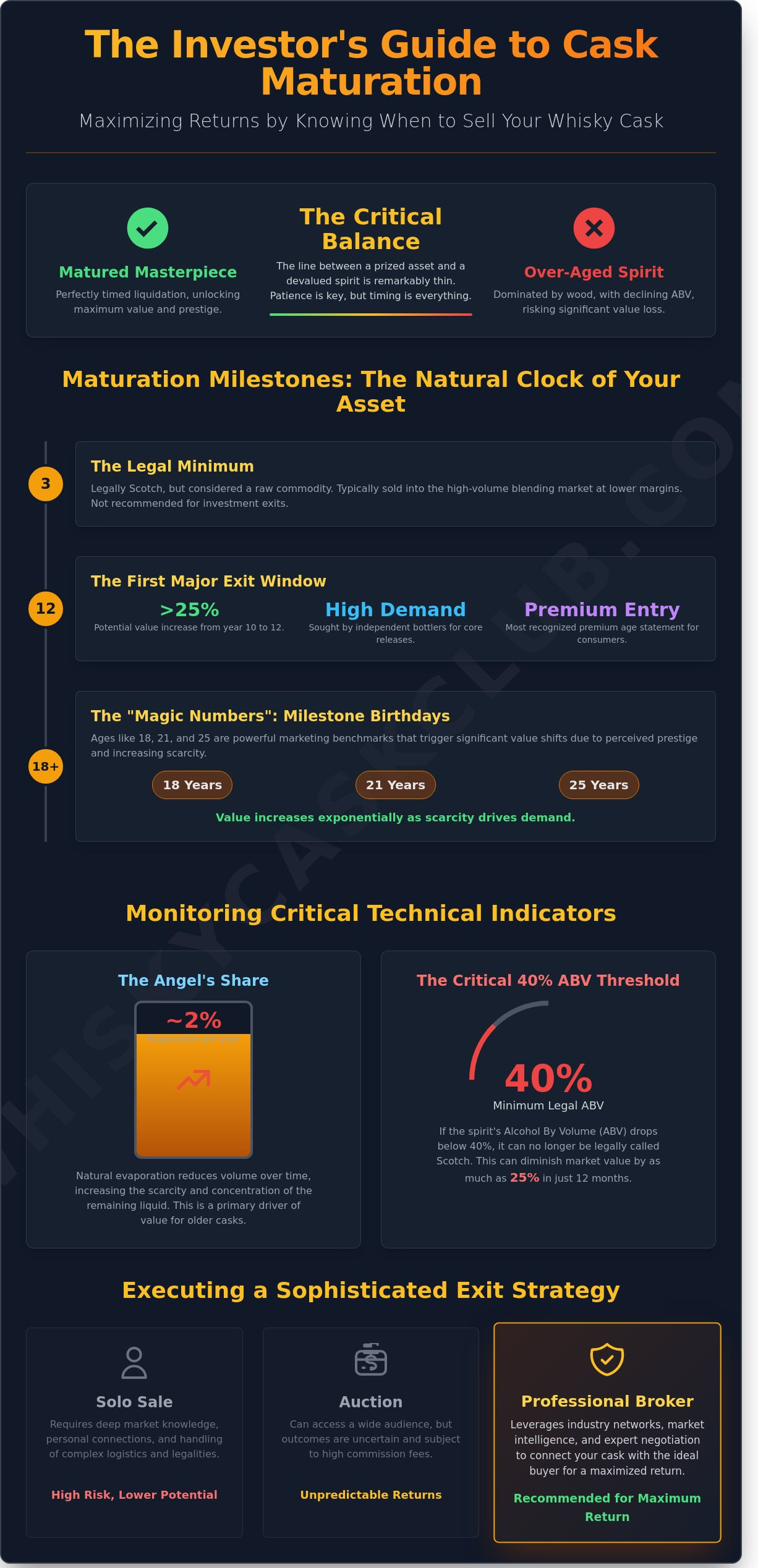
Whisky maturation isn’t a passive wait; it’s a complex chemical evolution. The biological clock of your asset involves a constant interaction between the spirit and the oak staves. Over decades, the liquid breathes through the wood, extracting lignins and vanillins while shedding harsh metallic notes. Understanding this timeline is essential for determining when is the best time to sell a whisky cask for maximum return. During the initial 3 to 5 years, the spirit is merely building its foundation. It lacks the sophisticated profile that global collectors demand. Exiting during this phase often results in selling a raw commodity rather than a refined luxury asset.
The true transformation occurs as the spirit reaches the 8 to 12-year threshold. This is the period where young spirit officially becomes mature whisky. Market forecasts for 2026 indicate a heightened demand for casks that have crossed this 10-year milestone. Supply data shows a 12% decrease in available decade-old stock compared to the previous five-year average. This scarcity creates a powerful leverage point for owners of well-managed casks who understand the value of patience.
The Legal Minimum vs. Investment Grade
The Scotch Whisky Act of 1988 requires a three-year maturation period before a spirit can legally be called Scotch. Selling at this three-year mark is rarely advisable for those building a legacy. At this age, the liquid is typically sold into the high-volume blending market at lower margins. Contrast this with investment-grade single malts. Investment-grade casks are defined as casks from top-tier distilleries with proven secondary market demand. These casks are curated for their rarity and potential to headline private collections or exclusive auctions.
The 12-Year Sweet Spot: The First Major Exit Window
For many strategic investors, 12 years represents the first significant opportunity for a profitable exit. This age serves as a psychological anchor for retail consumers and independent bottlers alike. It’s the point where the liquid has spent enough time in the wood to develop a distinctive distillery character without being overwhelmed by oak.
- Independent Bottler Demand: Small-batch bottlers frequently seek 12-year-old liquid to fill their core annual releases, creating a consistent exit route.
- Value Accretion: The price jump from a 10-year to a 12-year cask can exceed 25% in certain Highland regions, far outpacing the growth seen between years 3 and 5.
- Consumer Perception: The 12-year age statement is the most recognized premium entry point in the global market, providing a sense of security for the buyer.
Patience during the first decade is what separates a standard transaction from a high-yield investment. When you evaluate when is the best time to sell a whisky cask, the 12-year mark offers a balance of liquidity and realized value that younger casks simply cannot match. It’s the first moment your liquid truly reflects the prestige of its heritage.
Market Dynamics: Capitalizing on Milestone Birthdays and Distillery Booms
The whisky market operates on a chronological rhythm dictated by specific “Magic Numbers.” For investors, the ages of 15, 18, 21, and 25 are not merely markers of time; they are powerful marketing benchmarks that trigger significant value shifts. Independent bottlers and luxury labels hunt for these specific age statements to anchor their limited releases, as consumers associate these milestones with maturity and prestige. If your asset is approaching one of these birthdays, you’re entering a prime liquidity window. Understanding these cycles is vital when deciding when is the best time to sell a whisky cask to maximize your return.
Independent bottlers often pay a premium for casks that have already reached these milestones. This allows them to bypass the years of storage costs and evaporation risks, bringing a finished product to market immediately. By monitoring the release schedules of major houses, you can identify periods of high demand for specific age statements. This strategic alignment between your cask’s maturity and market appetite is the hallmark of a sophisticated exit strategy.
Why 18 and 21 Year Statements Command Exponential Premiums
Scarcity is the primary driver of value as a cask matures. The “Angel’s Share,” the natural evaporation of roughly 2% of the liquid each year, means that far fewer casks survive to reach 21 years than those harvested at 10. Beyond volume loss, the risk of the wood over-powering the spirit increases over time. A cask that maintains its balance at 21 years is a rare masterpiece. This rarity ensures that price growth isn’t linear; the jump from an 18-year-old to a 21-year-old statement often sees a value increase of 40% or more, despite only three years of additional aging. Examining The Ardmore Distillery Heritage reveals how consistent quality over decades builds a formidable legacy that collectors are willing to pay for.
Distillery ‘Hype’ Cycles: When to Sell a Rising Star
Brand momentum is a critical factor in determining when is the best time to sell a whisky cask. Distilleries often go through “hype cycles” where a change in ownership, a rebranding effort, or a high-scoring review from a critic sends secondary market prices soaring. If your cask’s distillery is currently “trending” among collectors, it may be the perfect moment to liquidate before the trend plateaus. Conversely, holding a “silent distillery” cask, one from a facility that is no longer in production, offers a different trajectory. These assets represent a finite supply that grows more valuable as every other cask from that era is bottled and consumed.
Monitoring global auction trends, such as the Rare Whisky 101 indices, allows you to track whether your distillery is currently an “overperformer.” It’s essential to stay informed; the goal is to exit while the trajectory is still upward, rather than waiting for the market to become saturated. Building a legacy requires more than just patience; it demands strategic timing. To ensure your asset is positioned for its peak valuation, you can speak with our portfolio managers for a bespoke market analysis.
Technical Indicators: Monitoring ABV and the Angel’s Share
Every year, the Scottish climate claims a small portion of your investment. This natural evaporation, known as the “Angel’s Share,” typically reduces the liquid volume by 1.5% to 2% annually. While this process concentrates the flavors, it simultaneously lowers the Alcohol by Volume (ABV). Managing this delicate decline is essential to determining when is the best time to sell a whisky cask. If the alcohol content drops too low, the asset’s financial value can plummet overnight.
The 40% ABV Red Line: Avoiding the ‘Dead Cask’
Scotch must maintain a minimum of 40% ABV to meet legal standards. If a cask dips to 39.9%, it loses its legal status and becomes “spirit drink,” a designation that strips away its premium investment value. This is the “dead cask” scenario every serious investor avoids through meticulous oversight. For an investor, the window between 42% and 40% is the most critical period in the life of the asset. Selling during this phase ensures you capture the maximum maturity before the liquid becomes legally unsellable as whisky.
‘A cask approaching 42% ABV is a ticking clock that requires immediate strategic evaluation.’
Balancing Oak Influence with Spirit Character
Maturity isn’t just a number; it’s a sensory equilibrium. First-fill casks, which haven’t held Scotch before, impart wood characteristics much faster than refill casks. While a 25-year-old Macallan in a refill hogshead might be sublime, the same liquid in a first-fill Sherry butt might become “over-oaked” and bitter. You must understand Does Whiskey Go Bad? to fully grasp the maturation science that dictates an asset’s longevity. As an investor, you aren’t just holding liquid; you’re stewarding a chemical transformation that has a finite peak.
Professional management uses annual regauging and sampling to track these shifts accurately. Identifying the moment when the wood’s influence begins to overshadow the spirit’s fruit and spice notes is vital for knowing when is the best time to sell a whisky cask for peak organoleptic value. Effective cask management includes:
- Regauging: Measuring the current volume and ABV to track the Angel’s Share and project the cask’s lifespan.
- Sensory Sampling: Tasting the spirit to detect the first signs of over-oaking or wood fatigue.
- Strategic Health Checks: Ensuring the dunnage or racked warehouse conditions remain stable to prevent accelerated evaporation.
By monitoring these technical indicators, you transform a gamble into a calculated exit strategy, ensuring your legacy is preserved in both quality and capital gain.
Strategic Portfolio Management: Selling Based on Financial Goals
Determining when is the best time to sell a whisky cask often has less to do with the liquid’s maturity and more to do with your personal balance sheet. While the spirit evolves in the warehouse, your financial requirements change in the real world. A sophisticated exit strategy aligns your cask’s peak maturation with your broader capital needs. You aren’t just selling a beverage; you’re liquidating a private equity style asset that’s matured over 10 or 15 years.
Rebalancing Your Alternative Asset Allocation
If your whisky holdings now represent more than 15% or 20% of your total net worth, you’re likely over-concentrated. Prudent investors use price surges to rebalance their portfolios. You might sell a mature Speyside cask to fund entry into other sectors or diversify within the category itself. For instance, moving capital into Highland Single Malts offers a different growth trajectory and risk profile. We recommend “laddering” your casks. By purchasing spirit at various ages, you ensure assets reach milestone years, like 18, 21, or 25, at staggered intervals. This provides consistent liquidity options every 3 to 5 years rather than waiting decades for a single payout.
Selling for Liquidity vs. Building a Multi-Generational Legacy
Your goals define your exit. Are you an investor seeking a target 10% to 12% annualized return, or a legacy builder? A “unicorn” cask from a prestigious or “ghost” distillery might be held for 30 years regardless of market fluctuations. These are generational assets. To ensure your heirs realize the full value, you must maintain impeccable provenance. Documented storage records and regauging reports from the last 18 months are essential. If you’re selling to fund a specific life milestone, like a property purchase in 2027, you should begin the valuation process 12 months in advance. This buffer allows you to wait for the right buyer rather than accepting a low bid due to urgency.
Timing is also influenced by the fiscal environment. As we approach 2026, potential shifts in Capital Gains Tax or Inheritance Tax frameworks in various jurisdictions may alter your net returns. While Scotch whisky is currently treated as a “wasting asset” and is generally exempt from CGT in the UK, staying ahead of legislative updates is vital for maximizing your take-home profit. Deciding when is the best time to sell a whisky cask requires looking at the tax calendar as closely as the age statement on the barrel. Proper planning ensures that the prestige of ownership is matched by the pragmatism of your profit.
Executing a Sophisticated Exit with The Whisky Cask Club
Realizing the value of your asset requires more than just watching the clock. You have three primary avenues for exit: a private sale to another collector, a public auction, or transitioning into independent bottling. Each path serves a different financial objective. A private sale offers immediate liquidity and discretion. Auctions can drive prices higher through competition, though they often command 15% to 25% in seller fees. Independent bottling represents the most complex route, but it’s often the most rewarding for those seeking to maximize their legacy and brand potential.
Market analysts highlight 2026 as a landmark year for Scotch liquidity. This coincides with a significant volume of casks from the 2014 production surge reaching the 12-year maturation milestone. This specific age statement is a psychological and financial benchmark for global buyers. Deciding when is the best time to sell a whisky cask often depends on these broader market cycles and the specific health of your spirit. Our experts track these macro trends to ensure your exit aligns with peak demand.
Professional brokers maximize the “exit spread” by leveraging global networks that a solo seller simply cannot access. While an individual might struggle to find a buyer for a specific Sherry Butt from a Highland distillery, our database connects your cask with blenders and private investors ready to pay a premium for that exact profile. This network effectively narrows the gap between the valuation and the final sale price, often increasing net returns by 8% to 12% compared to unassisted sales.
Secure storage in HMRC-approved bonded warehouses is the silent partner in value retention. Provenance is everything in the secondary market. A cask that has been meticulously managed, with a clear paper trail of every regauge and move, commands a significantly higher price than one with gaps in its history. We maintain this integrity until the exact moment the hammer falls or the contract is signed.
Brokerage vs. Bottling: Choosing Your Path
Selling a whole cask is a clean, efficient transaction that avoids the logistical hurdles of the bottling hall. Bottling involves navigating VAT, excise duty, and complex labeling regulations. Our team identifies the specific buyer profile for your cask, whether it’s a blender seeking a specific flavor profile or a private collector. This tailored approach is a core benefit of an “Exit Strategy Advisory” within a Whiskey Club membership, where we weigh the costs of glass and distribution against the potential retail value of the liquid.
How Our Portfolio Management Optimizes Your Timing
We don’t leave your exit to chance. Our management includes regular regauge reports to monitor the “Angels’ Share” and ABV levels. If a cask’s strength drops near the 40% legal limit, we’ll advise an immediate exit to preserve its status as Scotch whisky. This proactive stance ensures you’re never forced into a weak selling position. Knowing when is the best time to sell a whisky cask requires this level of technical oversight and market intuition.
Securing the Future of Your Liquid Asset
Strategic ownership demands a blend of patience and precision. You’ve seen how maturation milestones, particularly the leap from an 18-year to a 25-year expression, can fundamentally shift a cask’s valuation. Precision is key. You must monitor the Angel’s Share to ensure your spirit stays above the 40% ABV legal threshold. Dropping below this mark means it’s no longer Scotch. Our 2026 market data indicates that timing your exit to coincide with distillery anniversaries or rare ghost stock releases yields the highest returns from independent bottlers.
Determining when is the best time to sell a whisky cask doesn’t have to be a solitary endeavor. We offer expert guidance on exit strategies and provide secure storage within accredited bonded warehouses across Scotland. This gives you direct access to a global network of high-net-worth investors hungry for provenance. Your journey from a curious collector to a sophisticated investor rests on these calculated decisions. It’s time to realize the value you’ve patiently cultivated over the years.
Build Your Liquid Legacy: Explore Investment-Grade Casks with The Whisky Cask Club
Frequently Asked Questions
Is there a maximum age for a whisky cask before it becomes worthless?
No maximum age exists that renders a cask worthless, though the liquid’s profile changes significantly over decades. Most premium Scotch reaches its peak maturity between 25 and 50 years. Beyond the 50 year mark, the wood can dominate the spirit’s delicate notes. A 1964 Bowmore remains a legendary asset, but owners must monitor the wood influence to ensure the liquid remains a masterpiece of craftsmanship.
Can I sell my whisky cask back to the distillery?
You can rarely sell a cask back to the distillery as most major producers like Macallan or Dalmore focus on their own internal inventory. Statistics show distilleries buy back fewer than 5% of privately held casks. Instead, sophisticated investors exit through private brokers, specialized auctions, or independent bottlers. These channels appreciate the rare provenance of your tangible asset and offer competitive market rates.
How long does the actual process of selling a whisky cask take?
The process of selling a whisky cask typically takes between 4 and 12 weeks from start to finish. This timeline accounts for the 14 days required to receive a fresh regauge report and the administrative transfer of the Delivery Order. If you’re determining when is the best time to sell a whisky cask, you should begin the preparation 3 months before your desired liquidity date to ensure all paperwork is immaculate.
What happens if the ABV of my cask drops below 40%?
If the ABV drops below 40%, the liquid loses its legal status as Scotch Whisky and becomes “Spirit Drink.” This classification change typically results in a 75% reduction in market value. To protect your investment, you should request a regauge every 3 years once the cask passes its 15th anniversary. This proactive management ensures you exit the market while the spirit still holds its premium Scotch designation.
Do I have to pay Capital Gains Tax when I sell my whisky cask?
You don’t have to pay Capital Gains Tax on whisky cask sales in the UK because HMRC classifies them as wasting assets. Under the Taxation of Chargeable Gains Act 1992, assets with a predictable life of 50 years or less are generally exempt. This makes cask ownership a highly efficient way of building a legacy, as you retain the full 100% of your realized profits without the 20% tax burden of other investments.
Is 18 years always better than 12 years for an investment exit?
An 18 year old cask is frequently better for an exit because it enters a prestigious age bracket that collectors prize. Market data indicates that 18 year old expressions often command a price 2.5 times higher than 12 year old equivalents. Knowing when is the best time to sell a whisky cask involves identifying these psychological milestones. These specific ages signal a level of rarity and maturity that appeals to global connoisseurs.
How do I find a buyer for a single malt Scotch cask?
You find a buyer by leveraging a curated network of private collectors, independent bottlers, and trade professionals. The Whisky Cask Club provides our members with access to a global database of over 500 high net worth individuals seeking rare acquisitions. Selling through an established club ensures the provenance of your cask is verified. This professional verification often secures a final sale price 15% higher than unverified private listings.
What is the Angel’s Share and how does it affect my ROI?
The Angel’s Share is the natural evaporation of roughly 2% of the liquid’s volume each year during maturation. While this reduces the total liters of alcohol, it concentrates the flavors and increases the spirit’s rarity. A cask that loses 20% of its volume over a decade often sees a 150% increase in its total market value. This natural loss is an essential part of the journey toward creating a sophisticated and valuable liquid legacy.