Navigating the world of whisky investment requires an appreciation for its nuanced language, where the distinction between a barrel, a butt, and a hogshead can significantly impact the future of a tangible asset. For the discerning investor, understanding this terminology is not merely academic; it is fundamental to building a legacy of value. It is here, in the space between the common barrel and the capacious butt, that we find one of the most versatile and revered vessels in whisky craftsmanship: the hogshead cask.
This comprehensive guide is curated to provide you with the clarity and confidence needed to master this subject. We will delve into the unique provenance and characteristics of the hogshead, exploring how its size and history influence a whisky’s complex flavour profile. By the end, you will not only understand how this cask compares to its counterparts but also appreciate why it remains a cornerstone of any serious, forward-thinking investment portfolio.
Key Takeaways
- Understand how a cask’s size directly impacts its maturation potential and final value, positioning the hogshead as a strategic middle ground.
- Discover the principle of wood-to-liquid ratio and how it dictates the pace of maturation and the complexity of your whisky’s flavour profile.
- Acknowledge why the hogshead cask is considered a cornerstone asset, offering a sought-after balance of maturation efficiency and bottling volume for serious investors.
- Appreciate the craftsmanship behind the cask and learn how its provenance-often from ex-bourbon barrels-influences the spirit’s final character.
The Anatomy of a Hogshead Cask: Origin, Size, and Construction
Within the hallowed halls of Scotland’s distilleries, few vessels are as fundamental to the maturation process as the hogshead cask. It is the quintessential workhorse of the industry, a cornerstone of long-term aging strategies that balances capacity with profound flavour development. While smaller barrels impart their character more aggressively, and larger butts demand immense patience, the hogshead offers a masterful equilibrium. Its name, a curious relic of history, is believed to derive from an old English term for a specific unit of measurement. Today, the Hogshead is a symbol of both heritage and pragmatism, allowing distilleries to mature significant volumes of spirit efficiently, maximising the potential of their valuable warehouse space.
What Defines a Hogshead?
The identity of a hogshead is primarily defined by its generous proportions, which directly influence the whisky’s journey. While slight variations exist between cooperages, its key characteristics are consistent:
- Standard Volume: A hogshead typically holds between 230 and 250 litres, or approximately 55 imperial gallons.
- Increased Capacity: This represents a 25-30% increase in volume over the 200-litre American Standard Barrel (ASB).
- Maturation Profile: With a lower wood-to-spirit ratio than a barrel, the hogshead facilitates a slower, more graceful maturation, allowing complex, subtle flavours to emerge over time.
Its slightly shorter and wider build is not merely aesthetic; this geometry is crucial to developing the elegant character prized by connoisseurs.
The Art of Cask Reconstruction
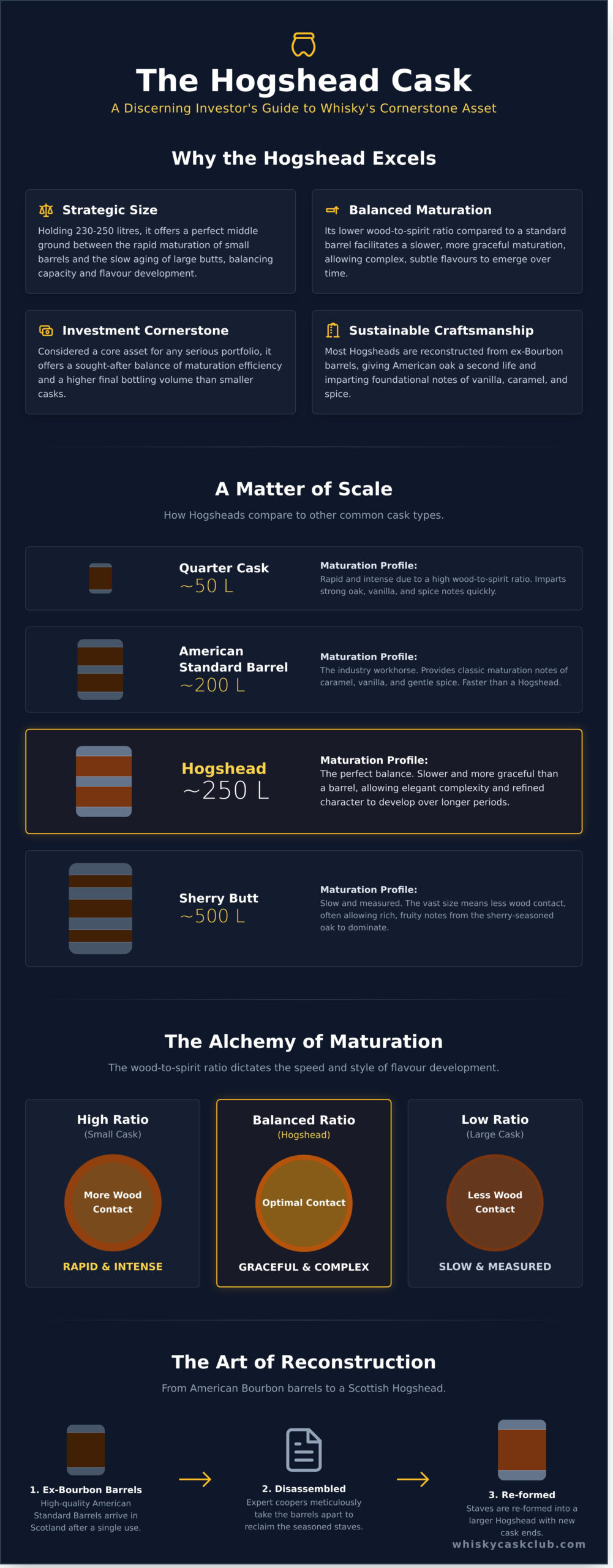
The provenance of a hogshead cask is often as compelling as the spirit it will one day hold. Most are not crafted from new timber but are born from an act of masterful recycling-a testament to the industry’s sustainable heritage. The process begins with high-quality American Standard Barrels, which, by U.S. law, can only be used once to mature bourbon. Once emptied, these casks are shipped to Scotland, where expert coopers meticulously disassemble them. The staves from several barrels are then re-formed into a larger vessel, bound by new, wider cask ends (or ‘heads’). This remarkable craftsmanship not only gives the American oak a second life but also imparts the classic vanilla, caramel, and spice notes from its bourbon-soaked past into the new-make Scotch spirit, forming the foundation of its future character.
A Matter of Scale: How Hogsheads Compare to Other Cask Types
In the meticulous craft of whisky maturation, the size of the cask is not a minor detail-it is a critical factor that dictates the spirit’s final character. The interaction between the wood and the liquid, known as the wood-to-spirit ratio, is fundamental to developing flavour, colour, and complexity. A smaller cask offers a higher ratio, leading to a more rapid and aggressive maturation, while a larger cask provides a slower, more measured evolution. The hogshead cask is prized by distillers and investors for its position as a perfectly balanced medium, offering a masterful compromise between these two extremes.
Hogshead vs. American Standard Barrel (ASB)
The American Standard Barrel (ASB), with a capacity of approximately 200 litres, is the workhorse of the bourbon industry and a common choice for Scotch maturation. A hogshead is slightly larger, holding around 250 litres. This increased volume means a hogshead has a lower wood-to-spirit ratio, facilitating a slower, more subtle maturation. This unhurried process is often preferred for crafting a spirit with elegant complexity and a refined character over a longer ageing period.
Hogshead vs. Sherry Butt
At the larger end of the spectrum sits the Sherry Butt, which holds a substantial 500 litres. Its vast size results in a significantly lower wood-to-spirit ratio compared to a hogshead. While Butts are revered for imparting rich, fruity notes from their sherry provenance, the hogshead provides more direct wood interaction over the same maturation timeline. This allows the distillery’s unique spirit character to shine through, harmonising with the oak rather than being dominated by it.
Visualizing Cask Sizes
To provide a clear perspective on how the hogshead cask fits within the broader landscape of whisky maturation, this table offers a direct comparison of the most common cask types. Each vessel offers a unique path for the spirit, contributing to the rich diversity found in the world of premium whisky.
| Cask Type | Capacity (Litres) | Common Origin | Typical Flavour Profile Influence |
|---|---|---|---|
| Quarter Cask | ~50 Litres | American or European Oak | Rapid and intense; strong notes of oak, vanilla, and spice. |
| Barrel (ASB) | ~200 Litres | American Oak (Ex-Bourbon) | Pronounced vanilla, caramel, coconut, and sweet spice. |
| Hogshead | ~250 Litres | American or European Oak | Balanced and elegant; allows spirit character to develop with subtle oak influence. |
| Puncheon | ~500 Litres | European Oak (Ex-Sherry) | Rich and robust; often imparts deep notes of dried fruit and spice. |
| Butt | ~500 Litres | European Oak (Ex-Sherry) | Deep and complex; classic sherry notes of raisin, fig, and Christmas cake. |
The Alchemical Process: How Hogshead Size Influences Whisky Maturation
The transformation of new-make spirit into mature single malt whisky is a patient art, governed by the silent dialogue between liquid and wood. The single most crucial factor in this process is the ratio of the cask’s internal surface area to the volume of spirit it holds. This dynamic dictates the pace and nature of maturation, and it is here that the hogshead truly demonstrates its exceptional provenance.
Far from being a passive container, the cask actively imparts flavour, colour, and character. The hogshead’s intermediate size facilitates what can best be described as a long and gentle conversation between the spirit and the oak. This unhurried interaction is the secret to developing the profound complexity and balance prized in older whiskies, making it the vessel of choice for expressions destined for 15 years or more of patient aging.
The ‘Wood-to-Spirit’ Ratio Explained
In maturation, size dictates influence. Smaller casks, such as quarter casks, have a high wood-to-spirit ratio, accelerating maturation and imparting intense, oak-forward flavours in a short time. Conversely, larger casks like butts have a lower ratio, resulting in a much slower, more subtle evolution. The hogshead occupies a strategic middle ground, offering a perfect equilibrium that encourages deep, graceful development without overwhelming the spirit’s intrinsic character.
Developing Complexity and Character Over Time
The classic hogshead cask, typically crafted from American oak ex-bourbon staves, is renowned for bestowing a signature flavour profile. Expect elegant notes of vanilla, rich caramel, honey, and a delicate spice to emerge over the years. Crucially, this gentle maturation process allows the distillery’s own spirit character to remain the protagonist. Whether the foundation is fruity, floral, or peated, the hogshead enhances rather than masks it, building layers of nuance and creating a whisky of exceptional depth.
The Angels’ Share and Its Impact
Maturation is not without its cost. A small percentage of spirit evaporates through the porous oak each year-a romantic loss known as the ‘Angels’ Share’. The rate of this loss is influenced by cask size and warehouse conditions. Due to its favourable surface-area-to-volume ratio, a hogshead offers superior volume retention over decades compared to smaller barrels. This efficiency is paramount for long-term investors, as it preserves more of the tangible asset, safeguarding its value as it matures toward its peak.
This masterful balance of elegant maturation and practical preservation is why the hogshead is a cornerstone of any serious whisky portfolio. To discover how you can build a legacy with these exceptional casks, explore our curated ownership opportunities.
The Investor’s Perspective: Why Hogsheads are a Portfolio Cornerstone
While the craftsmanship behind cask construction is fascinating, the true power of the hogshead for a discerning collector lies in its strategic investment profile. It represents the perfect confluence of volume, maturation potential, and market liquidity, making it a cornerstone for many successful whisky portfolios. This is where the passion for the spirit meets pragmatic financial acumen.
A Strategic Balance of Volume and Value
For the astute investor, a hogshead offers an exceptional value proposition. It holds significantly more spirit than a standard barrel-approximately 250 litres-for only a modest increase in initial outlay. This immediately translates to a superior cost-per-litre of potential aged whisky. Upon reaching maturity, this volume yields a substantial number of bottles, typically between 300 and 350, creating a significant tangible asset from a single, manageable investment.
Versatility and Market Demand
The ubiquity of the hogshead cask in the Scotch whisky industry is one of its greatest strengths as an asset. Its suitability for maturing a wide array of new make spirits from prestigious distilleries means it is constantly in demand. This inherent versatility ensures strong liquidity in the secondary market. Independent bottlers, fellow collectors, and distillers actively seek out well-matured hogsheads, confident in their ability to yield a spirit of exceptional character and quality. This consistent demand underpins its stability as a tangible asset.
Long-Term Potential: Building a Legacy
The patient maturation process within a hogshead aligns perfectly with a long-term investment horizon. Its larger volume allows for a slower, more graceful aging, enabling the spirit to develop profound complexity and depth over decades. This is not a short-term trade; it is the deliberate cultivation of a rare and valuable asset. For those focused on building a legacy, owning a hogshead is an act of foresight, securing a piece of liquid history that will appreciate in both character and value for years to come. Explore our curated selection of investment-grade casks.
The Hogshead Cask: A Cornerstone for Your Liquid Legacy
As we have explored, the hogshead is far more than a simple wooden vessel; it is a strategic instrument in the art of whisky maturation. Its unique construction and ideal size create a perfect environment for developing profound complexity and character, striking a masterful balance between spirit and oak. For the astute investor, the distinct maturation profile of a hogshead cask makes it an indispensable asset, offering a compelling blend of manageable scale and significant long-term growth potential.
Acquiring an asset of such prestige requires trusted guidance. At Whisky Cask Club, we provide our members with unparalleled, exclusive access to rare and premium Scotch whisky casks sourced from legendary distilleries. Your investment is protected by our expert portfolio management and advisory services and secured within accredited Scottish bonded warehouses, guaranteeing its provenance and integrity. This is the foundation upon which a true legacy is built.
Speak with a portfolio advisor to begin building your legacy. The journey into tangible, appreciating assets begins with a single, expertly chosen cask.
Frequently Asked Questions About Hogshead Casks
How many bottles of whisky can you get from a hogshead cask?
A hogshead cask typically yields between 250 and 300 70cl bottles of whisky. The exact number depends on several factors, most notably the age of the spirit. As whisky matures, a portion is lost to evaporation-the ‘angel’s share’-which reduces the final volume. The specific fill level and the cask’s unique character also influence the final outturn, but this range provides a reliable estimate for investors and connoisseurs seeking to build their legacy.
Are hogshead casks always made from American oak?
While a significant number of hogsheads are crafted from American oak (Quercus alba), particularly those reconstructed from ex-bourbon barrels, it is not a strict rule. Hogsheads can also be made from European oak (Quercus robur), often sourced from sherry butts. The choice of wood is a crucial decision by the distillery, as it imparts distinct flavour profiles-vanilla and caramel from American oak, or rich, spicy notes from its European counterpart, influencing the spirit’s final character.
Why are hogsheads typically reconstructed from bourbon barrels?
The practice of reconstructing hogsheads from bourbon barrels is rooted in pragmatism and supply. American law mandates that bourbon must be aged in new, charred oak barrels, creating a plentiful and cost-effective supply for the Scotch industry. Coopers skilfully break down these barrels and reassemble them with new ends to create the slightly larger hogshead. This process is an efficient way to reuse high-quality oak for the long-term maturation of premium single malt.
Is a hogshead better than a sherry butt for investment?
Neither cask is inherently ‘better’; they represent different investment strategies. Sherry butts are larger, rarer, and command a higher initial price, often producing a rich spirit with significant value potential. Hogsheads offer a more accessible entry point with a strong track record for steady appreciation. The ideal choice depends on your portfolio goals and the specific provenance of the spirit. Both are considered premium, tangible assets within the whisky investment landscape.
How does the cost of a hogshead compare to other cask sizes?
A hogshead cask occupies a strategic middle ground in terms of cost. It is generally more expensive than a standard 200-litre American Standard Barrel (ASB) but more affordable than a larger 500-litre sherry butt or puncheon. This balanced cost-to-volume ratio makes it a highly popular choice for both distilleries and private investors. It provides an excellent balance between the cost of acquisition and the potential volume of mature whisky, representing a sound investment.
What is the typical maturation period for a whisky in a hogshead?
Hogsheads are prized for their suitability for long-term maturation. Due to their size, the spirit has a lower wood-to-liquid ratio, leading to a slower, more gradual aging process. While they can be used for whiskies as young as 10 years, they are ideally suited for extended periods of 15, 20, or even 30+ years. This deliberate maturation allows for the development of deep complexity and character, crafting a truly exceptional final spirit.