For many, the first encounter with a premium whisky is dominated by a single, fiery note: alcohol. The nuanced world of flavour described by connoisseurs-of oak, vanilla, and fruit-can feel like a secret language, leaving one to wonder, what does whiskey taste like beyond that initial intensity? This perception, however, is merely the gateway to a far more rewarding journey. The ability to appreciate the profound complexity of a well-crafted spirit is not an innate gift but a cultivated skill, one that unlocks a deeper connection to the heritage and craftsmanship in every glass.
This guide is your invitation into that exclusive world. We will move beyond the burn, demystifying the essential flavour profiles that define the world’s finest whiskies, from the rich sweetness of the cask to the subtle spice of the grain. You will learn the proper method for tasting, acquire the vocabulary to articulate your experience, and gain the confidence to select and savour a dram with the discerning palate of a true enthusiast. Your journey into the heart of whisky begins here.
Decoding the Primary Flavors: Beyond the Alcoholic Burn
For the uninitiated, the immediate answer to ‘what does whiskey taste like?’ is often a simple, one-word response: ‘strong.’ This initial alcoholic warmth, or ‘burn,’ is a common first impression. However, beyond that sensation lies a world of profound complexity, a carefully orchestrated symphony of flavors derived from deliberate craftsmanship. To truly appreciate the spirit, one must learn to discern the notes beneath the heat.
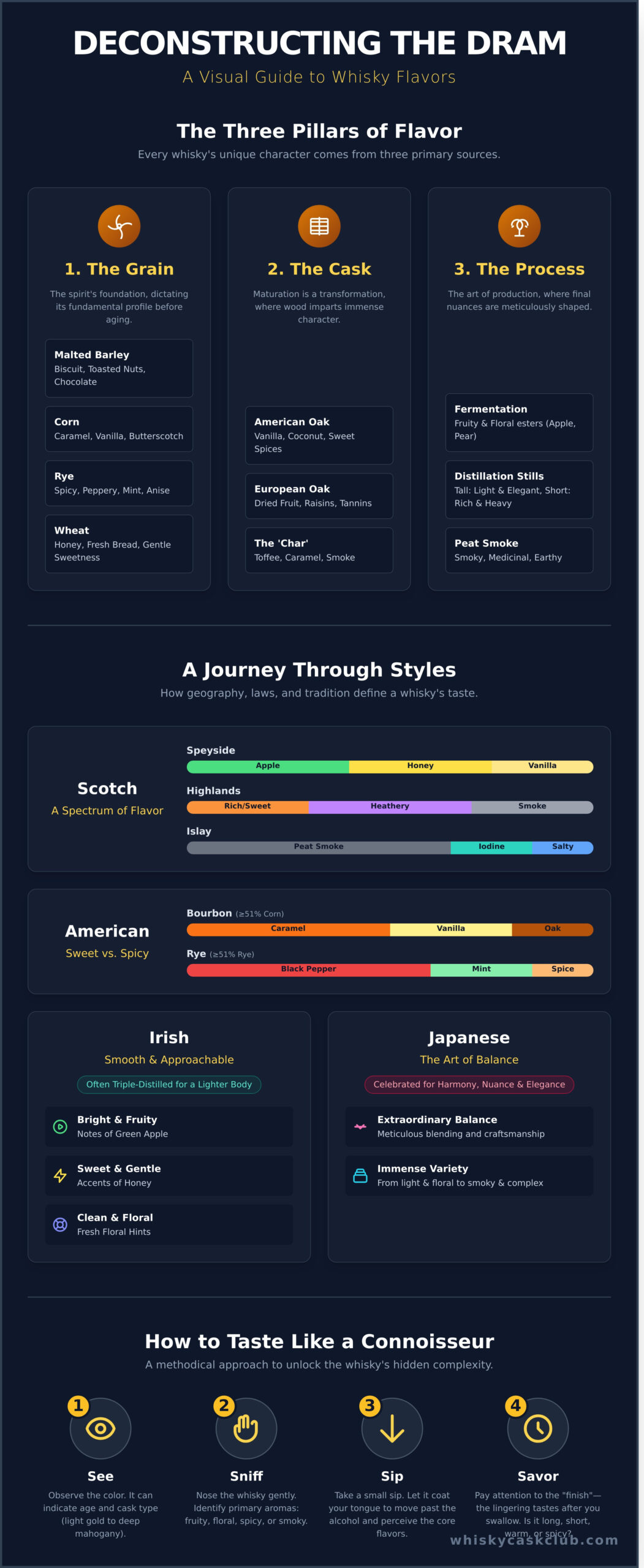
Understanding a whiskey’s flavor profile begins with recognizing its three primary sources of influence: the grain, the maturation cask, and the production process. Connoisseurs often use a ‘flavor wheel’ to articulate the vast spectrum of notes they encounter, from fruits and spices to wood and smoke. Each element contributes a distinct layer, and their interplay is what gives every bottle its unique identity and heritage.
Flavors from the Grain: The Spirit’s Foundation
The foundation of any whiskey’s character is its grain bill. This mash of fermented grains is the very essence of what whiskey is made from, and the specific choices dictate the spirit’s fundamental profile before it ever touches a cask.
- Malted Barley: The cornerstone of Scotch and many other whiskies, it imparts notes of biscuit, toasted nuts, and even rich chocolate.
- Corn: A key component in Bourbon, corn provides a signature sweetness, with flavors of caramel, vanilla, and butterscotch.
- Rye: Known for its assertive character, rye delivers a spicy, peppery kick, often accompanied by hints of mint or anise.
- Wheat: Used to create a softer, more delicate spirit, wheat lends gentle notes of honey, fresh bread, and subtle sweetness.
Flavors from the Cask: The Influence of Wood
Maturation is not mere storage; it is a transformative process where the spirit draws immense character from the wooden cask. The type of oak and its preparation are paramount to the final taste.
- American Oak: Typically used for Bourbon, these casks impart classic notes of vanilla, coconut, and sweet baking spices like cinnamon.
- European Oak: Often seasoned with Sherry or Port, these casks contribute richer, darker flavors of dried fruit, raisins, and complex tannins.
- The ‘Char’: Toasting or charring the inside of the barrel caramelizes wood sugars, creating deep notes of toffee, caramel, and, in heavier chars, smoke.
Flavors from the Process: Distillation and Fermentation
The final nuances are shaped by the meticulous art of production. From fermentation to distillation, each step is an opportunity to refine the spirit’s character.
- Fermentation: This stage creates fruity and floral esters, introducing delicate notes of apple, pear, and fresh-cut grass into the spirit.
- Distillation: The shape and size of the copper pot stills play a crucial role. Tall, slender stills create a lighter, more elegant spirit, while shorter stills produce a richer, heavier one.
- Peat: A signature of many Scotch whiskies, peat is dried moss used to dry the malted barley, infusing the grain with its distinctive smoky, medicinal, and earthy flavor.
A Journey Through Styles: How Region Defines Taste
Whiskey is not a monolith; it is a spirit profoundly shaped by its provenance. The unique character of each bottle is a direct result of geography, stringent local laws, and time-honoured traditions. To truly understand what does whiskey taste like, one must explore its global expressions, each offering a curated taste of its homeland. From the rugged coasts of Scotland to the meticulous distilleries of Japan, the journey of flavor is defined by place.
Scotch Whisky: A Spectrum from Delicate to Smoky
The spiritual home of whisky offers a breathtaking range of profiles, a testament to its diverse terroir and heritage. While a vast and complex category, its character is often understood through its primary regions:
- Speyside: Known for elegant and refined spirits. Expect notes of apple, honey, vanilla, and delicate florals. (e.g., The Glenlivet, Macallan)
- Highlands: A vast and varied region producing everything from rich and sweet drams to more heathery and subtly smoky expressions.
- Islay: Unmistakable and bold. This is the domain of powerful peat smoke, iodine, and maritime saltiness. (e.g., Laphroaig, Ardbeg)
American Whiskey: The Sweetness of Bourbon, the Spice of Rye
American whiskey’s identity is forged in new, charred oak barrels, creating bold and assertive flavors. Bourbon, with its corn-heavy mash bill (at least 51%), delivers a signature sweetness rich with caramel, vanilla, and toasted oak. In contrast, Rye whiskey, requiring 51% rye grain, presents a drier, spicier profile with notes of black pepper, mint, and baking spices. Tennessee Whiskey, like Bourbon, is corn-based but undergoes an additional charcoal filtering step, which imparts an exceptional smoothness.
Irish Whiskey: Approachable, Smooth, and Fruity
Renowned for its exceptionally smooth and approachable character, Irish whiskey is often triple-distilled-a process that yields a lighter-bodied, cleaner spirit. This makes it an excellent starting point for those new to the spirit. Its flavor profile typically lacks the heavy smoke of Islay Scotch, instead favoring bright notes of green apple, honey, and fresh floral hints. It is a style defined by its inviting elegance and clean finish.
Japanese Whisky: The Art of Balance and Nuance
While the craft was inspired by Scottish tradition, Japanese whisky has cultivated its own identity centered on meticulous craftsmanship and the art of blending. The result is a spirit celebrated for its extraordinary balance, harmony, and elegance. Flavor profiles vary immensely, from light and gracefully floral to subtly smoky and complex. Each bottle offers a masterclass in nuance, making this category a favorite among discerning connoisseurs.
How to Taste Whiskey Like a Connoisseur: A Practical Guide
To truly understand what does whiskey taste like beyond the initial warmth of alcohol, one must adopt a deliberate technique. The chasm between a novice taster and a seasoned connoisseur is bridged by methodology. The following steps are designed to bypass the spirit’s assertive proof and unlock the complex tapestry of flavors and aromas that define a premium whiskey. This is a practice of patience; developing your palate is a rewarding journey into the heart of the craft.
Step 1: The Right Vessel and Preparation
Your experience begins with the proper glass. A traditional tumbler is fine for a simple drink, but for tasting, a tulip-shaped glass, such as a Glencairn, is unequivocally superior. Its wide bowl allows for swirling, while the narrow rim concentrates the delicate aromatic compounds, delivering them directly to your nose. Before you pour, ensure your palate is clean by drinking a small amount of still water.
Step 2: The Art of ‘Nosing’ the Whiskey
The majority of taste is derived from smell. Swirl the whiskey gently-not vigorously-to release volatile esters without introducing excess alcohol vapor. Bring the glass towards you, but do not plunge your nose inside. Instead, smell from the rim with your mouth slightly open. This technique allows you to perceive more nuanced aromas, from rich vanilla and oak to subtle hints of fruit or smoke, without being overwhelmed by ethanol.
Step 3: The First Sip and Palate Development
Your first taste should be a very small, introductory sip. This “primer” sip simply acclimatizes your palate to the alcohol. Now, take a second, more generous sip and allow the liquid to coat your entire mouth. Before swallowing, consider the mouthfeel. Is the texture:
- Oily and viscous?
- Creamy and smooth?
- Thin and light?
This textural character is a key component of the whiskey’s profile.
Practicing this level of sensory analysis isn’t limited to spirits. Engaging with complex, non-alcoholic beverages can also sharpen your ability to identify subtle notes. For instance, the naturally infused drinks from Aroha Drinks offer a great way to train your palate to recognize fruit and botanical profiles without the presence of alcohol.
Step 4: The ‘Finish’ and the Role of Water
The “finish” is the lingering impression the whiskey leaves after you have swallowed. Note its length-does the flavor disappear quickly (a short finish) or does it evolve and remain for minutes (a long finish)? Identify the lasting notes: are they sweet, spicy, smoky, or tannic? For higher-proof expressions, adding a few drops of water can be transformative. This simple act can “open up” the spirit, softening the alcohol and revealing deeper layers of complexity. This dedication to uncovering a spirit’s true character is the first step on a rewarding journey, from enthusiast to serious collector.
From Palate to Provenance: Why Taste Dictates Value
Beyond the simple pleasure of a dram, the complex answer to what does whiskey taste like is a direct indicator of its tangible value. The intricate dance of flavors-from smoky peat to rich vanilla-is not an accident; it is the deliberate result of time, patience, and impeccable craftsmanship. For the discerning individual, this sensory profile becomes a blueprint for a powerful alternative asset, transforming a passion for flavor into a legacy investment.
The Maturation Journey: How Flavor Evolves in the Cask
A new-make spirit enters the cask clear and fiery, yet nearly all of its final character is bestowed upon it during its years resting in wood. This evolution, the very essence of what an investor purchases, occurs through three distinct processes:
- Subtractive Maturation: The charred oak cask acts as a natural filter, stripping away harsh, sulphurous compounds from the young spirit.
- Additive Maturation: The cask imparts its own signature flavors and all of the whisky’s color. Notes of vanilla, caramel, spice, and tannin are drawn from the wood itself.
- Interactive Maturation: Oxygen, spirit, and wood compounds react over time, creating new, complex esters that manifest as fruity and floral notes.
This journey from raw spirit to a complex, mature whisky is where value is meticulously cultivated.
Craftsmanship as an Asset: The Value of Provenance
A distillery’s legacy is built upon the consistent excellence of its unique flavor profile. This is its provenance. Every choice, from the mineral content of its water source to the precise shape of its copper pot stills, is a deliberate, value-creating decision designed to produce a signature spirit. This is why casks from distilleries with a celebrated heritage of craftsmanship command premium prices; you are investing in a proven track record of quality and global demand.
Tasting as an Investment Tool
Developing your palate moves you from enthusiast to investor. The ability to identify the subtle markers of quality-balance, complexity, and a long finish-is an invaluable tool for assessing a cask’s potential for appreciation. Understanding diverse flavor profiles allows you to build a curated portfolio, balancing robust, peated spirits from Islay with elegant, fruity malts from Speyside. This knowledge transforms your appreciation for what whiskey tastes like into a strategic financial advantage.
This refined understanding is the foundation of a successful cask ownership strategy. Begin your cask investment journey with expert guidance.
Your Journey Beyond the Glass: From Tasting to Legacy
Understanding the answer to what does whiskey taste like is the first step on a lifelong journey of discovery. You’ve learned that its flavor is a complex interplay of craftsmanship and provenance, a story told in notes of smoke, fruit, and spice. By mastering the art of tasting, you move beyond being a mere drinker to become a true connoisseur, appreciating the profound connection between a whisky’s character and its intrinsic value.
But what if your appreciation could become something more? What if you could move from savoring the final product to owning the very source of its creation? This is the next chapter in your journey-transforming passion into a tangible asset.
At the Whisky Cask Club, we provide this exclusive opportunity. We offer our members privileged access to premium, investment-grade Scotch casks, curated for their exceptional quality. Your journey is supported by our expert portfolio management and exit strategy advisory, with every cask secured in accredited Scottish bonded warehouses. This is more than an investment; it is the foundation of a personal legacy.
Explore the world of whisky cask ownership and build your legacy. Your adventure into the heart of whisky has only just begun.
Frequently Asked Questions About The Taste of Whisky
Why does whiskey burn my throat, and how do I stop it?
The characteristic warmth, often perceived as a “burn,” is a direct result of the spirit’s high ethanol content interacting with your palate. This sensation is entirely normal for newcomers. To refine your experience, begin with very small sips, allowing the liquid to acclimatise in your mouth before swallowing. This simple act of patience allows the complex flavours to emerge, moving past the initial intensity of the alcohol and revealing the whisky’s true character and craftsmanship.
What is the best type of whiskey for a complete beginner?
For those beginning their journey into the world of fine spirits, we recommend an approachable yet elegant starting point. Consider a classic Lowland Scotch or a triple-distilled Irish whiskey, celebrated for their smooth, delicate profiles with notes of fruit and honey. A quality wheated Bourbon also offers a softer, sweeter introduction. These foundational styles provide a gentler welcome, allowing you to appreciate the nuanced craftsmanship without the challenge of aggressive peat or high proof.
Does adding water or ice to whiskey ruin the taste?
Contrary to common misconception, adding a few drops of still water does not ruin a fine whisky; it is a technique revered by connoisseurs. Water can open up the spirit, softening the alcohol’s edge and releasing a cascade of subtle aromatic compounds and flavours. Ice, however, can chill the whisky to a point where these delicate nuances are muted. For a pure tasting experience, we advise a touch of water over ice to appreciate the full depth of the distiller’s craft.
What does it mean when a whiskey is described as ‘smoky’ or ‘peaty’?
The terms ‘smoky’ or ‘peaty’ refer to a distinctive flavour profile derived from the heritage of Scottish whisky-making. Peat, a dense organic soil, is burned to dry the malted barley, infusing it with a powerful, smoky aroma. This process imparts notes ranging from a gentle campfire to more intense medicinal or maritime characteristics. Whiskies from the Islay region of Scotland are the most renowned for this bold and complex expression of terroir and tradition.
How much does the age of a whiskey really affect its flavor?
The age statement on a bottle signifies the minimum time the spirit has spent maturing in an oak cask, a crucial period that profoundly shapes its final character. During this maturation, the harshness of the young spirit mellows, and a complex dialogue begins between the liquid and the wood. The cask imparts its own legacy of flavour-notes of vanilla, caramel, and spice-while subtracting undesirable compounds. This transforms the spirit, adding layers of depth, colour, and complexity.
Is there a difference in taste between single malt and blended whiskey?
Indeed, the distinction is fundamental to understanding what does whiskey taste like. A single malt is the product of one distillery, crafted exclusively from malted barley, offering a pure expression of that distillery’s unique character and terroir. A blended whisky, conversely, is an artful composition of multiple single malts and grain whiskies from various distilleries. The master blender’s craft is to create a consistent, balanced, and often complex flavour profile that can be more approachable than a singular malt.