Have you ever gazed at a bottle of premium single malt, noting terms like ‘triple distilled’ or ‘pot still’, and wondered what they truly signify? These prestigious labels all point to a single, transformative process at the heart of spirit creation. For any serious investor or connoisseur, understanding what does distilled mean is not merely academic; it is fundamental to appreciating the very soul of the liquid. It is the alchemical moment where humble ingredients begin their journey toward becoming a tangible asset of exceptional character and provenance.
In this definitive guide, we move beyond the technical jargon to reveal the art and science behind this crucial stage of craftsmanship. You will discover how this one process defines the smoothness, complexity, and ultimate value of every spirit, particularly the fine Scotch whisky we curate. Prepare to gain a new level of insight, transforming how you view every bottle and cask, and deepening your appreciation for the legacy held within.
The Fundamental Definition: Separating the Essential from the Impure
To truly understand what does distilled mean, one must first appreciate the art of separation. At its heart, distillation is a meticulous process that uses heat to purify a liquid, isolating its essential components from the impure. Consider the simple act of boiling a kettle: the steam that rises is pure water vapor, leaving heavier minerals behind. This same principle underpins the craftsmanship of the world’s finest spirits, achieving two primary objectives: to dramatically increase the concentration of alcohol and to remove undesirable elements. This process of selective vaporization is central to the fundamental definition of distilled spirits and is the foundation of their unique character and provenance.
The Science of Boiling Points: The Core Principle
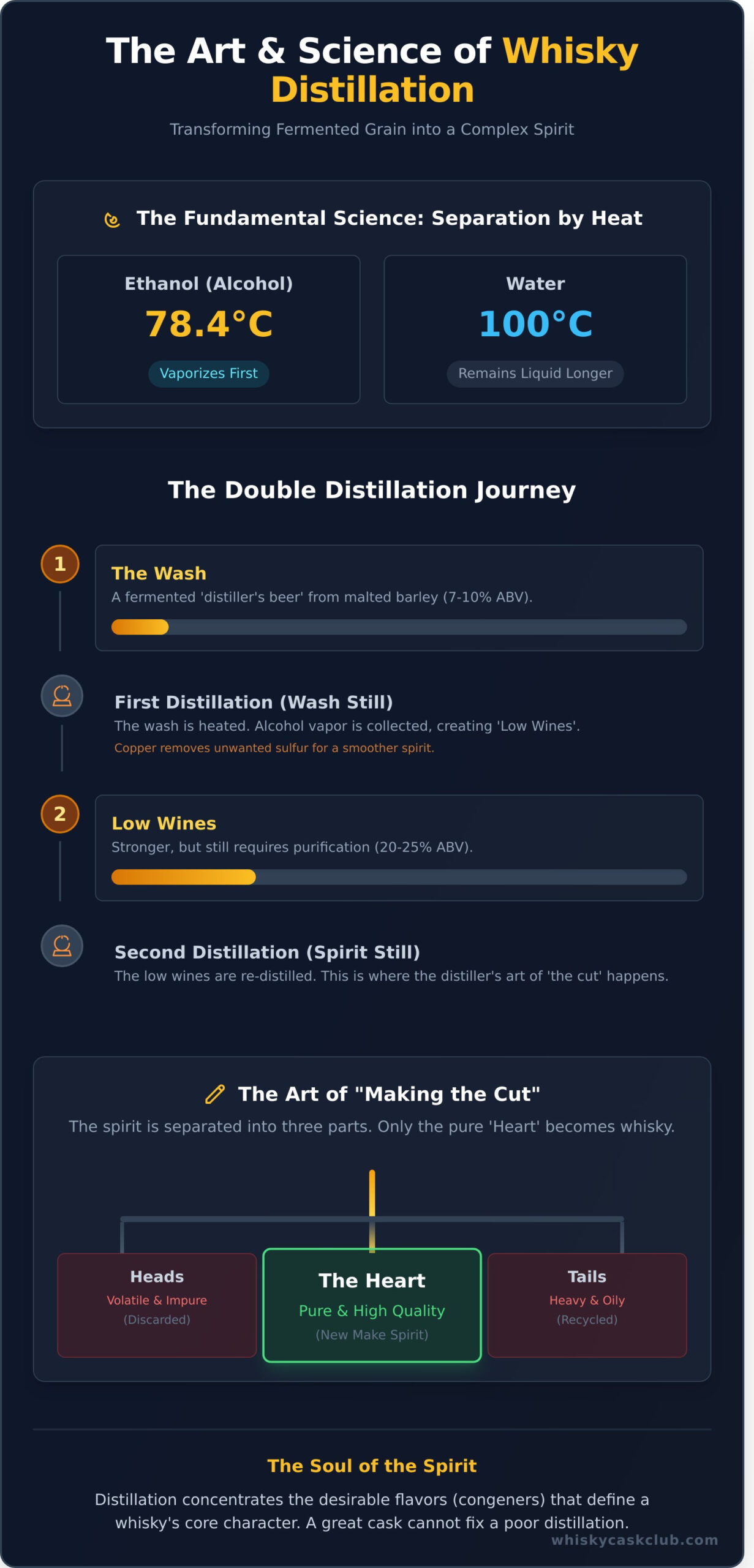
The magic of distillation lies in a simple, immutable law of physics: different liquids boil at different temperatures. The fermented liquid that begins the journey-known as the ‘wash’-is a mixture of primarily alcohol and water. Pure ethanol (alcohol) vaporizes at a lower temperature, 78.37°C (173.1°F), while water requires a much higher temperature of 100°C (212°F). This critical difference is the key that unlocks the distiller’s craft, allowing for their precise separation.
From Vapor to Liquid: The Role of Condensation
As the wash is heated in a still, the alcohol begins to evaporate long before the water does. This alcohol-rich vapor rises and is carefully channeled away. The next crucial step is condensation. The captured vapor is guided into a cooling system, where the drop in temperature forces it to transform back into a liquid. This newly formed liquid, known as the distillate, is a significantly more concentrated and purer form of alcohol, the very essence of the spirit.
Beyond Spirits: Distillation in the World Around Us
While we revere it for its role in creating premium spirits, distillation is a foundational scientific process with wide-ranging applications. It is the same technique used to create medically pure distilled water, to carefully extract fragrant essential oils for perfumes, and even on an industrial scale to refine crude oil into fuel. This shared heritage underscores that spirit making is not just an art, but a precise science-a mastery of natural principles.
The Distillation Process in Whisky Making: A Step-by-Step Journey
Having explored the science, we now turn to the craft. Distillation is the defining moment where a humble, fermented grain liquid-often called a ‘distiller’s beer’-is transformed into a potent and complex spirit. This is where the foundational character of a whisky is born, a testament to the distiller’s skill. For Scotch whisky, this is not merely tradition; it is a legal imperative. Understanding this journey is central to grasping what does distilled mean in the world of fine spirits. While the fundamental science behind the distillation process involves separating alcohol from water, its application in whisky making is a revered art form, honed over centuries.
The Starting Point: The ‘Wash’
Every great whisky begins its life as ‘wash’. This is a fermented, opaque liquid crafted from malted barley and other grains. Essentially a simple, unhopped beer, the wash typically has an alcohol by volume (ABV) of around 7-10%. It holds the raw potential and all the fermentable sugars that, through the magic of distillation, will be concentrated and purified into the spirit we recognise.
The Still: The Copper Heart of the Distillery
The primary instrument of this transformation is the still. In traditional Scotch whisky production, this is almost always a gleaming copper pot still, its unique shape influencing the final spirit’s character. While more industrial column stills exist, the pot still is synonymous with single malt craftsmanship. Copper is not just for aesthetics; it plays a crucial chemical role, reacting with and removing undesirable sulfur compounds, ensuring a smoother, more palatable spirit.
The First Distillation: Creating the ‘Low Wines’
The journey begins as the wash is heated in a large ‘wash still’. As the alcohol has a lower boiling point than water, it vaporises first, travels up the still’s neck, and is condensed back into a liquid. This initial product is known as ‘low wines’. With an ABV of approximately 20-25%, this spirit is stronger but still contains many impurities. It is not yet whisky; it requires further refinement to elevate its quality.
The Second Distillation: The Art of ‘Making the Cut’
The low wines are transferred to a second, often smaller, ‘spirit still’ for the crucial final run. Here, the distiller’s expertise is paramount. The distillate emerges in three distinct parts:
- The Heads: The first part, high in volatile compounds and undesirable for consumption.
- The Heart: The middle section, the pure, high-quality spirit destined to become whisky.
- The Tails: The final part, containing heavier, oily compounds.
The art of ‘making the cut’-precisely when to start and stop collecting the heart-defines a distillery’s signature style. Only the heart, or ‘new make spirit’, is deemed worthy of maturation. This selective purification is the ultimate answer to what does distilled mean: it is the careful separation of the desirable from the undesirable, capturing the very soul of the spirit.
How Distillation Defines a Whisky’s Character and Quality
To truly understand what does distilled mean in the context of premium spirits, one must look beyond the simple act of increasing alcohol content. Distillation is the foundational art form where a whisky’s soul is forged. It is a meticulous process of selection and concentration, setting the stage for the long, quiet years of maturation. A profound truth in the world of whisky craftsmanship is that a poor distillation can never be salvaged by a superior cask; the wood can only enhance the character it is given.
Concentrating Flavor, Not Just Alcohol
The primary purpose of distillation is purification, but its art lies in what is deliberately kept. The process masterfully concentrates desirable flavour compounds, known as congeners. These are the building blocks of taste and aroma-the fruity esters, delicate floral notes, and rich cereal tones captured from the fermented wash. This is why the unaged, crystal-clear new make spirit already possesses a distinct and complex character, a unique fingerprint of its distillery of origin.
The Influence of the Still’s Shape and Size
The copper pot still is the primary instrument in the distiller’s orchestra, and its physical dimensions dictate the final spirit’s profile. Tall, slender still necks encourage more reflux, where heavier vapours condense and fall back, allowing only the lightest and most delicate compounds to reach the top. This creates elegant, floral spirits. Conversely, short, wide stills produce richer, oilier, and more robust whiskies. The precise geometry of the still is a core element of The Science of Distillation that separates one distillery’s spirit from another.
Double vs. Triple Distillation: A Question of Style
The number of distillations profoundly influences a whisky’s style. The Scottish tradition typically favours double distillation, a method that retains more of the original grain character and heavier congeners, resulting in a complex and full-bodied spirit. In Ireland, triple distillation is common, with the third cycle creating an exceptionally smooth, light, and often fruit-forward spirit with a higher initial ABV. Neither method is inherently superior; they are deliberate stylistic choices rooted in heritage and a vision for the final product.
Ultimately, understanding the nuances of distillation is key to appreciating a whisky’s provenance. These foundational choices-from the cut points to the shape of the still-are precisely what we assess when curating casks with true legacy potential for our members.
Distillation’s Impact on Whisky Cask Investment
While the art of distillation creates the soul of a whisky, for the discerning investor, it represents something more tangible: the foundation of its future value. The meticulous process of separating alcohol from water is not merely a craft; it is the first and most critical step in creating a premium, appreciating asset. For an investor, understanding what does distilled mean is to understand the very blueprint of a cask’s potential returns.
The quality of the distillation process, and the resulting spirit, is the primary driver of a cask’s long-term appreciation. A distillery’s reputation, built over decades of consistency and excellence, is rooted in the character of the spirit that flows from its stills.
The ‘New Make Spirit’: The Foundation of Future Returns
When you invest in a whisky cask, you are acquiring the profound potential of its contents: the raw, unaged ‘new make spirit’. The character of this spirit-be it light and floral, or rich and oily-is determined entirely during distillation. This initial profile dictates how it will interact with the oak cask over years of maturation, ultimately defining the complexity, rarity, and desirability of the final whisky. A superior new make spirit from a celebrated distillery has a significantly higher value ceiling.
Provenance and Process: Why a Distillery’s Method Matters
A distillery’s unique distillation techniques are central to its provenance and collectibility. An institution renowned for its exceptionally slow distillation, precise ‘cuts’, or uniquely shaped copper stills produces a spirit that is both distinctive and sought-after. This verifiable process underpins the long-term value in the cask market. For collectors, a distillery’s heritage is inseparable from its methods, making the answer to what does distilled mean a direct indicator of investment grade quality.
From Spirit to Tangible Asset
Ultimately, the science of distillation is what transforms humble agricultural products-barley, water, and yeast-into the art within a cask. This remarkable transformation is the engine that turns a simple spirit into a powerful, tangible asset class. It is the genesis of a legacy built on craftsmanship, patience, and foresight.
Discover how to build a legacy with a portfolio of expertly sourced casks.
The Final Cut: From Distillation to a Tangible Legacy
Ultimately, the art of distillation is where the journey of every great whisky begins. It is a meticulous process of purification and concentration, the foundational step that separates the essential spirit from the impure. Understanding what does distilled mean is to understand the very heart of a whisky’s provenance and potential. This crucial stage doesn’t just create alcohol; it forges the unique character and sets the standard for quality, directly influencing the future value of the spirit as a tangible asset.
This appreciation for craftsmanship is the cornerstone of a prudent whisky cask investment. At Whisky Cask Club, we grant our members exclusive access to rare casks from Scotland’s finest distilleries, each a testament to this art. Your investment is protected by our expert portfolio management and advisory services and secured in government-accredited bonded warehouses, ensuring its integrity and growth.
Are you ready to transform an understanding of this heritage into a personal legacy? Begin your whisky cask ownership journey. Inquire with our experts today. The story of a legendary spirit begins in the still; yours can begin with a single cask.
Frequently Asked Questions About Distillation
What is the difference between distilled and fermented?
Fermentation is the foundational biological process where yeast converts sugars into a low-alcohol liquid, such as a beer or wine. Distillation is the subsequent art of refinement. It employs heat to separate and concentrate the alcohol and desirable flavours from that initial liquid, creating a purer, more potent spirit. One process creates the potential; the other is the act of craftsmanship that realises it, defining the spirit’s essential character.
Is all alcohol distilled?
No, only spirits are subject to distillation. Beverages like wine and beer undergo fermentation to create their alcohol content but are not refined further through this process. Distillation is a deliberate, additional step reserved for crafting spirits like whisky, gin, and rum. This critical stage elevates the alcohol concentration and purifies the liquid, separating it from the world of fermented drinks and defining its status as a premium spirit.
What does ‘double distilled’ or ‘triple distilled’ mean for whisky?
This refers to the number of times the spirit is meticulously passed through the stills. Each distillation cycle further purifies the liquid and lightens its character. By tradition, most Scotch whisky is double distilled, preserving a robust character. In contrast, many Irish whiskeys undergo triple distillation, a process that yields a notably smoother and more delicate spirit. This choice is a crucial element of craftsmanship that defines a whisky’s core profile and heritage.
Why are whisky stills almost always made of copper?
Copper is fundamental to the craftsmanship of premium whisky due to its unique chemical properties. During distillation, the heated spirit vapour reacts with the copper surface, which catalytically removes undesirable, sulphur-based compounds. This natural purification results in a cleaner, smoother new-make spirit. Therefore, copper is not merely a traditional choice; it is an essential component in shaping the final quality and character of the world’s most sought-after whiskies.
Does distillation happen before or after the whisky is aged in a barrel?
Distillation is a critical step that occurs entirely before the spirit is laid down to mature in an oak cask. The process creates what is known as the “new-make spirit”-a clear, potent liquid that holds the distillery’s unique character. Only after this spirit has been perfectly crafted is it filled into barrels for the long, transformative journey of aging. It is in the cask that the spirit acquires its signature colour, complexity, and depth.
Can you distill a liquid more than once?
Yes, a spirit can and often is distilled multiple times. This practice is central to understanding what does distilled mean in the context of creating a premium spirit. Each successive distillation strips out more impurities and heavier flavour compounds, resulting in a purer, smoother, and lighter liquid. The choice to distill once, twice, or three times is a deliberate decision made by the master distiller to precisely shape the final character of the spirit before maturation.