Ask about the true home of whiskey, and you will likely ignite a spirited debate between the rolling green hills of Ireland and the misty glens of Scotland. The story of this celebrated spirit is often shrouded in myth, its narrative complicated by technical terms and conflicting historical accounts. Untangling the true whiskey origin requires more than simply choosing a side; it demands a journey through centuries of alchemy, innovation, and unwavering craftsmanship.
This is that journey. We will move beyond the rival claims and dense academic texts to uncover the authentic heritage of whiskey. From the earliest whispers of distillation in ancient monasteries to the pioneering spirit that gave rise to iconic Scotch and Bourbon, you will gain a clear understanding of its legacy. By exploring its history, you will develop a deeper appreciation for the provenance and artistry that define every exceptional dram, empowering you to choose and discuss whiskey with newfound confidence and authority.
The Ancient Roots of Distillation: Before Whiskey Was Whiskey
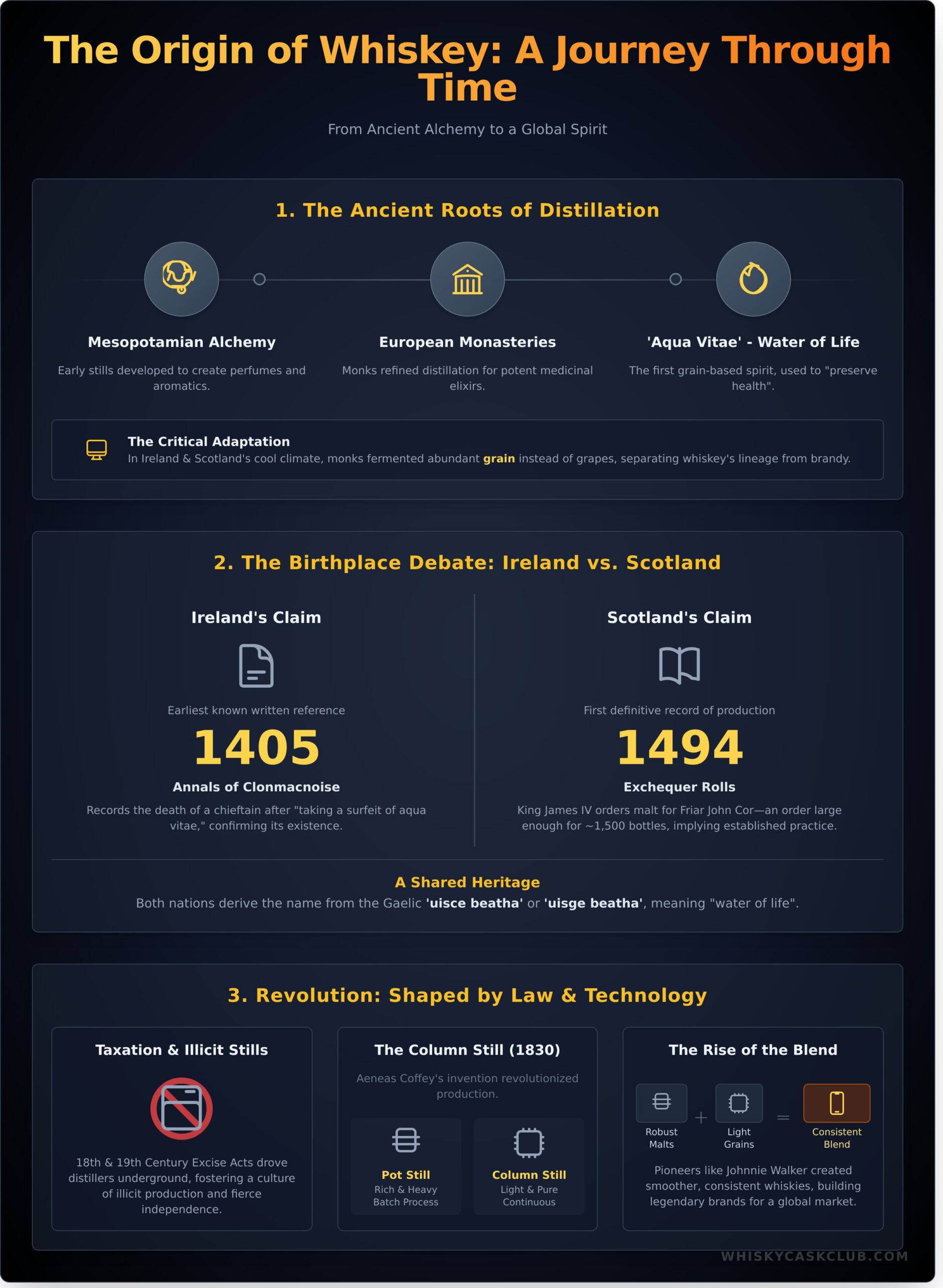
To truly understand the whiskey origin, one must look far beyond the misty glens of Scotland or the green fields of Ireland. The story of this celebrated spirit does not begin with grain and cask, but with the ancient art of distillation. This foundational craft, a cornerstone in the complete history of whisky, traces its lineage back to the alchemists of Mesopotamia. They first developed rudimentary stills not for libation, but to capture the essential essence of flowers and herbs for perfumes and aromatics. This fundamental knowledge of separating liquids was the first, crucial step in a journey that would eventually lead to the dram in your glass.
From Alchemy to ‘Aqua Vitae’
The migration of this alchemical knowledge into Europe, carried by traveling monks and scholars, marked a pivotal turn in the spirit’s heritage. Within the stone walls of medieval monasteries, the craft was meticulously refined and documented. Monks, the learned custodians of their age, adapted the alembic still to create potent medicinal remedies from fermented mashes. They christened the resulting clear, powerful spirit ‘aqua vitae’-a Latin term of profound significance meaning “water of life.” This was not a beverage for leisure but a revered elixir, a tangible asset in their infirmaries, believed to preserve health and treat a host of ailments.
The Monastic Cradle of Spirit Production
Monasteries provided the perfect crucible for the early chapters of the whiskey origin story. As self-sufficient centers of learning, agriculture, and craftsmanship, they possessed the essential resources: abundant grain from their harvests, pure water from local springs, and the scholarly patience required for meticulous experimentation. In the cooler, damp climates of Ireland and Scotland, viticulture was not viable. Lacking vineyards, monks turned to the plentiful barley and other grains that thrived in their fields. This critical adaptation-fermenting a mash of grain instead of fruit-is the very decision that separated the lineage of whiskey from that of brandy, setting the stage for a unique spirit with a rich, northern European heritage.
The Birthplace Debate: Ireland vs. Scotland
The question of whiskey origin is a matter of national pride, sparking a centuries-old rivalry between Ireland and Scotland. Both nations lay a passionate and legitimate claim to the spirit’s heritage, and both stories are rooted in a shared Gaelic tradition. The very name, derived from ‘uisce beatha’ or ‘uisge beatha’-Gaelic for “water of life”-highlights their deeply intertwined history. While the precise first drop may be lost to time, written records provide tantalizing clues that fuel this enduring debate.
Ireland’s Claim: The 1405 Annals of Clonmacnoise
Ireland presents the earliest known written reference to the spirit. The Annals of Clonmacnoise, a medieval Irish chronicle, record the 1405 death of a chieftain, Richard Magranell, after “taking a surfeit of aqua vitae.” While a grim introduction, it confirms that a potent distilled spirit was known and consumed in Ireland at the dawn of the 15th century. This early uisce beatha would have been a raw, unaged spirit, valued more for its perceived medicinal properties than for refined enjoyment.
Scotland’s Evidence: The 1494 Exchequer Rolls
Scotland’s claim is anchored by an official record of immense significance. The Exchequer Rolls of 1494 document an order from King James IV to Friar John Cor, granting him “eight bolls of malt wherewith to make aqua vitae.” The sheer scale of this order-enough to produce roughly 1,500 bottles by modern standards-implies that distillation was already a well-established practice. This document stands as the definitive starting point of Scotch whisky’s documented history and a cornerstone of its provenance.
A Shared Heritage, A Friendly Rivalry
Ultimately, declaring a single victor is impossible. The historical record suggests that the craft of distillation developed in parallel across both nations, nurtured by a shared culture and language. This friendly rivalry is not a dispute over facts but a testament to the profound cultural importance of whiskey in both Ireland and Scotland. The debate itself enriches the spirit’s legacy, reminding us that its story is one of shared craftsmanship, ancient traditions, and a passion for the “water of life.”
Evolution and Revolution: How Whiskey Was Shaped by Law and Technology
The ascent of whiskey from a provincial spirit to a global icon was not a gentle evolution, but a revolution forged by law and ingenuity. The rustic, small-scale craft that defined the early whiskey origin was fundamentally reshaped by the twin forces of government taxation and a pivotal technological breakthrough. This era of conflict and innovation was essential in developing the resilient character and commercial potential of the spirit we know today.
The Exciseman Cometh: Taxation and Illicit Distillation
As governments recognized the commercial power of distillation, they sought to control and tax it. The Excise Acts of the 18th and 19th centuries drove countless distillers into the shadows, birthing an era of illicit production. In hidden glens across Scotland and Ireland, these clandestine artisans perfected their craft away from the Exciseman’s gaze. This period of defiance didn’t just create outlaws; it instilled a fierce independence and resourcefulness that remains part of the spirit’s enduring heritage.
The Column Still: Aeneas Coffey’s Game-Changing Invention
While tradition was being defended in the hills, a technological paradigm shift was occurring. The invention of the column still by Aeneas Coffey in 1830 offered an alternative to the classic pot still. Where the pot still produced a heavy, deeply characterful spirit in limited batches, Coffey’s continuous still created a lighter, purer grain spirit with unparalleled efficiency. This innovation laid the groundwork for mass production, forever altering the industry’s economic landscape.
The Rise of the Blend
The true commercial genius of the era was marrying the old with the new. Visionary grocers and merchants like Johnnie Walker, James Chivas, and Andrew Usher began blending the consistent, light-bodied grain whiskies with a curated selection of robust single malts. The result was a product that was smoother, more approachable, and, crucially, consistent. This innovation of the blended whisky created a reliable standard of quality, allowing brands to build a legacy and take their curated expressions to a global market, securing Scotch’s place as a symbol of prestige.
Whiskey Goes Global: The Birth of New World Styles
The story of whiskey did not conclude in the misty glens of Scotland or the green fields of Ireland. As immigrants sought new lives across the oceans, they carried with them the invaluable knowledge of distillation. This migration planted the seeds of a global phenomenon, where the core principles of the spirit’s heritage were adapted to new lands, climates, and ingredients. The result was a spectacular diversification of style, adding rich new chapters to the story of the whiskey origin.
America’s Native Spirit: The Dawn of Bourbon
In the 18th and 19th centuries, settlers pushing into the American frontier, particularly Kentucky, were incentivized by “Corn Patch and Cabin Rights.” This encouraged the cultivation of corn, which quickly became the foundational grain for a new style of whiskey. The unique character of Bourbon was born from a convergence of critical elements, an identity now protected by law as “America’s Native Spirit.”
- A Corn-Heavy Mash Bill: Legally required to be at least 51% corn, providing a signature sweetness.
- Limestone-Filtered Water: The iron-free water of the region purifies the spirit and aids fermentation.
- New, Charred Oak Barrels: This pivotal step imparts the deep amber color and classic notes of vanilla and caramel.
The Japanese Pursuit of Perfection
The rise of Japanese whisky is a testament to meticulous study and a profound respect for tradition. In the early 20th century, Masataka Taketsuru journeyed to Scotland to learn the art of distillation firsthand. He returned not to replicate, but to refine. The Japanese approach embraces Scottish methodology but elevates it with an obsessive dedication to precision and balance. This pursuit of perfection has resulted in whiskies of extraordinary quality and craftsmanship, earning global acclaim and securing Japan’s place at the highest echelons of the whisky world.
A Spirit Without Borders
The spirit’s global journey continues to unfold. Today, world-class whisky is a craft without borders, with exceptional distilleries emerging in unexpected locations. Nations like Taiwan, India, and Australia are leveraging their unique climates and local grains to produce award-winning expressions that challenge convention. This global expansion underscores a fundamental truth: the enduring legacy of whiskey is one of constant evolution. Understanding the diverse whiskey origin stories from around the world is essential for any serious collector looking to build a truly premium portfolio.
How History Shapes Value: Provenance and Legacy in Every Cask
The rich narrative of whiskey’s evolution, from illicit stills to celebrated global spirit, is more than just a fascinating history; it is the very foundation of its modern value. A distillery’s heritage, its unwavering adherence to time-honoured production methods, and its unique story are not merely marketing points. They are tangible attributes that build brand prestige and drive serious investment returns.
This intrinsic value is fiercely guarded by legal protections, such as the Scotch Whisky Regulations, which mandate strict standards of production and labelling. This ensures that the liquid in the cask is as authentic and high-quality as the legacy behind it.
The Power of Provenance in Whisky Investment
In the world of fine spirits, provenance is a cask’s unimpeachable biography. It is the documented history confirming its authenticity, from the exact distillery and filling date to the specific type of wood that cradles the maturing spirit. Casks from older, renowned distilleries command higher prices precisely because their stories are legendary. An investor isn’t just buying aged alcohol; they are acquiring a piece of that distillery’s celebrated history. Understanding a specific whiskey origin and its journey through time is fundamental to appreciating its long-term investment potential.
Owning a Piece of Liquid History
To own a cask of whisky is to hold a tangible piece of this heritage. It transcends the typical definition of an asset, becoming a living investment that matures, evolves, and gains complexity with each passing year. There is a distinct romance in this process-the quiet, patient transformation happening inside the oak. This is not a fleeting transaction but a long-term commitment to craftsmanship and tradition.
It is an opportunity to build a personal legacy, creating a valuable asset that can be passed down or savoured, connecting your own story to the grand timeline of whisky. You are not just an investor; you are a custodian of liquid history. Begin your own legacy. Explore curated casks with the Whisky Cask Club.
From Heritage to Legacy: The Enduring Spirit of Whiskey
From the earliest alchemists’ experiments to the spirited debates between Ireland and Scotland, the journey of whiskey is a powerful narrative of passion, innovation, and resilience. As we’ve explored, this spirit was not born in a single moment but forged over centuries by law, technology, and the relentless pursuit of craftsmanship. This deep history is not just a story to be told; it is the very soul of the liquid, a testament to the provenance that defines its character and ultimate value.
Understanding the whiskey origin is to recognize that every cask holds more than just maturing spirit-it contains a piece of this rich heritage. This is where history meets opportunity, and connoisseurship becomes an intelligent investment. Owning a cask is to become a custodian of this legacy, participating in a tradition that continues to appreciate in both narrative and worth.
At Whisky Cask Club, we provide exclusive access to rare, investment-grade casks, supported by expert portfolio management and secure, bonded storage in Scotland. We invite you to continue this timeless story. Discover investment-grade casks with exceptional provenance and begin building a legacy that will stand the test of time.
Frequently Asked Questions About the Origin of Whiskey
Who officially invented whiskey?
The precise origin of whiskey is not credited to a single inventor but is rather the result of an evolution of craft. The art of distillation was introduced to Scotland and Ireland by travelling monks around the 11th century. They adapted techniques from mainland Europe, initially creating spirits for medicinal purposes. This gradual refinement by anonymous monastic distillers, rather than a singular moment of invention, forms the true heritage and legacy of the spirit we know today.
What is the difference between the spellings ‘whisky’ and ‘whiskey’?
The spelling is a matter of regional provenance and tradition. ‘Whisky’ is the required spelling for spirits distilled in Scotland, Canada, and Japan. In contrast, ‘whiskey’ is the standard spelling for spirits crafted in Ireland and the United States. This distinction is a crucial nod to the unique history, legal definitions, and production methods that govern this esteemed spirit in each location, a detail of importance to any serious connoisseur.
Why is Scotch whisky the most famous type in the world?
Scotch whisky’s global prestige is built upon a legacy of centuries-old heritage, uncompromising craftsmanship, and stringent legal protections. The Scotch Whisky Regulations ensure its quality and authenticity, creating a trusted global benchmark. Furthermore, its incredible diversity of flavour profiles-from the peated malts of Islay to the elegant expressions of Speyside-offers an unparalleled depth and complexity that has captivated discerning drinkers and investors for generations.
Was whiskey really used as medicine in the past?
Indeed, the spirit’s earliest form was exclusively medicinal. The first distillates, known as ‘aqua vitae’, were administered by monks and apothecaries as a treatment for a host of ailments, from colic to smallpox, and used as a primitive antiseptic. This historical role as a curative tonic is a fundamental part of whiskey’s story, underscoring its initial value to society long before it was appreciated for its complex character and flavour.
How did Prohibition in the United States affect whiskey’s global history?
Prohibition (1920-1933) decimated the American whiskey industry, forcing hundreds of distilleries to close and creating a significant void in the global market. This disruption provided a rare opportunity for distillers in Scotland, Ireland, and Canada, who expanded their exports to meet international demand. While some US distilleries survived by producing “medicinal whiskey,” the era irrevocably shifted the global balance, accelerating the rise of Scotch as a dominant world spirit.
What is ‘aqua vitae’ and how does it relate to whiskey?
‘Aqua vitae’ is the Latin term for “water of life,” the name given to the first distilled spirits developed in medieval Europe. This potent liquid is the direct ancestor of modern whiskey. The term was translated into Gaelic as ‘uisce beatha,’ which over centuries was anglicized into the word ‘whiskey.’ Understanding the role of aqua vitae is therefore essential to appreciating the true whiskey origin and its profound cultural and historical significance.