The allure of owning a cask of maturing Scotch whisky is undeniable—a tangible asset that deepens in character and value over time. It is an investment in craftsmanship, heritage, and legacy. Yet, for the discerning investor, the initial purchase price is merely the opening chapter of a much longer story. The fear of unforeseen expenses eroding your returns is a valid concern, and a lack of transparency can turn a promising venture into a source of anxiety. Understanding the full spectrum of potential hidden costs of whisky cask ownership is not just prudent; it is the cornerstone of a successful and rewarding journey.
This guide provides the clarity you seek. We look beyond the romance to deliver a transparent financial roadmap, detailing every potential cost from warehousing and insurance to eventual bottling or sale. Our purpose is to empower you with the knowledge to accurately forecast your total investment, vet brokers with confidence, and navigate the market with the quiet assurance of an expert. Arm yourself with this essential information to protect your investment, maximise your returns, and ensure the legacy you build is as sound and pure as the spirit in the cask.
Key Takeaways
- A successful whisky cask investment requires looking beyond the initial purchase price to understand the full lifecycle of costs, from acquisition to eventual sale.
- Factor in annual carrying costs for professional storage and insurance, which are essential for protecting the integrity and value of your tangible asset during its maturation.
- Acknowledge that the hidden costs of whisky cask ownership include not only fees but also natural factors like the ‘Angel’s Share’ and the varied expenses tied to your chosen exit strategy.
- Partnering with a transparent expert demystifies these expenses, providing the clarity needed to confidently manage your investment and secure your legacy.
Beyond the Purchase Price: Deconstructing Whisky Cask Investment Costs
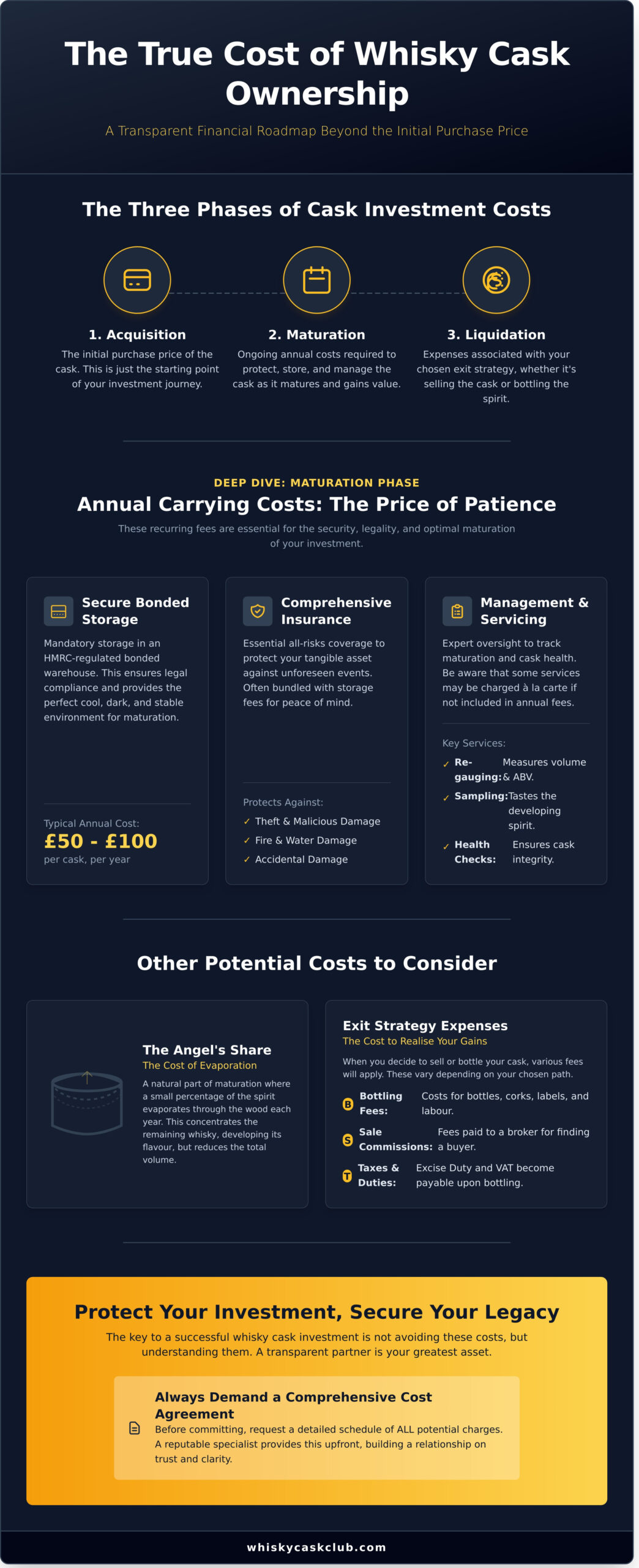
Embarking on a whisky cask ownership journey is to invest in a legacy of craftsmanship and provenance. While the initial acquisition price is the entry point, a discerning investor understands this is just the beginning. The true value of a premium Scotch whisky cask is cultivated over time, and this maturation process requires meticulous, professional stewardship. To navigate this landscape with confidence, one must deconstruct the full spectrum of costs, which we categorise into three distinct phases: acquisition, maturation, and eventual liquidation. A transparent partner will present these not as afterthoughts, but as integral components of a successful investment strategy.
What Are ‘Hidden Costs’ in This Context?
In the world of premium alternative assets, the term ‘hidden costs’ requires clarification. It does not refer to fraudulent fees—the hallmarks of a scam—but rather the essential operational expenditures required to protect and mature your investment. The true hidden costs of whisky cask ownership emerge not from the fees themselves, but from a lack of upfront disclosure. These are standard charges for critical services, including secure bonded warehousing, comprehensive insurance, and expert cask management.
The Importance of a Comprehensive Cost Agreement
A hallmark of a trusted and transparent partner is the provision of a comprehensive cost agreement. This is not merely a suggestion; it is a prerequisite for any serious investor. Before committing, you must request a detailed schedule of all potential charges, from annual storage and insurance to eventual bottling or sale commissions. A reputable cask specialist provides this document without hesitation, viewing transparency as the foundation of a long-term relationship built on trust and mutual success.
Annual Carrying Costs: The Price of Patience During Maturation
Once you acquire a premium cask, the initial purchase is only the beginning of your journey. The maturation process, where time and craftsmanship transform the new-make spirit, requires patience and professional oversight. Understanding the annual carrying fees is fundamental to navigating the hidden costs of whisky cask ownership. These recurring charges are not optional extras; they are the bedrock of a secure and legally sound investment, ensuring your tangible asset is protected and matures under optimal conditions. Bypassing these steps can expose investors to the significant hidden risks of whisky cask investments, including issues with legal title and fraud.
Secure Bonded Storage Fees
Your cask must legally be stored in an HMRC-regulated bonded warehouse. This is non-negotiable. A bonded warehouse is a secure facility where excise duty is suspended until the whisky is bottled or removed. This ensures regulatory compliance and provides the perfect environment—cool, dark, and stable—for maturation. Fees are typically charged annually per cask, with industry standards ranging from £50 to £100 per year, depending on the facility and cask size.
Insurance: Protecting Your Tangible Asset
A cask of rare whisky is a valuable, tangible asset that demands comprehensive protection. All-risks insurance is essential, providing financial security against unforeseen events. This coverage typically protects your investment from:
- Theft or malicious damage
- Fire and water damage
- Accidental damage during handling
In most professional management agreements, this insurance is conveniently bundled with your annual storage fees, offering seamless and complete peace of mind.
Management, Sampling, and Re-gauging Fees
Expert management is key to maximising your cask’s potential. This includes periodic health checks, most notably re-gauging. A re-gauge is a detailed assessment of the cask’s contents, measuring its volume and Alcohol by Volume (ABV) to track maturation progress and the ‘angel’s share’ (evaporation). Occasional sampling may also be desired to taste the developing spirit. While some brokers include one re-gauge in their annual fees, others may charge for these services on an à la carte basis, representing another of the potential hidden costs of whisky cask ownership if not clarified upfront.
The Angel’s Share: Accounting for the Cost of Evaporation
Within the silent, hallowed halls of a bonded warehouse, a quiet, almost poetic, process is constantly at play. This is the ‘Angel’s Share’—the small portion of whisky that evaporates through the oak cask during its long maturation. This is not a fee levied by a distillery or a broker; it is a natural, unavoidable cost of craftsmanship. As the spirit breathes, it matures, but a portion is offered up to the heavens. Understanding this volume reduction is essential for any serious investor looking to grasp the full spectrum of the hidden costs of whisky cask ownership.
Typically, a cask will lose approximately 2% of its volume per year in Scotland, though this rate is far from static. While this natural reduction is an accepted part of the maturation journey, it is critical to account for its financial impact. It’s one of several variables that contribute to the sobering truth about investing in whisky, where meticulous planning separates the connoisseur from the casual speculator.
How the Angel’s Share Impacts Your Investment
The primary impact of the Angel’s Share is on the final volume of your tangible asset. A lower volume directly translates to a smaller bottling yield, a crucial factor for one of the most popular exit strategies. Furthermore, your cask’s value is officially determined by its Regauged Litres of Alcohol (RLA). As the volume decreases, so does the RLA. However, this is balanced by a fascinating paradox: as the whisky ages and concentrates, its rarity and complexity grow, often increasing its value per litre at a rate that outpaces the volume lost.
Factors Influencing the Rate of Evaporation
The precise rate of the Angel’s Share is a delicate interplay of several environmental and physical factors. A discerning investor understands these nuances:
- Warehouse Environment: The location, temperature, and humidity of the bonded warehouse play a significant role. Warmer, drier conditions, often found higher up in a racked warehouse, will accelerate evaporation compared to the cooler, more stable environment of a traditional dunnage warehouse.
- Cask Size: The principle of surface-area-to-volume ratio is key. Smaller casks, such as barrels or quarter casks, expose more of the liquid to the wood, leading to a faster rate of evaporation and maturation than larger formats like butts or puncheons.
- Wood Provenance and Porosity: The type of oak (e.g., American versus European) and its unique grain structure influence how much the cask “breathes.” A more porous cask will naturally have a higher rate of evaporation.
Ultimately, the Angel’s Share is not a loss to be feared but a factor to be managed. It is the price of creating an exceptional and rare spirit—an integral part of building a legacy through whisky and a key consideration among the hidden costs of whisky cask ownership.
Exit Strategy Expenses: The Costs to Realise Your Gains
An intelligent investment journey requires meticulous planning, not just for acquisition and maturation, but for the final, crucial stage: liquidation. Converting your tangible asset into cash is the moment your legacy is realised, yet it comes with its own set of expenses. These final hurdles are often the most overlooked hidden costs of whisky cask ownership, and they can significantly impact your net return if not anticipated.
The path you choose to sell your cask will dictate the costs you incur. Discerning investors typically pursue one of three primary exit strategies: a private sale brokered on your behalf, a public auction, or the ultimate expression of ownership—bottling the spirit yourself.
Brokerage and Commission Fees for Cask Sales
Engaging a specialist broker provides access to a global network of buyers, ensuring you achieve a fair market price for your mature cask. For this service, brokers typically charge a commission, generally between 10-15% of the final sale price. It is imperative to clarify all terms upfront, including who is responsible for the costs of moving the cask from the bonded warehouse to its new owner, as these logistics fees can vary.
The True Cost of Bottling Your Cask
Transforming your liquid history into a collection of bottles is a rewarding path, but it is also the most complex and expensive. The costs extend far beyond the cask’s value and include:
- Statutory Charges: UK Duty (levied per litre of pure alcohol) and VAT on the total value.
- Production Costs: Fees for the bottling facility to disgorge, dilute, and bottle your whisky.
- Dry Goods: The cost of bottles, corks, capsules, and bespoke label design and printing.
- Logistics: Expenses related to packaging, shipping, and distribution.
Taxes and Duties: A Critical Consideration
In the UK, a whisky cask is often considered a ‘wasting asset’ and may therefore be exempt from Capital Gains Tax (CGT). However, this advantageous status ceases the moment the whisky is bottled and becomes a finished product. Understanding your tax liabilities is essential to avoid unpleasant surprises that erode your profits. These potential liabilities are among the most critical hidden costs of whisky cask ownership to consider. We strongly advise consulting a qualified tax professional to receive guidance tailored to your specific circumstances.
Factoring these exit costs into your initial ROI calculations is not just prudent; it is the hallmark of a serious investor. For a more detailed consultation on navigating these final steps, explore the curated services at the Whisky Cask Club.
Partnering for Transparency: How to Manage Cask Ownership Costs
Embarking on a whisky cask investment is a journey toward building a tangible legacy. As we have explored, its success hinges not just on the quality of the spirit, but on a clear understanding of the full financial commitment. Navigating the potential hidden costs of whisky cask ownership requires more than passion; it demands expertise and a trusted partner dedicated to your success.
The right partner transforms complexity into clarity. They provide a transparent framework that accounts for every variable—from warehousing and insurance to bottling and logistics—granting you the confidence to focus on the long-term appreciation of your rare asset. This is the cornerstone of a secure and rewarding investment.
Vetting Your Cask Partner
A prospective partner’s commitment to transparency is the most critical factor in your decision. A discerning investor should demand clear evidence of their expertise and integrity. Before committing, ensure you receive:
- Clear Fee Schedules: All potential costs, including management, storage, insurance, and re-gauging, must be documented upfront. There should be no ambiguity in their fee structure.
- Proven Exit Strategies: Inquire about their experience and network for liquidating casks, whether through private sale, auction, or independent bottling. Their expertise here is paramount to realising your return.
- Comprehensive Reporting: A reputable partner will provide regular, detailed updates on your cask’s location, condition, and maturation progress, including official warehouse reports and sample analysis.
The Value of a Managed Portfolio
A fully managed service is the definitive solution to mitigating risk and maximising potential. It is your primary defence against the unexpected hidden costs of whisky cask ownership. At Whisky Cask Club, our expert team handles all administrative and logistical burdens, from liaising with bonded warehouses to ensuring regulatory compliance, leaving you with the pure pleasure of ownership.
This level of professional oversight offers more than convenience; it provides strategic guidance. We help you make cost-effective decisions on maturation timelines and optimal exit points, ensuring your journey in building a legacy is both profitable and seamless. Ready to begin your journey with a partner committed to absolute transparency? Schedule a consultation with our specialists to discuss a curated investment strategy.
Building a Legacy on a Foundation of Transparency
Embarking on a whisky cask investment journey extends far beyond the initial acquisition. A truly successful portfolio is built upon a clear understanding of the full financial landscape—from annual carrying costs and the Angel’s Share to the final expenses of realising your asset’s potential. By partnering with a trusted advisor, you can confidently navigate the potential hidden costs of whisky cask ownership, transforming them from daunting unknowns into manageable, planned expenses.
Whisky Cask Club provides this essential clarity. With our expert portfolio management, exclusive access to premium, investment-grade casks, and secure storage in accredited Scottish bonded warehouses, we ensure your path is seamless and secure. We believe that a well-informed investor is a successful one, and our commitment is to provide the unparalleled expertise you deserve.
Take the next step in building your legacy with confidence. Request a private consultation to build your transparent cask portfolio. Your journey into the world of tangible, liquid luxury awaits.
Frequently Asked Questions
Are the profits from selling a whisky cask tax-free?
In the UK, a whisky cask is often classified by HMRC as a “wasting asset,” meaning profits from its sale can be exempt from Capital Gains Tax. However, tax legislation is complex and subject to individual circumstances and changes. We strongly recommend seeking professional advice from a qualified financial advisor to ensure full compliance and to understand the specific tax implications for your portfolio.
How much should I budget for annual storage and insurance fees?
As a prudent investor, you should budget for annual fees covering both secure storage and comprehensive insurance. These costs typically range from £50 to £100 per cask, per year. This essential service ensures your tangible asset is maintained in optimal, government-regulated conditions within a bonded warehouse, safeguarding its provenance and value throughout its maturation journey. This is a critical factor when considering the hidden costs of whisky cask ownership.
Can I avoid bonded warehouse fees by storing my cask myself?
No, this is not a viable option for an investment-grade cask. To defer excise duty and VAT, and to maintain its status as a tradable asset, your whisky must remain “in bond” at an HMRC-regulated facility. Removing the cask from this secure environment triggers immediate tax liabilities and significantly diminishes its provenance and resale value. Professional storage is a non-negotiable component of protecting your legacy.
What documentation proves my ownership and outlines my cost obligations?
Your ownership is legally confirmed by a Certificate of Title or a Delivery Order issued in your name by the bonded warehouse. This document specifies the unique cask number, distillery of origin, and fill date. Concurrently, your purchase agreement will meticulously detail all cost obligations, including annual management fees and any potential exit or bottling charges, providing complete transparency for your investment.
Does the ‘Angel’s Share’ differ between distilleries or cask types?
Yes, the Angel’s Share—the natural evaporation of spirit—is highly variable. It is influenced by warehouse temperature, humidity, and airflow, which can differ between locations. Cask type also plays a significant role; a smaller cask, such as a quarter cask, has a greater surface-area-to-volume ratio than a large sherry butt, resulting in a higher rate of evaporation, typically ranging from 1-2% annually.
Is it generally more profitable to sell the cask or bottle the whisky?
For the majority of investors, selling the cask to another collector, an independent bottler, or a blender is the more profitable exit strategy. This approach avoids the substantial costs associated with bottling, which include excise duty, VAT, bottling line fees, labelling, and distribution. While bottling creates a personal legacy, selling the cask as a whole typically preserves the asset’s premium value and maximizes financial return.