Your most valuable tangible asset is currently vanishing into thin air, and it is the best news your portfolio could receive. While a 2% annual loss of liquid might initially feel like a leak in your balance sheet, this natural evaporation is the literal price of prestige. You likely recognize the tension between preserving volume and pursuing the deep, oak-driven complexity that only time can provide. It is natural to feel a sense of unease when “invisible” losses appear to erode your potential profits, especially when the relationship between ABV and market value remains opaque.
This guide examines the angels’ share investment impact to reveal how this atmospheric exchange dictates the ultimate ROI of your whisky cask. You will discover a precise framework for calculating expected evaporation and gain the confidence to view this loss as a necessary investment in liquid quality. We will also detail the specific data points used to mitigate excessive loss, ensuring your legacy reaches its peak valuation before the spirit drops below the critical 40% ABV threshold. Understanding these mechanics transforms a simple physical loss into a calculated strategy for wealth preservation.
Key Takeaways
- Understand how the ‘Angels’ Share’-the natural evaporation of spirit-acts as a defining factor in both the rarity and the ultimate valuation of your cask.
- Learn to navigate the mathematics of maturation by distinguishing between OLA and RLA to accurately project the growth of your tangible assets.
- Discover how to master the angels’ share investment impact to avoid the 40% ABV ‘cliff’ and protect the legal integrity of your Scotch whisky.
- Explore why the temperate Scottish climate serves as a strategic guardian of your portfolio, balancing volume loss with an unparalleled concentration of flavor.
- Gain insight into our curated management approach, which utilizes accredited bonded warehouses to ensure your investment builds a lasting legacy.
What is the Angels’ Share and Why Does it Matter to Investors?
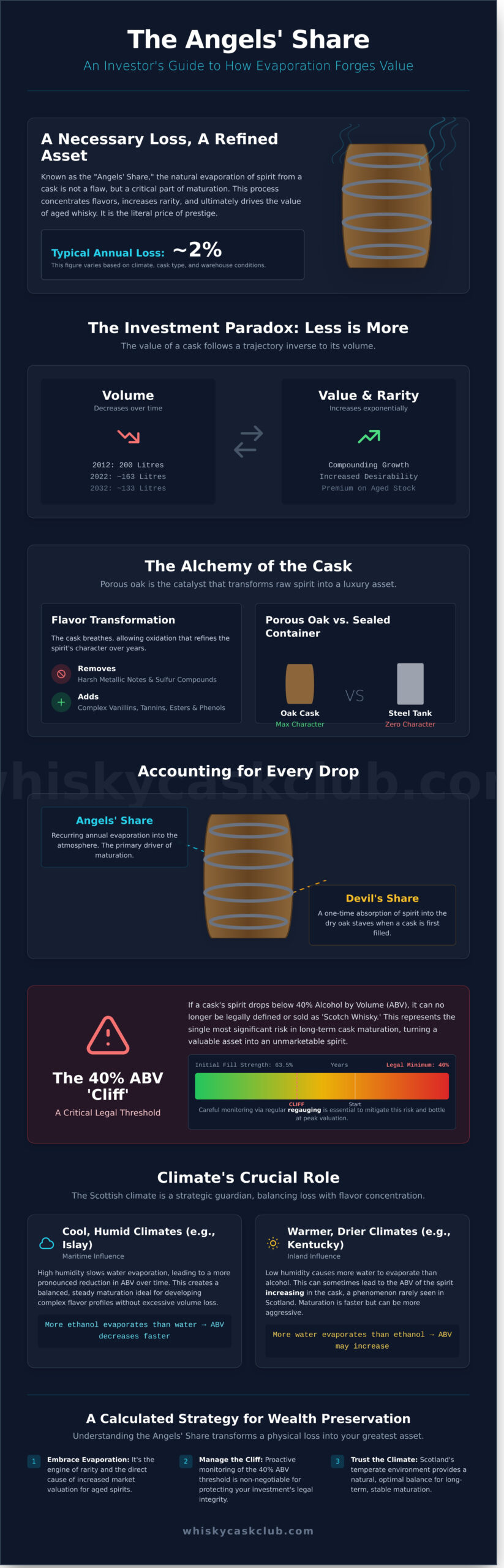
In the cool, damp climate of a traditional Scottish dunnage warehouse, a silent and inevitable transaction takes place. Every year, roughly 2% of a cask’s volume vanishes into the atmosphere. This natural evaporation of water and ethanol through the porous oak staves is known as the “Angels’ Share.” While 18th-century distillers viewed this loss with a sense of romantic mystery, the modern investor recognizes it as a critical metric of maturation. Understanding the What is the Angels’ Share? phenomenon is the first step in mastering the angels’ share investment impact on a private portfolio.
This loss isn’t a flaw in the process; it’s a refinement of the asset. As the liquid volume decreases, the rarity of the remaining spirit increases. A 200-liter American Standard Barrel filled in 2012 will contain significantly less liquid by 2032, yet its market value follows a steep upward trajectory. This inverse relationship defines the prestige of aged Scotch. You’re not just holding a commodity; you’re holding a concentrated essence of time and craftsmanship. The premium placed on older expressions exists because the “angels” have left so little behind for the rest of us.
The Alchemy of the Cask
Oak is a living, breathing medium. During the temperate Scottish summers, the wood expands; in the biting winters, it contracts. This rhythmic movement allows the spirit to interact with the surrounding air. This process of oxidation is vital for long-term value. It strips away harsh metallic notes and sulfur compounds found in new-make spirit, replacing them with the complex vanillins and tannins that define a world-class dram. If you stored whisky in a completely sealed, non-porous container like stainless steel, the result would be a flat, unmarketable product. The 100% retention of volume would result in a 0% increase in character. For the discerning investor, the porous nature of the cask is what transforms a raw spirit into a tangible luxury asset.
Angels’ Share vs. Devils’ Share
Distinguishing between these two forms of loss is essential for accurate asset management and financial forecasting. While the Angels’ Share refers to what evaporates into the air, the “Devils’ Share” describes the liquid absorbed into the wood fibers of the cask itself. When a fresh 500-liter Sherry Butt is first filled, the thirsty oak can absorb several liters of the initial volume almost immediately. This is a one-time “tax” taken by the wood, whereas the Angels’ Share is a recurring annual event.
These factors culminate in the “reguage,” a formal measurement of the cask’s current volume and alcohol strength. When you review your holdings, these measurements provide the data needed to assess the angels’ share investment impact on your projected returns. Investors should expect specific technical shifts over time:
- A gradual reduction in Alcohol by Volume (ABV) from the standard 63.5% filling strength toward the legal minimum of 40%.
- A typical annual volume loss of 1.5% to 2.5% depending on the specific warehouse microclimate.
- An increase in the concentration of esters and phenols that create a sophisticated flavor profile.
Owning a cask is a journey of patience. It’s a commitment to a process that cannot be rushed by modern technology. By embracing the natural loss of the Angels’ Share, you’re participating in a centuries-old tradition of excellence. You’re not just buying whisky; you’re building a legacy that gains value as it loses volume.
Variables Influencing the Rate of Evaporation
Owning a cask is a study in patience and precision. While the industry frequently cites a standard 2% annual loss as a rule of thumb, this figure is merely a starting point for sophisticated portfolios. It’s a baseline used for financial modeling, but it isn’t a guarantee. In reality, the actual angels’ share investment impact fluctuates based on a complex interplay of environmental and physical factors. A cask stored in a damp, coastal corner of Scotland might lose only 1.2% of its volume annually, while a cask in a drier, inland facility could see losses closer to 2.5%. These small percentages compound over decades, directly affecting the final yield and the rarity of the remaining spirit.
Geography and Microclimates
Geography dictates the rhythm of maturation. In the Highlands, the air is often cooler and drier, which can lead to a higher loss of water molecules, potentially increasing the alcohol by volume (ABV) even as the total liquid level drops. Conversely, Islay’s maritime climate offers high humidity levels, often averaging 80% year-round. This moisture keeps the oak staves hydrated and limits the volume of spirit escaping through the grain. The constant “pumping” effect, where the spirit moves in and out of the wood due to seasonal temperature shifts, is more gradual in Scotland’s temperate environment, allowing for a refined and elegant aging process.
Warmer climates like Kentucky lose volume much faster than Scotland because higher temperatures increase the kinetic energy of the spirit and cause the wood to expand and contract more aggressively, leading to annual losses of 5% to 10%.
The physical structure of the warehouse also plays a decisive role. Traditional dunnage warehouses, characterized by their thick stone walls and earthen floors, maintain a remarkably stable, cool, and humid environment. In contrast, modern racked systems stack casks up to eight levels high. In these facilities, temperature gradients can vary by 5 degrees Celsius between the floor and the roof. Understanding the Duty Implications of Evaporation is vital for any serious investor, as tax authorities recognize that a portion of the asset literally vanishes into the air during its journey to maturity. To see how these environmental factors influence our current inventory, you may browse our curated selection of premium casks.
The Wood Factor: Cask Quality and Type
The choice of timber is a primary driver of the angels’ share investment impact. American Oak (Quercus alba) is generally denser and less porous than European Oak (Quercus robur), which often results in a slower rate of evaporation. However, the history of the cask is just as important as the species of wood. A first-fill cask, which is being used for Scotch for the first time after its original contents are removed, has active, tight fibers. As a cask is reused, becoming a “refill” cask, the wood can lose some structural integrity and become more prone to micro-leaks if not properly maintained by a master cooper.
Sophisticated investors also pay close attention to the surface-area-to-volume ratio. A 250-liter Hogshead has significantly more wood contact per liter of spirit than a 500-liter Sherry Butt. This increased contact area doesn’t just accelerate flavor extraction; it also provides more opportunities for evaporation to occur. A Hogshead will typically lose a higher percentage of its volume than a Butt over the same period. Ensuring your asset is housed in a “tight” cask, meticulously inspected for stave density and hoop tension, is the best way to protect your long-term legacy from excessive loss.
The Mathematics of Maturation: Calculating the Investment Impact
Successful cask ownership requires a transition from viewing whisky as a simple liquid to analyzing it as a mathematical asset. The most critical distinction for any serious investor is the shift from Original Litres of Alcohol (OLA) to Regauged Litres of Alcohol (RLA). When you first acquire a cask, you’re purchasing the OLA, the volume of pure spirit initially filled into the wood. As the years pass, the angels’ share investment impact manifests as the liquid transitions into RLA, the actual volume remaining after evaporation and wood absorption. While the physical volume decreases, the intrinsic value of the remaining spirit undergoes a profound concentration of flavor and prestige.
Scholars from Ilmenau University of Technology developed an empirical economic model of whisky production that quantifies this annual 2% volume reduction as a fundamental variable in asset valuation. This loss isn’t merely a cost; it’s the price of excellence. As water and alcohol escape the cask, the remaining spirit interacts more intensely with the oak, accelerating the development of complex esters and phenols. This process leads to the “Value Inflection Point,” the specific moment in a cask’s lifecycle where the exponential increase in age-statement value far outpaces the linear rate of evaporation.
Projecting your volume retention is essential for building a multi-generational legacy. Based on a standard 2% annual loss, a 200-litre barrel will follow a predictable trajectory of scarcity:
- 10 Years: Approximately 163 litres (81.7% retention) remain, as the spirit enters its first peak of maturity.
- 20 Years: Approximately 133 litres (66.7% retention) remain, often doubling the price per litre compared to the 10-year mark.
- 30 Years: Approximately 109 litres (54.5% retention) remain, reaching the upper echelons of rarity where individual bottle prices skyrocket.
LPA: The Currency of the Whisky Trade
Professional investors don’t trade in bulk liquid; they trade in Litres of Pure Alcohol (LPA). This metric removes the variables of water content and focuses solely on the spirit’s strength. To calculate your LPA, you multiply the bulk volume of the cask by its current Alcohol by Volume (ABV). For example, a 200-litre cask at 63.5% ABV contains 127 LPA. Tracking this yield over a decade allows you to monitor the angels’ share investment impact with surgical precision. It ensures you’re measuring the true “engine” of your investment’s value rather than just the size of the container.
The Premium of Rarity
The marketplace rewards scarcity with aggressive premiums. A 25-year-old cask yielding only 150 bottles possesses a “Scarcity Multiplier” that a 10-year-old cask with 300 bottles cannot match. This natural supply-side squeeze is why ultra-aged single malts command record-breaking prices at auction. In 2023, data from leading auction houses showed that 30-year-old expressions from Tier 1 distilleries outperformed younger counterparts by over 400% in capital appreciation. The Angels’ Share acts as a built-in mechanism for rarity, ensuring that the longer you hold your asset, the more exclusive it becomes. You’re not just losing liquid; you’re gaining entry into an elite tier of the global whisky market.
Risk Management: The 40% ABV ‘Cliff’ and Duty Implications
The Scotch Whisky Regulations 2009 mandate a strict legal threshold for any spirit bearing the name of Scotland’s most famous export. To be legally sold as Scotch Whisky, the liquid must maintain a minimum bottling strength of 40% alcohol by volume (ABV). If a cask’s contents dip to 39.9%, the liquid instantly loses its protected status. It is reclassified as a “spirit drink,” a move that can trigger a value collapse of 80% or more. For the serious investor, this 40% mark is not just a number; it is a financial cliff edge that requires vigilant management.
Understanding the angels’ share investment impact means recognizing that maturity and proof often move in opposite directions. While time in the oak enhances flavor and prestige, the natural porousness of the wood allows ethanol to escape. In the damp, temperate climate of a traditional Scottish dunnage warehouse, alcohol molecules often evaporate more quickly than water. This gradual reduction in proof is the price of excellence, but it demands a strategic exit plan before the spirit reaches the danger zone.
Monitoring the ABV Threshold
In environments where relative humidity exceeds 70%, the concentration of alcohol in a cask typically declines over time. This is the standard reality for most bonded facilities in the Highlands and Speyside. When a rare cask approaches the 41% “red zone,” the window for a profitable exit begins to close. This data is the only way to quantify the angels’ share investment impact over the duration of your hold.
The Master Blender’s role at this stage is one of sensory and technical precision. They don’t just taste for profile; they analyze the rate of decline. If a 1995 vintage cask shows a sudden 1.2% drop in ABV over a single year, the blender may recommend an immediate bottling. This proactive “rescue” strategy ensures the whisky is captured at its peak proof, preventing a lucrative asset from becoming a low-value commodity.
We recommend a formal “reguage” every three years for casks under 15 years old, moving to annual checks for those approaching two decades of maturity. A reguage provides two vital metrics: the Bulk Liters (total liquid volume) and the Liters of Pure Alcohol (LPA). These figures are essential for calculating your future tax liabilities. As of August 2023, the UK Excise Duty rate sits at £28.74 per liter of pure alcohol. Knowing your exact LPA allows for precise net-return forecasting and prevents surprises when it comes time to settle with HMRC.
Storage and Insurance Protection
Every cask held through our club resides in an HMRC-approved bonded warehouse. These high-security facilities are legally required to track evaporation and volume for tax purposes, providing a transparent paper trail for your investment. While a standard 2% annual loss is expected and factored into your projections, mechanical failures or “leakers” can occasionally occur in older timber.
Insurance coverage is a non-negotiable component of sophisticated cask ownership. We ensure your asset is protected by specialist policies that cover “excessive loss” beyond the natural evaporation of the Angels’ Share. This provides a layer of security that standard property insurance cannot replicate, protecting your capital against the physical risks of long-term maturation.
Secure your portfolio by partnering with our experts for professional cask management services that prioritize asset health and legal compliance.
Building a Legacy: How Whisky Cask Club Manages the Angels’ Share
Managing a tangible asset requires more than just a purchase; it demands a stewardship that respects the natural chemistry of the spirit. At Whisky Cask Club, we view the 2% annual evaporation not as a loss, but as a calculated trade for complexity and value. Our curation team selects only the top 3% of available casks from premier distilleries, focusing on those with the structural integrity to endure long-term maturation. We prioritize First-fill Bourbon barrels and Sherry butts that provide the necessary oak influence to balance the angels’ share investment impact over a 10, 15, or 20-year horizon.
We operate exclusively within HMRC-approved bonded warehouses across Scotland, including high-security facilities in Speyside and the Highlands. These environments are strictly controlled to maintain the cool, damp conditions that slow evaporation and prevent the alcohol by volume (ABV) from dropping too rapidly. As your “Discreet Advisor,” we assume the technical burden of monitoring these variables. We track the humidity levels and temperature fluctuations so you don’t have to; ensuring your liquid remains a premium asset while it rests in the wood.
Timing is the final, most critical component of our management strategy. A cask that loses too much volume becomes a liability, while one bottled too early misses its peak valuation. We provide bespoke exit strategy advisory that analyzes the current market demand for specific age statements against your cask’s remaining liters. If a 250-liter Hogshead has reduced to 190 liters but reached a prestigious 18-year-old status, we help you determine if the price per liter justifies a sale or if further aging will yield a higher total return.
Professional Portfolio Oversight
Our management protocol includes reguaging every 3 years to precisely measure volume and ABV. We ensure your whisky never dips below the legal 40% threshold, which would strip it of its “Scotch Whisky” designation. By leveraging our network of 1,500+ private collectors and independent bottlers, we find the right buyer when your cask reaches its optimal maturation point. This meticulous oversight transforms a simple barrel into a multi-generational legacy.
Take the Next Step in Your Investment Journey
The difference between a hobbyist and a serious investor lies in professional management and verified provenance. Every cask in our curated list comes with a full paper trail and a guaranteed storage spot in an accredited warehouse. The angels’ share investment impact is a natural part of the journey, but with our expertise, it becomes a hallmark of quality rather than a risk. Join the Whisky Cask Club and begin building your legacy today to secure your piece of Scotland’s liquid history.
Master Your Liquid Legacy Through Strategic Maturation
Navigating the angels’ share investment impact requires a sophisticated blend of traditional reverence and modern financial precision. While the standard 2% annual evaporation rate is a natural part of the aging process, it’s the professional oversight that ensures your asset doesn’t fall below the critical 40% ABV legal threshold. You’ve seen how environmental variables dictate the pace of maturation and why proactive management is the only way to safeguard your capital. At Whisky Cask Club, we host your portfolio in HMRC-accredited bonded warehouses to maintain 100% regulatory compliance and optimal storage conditions. Our members enjoy exclusive access to rare casks from top-tier Scottish distilleries, ensuring every investment carries the weight of authentic heritage. We don’t just help you buy; we provide bespoke exit strategies for global investors to ensure your transition from owner to seller is seamless. It’s time to move beyond traditional markets and embrace a tangible asset with a proven history of excellence. Your path to a prestigious and secure future starts with a single cask.
Secure your tangible legacy with our exclusive cask opportunities
We’re ready to help you build something that stands the test of time.
Frequently Asked Questions
What is the average percentage of whisky lost to the Angels’ Share annually?
In the temperate Scottish climate, a cask typically loses 2% of its liquid volume every year to evaporation. This natural process is a fundamental requirement for the spirit to interact with the wood and develop its complex character. Over a 10-year maturation period, you’ll see a total volume reduction of approximately 20%. While the quantity decreases, the remaining liquid gains the sophistication and rarity that define a premium investment.
Can the Angels’ Share be prevented or stopped?
You can’t stop the Angels’ Share entirely because oak is a porous material that must breathe to mature the spirit. Distilleries manage these losses by maintaining humidity levels between 60% and 70% in traditional dunnage warehouses. While modern climate-controlled facilities can slow the rate of evaporation, halting it would prevent the chemical oxidation that creates a rare single malt’s flavor profile. It’s a necessary cost for building a liquid legacy.
Does the Angels’ Share happen in glass bottles as well as casks?
Evaporation doesn’t occur in glass bottles because glass is non-porous and provides a hermetic seal. Unlike a 200-liter oak cask, a sealed bottle prevents any exchange of air or liquid with the outside environment. Once your whisky is bottled, the angels’ share investment impact ceases completely. This stability makes bottled Scotch a static asset, whereas a maturing cask remains a living, breathing investment that evolves over time.
How does the Angels’ Share affect the price of a bottle of Scotch?
The Angels’ Share drives the price of Scotch higher by creating physical scarcity as the whisky ages. If a cask loses 30% of its volume over 15 years, the remaining 70% must account for the total cost of production, storage, and insurance. This is why a 25-year-old expression commands a premium price; there’s simply less of it left in the world. Investors value this diminishing supply as it guarantees the rarity of their tangible asset.
What is the ‘Devils’ Share’ and how does it differ from the Angels’ Share?
The Devils’ Share refers to the spirit absorbed into the wood of the cask, while the Angels’ Share is the portion lost to the atmosphere. During the first year of maturation, a new 200-liter cask can absorb up to 2% of the initial spirit. While the angels take their cut through the air, the wood claims its portion through the staves. Both factors are essential considerations when calculating the long-term angels’ share investment impact on your portfolio’s yield.
Is evaporation higher in different types of casks, like Sherry vs. Bourbon?
Evaporation rates vary by cask size and wood type, with 500-liter Sherry butts often losing volume more slowly than 200-liter Bourbon barrels. This happens because larger casks have a lower surface-area-to-liquid ratio, which reduces the contact point for evaporation. European oak used for Sherry is also typically denser than American white oak. You’ll find a Sherry butt might lose 1.5% annually, while a smaller Bourbon barrel loses closer to 2% in the same warehouse.
What happens to my investment if the ABV drops below 40%?
If the alcohol by volume (ABV) falls below the 40% threshold, the liquid can’t legally be labeled or sold as Scotch Whisky. This limit is strictly mandated by the Scotch Whisky Association to protect the heritage of the spirit. We monitor our clients’ casks meticulously to ensure they’re bottled or moved before this happens. Reaching 39% ABV would significantly diminish the marketability of your asset, as it loses its protected status and premium valuation.
How often should I regauge my cask to monitor the evaporation impact?
We recommend a formal regauge of your cask every 3 to 5 years to accurately track both volume and ABV. This process provides a certified report on the Liters of Pure Alcohol (LPA) remaining within the wood. For casks that have aged beyond 20 years, increasing this frequency to every 2 years is a prudent strategy. Regular data ensures your investment stays on a sophisticated trajectory and helps you decide the optimal moment to bottle your legacy.