In the world of alternative assets, few things carry the prestige of a maturing Scotch cask. Yet, as the market evolves toward 2026, the distinction between a secure legacy and a costly mistake has never been finer. For the discerning investor, the fear of “ghost casks” or navigating the labyrinth of HMRC regulations can often overshadow the passion for the spirit itself. To protect your capital and ensure the liquid inside the wood matches its promised provenance, you require more than just intuition; you need a rigorous whisky investment due diligence checklist that mirrors the standards of the world’s most elite private cellars.
This guide provides a professional-grade framework for auditing every cask offer that crosses your desk. We will demystify the complexities of legal title, physical verification, and the nuances of liquid valuation, replacing uncertainty with quiet confidence. By mastering this repeatable verification process, you secure not just a tangible asset, but a clear path to a profitable exit. Join us as we explore the essential steps to safeguard your financial future and build a legacy defined by both craftsmanship and pragmatic foresight.
Key Takeaways
- Secure your financial legacy by mastering the legal audit, ensuring every acquisition is backed by an irrefutable Delivery Order and verified WOWGR status.
- Discover how to interpret a Regauge Report to verify the true volume of your liquid, moving beyond original estimates to institutional-grade physical verification.
- Protect your tangible assets by utilizing the whisky investment due diligence checklist to audit HMRC-accredited storage facilities and “In Bond” security protocols.
- Develop a sophisticated exit strategy by evaluating the three primary routes to liquidity, ensuring your rare cask translates into a realized legacy.
- Elevate your portfolio from hobbyist collecting to professional-grade management through a meticulous verification process designed for the discerning investor.
Why Due Diligence is the Foundation of Whisky Cask Wealth
In the world of alternative assets, due diligence is the meticulous process of verifying the provenance, ownership, and physical integrity of an asset before capital is committed. For the discerning investor, this process is what separates a speculative gamble from a sophisticated wealth-building strategy. As we navigate the complex market dynamics of 2026, the industry has transitioned from casual hobbyist collecting to institutional-grade portfolio management. Today, securing a legacy requires more than just a passion for the spirit; it demands rigorous verification and absolute transparency.
A robust whisky investment due diligence checklist is the primary tool for mitigating risk. It ensures that when you invest in What is Single Malt Whisky?, you are acquiring a tangible asset with a verifiable heritage. In an era where digital certificates are common, the role of transparency remains paramount in building a portfolio that can be passed down through generations with confidence and pride.
The Anatomy of a Secure Cask Investment
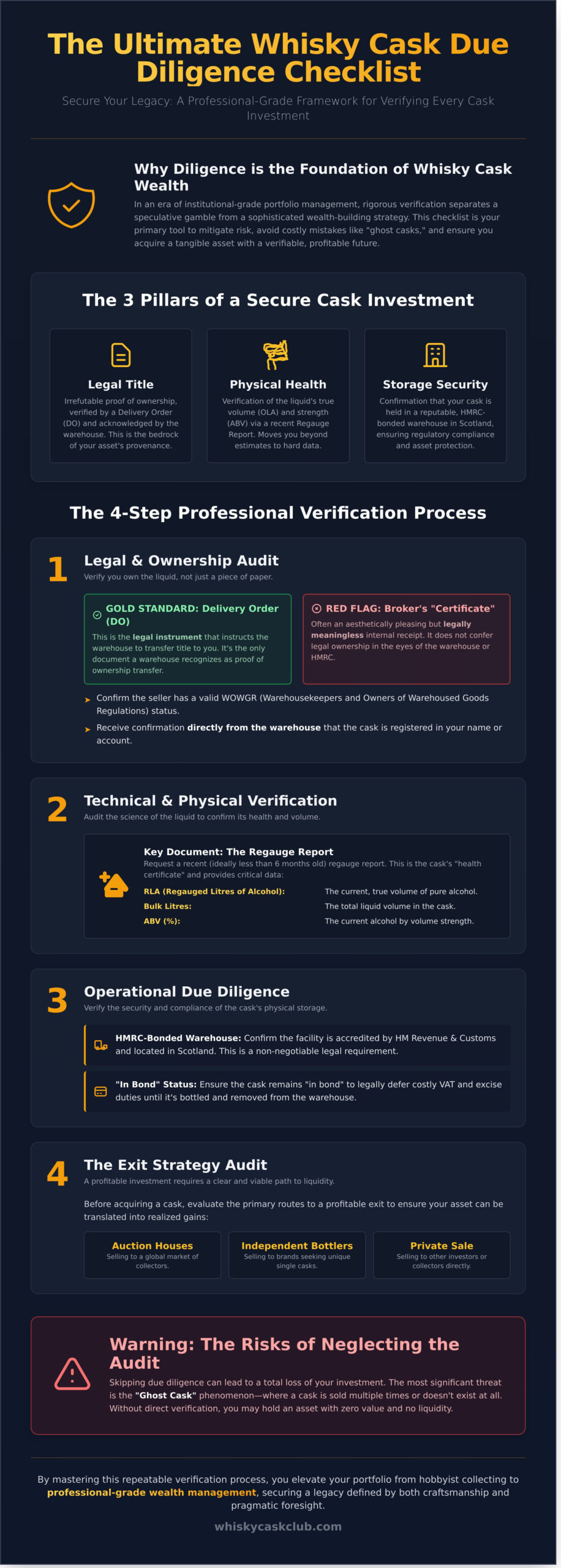
A secure investment rests upon three non-negotiable pillars: Legal Title, Physical Health, and Storage Security. To truly own your investment, you must ensure the transition from buying “paper”-mere promises of future value-to owning the actual liquid held in a government-bonded facility. Key considerations include:
- Legal Title: Verification of the Delivery Order (DO) or ownership via a Warehouse Keeper’s Warehouse Goods Receipt (WWC/WOWGR).
- Physical Health: Reviewing recent regauge reports to check the ABV (Alcohol by Volume) and OLA (Original Litres of Alcohol).
- Storage: Confirming the cask is stored in a reputable, HMRC-bonded warehouse in Scotland.
Investors should remain vigilant: “too good to be true” projected yields are often the first red flag in any audit. Authentic whisky maturation is a patient process, and any broker promising guaranteed, outsized returns without risk is likely overlooking the fundamental realities of the market.
The Risks of Neglecting the Audit
The consequences of skipping a whisky investment due diligence checklist can be devastating. One of the most significant threats is the “Ghost Cask” phenomenon-a situation where a single cask is sold multiple times to different investors, or worse, does not exist at all. Without verifying the paperwork directly with the warehouse, an investor may find themselves holding an asset with zero liquidity at the point of exit.
Improper documentation or lack of clear title can lead to a total loss of investment value, as reputable auction houses and independent bottlers will refuse to handle casks with murky provenance. Due diligence is the bridge between speculation and sophisticated investment.
The Legal & Ownership Audit: Verifying Title and Provenance
In the world of alternative assets, the allure of a rare spirit must be matched by the rigidity of its legal standing. A critical component of any whisky investment due diligence checklist is ensuring that what you “own” is recognized by the warehouse and the law, not just by your broker’s ledger. True provenance is the bedrock of a legacy, and it begins with a rigorous audit of title and registration.
Decoding the Paperwork: DOs vs. Certificates
Many first-time investors are lulled into a false sense of security by an “Ownership Certificate” issued by a broker. While aesthetically pleasing, these are often merely internal receipts. In the eyes of a bonded warehouse, the only document that matters is the Delivery Order (DO). This is the legal instrument that instructs the warehouse manager to transfer the title of the cask from the seller to the buyer.
To secure your tangible asset, you must ensure the warehouse acknowledges you as the legal owner. For those exploring Whiskey Casks for Sale: An Investor’s Guide, the step-by-step process of title transfer involves the broker submitting a DO to the warehouse, followed by the warehouse confirming the transfer into your name or an Ownership Lead Account (OLA).
HMRC Compliance and WOWGR Explained
The Scotch whisky industry is strictly regulated to protect its global prestige. All casks must be managed within the framework of The Scotch Whisky Regulations 2009, which mandates that the spirit remains “in bond” to defer excise duty and VAT. To trade or own these goods professionally, a broker must hold a WOWGR (Warehousekeepers and Owners of Warehoused Goods Regulations) certificate.
- Verify the Broker: Use UK government portals to cross-reference a company’s VAT number and WOWGR status.
- Distillery Records: A sophisticated investor should request a recent “dip” or warehouse receipt directly from the facility to verify the liquid matches the broker’s claims.
- OLA Access: Confirm if your cask is held in a sub-account that grants you ultimate control over the asset’s movement.
By incorporating these verification steps into your whisky investment due diligence checklist, you transform a speculative purchase into a secure, sophisticated investment. This meticulous attention to detail ensures that your path to building a legacy is protected by the full weight of UK law.
Technical & Physical Verification: The Science of the Liquid
To build a lasting legacy in alternative assets, one must look beyond the prestige of the distillery name and into the science of the cask itself. Verifying the technical health of your liquid is a non-negotiable step in any whisky investment due diligence checklist. This process transforms a speculative purchase into a secure, tangible investment by confirming exactly what resides within the wood.
The cornerstone of this verification is the Regauge Report. This document is the only definitive way to assess the current state of your asset. It highlights the critical transition from Original Litres of Alcohol (OLA)-the volume recorded at the moment of filling-to Regauged Litres of Alcohol (RLA), which accounts for years of maturation and the “Angels’ Share.” While a loss of 1.5% to 2% per annum is a sign of a healthy, breathing cask, any figure significantly higher may indicate structural flaws or poor environmental management.
Furthermore, the provenance of the vessel is as vital as the spirit. Whether the liquid is housed in an Ex-Bourbon barrel or a Sherry butt significantly dictates the flavor profile and, ultimately, your ROI. Rare wood types often command higher premiums upon exit, making a wood quality audit essential for long-term value projection.
Analyzing the Regauge Report
A sophisticated investor monitors Alcohol by Volume (ABV) trends with precision. If the ABV drops too close to the legal minimum of 40%, the liquid risks losing its classification as Scotch whisky, jeopardizing its rarity and value. Conversely, a steady, predictable decline suggests a well-managed maturation process. A cask’s market value is tied directly to its RLA, not its original fill volume. Always scrutinize the report for red flags such as “low fill” or “excessive leakage,” which can signal a failing asset.
The Importance of a Health Check
Physical verification provides the final layer of security for your portfolio. We recommend requesting recent, high-resolution photographs to inspect the integrity of the staves and hoops. For high-value acquisitions, a “pre-purchase” sample is essential; it allows you to verify the craftsmanship and profile of the spirit before committing. As part of a comprehensive whisky investment due diligence checklist, ensure the warehouse has conducted a recent dip-test to confirm the liquid levels match the regauge data, ensuring your investment remains as secure as it is prestigious.
Operational Due Diligence: Warehousing, Insurance, and Taxes
Operational excellence is the bedrock of a secure alternative investment. When refining your whisky investment due diligence checklist, the physical environment where your spirit matures is as vital as the provenance of the liquid itself. A cask is not merely a purchase; it is a developing legacy that requires a meticulously managed environment to reach its full potential.
The “In Bond” status is the gold standard for any serious investor. By keeping your cask in an HMRC-accredited bonded warehouse, you ensure the asset remains within a regulated ecosystem, deferring VAT and excise duty while guaranteeing the spirit’s authenticity. This professional oversight provides the quiet confidence required when building a high-value portfolio of tangible assets.
The Role of the Bonded Warehouse
To legally retain the name “Scotch,” the whisky must never leave the borders of Scotland during its maturation process. Beyond geography, you must verify that the warehouse maintains a rigorous internal ledger. Your due diligence should confirm that your ownership is clearly recorded via a Delivery Order or a Warehouse Warrant.
- Security: Facilities should feature 24/7 surveillance and strict access protocols.
- Costs: In 2026, a fair annual fee for storage and insurance typically ranges from £70 to £150 per cask, depending on the facility’s prestige and the cask size.
- Climate: The warehouse must offer the cool, damp conditions necessary to manage the “Angels’ Share” evaporation effectively.
Tax Efficiency and Asset Protection
Whisky casks offer a unique intersection of passion and pragmatism. In the UK, whisky is generally classified as a “wasting asset” because the spirit naturally evaporates over time. This classification often exempts the cask from Capital Gains Tax (CGT), making it an exceptionally tax-efficient vehicle for long-term wealth preservation. However, always consult with a professional tax advisor to confirm how these rules apply to your specific jurisdiction.
Protecting your investment also requires sophisticated indemnity. It is essential to secure “replacement value” insurance rather than “purchase price” insurance. As your whisky ages and its rarity increases, its market value will far outpace your initial outlay. Ensuring your policy reflects this appreciation is a critical step in any whisky investment due diligence checklist. For further details on safeguarding your portfolio, see our expertise on Secure Storage: Protecting Your Tangible Asset.
At the Whisky Cask Club, we believe that true luxury lies in peace of mind. By ensuring your cask is housed in a premier facility with robust protections, you are not just buying whisky-you are securing a legacy.
The Exit Strategy Audit: Ensuring Liquidity for Your Legacy
An investment is only as successful as its conclusion. While the romanticism of maturing Scotch is undeniable, a sophisticated investor views their cask as a tangible asset that must eventually be realized. As the final pillar of your whisky investment due diligence checklist, the exit strategy audit ensures that your legacy remains liquid and your returns are secure.
A reputable broker should demonstrate a proven track record of facilitating successful exits. When evaluating your options, consider these three primary routes:
- Private Sale: Selling to another private collector or a blender within an exclusive network often yields the highest net return by avoiding public fees.
- Auction: Utilizing global spirits auctions provides transparency and access to a competitive market of international connoisseurs.
- Independent Bottling: For those seeking the ultimate expression of their investment, bottling the liquid under a private label can offer significant margins, though it requires meticulous navigation of labeling and tax laws.
Exercise caution regarding “guaranteed buy-backs.” In a transparent, premium market, such promises can be a red flag, potentially masking a lack of genuine market access or inflated entry prices. Instead, focus on building a portfolio with diverse maturation dates. Staggering your “harvest” ensures that liquidity is available at strategic intervals rather than being tied to a single date.
The Whisky Cask Club Advantage
At Whisky Cask Club, we manage the entire due diligence lifecycle, allowing you to focus on the prestige of ownership. Our exclusive club provides a curated bridge between rare distilleries and a global network of buyers. By leveraging our deep industry heritage, we ensure your casks are managed with the same craftsmanship used to create the spirit, transforming a simple purchase into a multi-generational legacy.
Final Checklist: Before You Wire Funds
Before finalizing any transaction, perform this 5-minute sanity check to protect your capital:
- Verification: Has the distillery or warehouse confirmed the cask’s existence and your ownership via a Delivery Order (DO)?
- Transparency: Are storage and insurance fees clearly defined for the next five to ten years?
- The “Uncomfortable” Question: Ask your broker: “If I chose to sell this cask back to the open market tomorrow, what is the current bid-ask spread?”
Ownership of rare Scotch is a journey of patience and pragmatism. To ensure you have covered every technical and financial detail, download our full 2026 Due Diligence PDF Checklist before you commit your capital to the cask.
Securing Your Liquid Legacy: The Path Forward
As we look toward 2026, the distinction between a casual purchase and a strategic acquisition lies in the rigor of your approach. Success in this market demands a meticulous verification of provenance, a scientific understanding of the maturing spirit, and a clear-eyed strategy for eventual liquidity. By adhering to a robust whisky investment due diligence checklist, you transform a passion for fine spirits into a secure, tangible asset that honors both heritage and financial pragmatism.
The Whisky Cask Club provides the expertise required to navigate these complexities with absolute confidence. Our members enjoy exclusive access to premium Scotch distilleries, supported by HMRC-compliant bonded storage and comprehensive insurance. To ensure your long-term success, we provide a dedicated exit strategy advisory for all club members, guiding you from initial acquisition to a prestigious realization. Own the cask; own the liquid.
Secure your legacy with our expert-vetted cask portfolios. Contact the Whisky Cask Club today.
The journey of cask ownership is one of patience, prestige, and enduring value. We invite you to take the next step in building a legacy that matures as beautifully as the spirit itself.
Frequently Asked Questions
Is whisky cask investment regulated by the FCA?
Whisky cask investment is not currently regulated by the Financial Conduct Authority (FCA). As a tangible asset rather than a financial security, it falls outside their traditional remit. However, legitimate operators adhere to strict HMRC guidelines. When conducting your whisky investment due diligence checklist, ensure your provider operates within a WOWGR-licensed warehouse, which provides the necessary oversight for the storage and movement of duty-suspended spirits.
How do I know the cask actually exists in the warehouse?
Verification of your asset is paramount for peace of mind. Every cask is assigned a unique identification number and stored in a specific bonded warehouse. You should receive a warehouse receipt or a regauge report issued directly by the facility manager. This document confirms the cask’s location, the original volume of spirit, and the current alcohol strength, ensuring your rare liquid is exactly where it is claimed to be.
What happens to my cask if the broker goes out of business?
Your investment should be protected by clear legal title. If you hold a Delivery Order or are registered as the owner in the warehouse’s records, the cask is your private property, not an asset of the broker. In the event of a broker’s insolvency, your tangible asset remains secure within the bonded warehouse, allowing you to appoint a new manager or sell the cask independently to preserve your legacy.
Can I visit my cask in Scotland to perform my own due diligence?
Most reputable bonded warehouses allow owners to visit their casks by prior appointment. While these are working industrial sites with strict health and safety protocols, a visit offers a visceral connection to your investment. You can witness the craftsmanship of the oak and the serene environment where your spirit matures, providing ultimate confidence regarding the physical security and provenance of your premium Scotch whisky.
What is a ‘Delivery Order’ and why is it more important than a certificate?
A certificate is often merely a decorative document issued by a broker, whereas a Delivery Order (DO) is a legal instrument of title. The DO instructs the warehouse manager to transfer the ownership of the cask into your name. Without a DO or a direct account at the warehouse, you may lack legal proof of ownership, making it the most critical component of any whisky investment due diligence checklist.
How often should I request a regauge report for my investment?
We recommend requesting a regauge report every three to five years. This process involves measuring the Bulk Litres, Strength (ABV), and Litres of Pure Alcohol (LPA) currently in the cask. Frequent regauging is unnecessary and can lead to excessive evaporation-the “Angels’ Share”-but periodic checks are essential to monitor the maturation progress and the health of your liquid gold as it gains complexity.
Do I have to pay UK tax on my whisky cask gains?
Currently, whisky casks are classified by HMRC as a “wasting asset” because the spirit naturally evaporates over time. Consequently, they are generally exempt from Capital Gains Tax (CGT) for UK residents. This tax efficiency, combined with the potential for appreciation as the spirit matures, makes cask ownership a sophisticated choice for those looking to build a tax-efficient legacy through the acquisition of tangible luxury assets.
What is the biggest red flag to look for in a whisky investment company?
The most significant red flag is the promise of guaranteed high returns. In the world of premium spirits, no reputable advisor can guarantee future profits. Other warnings include a lack of transparency regarding warehouse locations or a refusal to provide a Delivery Order. A trustworthy partner focuses on the heritage and provenance of the cask rather than employing aggressive, high-pressure sales tactics that undermine the prestige of the craft.