In the world of premium Scotch, few names command as much reverence-and create as much frustration-as Springbank. You have likely encountered the elusive bottles, the formidable prices, and the quiet confusion surrounding the distillery’s three distinct styles: Springbank, Longrow, and Hazelburn. The hype is undeniable, yet the specific reasons behind its cult status can feel like a closely guarded secret. This mystique is central to the enduring legacy of the springbank distillery, a bastion of tradition in the historic whisky region of Campbeltown.
Consider this your exclusive guide. We will journey through the rich heritage and uncompromising craftsmanship that define this fiercely independent producer. You will discover why their traditional, 100% on-site production methods create a spirit of unparalleled quality and provenance. More than just a connoisseur’s dram, you will come to understand why Springbank is not only a benchmark for rarity but also a tangible asset with significant investment potential. Prepare to appreciate the substance behind the legend.
The Last Bastion of Campbeltown: A Legacy of Independence
In the world of premium Scotch, provenance is paramount. Few distilleries can claim a heritage as deeply rooted and fiercely independent as Springbank. To understand its exclusive character, one must first journey to its home: Campbeltown, a remote peninsula that was once the undisputed ‘whisky capital of the world’. Today, Springbank stands as a proud and solitary guardian of that formidable legacy, a testament to resilience, family, and an unwavering commitment to craftsmanship.
The Rise and Fall of Campbeltown Whisky
During the Victorian era, Campbeltown was a titan of industry, boasting over thirty active distilleries whose collective smoke plumed from a forest of chimneys. Its deep-water loch provided a direct route to global markets, and the region’s distinctive, robust spirit was in high demand. However, a perfect storm of 20th-century events-including American Prohibition, two World Wars, and a damaging shift by competitors towards quantity over quality-decimated the industry. One by one, the great whisky houses fell silent, and Campbeltown’s crown slipped. Through this catastrophic decline, Springbank endured, not by chance, but by choice, safeguarding the authentic, complex style that had made the region famous.
Five Generations of Unbroken Family Ownership
The secret to Springbank’s survival lies in its most defining feature: its independence. Founded in 1828, the springbank distillery remains in the hands of the original Mitchell family, making it the oldest independent family-owned distillery in Scotland. This unbroken chain of command, now in its fifth generation, is a profound rarity in an industry dominated by global corporations. The comprehensive Springbank Distillery history is a masterclass in long-term vision. While others chase quarterly targets, the J&A Mitchell family has the freedom to prioritise legacy over fleeting trends, ensuring that every decision serves the liquid first. This autonomy is the bedrock upon which its entire philosophy of traditional production is built.
This steadfast independence allows for a production ethos that is simply unfeasible under corporate ownership. It is a commitment not just to a brand, but to a heritage-a promise to preserve the methods and character that make its whisky one of the most sought-after tangible assets for collectors and investors alike.
The Craft of Scarcity: 100% On-Site Production
In an era defined by industrial scale and efficiency, the springbank distillery stands as a bastion of uncompromising tradition. It is one of Scotland’s very few remaining self-sufficient distilleries, a place where the entire whisky-making journey-from malting the barley to bottling the final spirit-is meticulously conducted on a single historic site. This unwavering commitment to heritage is a direct reflection of Springbank’s independent family ownership, which has preserved a hands-on production method devoid of computers, ensuring every drop is a product of pure, tangible craftsmanship.
The Art of Traditional Floor Malting
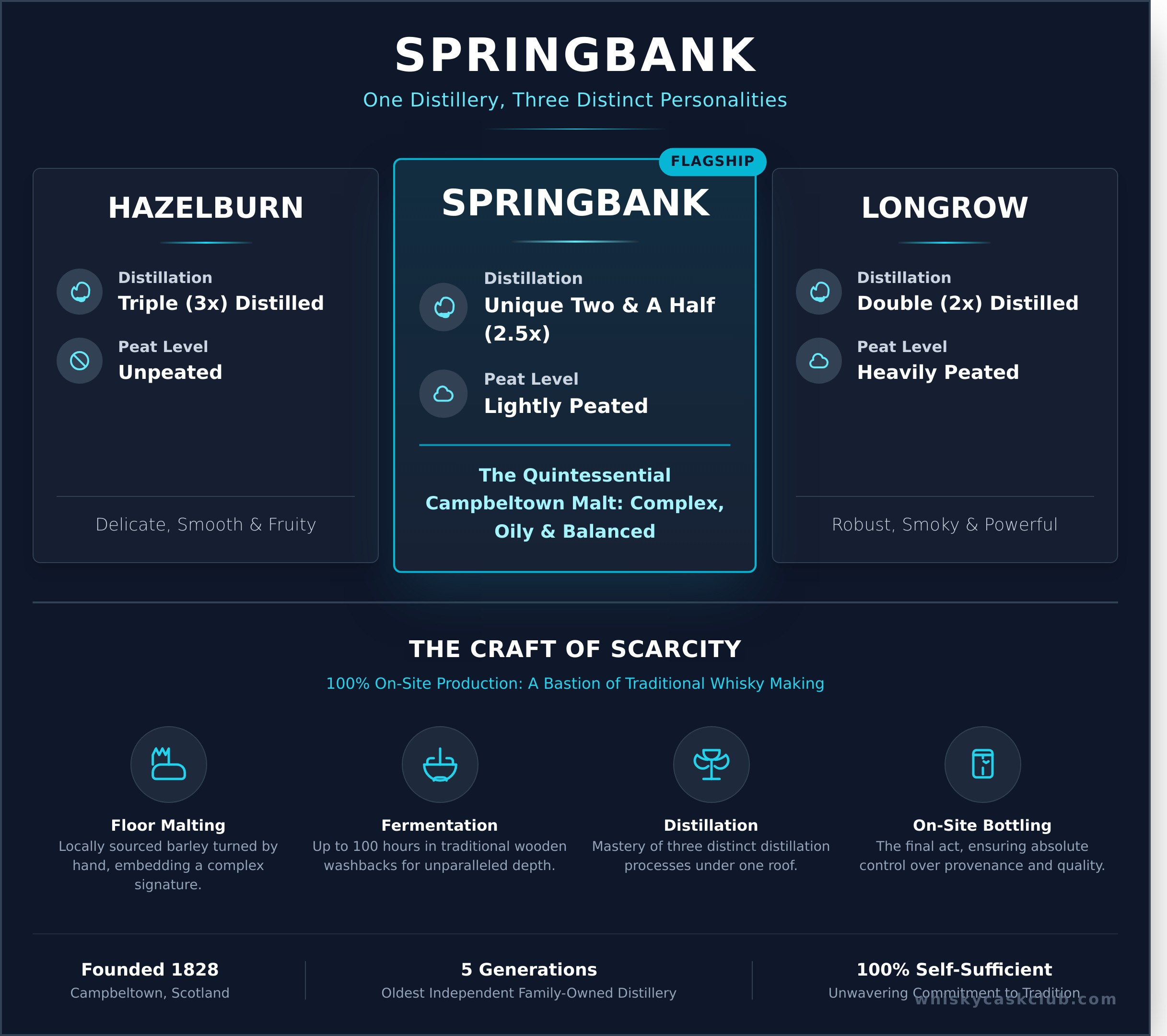
At the heart of Springbank’s unique character is the art of traditional floor malting, a practice largely abandoned by the industry in favour of efficiency. Here, locally sourced barley is steeped and spread across vast concrete floors to germinate. Skilled maltmen then turn the grain by hand with wooden shovels, or ‘shiels’, a rhythmic and physically demanding process. This intimate control over temperature and aeration is fundamental, directly embedding a complex, robust signature into the spirit that industrial methods cannot replicate.
Milling, Mashing, and Fermentation: The Old Way
This reverence for time-honoured techniques continues in the mash house and tun room. The distillery employs a vintage cast iron, open-topped mash tun and traditional wooden washbacks. These larch and pine vessels are crucial, as they harbour their own colonies of microflora that contribute unique notes to the fermenting ‘wash’. Springbank’s fermentation is exceptionally long, often lasting up to 100 hours. This patient process is vital for cultivating the rich tapestry of complex esters and flavour compounds that define the spirit’s remarkable depth.
On-Site Bottling: The Final Step in Quality Control
The final, defining act of this self-contained philosophy is bottling the spirit on-site. While most distilleries send their casks elsewhere for this crucial stage, Springbank ensures its liquid never leaves its care until it is sealed. This guarantees absolute control over the entire provenance, from the first grain of barley to the final numbered bottle. It is the ultimate assurance of quality and authenticity, cementing the legacy of a truly rare and complete Campbeltown single malt.
One Distillery, Three Distinct Personalities: The Springbank Malts
While most distilleries dedicate their entire operation to perfecting a single house style, the springbank distillery stands apart as a bastion of traditional craftsmanship. Under one roof, it produces three entirely distinct single malts, each with its own production method and flavour profile. This remarkable versatility is a testament to a mastery of craft that has cemented its status as one of Scotland’s cult malt whiskies. For the discerning investor, this presents a rare opportunity: the ability to build a diverse portfolio with three unique spirits, all originating from a single, highly coveted source of provenance.
Springbank: The Flagship Spirit
The distillery’s namesake malt is a masterclass in complexity. Produced using a unique ‘2.5 times’ distillation process and lightly peated barley, it strikes a perfect equilibrium. The resulting spirit is rich and oily, with a signature profile that balances maritime salinity, orchard fruits, and a delicate wisp of smoke. It is the quintessential Campbeltown malt and the heart of the distillery’s legacy.
Longrow: The Heavily Peated Powerhouse
First distilled in 1973, Longrow was created to prove that Campbeltown could produce a heavily peated whisky to rival those from Islay. It is double-distilled from heavily peated malt, resulting in a robust, smoky, and wonderfully oily spirit. Its powerful character offers a compelling asset for collectors who appreciate bold, phenolic whiskies, adding a different dimension of rarity to the Springbank portfolio.
Hazelburn: The Delicate Triple-Distilled Malt
Representing the lightest expression, Hazelburn is triple-distilled from entirely unpeated malt. This meticulous process, similar to that used for many Irish whiskeys, creates a spirit that is light, fruity, and exceptionally smooth. Its elegant and accessible profile, full of vanilla and honeyed notes, provides a sophisticated entry point into the distillery’s range while showcasing incredible finesse and maturation potential.
This trinity of styles is not merely a product line; it is a profound statement of skill and heritage. Each expression offers a distinct character and aging trajectory, making casks from the Springbank distillery a uniquely versatile and prestigious tangible asset for building a lasting legacy.
The Investment Case: Why Springbank Casks are a Premier Asset
While the romanticism of Springbank’s heritage is undeniable, its standing as a premier alternative asset is rooted in cold, hard economics. The very principles that make its whisky so revered-unwavering tradition, small-batch production, and uncompromising quality-are the same drivers behind its remarkable financial performance. For the discerning investor, Springbank represents more than a rare spirit; it is a tangible asset with a proven track record of significant appreciation.
The Economics of Scarcity and Demand
The foundation of Springbank’s value lies in its profound scarcity. With an annual production of just 750,000 litres-a mere fraction of what industry giants produce-the supply is permanently constrained. This limited output from the springbank distillery collides with an insatiable global demand from collectors and connoisseurs who prize its authenticity and provenance. This classic economic imbalance creates a powerful and sustained upward pressure on value, making every bottle and cask a coveted commodity.
Auction Performance and Market Trends
The secondary market provides clear evidence of Springbank’s blue-chip status. Bottles regularly shatter auction estimates, with rare expressions achieving world-record prices. A bottle of Springbank 1919, for example, fetched an astonishing £266,200 at auction, cementing its position in the highest echelon of collectible whiskies. This is not an isolated event but part of a consistent upward trend over the past decade, demonstrating robust and resilient growth that few other assets can match.
Building a Legacy with a Springbank Cask
While collecting rare bottles offers a glimpse into this appreciating market, owning a cask provides direct access to the source. Cask ownership is the ultimate way to secure this rare liquid as it matures, growing in both age and value year after year. As the spirit evolves within the oak, its character deepens and its worth compounds, transforming from a premium new-make into a highly sought-after aged single malt. This is an opportunity to cultivate a personal legacy and a uniquely rewarding portfolio. Inquire about securing a Springbank cask for your portfolio.
Springbank: A Legacy of Craftsmanship and a Future of Opportunity
Springbank’s position is not merely that of a distillery, but of a cultural icon-the last bastion of Campbeltown’s proud, independent whisky heritage. Its unwavering commitment to 100% on-site production is a masterclass in the craft of scarcity, creating a liquid of unparalleled character and inherent rarity. This unique approach, combined with its three distinct personalities of malt, is precisely why casks from the springbank distillery are considered a premier tangible asset. Owning a piece of this legacy is more than a financial decision; it is an acquisition of provenance, a stake in a story of resilience and uncompromising quality that continues to mature in value.
Translating this potential into a robust portfolio requires expertise and access. At Whisky Cask Club, we offer our members exclusive opportunities to acquire rare casks from iconic distilleries, guided by expert portfolio management and strategic advice. Your asset is secured in HMRC bonded warehouses, fully insured for your peace of mind. Discover the potential of owning a rare whisky cask. Request our investment guide. Begin your journey and build a legacy that will stand the test of time.
Frequently Asked Questions About Springbank
Why is Springbank whisky so difficult to find and expensive?
Springbank’s rarity stems from a deliberate focus on craftsmanship over volume. The distillery maintains traditional, labour-intensive methods, including 100% on-site floor maltings, which significantly limits production. This controlled, low supply, coupled with soaring global demand from connoisseurs who value its unique character, naturally drives its premium price. Each bottle represents a commitment to heritage, making it a sought-after commodity for collectors and enthusiasts.
What does Springbank single malt taste like?
The classic Springbank single malt taste is renowned for its remarkable complexity and robust character. It presents a signature Campbeltown profile, masterfully balancing a gentle, earthy peat smoke with distinct maritime and saline notes. This foundation is often complemented by layers of orchard fruits, vanilla, and a rich, oily mouthfeel. It is a dynamic dram that offers a different experience with every sip, a testament to the distillery’s meticulous process.
Is all Springbank whisky peated?
While the flagship Springbank expression is lightly peated, not all whisky from the distillery is. Springbank produces three distinct styles of single malt, each with a different peat level. The core Springbank is lightly peated, Longrow is a heavily peated and smoky spirit, and Hazelburn is triple-distilled and entirely unpeated. This versatility allows the distillery to showcase a remarkable range of character, all produced under one roof to exacting standards.
What is the difference between Springbank, Longrow, and Hazelburn?
The distinction lies in their production methods and peat levels. Springbank, the flagship, is lightly peated and uniquely distilled 2.5 times for added complexity. Longrow is a heavily peated, robust spirit that is double distilled in a more traditional Scottish style. In contrast, Hazelburn is completely unpeated and triple distilled, resulting in a lighter, more delicate, and sweeter single malt. Each represents a different facet of the distillery’s exceptional craftsmanship.
Who owns the Springbank distillery?
The Springbank distillery proudly remains one of the few independent, family-owned distilleries in Scotland. It is owned by J & A Mitchell & Co. Ltd., a company chaired by Hedley G. Wright, the great-great-grandson of the distillery’s founder. This continuous family ownership is central to its identity, ensuring that traditional values and an unwavering commitment to quality have been preserved for generations, safeguarding its esteemed legacy.
Can you visit the Springbank distillery in Campbeltown?
Yes, you can visit the iconic Springbank distillery for a tour and tasting experience. Located in the heart of Campbeltown, the distillery welcomes enthusiasts to witness its traditional production methods firsthand. Given its esteemed status and the intimate nature of the tours, it is highly recommended to book your visit well in advance to secure a place. It offers a rare opportunity to step inside one of Scotland’s most revered whisky-making institutions.
Why are Springbank casks considered a good investment?
Springbank casks are considered a premier investment due to the brand’s cult status, limited production, and sterling reputation for quality. The consistently high demand for both bottles and casks on the secondary market creates strong potential for appreciation. As a tangible asset with impeccable provenance from a family-owned distillery, a Springbank cask represents not just a rare liquid, but a secure store of value for discerning investors looking to build a legacy portfolio.