The allure of owning a piece of Scotland’s liquid heritage is undeniable, yet the path to ownership can seem shrouded in complexity and risk. This uncertainty often prevents discerning investors from confidently entering the market for a single malt scotch cask for sale, leaving aspirations of owning a truly unique, tangible asset unfulfilled.
This definitive 2026 guide from Whisky Cask Club is crafted to transform that uncertainty into confident action. We will demystify the entire journey, from understanding the nuances of valuation and provenance to the practicalities of sourcing, secure storage, and creating a strategic exit plan. We provide the clarity and expertise needed to navigate this exclusive world with precision.
Consider this your trusted roadmap to acquiring more than just an alternative investment. It is your opportunity to own a piece of craftsmanship, a moment in time, and the foundation for a lasting legacy.
Key Takeaways
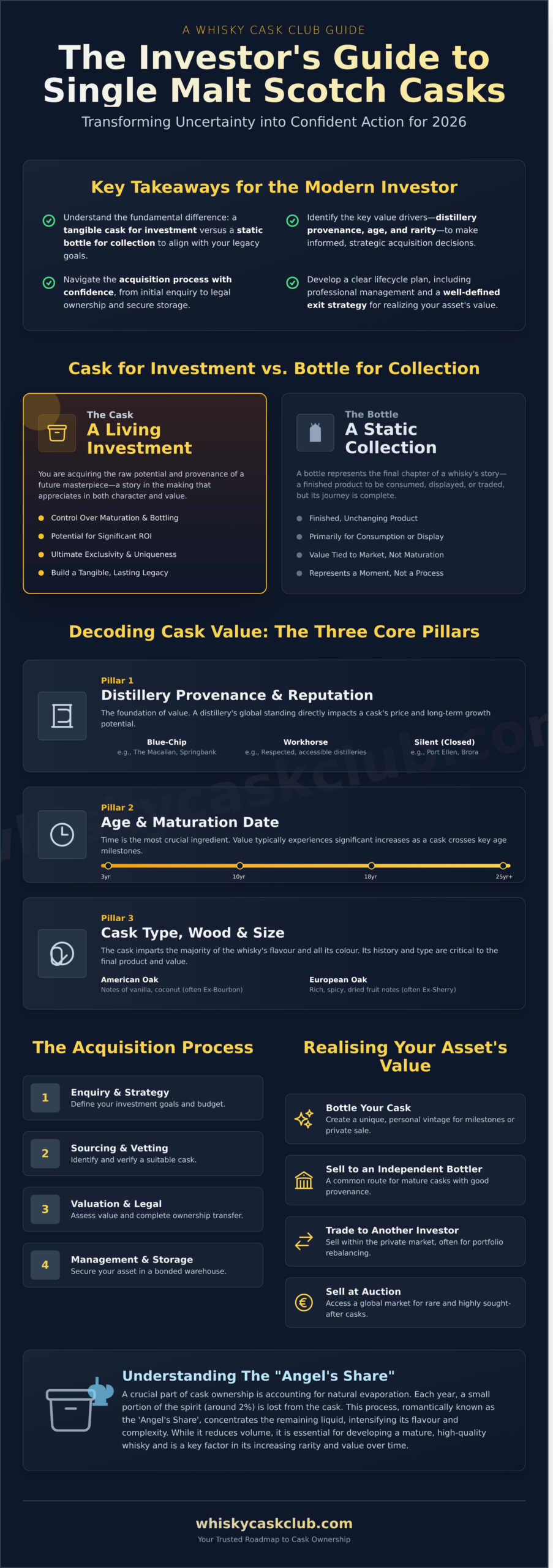
- Understand the fundamental difference between investing in a tangible cask and collecting individual bottles to ensure your acquisition aligns with your legacy goals.
- Learn to identify the key drivers of a cask’s value-including distillery provenance, age, and rarity-to make an informed and strategic investment.
- Navigate the acquisition process with confidence, from initial enquiry to legal ownership, when you find the right single malt scotch cask for sale.
- Develop a clear plan for the entire lifecycle of your asset, from professional storage and management to a well-defined exit strategy for realising its value.
Understanding Your Acquisition: A Cask for Investment vs. a Bottle for Collection
When you begin searching for a single malt scotch cask for sale, you are embarking on a journey fundamentally different from that of a bottle collector. A bottle represents the final chapter of a whisky’s story-a finished, static product to be consumed or displayed. A cask, however, is the story itself, a living, breathing asset that appreciates in both character and value over time. You are not purchasing a consumable; you are acquiring the raw potential and provenance of a future masterpiece. Own the cask. Own the liquid.
What Defines a ‘Single Malt Scotch’ Cask?
A single malt Scotch cask contains a spirit governed by strict legal and traditional definitions. The regulations defining what is single malt Scotch are famously precise, ensuring its quality and heritage. The spirit must be distilled from 100% malted barley at a single Scottish distillery and aged in oak casks for a minimum of three years. The cask itself is not a passive container; it is an active ingredient, imparting the majority of the whisky’s final flavour and all of its colour. It transforms the raw ‘new make spirit’ into the complex, golden liquid revered worldwide.
The Core Benefits of Owning the Entire Cask
Acquiring an entire cask offers a level of control and exclusivity that a bottle simply cannot match. It is the transition from enthusiast to investor, from consumer to custodian. The primary benefits of this unique form of ownership include:
- Control Over Maturation: As the owner, you guide the whisky’s destiny. You decide the precise moment of peak maturity, allowing you to bottle a spirit tailored perfectly to your palate or market demand.
- Potential for Significant ROI: Age and rarity are the twin pillars of a whisky’s value. As your spirit matures within the cask, its scarcity increases, creating a tangible asset with a proven history of appreciation.
- Ultimate Exclusivity: Your cask contains a liquid that is entirely unique. No two casks are identical. This is your personal vintage, a one-of-a-kind expression that can never be replicated.
- Building a Legacy: A cask is more than an investment; it is a tangible piece of craftsmanship to be passed down through generations or bottled to commemorate a significant milestone, creating a truly personal heritage.
How to Value a Single Malt Cask: Key Factors for Investors
Understanding the value drivers behind a premium single malt scotch cask for sale is paramount for any serious investor. The market value of this tangible asset is not arbitrary; it is a direct function of three core pillars: the distillery’s reputation, the liquid’s age, and the quality of the wood it matures in. Not all casks are created equal, and a discerning eye for these details separates a sound investment from a speculative one. This framework provides the essential knowledge needed to assess the true potential of a cask offering.
Distillery Provenance and Reputation
The story of a whisky begins at its distillery, and its provenance is the foundation of its value. ‘Blue-chip’ distilleries like The Macallan, Springbank, or Dalmore have a global reputation for excellence and command the highest prices due to consistent demand. Conversely, respected ‘workhorse’ distilleries offer excellent spirit at a more accessible entry point, perfect for building a diversified portfolio. For those seeking the pinnacle of rarity, casks from silent (closed) distilleries such as Port Ellen or Brora represent a finite and irreplaceable piece of whisky heritage, driving exceptional long-term growth.
The Influence of Age and Fill Date
Time is the most crucial ingredient in crafting both exceptional whisky and exceptional returns. A newly filled cask of new make spirit is significantly less expensive than one that has already matured for several years. For a spirit to be legally called Scotch, it must mature in oak casks in Scotland for a minimum of three years, a standard defined by the official Scotch Whisky Regulations 2009. As a cask crosses key age milestones-such as 10, 12, 18, and 25 years-its value typically experiences significant increases. However, the goal is peak maturation, as over-oaking can diminish the spirit’s quality and value.
Cask Type, Wood, and Size
The cask is not merely a container; it is the final, critical contributor to a whisky’s character, rarity, and value. Several factors are at play:
- Wood and Seasoning: Casks are typically made from American oak (imparting notes of vanilla and coconut) or European oak (delivering rich, spicy, and dried fruit flavours). The previous contents, most commonly ex-bourbon or ex-sherry, profoundly shape the final spirit.
- Fill Count: A ‘first-fill’ cask, used for the first time to mature Scotch, will impart the most intense flavour and is highly sought after. ‘Refill’ casks have a subtler influence and are valued differently.
- Size: Common sizes include American Standard Barrels (approx. 200 litres), Hogsheads (approx. 250 litres), and Sherry Butts (approx. 500 litres). Smaller casks offer a greater wood-to-spirit ratio, accelerating maturation, while larger casks yield more bottles upon exit.
The Acquisition Process: A Step-by-Step Guide to Buying Your Cask
Embarking on your whisky cask ownership journey is a significant step, one that transforms a passion for Scotch into a tangible, appreciating asset. The path from initial enquiry to legal ownership is a meticulously structured process designed to ensure transparency, security, and the complete provenance of your investment. Navigating this landscape with a trusted, expert advisor is paramount to success.
Step 1: Sourcing and Selection
Your journey begins with defining your investment objectives: your budget, desired timeline, and risk appetite. While casks can be found through auction houses or private sales, a managed service provides exclusive access to curated inventories from premium distilleries. A dedicated advisor helps align your goals with the perfect cask, ensuring the spirit’s character and maturation potential match your portfolio strategy. Request our latest stock list to see available casks.
Step 2: Due Diligence and Verification
This stage is critical for verifying the authenticity and condition of your chosen cask. A reputable broker will provide all necessary documentation for your review, safeguarding your investment. It is essential to understand the risks of whisky cask investment, as fraudulent listings for a single malt scotch cask for sale often lack this fundamental paperwork. Key documents include:
- Delivery Order: The original document from the distillery confirming the cask’s details.
- Certificate of Ownership: Proof of the current owner’s legal title.
- Re-gauge Report: A recent analysis confirming the exact volume of liquid and its Alcohol by Volume (ABV), which is crucial for valuation.
We also verify that the cask is securely stored in your name within a government-regulated bonded warehouse.
Step 3: Purchase and Transfer of Ownership
Once due diligence is complete, the final transaction is executed. Your payment covers the cask itself and the transfer of title. Our team manages the entire legal process, liaising with the bonded warehouse to ensure ownership is officially and irrevocably transferred to you. As the new legal owner, you will receive a new, personalised Certificate of Ownership. This document is your definitive proof of title for your unique single malt scotch cask for sale, representing a new chapter in your legacy.
Life After Purchase: Cask Management,Storage, and The Angel’s Share
The acquisition of your cask is a milestone, but it marks the beginning, not the end, of your investment journey. A common question from new owners is, ‘What happens next?’ The answer lies in meticulous, professional management-the silent, patient work that transforms new-make spirit into a rare and valuable tangible asset. This phase is where the true legacy of your investment is built.
The Importance of Bonded Warehousing
Your cask will spend its entire maturation life within a bonded warehouse. These are not mere storage units; they are highly secure, government-regulated facilities where your whisky can age gracefully. The primary benefit for an investor is financial: while your cask remains ‘in bond’, all UK excise duty and VAT are deferred. These taxes are only payable if you decide to remove the whisky from the warehouse for consumption in the UK. Furthermore, these warehouses provide the perfect environment-a consistently cool, dark, and damp atmosphere-essential for the slow, nuanced maturation that defines premium Scotch. At Whisky Cask Club, every cask we manage is fully insured against loss and damage, offering complete peace of mind.
Understanding Ongoing Costs and The ‘Angel’s Share’
Prudent investors understand that ownership includes modest ongoing costs. For complete transparency, you should anticipate an annual fee which covers both secure storage and comprehensive insurance. This is a minor expense designed to protect your valuable asset as it matures. During this time, a natural phenomenon known as the ‘Angel’s Share’ occurs.
- The Angel’s Share: This is the small portion of spirit-typically 1-2% per year in Scotland’s climate-that evaporates through the porous oak. Far from being a loss, this is a vital part of the aging process, allowing the spirit to breathe and concentrate its flavours.
- Periodic Sampling: To monitor your cask’s unique development, we offer the option for periodic sampling. This allows you to track the maturation and witness the spirit’s character evolve over time, a key part of the experience when you invest in a premium single malt scotch cask for sale.
Professional management is not an optional extra; it is the cornerstone of a successful whisky cask investment. It ensures the provenance, security, and optimal maturation of your spirit. The expert oversight provided by Whisky Cask Club is designed to safeguard your asset, allowing you to focus on the rewarding journey of building your liquid legacy.
Your Exit Strategy: How to Realise the Value of Your Cask
A prudent investment strategy always begins with the end in mind. While the maturation journey is one of patience, realising your asset’s value requires a clear and well-executed exit plan. Fortunately, the global demand for rare whisky ensures a liquid market when you decide to list your single malt scotch cask for sale. A full-service partner is essential in navigating this final, crucial step, providing exclusive access to the most lucrative exit channels.
The path you choose will depend on your personal goals, whether they are purely financial or a blend of passion and pragmatism. Here are the primary avenues for realising the value of your tangible asset.
Option 1: Selling the Cask to Another Investor
This is the most direct and common route to realising your investment. Your mature cask is offered to a curated network of private collectors, funds, and fellow investors seeking to acquire aged stock. As your trusted advisor, we manage this process discreetly, leveraging market data on distillery provenance and recent sales to secure the optimal value for your asset. It is a seamless transfer of ownership from one portfolio to another.
Option 2: Selling to an Independent Bottler
Independent bottlers are revered curators in the whisky world, constantly searching for exceptional casks to release under their prestigious labels. Selling to an independent bottler is a testament to the quality of your whisky. They seek out unique expressions and well-aged spirits that distilleries may not bottle themselves, making this a prime exit for a cask with distinctive character. We maintain strong relationships with these key industry players, connecting our clients directly to this exclusive market.
Option 3: Bottling Your Cask
For many, this is the ultimate goal: transforming your liquid asset into a personal legacy. You can bottle your whisky for a private collection, for milestone gifts, or for a small-scale private label. While this path offers unparalleled personal satisfaction, it is crucial to account for associated costs, including bottling, labelling, UK Duty, and VAT. This is less a pure ROI strategy and more the final, rewarding chapter of your ownership story. Speak with an advisor about building your own whisky legacy.
From Tangible Asset to Timeless Legacy: Your Next Chapter
Embarking on the path of whisky cask investment is to engage with a tradition of craftsmanship and astute financial planning. As we’ve explored, success lies in understanding valuation, navigating the acquisition process, and executing a clear exit strategy. When you invest in a single malt scotch cask for sale, you are acquiring more than just a spirit; you are curating a tangible asset with a story that matures with every passing year, building a legacy of exceptional value.
Navigating this exclusive market requires a trusted partner. At Whisky Cask Club, we provide discerning investors with unparalleled access to rare casks from world-renowned distilleries, secured in HMRC-regulated bonded warehouses and backed by expert portfolio management. We are here to guide your journey from initial acquisition to final sale, ensuring your investment is managed with precision and care. Begin your cask ownership journey. Enquire about our exclusive inventory today. Your legacy in liquid gold awaits.
Frequently Asked Questions
How much does a single malt Scotch cask cost to buy?
The entry point for a premium cask can begin around £2,000, but prices vary significantly based on the distillery’s prestige, the age of the new-make spirit, and the type of wood. A cask from a blue-chip distillery or a rare silent still will command a much higher price. Our curated portfolio offers a range of options to align with your specific investment goals, ensuring you find the right tangible asset to begin building your legacy.
Is investing in whisky casks a regulated financial activity?
Investing in whisky casks is not a regulated financial activity by bodies like the Financial Conduct Authority (FCA). This is why it is paramount to work with a reputable partner who provides transparency and expertise. We act as your trusted advisor in this alternative asset class, ensuring every step, from acquisition to maturation management, is handled with meticulous care and professionalism, safeguarding your investment and its provenance.
Can I visit and sample my cask while it is maturing in Scotland?
Absolutely. We believe that cask ownership is a deeply personal journey. We can arrange for you to visit the bonded warehouse in Scotland where your asset is securely maturing. During this exclusive experience, you can view your cask and, in most cases, draw a sample to appreciate its development. It is a unique opportunity to connect with the craftsmanship and heritage behind your investment, transforming it from a ledger entry to a tangible legacy.
What is the average holding period for a whisky cask investment?
While there is no mandated holding period, we typically advise clients to view this as a medium to long-term investment of at least 5 to 10 years. This allows the spirit sufficient time to mature, develop complexity, and appreciate in value. The most significant value increases often occur as the whisky approaches key age statements, such as 10, 12, or 18 years. Patience is integral to realising the full potential of this appreciating asset.
What are the tax implications when I sell my whisky cask?
In the UK, Scotch whisky is generally considered a ‘wasting asset’ by HMRC, meaning it is typically exempt from Capital Gains Tax upon sale. This tax efficiency is a significant advantage of cask investment. However, tax laws are complex and can change. We strongly recommend that all our clients seek independent financial advice from a qualified professional to understand the specific tax implications relevant to their personal circumstances and jurisdiction.
How do I know the cask I’m buying actually exists and is legitimate?
Verifying the existence and ownership of your cask is fundamental to our process. Upon purchase, you receive a certificate of ownership and a Delivery Order. This legal document, along with a unique cask number, proves your title to the cask stored in a government-regulated (HMRC) bonded warehouse. When searching for a single malt scotch cask for sale, this level of documentation is the ultimate assurance of its provenance and your secure ownership.
What happens if the distillery that produced my whisky closes down?
If the distillery that produced your whisky ceases production-becoming a ‘silent still’-the finite supply of its spirit often makes existing casks exceptionally rare and highly sought-after. This rarity can significantly increase the cask’s value and desirability among collectors and independent bottlers. This can represent a substantial opportunity for the cask owner, turning your tangible asset into a piece of liquid history with enhanced investment potential.