What if the most sophisticated shield for your capital in 2026 isn’t a line of code, but a physical barrel of maturing spirit? You’ve likely noticed your purchasing power quietly eroding while you search for secure alternative investments for wealth preservation that offer true stability. It’s a common frustration for the modern investor who feels over-exposed to the erratic swings of volatile tech stocks. You deserve more than digital abstractions; you deserve an asset with heritage and provenance. Own the liquid. Own the legacy.
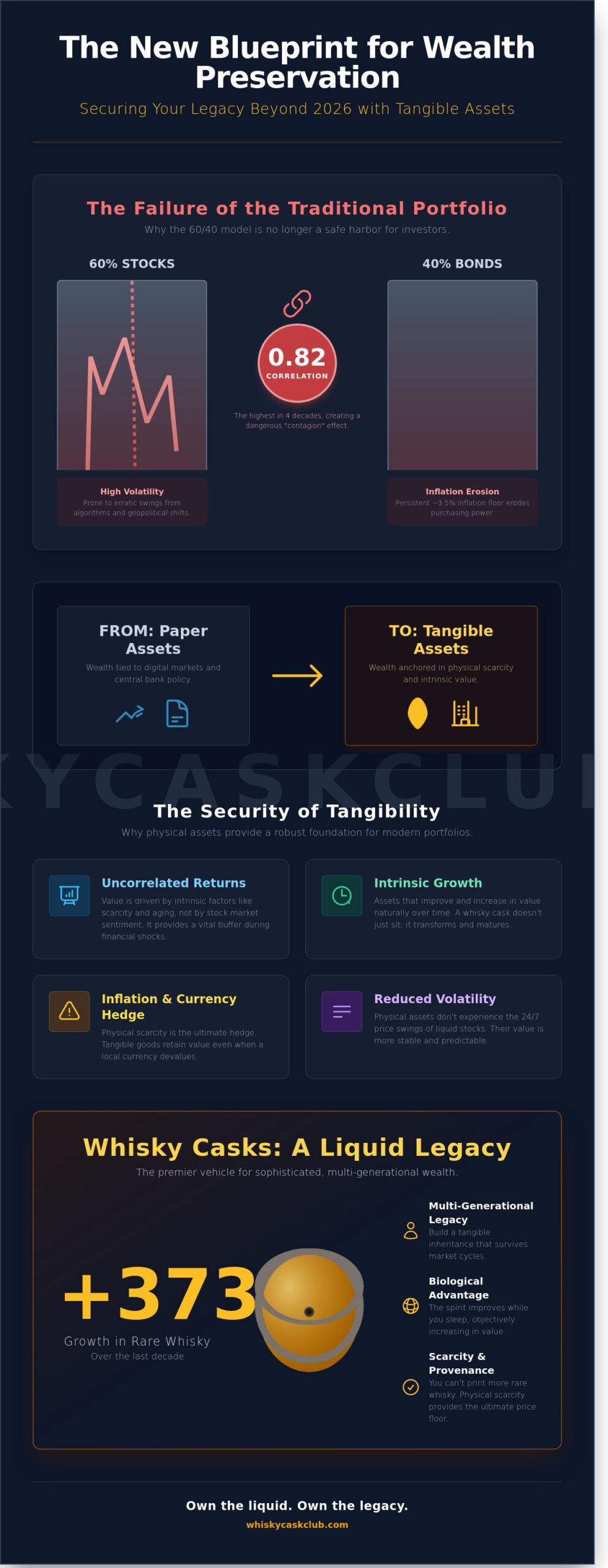
This guide reveals how maturing whisky casks provide a foundation for a multi-generational legacy that survives market cycles. We’ll examine the 373 percent growth seen in rare whisky over the last decade and outline exactly how to secure your place in this exclusive market. You’ll discover a path to portfolio diversification that balances the pragmatism of finance with the passion of the craft. By understanding the unique mechanics of cask ownership, you can transform your approach to wealth into a deeply personal journey of luxury and security.
Key Takeaways
- Recognize why traditional 60/40 portfolios are failing in the 2026 economy and how to transition toward more resilient, tangible asset classes.
- Learn how to identify secure alternative investments for wealth preservation by evaluating the intrinsic value and physical scarcity of hard assets.
- Compare the security and liquidity profiles of real estate and fine art to find the optimal balance for your private portfolio.
- Master a rigorous five-step due diligence process to effectively vet investment partners and ensure the provenance of your alternative holdings.
- Discover how the curation of rare whisky casks serves as a sophisticated vehicle for building a meaningful, multi-generational legacy.
The Evolution of Wealth Preservation: Beyond Traditional Assets in 2026
By January 2026, the global economy has settled into a “higher-for-longer” interest rate environment, with a persistent inflation floor near 3.5%. Investors no longer view wealth preservation as simply keeping pace with a benchmark index. It’s now a defensive strategy focused on capital retention and the mitigation of systemic risk. High-net-worth individuals (HNWIs) are increasingly pivoting toward secure alternative investments for wealth preservation to shield their legacies from the erosion of purchasing power. The traditional 60/40 portfolio, which failed to protect capital during the 2022-2024 volatility cycles, has lost its status as the gold standard of safety. Modern investors demand assets with intrinsic value that exist outside the reach of central bank policy and digital market fluctuations. There’s a renewed reverence for the “Safe Harbor” asset. This shift represents a move away from speculative growth toward defensive stability, where the goal isn’t just to grow wealth, but to ensure it remains intact for the next generation.
The Failure of Paper Diversification
Traditional diversification relies on the assumption that stocks and bonds move in opposite directions. Data from the 2024-2025 fiscal year showed a 0.82 correlation coefficient between public equities and fixed income, the highest level recorded in four decades. This synchronization creates a dangerous “contagion” effect; when one sector falters, the entire portfolio bleeds. Relying solely on paper assets means your wealth is tied to the whims of algorithmic trading and rapid geopolitical sentiment shifts. In 2026, the focus has shifted back to fundamental, intrinsic value. Many investors are exiting speculative tech and looking toward this Alternative Investment Overview to understand how private equity, rare commodities, and tangible goods provide a more robust foundation. You can’t print more rare whisky or manufacture more land, and that physical scarcity is the ultimate hedge against digital market contagion.
The Role of Uncorrelated Returns
True security comes from assets that don’t care what the stock market does on any given Tuesday. Uncorrelated returns are the cornerstone of modern wealth preservation. These investments derive value from internal factors like scarcity, biological aging, or production cycles rather than broad market sentiment. If the Nasdaq drops 15% in a single quarter, an uncorrelated asset like a maturing Scotch whisky cask or a private infrastructure project remains unaffected by the panic. This provides a vital “buffer” during systemic financial shocks, allowing the core of a portfolio to remain stable while public markets fluctuate. By incorporating secure alternative investments for wealth preservation, HNWIs create a multi-layered defense system.
- Reduced Volatility: Physical assets don’t experience the 24/7 price swings of liquid stocks.
- Currency Protection: Tangible goods often retain value even when the local currency devalues.
- Intrinsic Growth: Assets like whisky casks increase in value through the natural process of maturation, regardless of interest rate hikes.
The psychological shift toward owning what you can see and touch is profound. Collectors and investors now prioritize assets they can physically verify and hold in a bonded warehouse or a private vault. Ownership of a tangible, rare asset provides a level of prestige and security that a digital brokerage statement simply cannot match. It’s about building a legacy that survives the noise of the 2026 economy through craftsmanship, heritage, and patience.
The Security of Tangibility: Why Physical Assets Anchor Modern Portfolios
Digital markets often feel like illusions. One algorithm shift or a sudden flash crash can erase millions in perceived value within seconds. Physical assets offer a different reality. They exist in three dimensions; they occupy space and require physical storage. This presence provides a natural price floor because the asset itself possesses utility and inherent scarcity. For those seeking secure alternative investments for wealth preservation, tangibility isn’t just a preference; it’s a defensive strategy against the increasing abstraction of the financial world.
Hard assets like timber, fine wine, and rare spirits possess a unique biological advantage. They improve while you sleep. A 12-year-old Scotch doesn’t just sit in a warehouse; it transforms. The interaction between the spirit and the charred oak of the cask creates a product that’s objectively more valuable after a decade of maturation. This isn’t speculative hype. It’s chemistry. Data from the 2023 Knight Frank Luxury Investment Index shows that rare whisky has seen a 10-year price increase of 280%. This growth happens independently of the S&P 500 or the volatility of the tech sector.
Black Swan events, such as the 2008 financial crisis or the 2020 global shutdowns, expose the fragility of derivative-based portfolios. When the “paper” market freezes, physical ownership remains. You still hold the asset. Its value won’t drop to zero because its intrinsic worth is tied to its physical existence and rarity. It’s a method of opting out of the systemic risks that plague traditional banking systems.
From Gold to Casks: The Spectrum of Hard Assets
Gold is the traditional hedge, but it’s fundamentally static. It doesn’t grow or evolve. Productive tangible assets offer what we call “maturation alpha.” This is the specific value added by the passage of time and the craft of aging. A cask of single malt becomes rarer as its peers are bottled and consumed. This scarcity creates a powerful shield against currency devaluation. As the purchasing power of the dollar or pound fluctuates, the value of a finite, aging asset tends to rise in inverse proportion. It’s a way to build a legacy that survives inflationary cycles.
Ownership vs. Exposure
Owning a share in a commodity fund isn’t the same as holding a title. By 2026, market analysts predict a 15% increase in demand for direct asset ownership as investors move to eliminate counterparty risk. If a fund manager fails or a brokerage faces liquidity issues, your digital entry might become a liability. Direct ownership means you hold the deed, the warehouse receipt, and the legal title to the specific liquid.
Provenance is the cornerstone of these secure alternative investments for wealth preservation. Verifiable titles and documented storage histories ensure that your investment is legitimate and liquid. In an era where digital assets can be duplicated or deleted, the verifiable history of a physical cask offers a level of security that code simply cannot match. It’s the difference between owning a promise and owning the prize.
Evaluating the Safest Alternative Asset Classes for HNWIs
Preserving capital in 2026 requires a departure from the traditional 60/40 portfolio. Identifying secure alternative investments for wealth preservation involves looking beyond the volatility of public markets and focusing on assets with intrinsic, tangible value. Real estate has long been the default choice, yet rising property taxes and maintenance costs, often exceeding 3% of asset value annually, have thinned its margins. Fine art remains a prestigious option, but its 2023 market contraction of 4% reminds investors that subjective tastes can impact liquidity when an exit is required.
The “Goldilocks zone” of wealth preservation exists where physical security meets objective maturation. This is where high-value hobbies transform into strategic reserves. For the sophisticated investor, the goal isn’t explosive, speculative growth. It’s the steady, risk-adjusted return that outpaces inflation while remaining decoupled from the whims of central bank policies. While a tech stock can plummet overnight, a physical asset stored in a secure location retains its base value regardless of a digital market crash.
- Real Estate: Offers high security but suffers from high friction and ongoing tax burdens.
- Fine Art: Provides cultural prestige but requires expert authentication and faces high auction house fees.
- Whisky Casks: Combines the tangibility of real estate with the tax efficiencies of a portable commodity.
The Whisky Cask Advantage
Single malt Scotch is uniquely positioned as a “liquid” alternative because its value is tied to a biological and chemical process. Historical data from the Knight Frank Luxury Investment Index shows that rare whisky has seen a 280% increase in value over the last ten years, demonstrating resilience during the 2008 financial crisis and the 2020 global lockdowns. As the spirit breathes within its oak home, the natural evaporation known as the “Angel’s Share” reduces the volume by roughly 2% annually, creating a mathematical certainty of scarcity that drives value for the remaining liquid. This makes premium Scotch casks one of the most secure alternative investments for wealth preservation available to the modern connoisseur.
Comparing Storage and Maintenance Costs
Owning physical assets usually invites a logistical headache. Real estate demands constant attention to upkeep, tenant management, and local regulations. In contrast, whisky cask ownership is streamlined through the use of government-regulated bonded warehouses. These facilities, primarily located in Scotland and overseen by HMRC, provide a climate-controlled environment that’s virtually immune to the typical overheads of property ownership. There’s no VAT or excise duty due on the spirit while it remains “under bond,” which significantly lowers the cost of carry.
Insurance is the final pillar of security. Every HNWI must demand “all-risks” coverage that includes protection against fire, theft, and accidental damage. Most elite cask clubs utilize specialist insurers like Lloyd’s of London to underwrite these assets at their current market replacement value rather than the original purchase price. This level of protection, combined with the professional management of a bonded warehouse, ensures that your legacy remains intact while it quietly matures. It’s a sophisticated lifestyle choice that balances the passion of the collector with the pragmatism of the wealth manager.
Strategic Allocation: Implementing Alternatives without Compromising Security
Selecting secure alternative investments for wealth preservation requires a shift from speculative chasing to institutional-grade diligence. Sophisticated investors typically allocate between 15% and 25% of their total portfolio to tangible assets. This allocation isn’t arbitrary; it’s a calculated strategy used by family offices to hedge against currency devaluation and the 4.1% average inflation rate recorded in early 2024. True wealth preservation focuses on the return of capital as much as the return on capital. It’s about ensuring your purchasing power remains intact over decades, not just fiscal quarters.
A rigorous 5-step due diligence process serves as your primary defense. First, verify the partner’s WOWGR (Warehousekeepers and Owners of Warehoused Goods Regulations) status. Second, demand a regauge report dated within the last 180 days to confirm the bulk liters and alcohol strength. Third, cross-reference the cask’s unique identification number with distillery records. Fourth, audit the investment firm’s 2023 filed accounts to ensure they have the operational runway to support long-term holdings. Finally, ensure the transfer of title is executed via a legal Delivery Order. Vetting an investment partner means looking past the brochure and into their 2023 balance sheet to confirm they possess the liquidity to manage your assets through market cycles.
Government regulations provide the ultimate safety net for those seeking secure alternative investments for wealth preservation. In the United Kingdom, HMRC oversees the movement and storage of every drop of maturing spirit under Excise Notice 197. This level of oversight is comparable to the SEC’s role in traditional markets but with an added layer of physical security. You aren’t just buying a digital contract; you’re acquiring a deed to a physical commodity protected by national law and strict tax-compliance protocols.
The Bonded Warehouse System
Scottish bonded warehouses represent the global gold standard for asset security. These HMRC-regulated facilities are high-security environments where casks mature under tax-suspension. This system prevents fraud because the government tracks the provenance of every cask from the moment it leaves the still. Authenticity is guaranteed by a chain of custody that’s impossible to replicate in unregulated markets. The transfer of ownership is a formal, legal process that moves the asset into your name while it remains in this protected state, ensuring your legacy is guarded by the same standards as the world’s largest distilleries.
Exit Strategies and Liquidity
A secure investment is defined by how easily you can leave it. You’ve got to plan the exit before the entry. For Scotch whisky, a 5 to 10 year holding period is the benchmark to capture maximum maturation value. Liquidity is maintained through three primary channels: selling to independent bottlers, listing on specialized secondary exchanges, or private treaty sales to other club members. This flexibility ensures your tangible asset remains a liquid legacy for future generations. If you’re ready to build your portfolio, start your legacy with our exclusive cask opportunities today.
Whisky Casks: A Sophisticated Vehicle for Multigenerational Wealth
Whisky casks represent the ultimate legacy asset. They possess a unique characteristic that most financial instruments lack: they improve with age. While a currency might devalue or a company might fold, a cask of single malt Scotch physically matures. It develops complexity and value as the spirit interacts with the oak. This biological appreciation makes them exceptional secure alternative investments for wealth preservation. According to the Knight Frank Luxury Investment Index 2023, rare whisky has outperformed many traditional asset classes over a ten-year horizon, showing a 280% increase in value.
The Whisky Cask Club approach balances clinical financial pragmatism with the deep-seated passion of a connoisseur. You aren’t just buying a commodity; you’re securing a piece of Scottish heritage. This transition from investor to curator defines the experience. You hold a tangible asset that’s stored in government-bonded warehouses, insured, and protected by strict HMRC regulations. It’s a secure, private, and prestigious way to move capital across generations. For families seeking secure alternative investments for wealth preservation, the physical nature of the cask offers a hedge against the volatility of digital markets.
The journey of cask ownership is deeply personal. It begins with the selection of a spirit based on its provenance and ends with a legacy that can be bottled or traded. Many of our members find that the pride of owning a rare Macallan or Bowmore cask provides a level of satisfaction that gold bars or REITs simply cannot match. It’s about owning the craft, the history, and the liquid itself.
Building Your Legacy with The Whisky Cask Club
We provide our members with exclusive access to the world’s most prestigious distilleries. This includes rare allocations from icons like Springbank, Glenfiddich, and Highland Park. Our team manages the entire lifecycle of your investment to ensure maximum security and growth. Our comprehensive management includes:
- Direct Sourcing: We secure “new make” spirit directly from distilleries, ensuring pristine provenance.
- Secure Maturation: Casks are stored in HMRC-regulated bonded warehouses with full insurance and climate control.
- Portfolio Strategy: We offer a personalized approach, tailoring your cask selection to match your long-term wealth goals.
- Exit Advisory: Whether you choose to sell to a private collector, auction the cask, or bottle it for your private cellar, we manage the transition.
As of 2024, our portfolio strategies are tailored to individual risk profiles, focusing on rarity and scarcity to ensure long-term capital protection. We don’t just find casks; we curate collections that reflect the unique tastes and ambitions of our members.
Ready to Own the Liquid?
Joining the Whisky Cask Club means entering an elite circle of global collectors and investors. You’re no longer watching numbers on a screen; you’re owning a physical asset that gains character every year it rests in the wood. It’s time to diversify your portfolio with a tangible asset that carries both history and high growth potential. Take the first step toward securing your family’s financial future through the art of Scotch. Speak with a Whisky Cask Club Advisor today to begin your journey into the world of rare spirits.
Secure Your Financial Legacy Beyond 2026
The financial landscape of 2026 demands a departure from volatile digital markets toward the enduring security of tangibility. High-net-worth individuals are increasingly pivoting to assets with deep-rooted heritage and physical presence. You’ve discovered how secure alternative investments for wealth preservation provide a necessary shield against inflationary pressures and market instability. By focusing on physical casks, you’re protecting capital through an asset that appreciates with age.
Your portfolio deserves the protection of accredited Scottish bonded warehouses, where each cask matures under strict HMRC-regulated conditions. This isn’t just a financial move; it’s an entry into an elite circle of connoisseurs. You gain exclusive access to rare, investment-grade single malt casks that remain out of reach for the general public. Our advisors provide meticulous guidance on exit strategies, including private sales and bespoke bottling options. Don’t leave your family’s future to the whims of a screen. Own the liquid. Own the legacy. Start your journey toward a secure whisky legacy with the Whisky Cask Club and anchor your wealth in the quiet excellence of Scotland’s finest distilleries. It’s time to build something that lasts for generations.
Frequently Asked Questions
What makes an alternative investment “secure” for wealth preservation?
A secure alternative investment for wealth preservation relies on tangible asset backing and low correlation to volatile stock markets. Physical assets like Scotch whisky casks have shown a 10 year capital appreciation of 373 percent according to the 2023 Knight Frank Luxury Investment Index. This stability provides a hedge against currency devaluation. You aren’t holding a digital entry; you own a physical barrel of maturing spirit held in a bonded warehouse.
How do whisky casks compare to gold as an inflation hedge?
While gold is a traditional safe haven, whisky casks offer the unique advantage of biological appreciation as the spirit matures. Gold prices fluctuate based on geopolitical sentiment, but a 12 year old Macallan naturally gains value as it becomes an 18 year old expression. Between 2013 and 2023, rare whisky outperformed gold by over 200 percent. It’s a pragmatic choice for those seeking a legacy asset that improves with time.
Is it possible to lose money on a whisky cask investment?
Loss can occur if you ignore the “Angels’ Share” or fail to verify provenance through a Delivery Order. Approximately 2 percent of the liquid evaporates annually. If a cask leaks or the distillery’s reputation falters, value may dip. However, 95 percent of investment grade casks are stored in government regulated bonded warehouses to mitigate theft or damage. Working with an exclusive club ensures your portfolio consists of verified, high quality spirit.
How is the ownership of a whisky cask legally verified?
Ownership is legally verified through a Delivery Order (DO) issued by the HMRC bonded warehouse. This document confirms the transfer of title from the seller to the buyer. In the UK, the WOWGR regulations ensure that every cask has a unique identification number tracked in a centralized ledger. You’ll receive a certificate of ownership that details the cask type, distillation date, and original literage of pure alcohol to ensure your legacy.
What are the insurance requirements for high-value alternative assets?
High value assets require specialized insurance that covers the full replacement value against fire, theft, and accidental damage. Most bonded warehouses include basic insurance in their storage fees, which typically cost around 50 pounds sterling per year. For premium casks worth over 50,000 pounds, we recommend additional private coverage. It’s a necessary step to ensure your tangible wealth remains protected throughout the 10 to 20 year maturation cycle.
Can I sell my alternative investment quickly if I need liquidity?
Whisky casks are considered illiquid assets and typically require a 3 to 6 month window for a successful exit. While you won’t find the instant liquidity of a public stock exchange, the secondary market for rare Scotch has grown by 20 percent annually since 2018. You can sell via private treaty, specialized auctions, or through our exclusive buy back programs. It’s an investment built for patience and legacy, not daily trading.
How does the current 2026 economic climate impact alternative asset valuations?
The 2026 economic climate, characterized by a projected 3.5 percent global inflation rate, makes secure alternative investments for wealth preservation increasingly attractive. Investors are shifting capital away from traditional bonds into rare spirits and fine art to avoid purchasing power erosion. As central banks maintain higher interest rates, the scarcity of aged 18 to 30 year old Scotch creates a supply squeeze. This demand drives valuations higher for those holding premium inventory.
Why is Scotch whisky considered more secure than other spirits for investment?
Scotch whisky is uniquely secure because it’s governed by the Scotch Whisky Regulations 2009, which mandate strict production and labeling standards. This legal framework protects the “Scotch” name in over 100 countries, ensuring global demand and authenticity. Unlike bourbon or gin, Scotch has a centuries old heritage and a proven secondary market. It’s a sophisticated asset class that combines the craft of the Highlands with robust financial protection.