In the pursuit of a lasting legacy, the path often leads beyond traditional stocks and bonds into the exclusive world of tangible assets. Yet, this landscape is where the line between a rare opportunity and a ruinous scheme can seem impossibly fine. The fear of opaque valuations, unclear exit strategies, and outright fraud are the very heart of unregulated investments risks. For the discerning investor, however, these challenges are not insurmountable barriers; they are simply variables to be managed with expertise and foresight, separating a portfolio of distinction from one of disappointment.
This guide is crafted for that very purpose. We will demystify the world of alternative assets, providing you with a robust framework to identify, evaluate, and ultimately mitigate these risks. You will learn to distinguish true craftsmanship from fleeting promises and gain the clarity needed to invest with confidence. Prepare to build a secure, high-value legacy, anchored not by speculation, but by a profound understanding of the tangible assets you choose to acquire.
Key Takeaways
- Discover why sophisticated investors strategically enter unregulated markets to seek higher returns and true portfolio diversification.
- Learn to identify the core unregulated investments risks, including counterparty failure and the challenge of accurate asset valuation.
- Understand the critical distinction between “unregulated” and “unprotected” to see how certain tangible assets offer security.
- Utilise a practical due diligence checklist to confidently assess alternative assets by verifying crucial details like provenance and physical custody.
Understanding the Landscape of Unregulated Investments
Unregulated investments are assets operating outside the direct oversight of central financial bodies like the Financial Conduct Authority (FCA) or the Securities and Exchange Commission (SEC). For the discerning investor, this is not a red flag but an entry point to a world of exclusive opportunity. Sophisticated individuals seek these spaces for compelling reasons: the potential for higher alpha, genuine portfolio diversification, and a connection to assets with tangible worth. This represents a crucial psychological shift-moving from a reliance on institutional trust to a more profound confidence in asset-based trust, where value is intrinsic and directly owned.
It is vital to distinguish these legitimate markets from illegal schemes. The absence of a central regulator does not equate to a lawless environment. Instead, it signifies a different framework for diligence and expertise. Understanding and managing unregulated investments risks begins with recognising that you are operating in a specialist field, not an illicit one. The focus shifts from regulatory safety nets to the provenance, scarcity, and inherent quality of the asset itself.
The Rise of Alternative Tangible Assets
For those building a modern legacy, traditional stocks and bonds are often no longer sufficient. A new frontier of wealth preservation has emerged through tangible assets like fine wine, art, and rare cask whisky. This type of alternative investment offers a powerful advantage: its value is intrinsic to the physical object, not tied to a digital derivative or market sentiment. You own the cask. You own the liquid. This direct ownership provides a unique layer of security and prestige.
Why Regulation Lags Behind Innovation
Legislative bodies naturally move at a more deliberate pace than market innovation, particularly in highly specialised asset classes. While this can create a perception of a “Wild West,” this reputation is often outdated. Mature niches, such as the premium whisky cask market, are governed by robust industry standards, centuries of heritage, and transparent self-regulation. Expert guidance becomes paramount, transforming perceived unregulated investments risks into a well-navigated and rewarding journey.
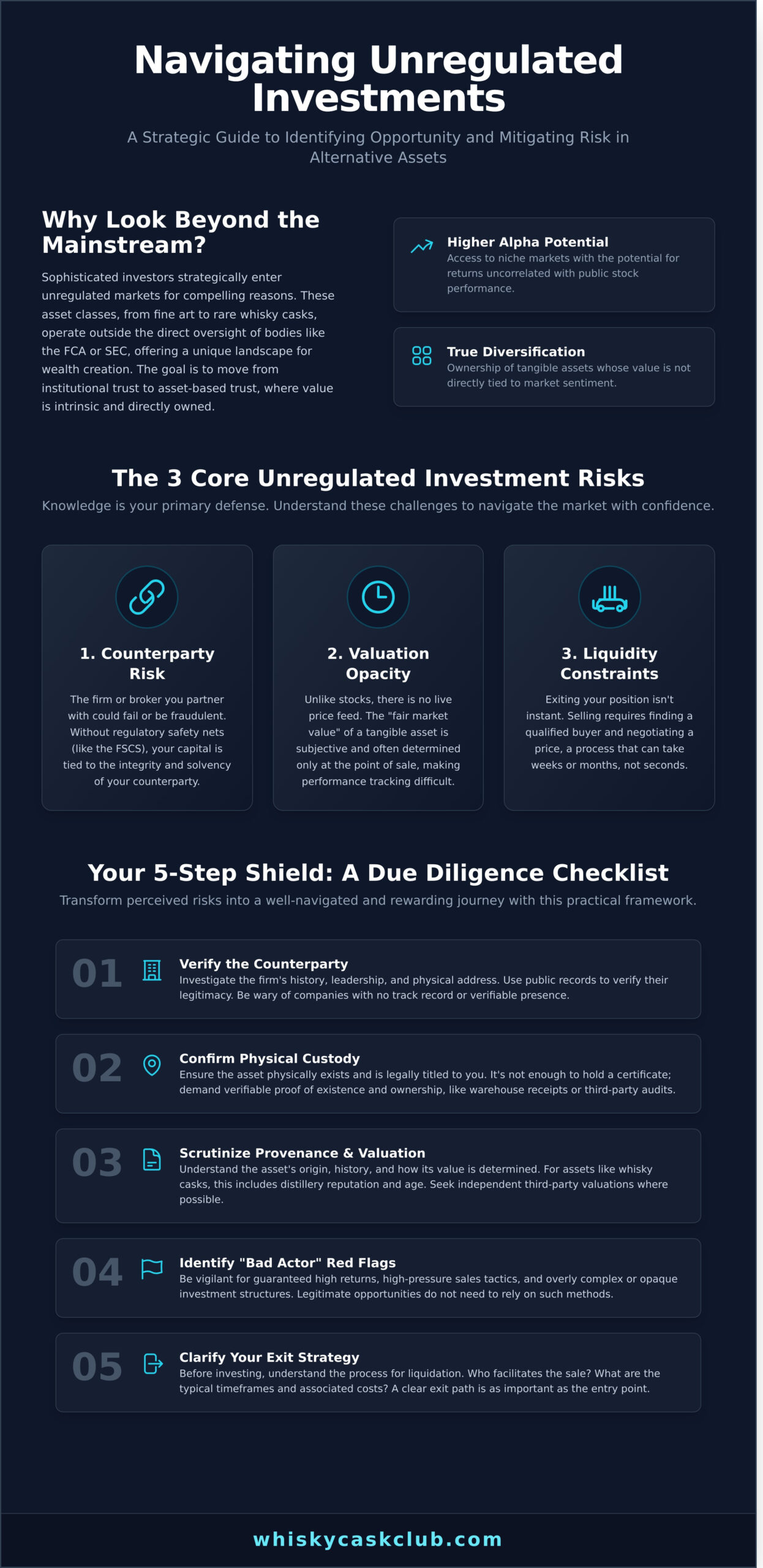
The 3 Core Risks of Unregulated Investment Markets
Venturing beyond traditional public markets opens a world of rare and tangible assets, but it also means stepping away from the stringent oversight that protects mainstream investors. Understanding the inherent unregulated investments risks is the first step toward building a resilient, long-term portfolio. These challenges primarily revolve around three core principles: the partner you choose, the asset’s true value, and your ability to liquidate.
At the heart of these risks lies the “information gap,” where seasoned experts possess a distinct advantage over newcomers. Unlike the stock market, where information is widely disseminated, unregulated markets are often opaque. This creates challenges with:
- Counterparty Risk: The firm or broker you partner with could cease operations, leaving you with little recourse. Without regulatory protection schemes, your capital is directly tied to the solvency and integrity of your counterparty.
- Valuation Opacity: There is no central exchange providing a live price for a rare whisky cask or a piece of fine art. Its “fair market value” is subjective and determined only at the point of sale, making it difficult to track performance accurately.
- Liquidity Constraints: Exiting your position is not instantaneous. Selling a tangible asset requires finding a qualified buyer, negotiating a price, and processing the transfer of ownership-a process that can take weeks or months, not seconds.
Identifying Fraud and “Bad Actors”
The most severe counterparty risk is outright fraud. Disreputable firms often prey on the aspirational nature of these investments. Be vigilant for red flags such as guaranteed high returns, high-pressure sales tactics, and a lack of a verifiable physical address. Some employ sophisticated digital tools, like the “MT5 Trap,” using manipulated software to mimic legitimate market activity. The UK’s Financial Conduct Authority (FCA) explicitly warns consumers about the dangers of Unregulated collective investment schemes, highlighting the limited protections available. Always verify a company’s history and the provenance of its leadership through public records before committing capital.
The Problem of Physical Custody
When investing in tangible assets, you must confirm the asset physically exists and is legally yours. The risk of “paper casks” or other non-existent holdings is a serious concern in opaque markets. It is not enough to hold a certificate; you must be able to verify the exact location of your investment, such as its unique cask number within a specific, government-regulated bonded warehouse. Furthermore, inquire about insurance gaps. A reputable custodian will ensure your asset is fully insured against physical loss, theft, or damage, providing you with a copy of the policy.
Regulated vs. Unregulated: A Strategic Comparison
Navigating the investment landscape requires understanding the fundamental differences between regulated and unregulated markets. Regulated environments, overseen by bodies like the FCA or SEC, offer established safety nets and compensation schemes. However, this security often comes with limitations on returns and accessibility. Unregulated assets, in contrast, offer autonomy and access to unique opportunities defined by rarity and craftsmanship rather than market indices.
The key to managing unregulated investments risks lies in discerning the nature of the asset itself. While financial authorities rightly warn investors about the risks of unregulated investments, a profound distinction exists between a speculative financial product and a tangible asset. For the astute investor, the goal is not to avoid this space entirely but to strategically allocate capital where oversight is exchanged for genuine, long-term value potential, such as superior rarity and tax efficiency.
Financial Derivatives vs. Tangible Assets
Unregulated Forex, for example, operates in a high-stakes, zero-sum environment driven by complex algorithms and contractual promises. Its value is abstract. A premium Scotch whisky cask, however, is a tangible asset with a clear title deed. Its value is not derived from speculation but from the physical process of maturation-a natural appreciation grounded in time and heritage. You own the cask; you own the liquid. This direct ownership structure provides a layer of security that abstract derivatives lack.
The Legal Recourse Myth
A common misconception is that “unregulated” means “unprotected.” While you cannot turn to a financial ombudsman, your investment is still governed by robust contract law. In the event of a dispute, your legal standing is built upon the proof of ownership and the terms of your agreement. This is why meticulous documentation and verified provenance are paramount in alternative markets; they form your best legal defense and secure the integrity of your asset, building a legacy on a foundation of certainty.
Ultimately, a sophisticated portfolio balances both pillars. Traditional, regulated investments provide a foundation of stability and liquidity. Carefully selected tangible assets, from curated whisky casks to real estate, offer a powerful hedge against inflation and market volatility. For investors exploring land as a tangible asset, you can visit Coulee Land Company to see examples of how this strategy is applied in practice.
For those focused on property, securing the right financing is a critical step in managing risk and maximizing returns; specialized lenders like Icon Capital LLC provide a range of real estate loan programs to support such tangible asset investments.
A 5-Step Due diligence Checklist for Alternative Assets
Navigating the world of tangible assets like rare whisky casks requires a blend of passion and pragmatism. While these investments offer unique opportunities, they also carry inherent unregulated investments risks. A meticulous due diligence process is not just recommended; it is essential for protecting your capital and building a secure legacy. This checklist provides a framework for discerning investors.
Step 1: Verify Provenance. Every premium asset has a story. Your first step is to trace your cask back to its origin-the distillery. Authentic documentation confirms its heritage and craftsmanship, which are the cornerstones of its future value.
Step 2: Confirm Physical Custody. A digital entry on a dashboard is not ownership. You must know precisely where your tangible asset is stored and who controls access. For whisky, this means a specific, accredited bonded warehouse.
Step 3: Audit the Broker. Your broker is your guide. Investigate their professional standing, years in operation, and market reputation. A trustworthy advisor will be transparent and encourage independent verification.
Step 4: Review the Exit Strategy. A successful investment begins with the end in mind. Understand the potential paths to liquidity-will you sell to another collector, an independent bottler, or a blender? A clear strategy is paramount.
Step 5: Inspect the Insurance. Your asset must be insured against theft and damage. Critically, the policy should be in your name, not the broker’s. This ensures you are the direct beneficiary.
The Importance of Third-Party Verification
Never rely solely on a broker’s internal systems. Insist on verification from independent parties, such as accredited valuers and warehouse managers. For whisky cask owners, the key is the official “Stock Transfer” document, which legally assigns ownership to you. This paperwork is your ultimate proof of title, transforming a number on a screen into a secured asset.
Understanding Bonded Warehouses
In the UK, whisky casks must be stored in a government-regulated bonded warehouse. This system, overseen by HMRC, provides a powerful layer of de facto regulation that helps mitigate many unregulated investments risks. These highly secure facilities are audited and controlled, providing absolute certainty that your asset physically exists and is protected, maturing under optimal conditions.
Whisky Cask Club: Securely Building Your Liquid Legacy
Navigating the world of alternative assets requires a partner committed to mitigating the inherent unregulated investments risks. At Whisky Cask Club, we bridge this gap by transforming a passion for rare Scotch whisky into a secure, tangible asset class. Our foundation is built on absolute transparency, ensuring every client receives full legal title deeds and warehouse receipts for their cask, held securely in their name. Own the cask. Own the liquid.
We uphold an exacting standard, sourcing casks exclusively from Scotland’s most revered and accredited distilleries. This commitment to provenance is your first line of defence against uncertainty. Furthermore, our strategic global presence with offices in Singapore, Hong Kong, and London provides our members with unparalleled access to a robust secondary market, ensuring a well-managed and timely exit strategy when your asset reaches peak appreciation.
The Security of Bonded Storage
Your legacy is protected within Scotland’s finest HMRC-regulated bonded warehouses. These secure facilities are not just for storage; they are the heart of the maturation process. Every cask is fully insured against theft and damage at its replacement value. As a member of our exclusive club, you also have the unique opportunity to arrange a physical inspection of your tangible asset, connecting you directly to your growing portfolio.
Crafting Your Bespoke Portfolio
We believe in moving beyond simply buying a cask to the art of building a legacy. Our specialists work with you to curate a bespoke portfolio tailored to your financial goals, providing the expertise needed to manage potential unregulated investments risks. We offer expert advisory on the optimal time to exit, ensuring your passion translates into maximum appreciation. Ready to begin your journey?
Speak with a Cask Specialist at Whisky Cask Club and discover how to secure your tangible, liquid legacy today.
From Risk to Legacy: Securing Your Alternative Asset Portfolio
The world of alternative assets offers remarkable opportunities, but success hinges on navigating its complexities with precision and foresight. The key takeaway is clear: meticulous due diligence is not merely advisable; it is the definitive barrier between a prudent investment and a speculative gamble. By understanding the core unregulated investments risks and applying a structured evaluation process, discerning investors can confidently identify assets of true provenance and potential, transforming uncertainty into a tangible legacy.
At Whisky Cask Club, we provide the framework for this confidence. We secure your investment with title deeds in your name and storage in an accredited bonded warehouse, all while offering guidance from our expert advisory team in Singapore and Hong Kong. We turn the passion of whisky into a pragmatic and secure asset class. To empower your next step, we invite you to explore our comprehensive guide.
Download our Due diligence Guide for Cask Investment and begin your journey toward building a truly timeless liquid legacy.
Frequently Asked Questions
Are all unregulated investments considered high risk?
While many unregulated investments carry significant risk, it is more accurate to say the risk profile varies. Assets without a tangible form, for example, can be highly speculative. In contrast, a physical asset like a premium whisky cask has intrinsic value. The key to managing unregulated investments risks lies in diligent research, ensuring clear ownership, and partnering with a reputable advisor who understands the specific asset class. True security is built on knowledge and provenance.
What is the biggest danger when investing in whisky casks?
The most significant danger is a lack of verifiable ownership and provenance. Fraudulent schemes often involve selling casks that do not exist, are of inferior quality, or are owned by someone else. Without a clear paper trail, including a unique cask number and a delivery order confirming your title, your investment has no foundation. This is why we insist on absolute transparency and secure documentation for every cask we source for our members.
How do I know if a whisky cask investment company is legitimate?
A legitimate company operates with complete transparency and holds the necessary credentials. In the UK, verify they are a registered UK company and hold a WOWGR (Warehousekeepers and Owners of Warehoused Goods Regulations) certificate from HMRC. They should provide clear proof of ownership and welcome independent verification. A trusted advisor will guide you through this due diligence, ensuring every aspect of your investment is secure and properly documented from the outset.
Can I lose all my money in an unregulated investment?
Yes, a total loss is a possibility in any investment, particularly those lacking regulatory oversight. This typically occurs through fraud or the complete failure of the underlying asset. However, by investing in a tangible asset with proven demand, like a premium Scotch whisky cask, and ensuring your legal ownership is undisputed and held in a secure, government-regulated bonded warehouse, you substantially mitigate this risk. Prudence and diligence are your greatest protectors.
Does the FCA regulate whisky cask investments in the UK?
No, the Financial Conduct Authority (FCA) does not regulate the sale or purchase of whisky casks. This is because a cask of whisky is considered a tangible, consumable good rather than a specified financial instrument. While the investment itself is unregulated, the storage and movement of the cask are strictly controlled by HM Revenue & Customs (HMRC) within the bonded warehouse system, which provides a different, yet robust, layer of security for your asset.
What is provenance and why does it matter for my investment?
Provenance is the authenticated history of your cask, detailing its origin from a specific distillery on a specific date. It is the undeniable proof of your asset’s heritage and authenticity. For a tangible asset like whisky, provenance is paramount; it underpins the cask’s future value, rarity, and desirability. Without impeccable provenance, you own a story without its author. It is the foundation upon which the legacy of your investment is built and secured.
How does bonded storage protect me from fraud?
Bonded storage provides an essential layer of third-party verification and security. These facilities are strictly regulated by HMRC, operating independently of the company that sold you the cask. When your cask is held in a bonded warehouse under your own name or account, it provides unassailable proof that the asset exists and that you are its legal owner. This impartial custody separates ownership from sales, effectively eliminating the risk of the same cask being sold to multiple people.
What legal protections do I have if an investment platform goes bust?
Your protection depends entirely on the ownership structure. If you hold direct title to your cask-evidenced by a delivery order and held in your name at a bonded warehouse-the asset remains yours regardless of the platform’s financial state. It is not part of their company assets. This is the cornerstone of a secure tangible asset strategy. However, if you only own a “share” in a cask or fund, your capital could be at risk as a creditor.