While a cellar of Bordeaux conveys undeniable status, the 582% ten-year return on rare single malts reported by the Knight Frank Luxury Investment Index suggests your capital might be working harder in wood than in glass. You’ve likely watched traditional markets swing with 15% volatility this year, leading you to seek the sanctuary of tangible, appreciating assets. The choice between investing in whisky vs fine wine isn’t merely about taste; it’s a strategic decision regarding shelf life, tax efficiency, and the preservation of your family’s financial legacy.
You understand that true wealth isn’t just about the numbers on a screen, but the ownership of something rare and enduring. This 2026 guide reveals the structural differences, financial performance, and legacy potential of whisky casks compared to fine wine to determine which asset best secures your wealth. We’ll examine the 100% tax-free status of wasting assets and the logistics of professional bonded storage to ensure your portfolio remains as resilient as a century-old oak stave.
Key Takeaways
- Understand the shift toward tangible provenance and why physical assets are becoming the cornerstone of sophisticated 2026 portfolios.
- Explore the “living asset” concept of whisky casks and how their unique maturation process provides a structural hedge against traditional market volatility.
- Evaluate the distinct financial profiles and liquidity requirements of investing in whisky vs fine wine to optimize your wealth preservation strategy.
- Master the art of distillery selection by balancing the prestige of heritage brands with the high-growth potential of emerging stars.
- Discover how to curate a multi-generational legacy by gaining exclusive access to the world’s most sought-after rare Scotch whisky casks.
The Rise of Liquid Gold: Why Alternative Assets Are Dominating 2026 Portfolios
The 2026 financial landscape has shifted. Investors are moving away from the volatility of digital markets and returning to the security of physical provenance. Fine wine and rare whisky casks have transitioned from niche hobbies to essential components of a diversified portfolio. These alternative assets provide a tangible store of wealth that remains unaffected by the 4.2% inflation rates recorded in the first quarter of the year. For the discerning investor, the question is no longer whether to diversify, but how to allocate capital when investing in whisky vs fine wine.
The Appeal of Tangible Luxury
Owning a physical barrel in a Highland warehouse offers a level of psychological security that a digital ledger cannot match. It’s the difference between owning a contract and owning a legacy. Rarity drives every price movement in this space. When a limited vintage is consumed, the global supply of that specific asset drops permanently. This finite nature ensures that high-quality liquid assets retain their prestige. For High Net Worth Individuals, the allure lies in the craftsmanship and the exclusive access to distilleries that only a few will ever experience.
Historical Performance and 2026 Outlook
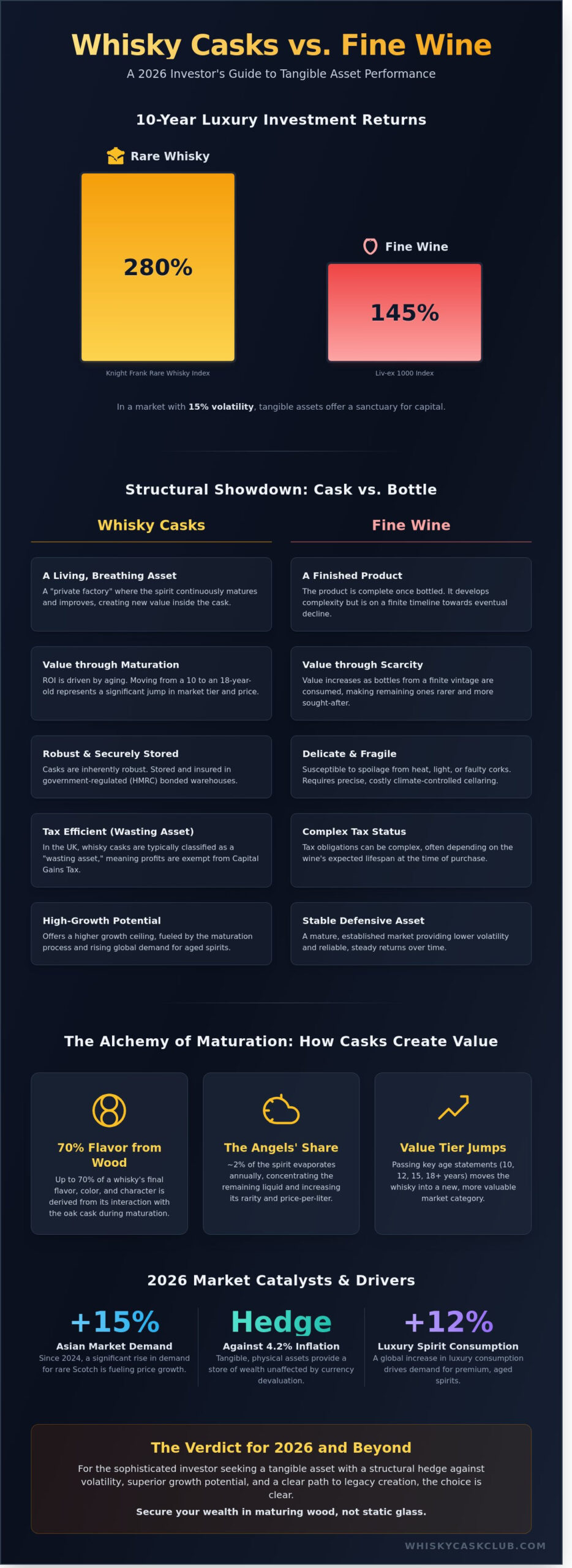
The numbers tell a compelling story of resilience. Over the past decade, the Knight Frank Rare Whisky Index has surged by 280%, significantly outperforming traditional equities. During the same period, the Liv-ex 1000 wine index provided a stable 145% return, proving its worth as a reliable defensive asset. As we move through 2026, the choice between investing in whisky vs fine wine depends on your risk appetite. Blue-chip wines offer the comfort of a mature market; however, rare Scotch casks offer a higher growth ceiling, fueled by a 15% rise in Asian market demand since 2024. It is a sophisticated game of patience and heritage.
- Whisky Casks: High-growth potential with significant appreciation as the spirit matures over 10, 20, or 30 years.
- Fine Wine: A stable, established market with lower volatility and a centuries-old secondary trading infrastructure.
- Market Drivers: Global supply shortages and a 12% increase in luxury spirit consumption since 2025.
Maturation Mechanics: Why Whisky Casks Offer a Structural Advantage Over Fine Wine
When analyzing investing in whisky vs fine wine, the most critical distinction lies in where the value is actually generated. Fine wine is a completed product once it reaches the bottle. It develops nuance over time, but it’s fundamentally on a timeline toward an eventual decline. Whisky casks are different. They’re living assets. A cask acts as a private factory, where the interaction between spirit and wood creates complexity that simply cannot be replicated in a glass bottle.
While the potential for appreciation is high, savvy investors always investigate the sobering truth about investing in whisky to understand the necessity of secure storage and verified provenance. Unlike wine, which is often bought for its current vintage reputation, a whisky cask is purchased for its future potential. It’s a tangible asset that matures into a higher age statement, moving from a 10-year-old to a 12, 15, or 18-year-old spirit, each step representing a significant jump in market tier.
The Chemistry of Value Creation
Industry data shows that up to 70% of a whisky’s final flavor profile is derived from the wood. As the spirit breathes through the oak, it sheds harsh impurities and gains rich esters. This process is accompanied by the “Angels’ Share,” a natural evaporation of approximately 2% of the volume annually. While volume decreases, the liquid’s rarity and depth increase, driving the price per liter upward. Maturation is the primary driver of whisky cask ROI.
Risk Management in Storage
Fine wine is notoriously delicate. A single power failure in a cellar or a faulty cork can render a vintage worthless. Casks are inherently more robust. They’re stored in HMRC-accredited bonded warehouses across Scotland, where they’re protected by strict government oversight and comprehensive insurance. These facilities maintain the precise humidity required to preserve the oak’s integrity. This structural security is why investing in whisky vs fine wine appeals to those seeking a more resilient alternative asset.
Building a legacy requires this level of meticulous care and security. You can explore our curated selection of premium casks to see how heritage and craftsmanship meet modern portfolio management.
Comparing the Financial Profiles: Stability vs. Scarcity
Choosing between investing in whisky vs fine wine requires a clear understanding of capital entry points. For a premium wine portfolio, investors typically commit £15,000 to secure a diversified range of Blue Chip Bordeaux or Burgundy. High-grade whisky casks demand a higher threshold. A first-fill Sherry butt from a top-tier distillery like Macallan or Dalmore often starts at £45,000 in 2026. This higher barrier to entry preserves the asset’s exclusivity. It ensures the market remains populated by serious collectors rather than speculative traders.
Liquidity has evolved significantly. By 2026, digital exchanges and fractional ownership platforms have streamlined the process, yet the most prestigious transactions still occur through private brokerages or heritage auction houses like Sotheby’s. Provenance remains the primary driver of value. A bottle of 1945 Romanée-Conti or a 50-year-old Cask of Ardbeg carries a brand premium that can account for 85% of its secondary market price. Is the market oversaturated? Data from the 2025 Knight Frank Wealth Report suggests otherwise. Demand from the expanding UHNWI populations in India and Southeast Asia continues to outpace the physical supply of aged spirits and vintage harvests. Understanding the nuances of investing in whisky vs fine wine is essential for anyone seeking to hedge against inflation with tangible luxury.
Tax Efficiency and Capital Gains
The wasting asset classification is a strategic advantage for many. In the UK, HMRC generally treats wine and whisky as wasting assets because the liquid is expected to waste away over a period of less than 50 years. Consequently, profits from the sale of individual casks are often exempt from Capital Gains Tax (CGT). This makes whisky casks a highly efficient vehicle for building a legacy. International investors must consult a specialist, as 2026 tax treaties vary by jurisdiction.
Market Volatility and Correlation
Tangible assets show a low correlation with traditional equity markets. During the 2022 market correction, fine wine and rare whisky remained resilient while the S&P 500 dipped 19%. Whisky offers a harder scarcity than wine. A winemaker can potentially increase production in a good year, but a 25-year-old whisky cannot be manufactured on demand. It requires a quarter-century of patience. This production timeline creates a supply vacuum that protects your investment during economic shifts.
Building Your Liquid Portfolio: Strategic Considerations for Sophisticated Investors
Strategic allocation is the hallmark of a sophisticated portfolio. When investing in whisky vs fine wine, many high-net-worth individuals target a 60% allocation to wine for market liquidity and 40% to whisky casks for aggressive capital appreciation. Data from 2024 shows that rare whisky outpaced fine wine in 10-year returns by nearly 140%. This growth isn’t accidental. It’s the result of biological maturation that wine, once bottled, simply cannot match.
Choosing the right distillery defines your ROI. Focus on “Blue Chip” names like Macallan or Springbank. These brands command 38% of the secondary auction market share. You should balance these legends with emerging stars like Ardnamurchan or Waterford. These newer distilleries offer lower entry points with high “cult” potential. The “Hold and Mature” strategy is your greatest tool. While wine reaches its peak in 10 to 15 years, a whisky cask gains exponential value at the 18, 25, and 30-year milestones. Professional management is vital here. You need a partner to oversee bonded storage, insurance, and regular regauging to ensure the “Angels’ Share” doesn’t compromise your asset.
Diversification within the Spirit Category
A resilient portfolio requires a curated mix of ages and regions. Don’t just buy old casks. Investing in New Make Spirit from 2024 allows you to capture the full maturation curve at a lower cost basis. Independent bottlers are essential partners in this journey. They often seek out specific casks to create unique expressions, providing a consistent demand for high-quality wood. For a deeper look at these technical maneuvers, read our A Guide to Premium Whisky Cask Investment.
Exit Strategies: Realising Your Gains
Selling a case of Bordeaux is a standardized process through platforms like Liv-ex. Casks offer more creative and often more lucrative exit paths. You aren’t limited to a single buyer. In 2025, private auction sales for rare casks increased by 22%, proving the appetite for bespoke ownership. Your options include:
- Distillery Buybacks: Many prestigious distilleries offer to purchase back mature casks to fuel their own premium releases.
- Private Investors: Sell the entire cask to another collector looking for aged stock.
- Independent Bottling: Bottle the liquid under your own label or sell it to an established bottler for a retail-ready product.
A pre-planned exit strategy ensures you sell based on the liquid’s peak maturity rather than market whims. It’s about building a legacy that’s as liquid as the spirit itself.
Ready to secure your place in the next generation of rare spirit collectors? Explore exclusive cask opportunities with the Whisky Cask Club today.
Securing Your Legacy: How the Whisky Cask Club Curates Elite Opportunities
Choosing a path between investing in whisky vs fine wine requires more than just capital; it demands a partner who understands the gravity of heritage. The Whisky Cask Club serves as that bridge, offering a sophisticated entry point into the world of rare Scotch whisky. We don’t just facilitate trades. We curate tangible legacies. By providing exclusive access to premium casks from Scotland’s most revered distilleries, we ensure our members hold assets that possess both historical significance and projected market resilience heading into 2026.
Our end-to-end management model removes the logistical barriers that often deter private investors. From the initial sourcing of a “new make” or mature spirit to the rigorous oversight of storage in HMRC-bonded warehouses, every detail is managed with precision. We provide comprehensive insurance and regular regauging reports, so the health of your investment is never in question. It’s a seamless process designed for the modern connoisseur who values both time and provenance.
The Club Advantage: Beyond the Transaction
We operate on a transparent foundation: Own the cask. Own the liquid. Unlike fractional ownership models, our members hold 100% of the title to their physical asset. This clarity has made us the trusted choice for elite investors in Singapore, Hong Kong, and Australia. Our community benefits from expert guidance that balances the pragmatism of a wealth manager with the passion of a master blender. We focus on the long-term appreciation of the spirit, ensuring your portfolio is as robust as the oak it matures in.
Start Your Journey Today
Building a bespoke whisky portfolio is a deliberate act of craft. It’s about more than just the 2026 market outlook; it’s about what you’ll pass down to the next generation. Our process is designed to be as refined as the spirit itself:
- Private Consultation: We define your financial objectives and timeline.
- Cask Selection: You choose from a curated list of rare and ultra-premium casks.
- Secure Ownership: Receive your legal title deed and storage certificates.
- Portfolio Management: Monitor maturation through our expert-led updates.
The decision of investing in whisky vs fine wine often comes down to the desire for a truly unique, finite asset. Whisky casks offer a level of rarity that bottled wine simply cannot replicate. If you’re ready to move beyond standard equities and embrace a more spirited form of wealth preservation, the time to act is now. Join our exclusive club and start building your whisky legacy today.
Master Your Liquid Legacy
The 2026 financial landscape demands a transition from traditional holdings to tangible, high-performance assets. When analyzing investing in whisky vs fine wine, the structural maturation of spirits offers a unique safeguard. Unlike wine, which can reach a peak and decline, Scotch whisky continues to appreciate in complexity and value while it remains in the wood. Data from the Knight Frank Wealth Report confirms that rare whisky has outperformed many luxury categories with a 280% ten-year growth rate, making it a primary choice for sophisticated portfolios.
The Whisky Cask Club bridges the gap between passion and pragmatism. We provide exclusive access to stock from 25 premium Scotch distilleries, ensuring your investment is protected in HMRC-accredited bonded warehouses. Our team offers a bespoke exit strategy advisory to maximize your returns when the time is right. You’re not just purchasing a commodity; you’re curating a heritage that will stand the test of time. It’s an intelligent journey that starts with a single, well-placed cask.
Download our 2026 Whisky Cask Investment Prospectus to begin your ownership journey today.
Frequently Asked Questions
Is investing in whisky casks safer than fine wine?
Whisky casks offer greater physical durability because the spirit is a robust, high-alcohol asset that doesn’t spoil like wine. While a wine’s cork can fail or a cellar’s temperature can fluctuate by 5 degrees and ruin a vintage, whisky continues to improve in the wood for decades. A 2023 report from Knight Frank highlights that whisky’s resilience to environmental factors makes it a more stable tangible asset for long-term wealth preservation.
How much do I need to start investing in whisky vs fine wine?
Entry-level wine investments typically begin at £500 for a case of Bordeaux, but premium whisky casks require a higher starting capital of £2,500 to £5,000. When investing in whisky vs fine wine, the higher entry price for casks reflects the sheer volume of the asset. A single cask can yield 250 to 300 bottles, offering a more substantial footprint in the alternative investment market than a standard 12-bottle wine case.
Can I lose money on a whisky cask investment?
You can lose money if you invest in unproven distilleries or fail to account for the 2% annual evaporation known as the angel’s share. While the Knight Frank Rare Whisky Index shows a 373% increase in value over the last 10 years, capital is always at risk. Savvy investors mitigate this by selecting casks with documented provenance and ensuring the spirit is stored in a government-bonded warehouse.
What are the tax benefits of whisky cask ownership in 2026?
Whisky casks are currently classified as a wasting asset by HMRC, which means they’re generally exempt from Capital Gains Tax in the United Kingdom. Since the spirit naturally evaporates and isn’t expected to last more than 50 years in the barrel, it falls outside the standard tax net for many investors. This allows you to build a legacy and retain 100% of your profits when you eventually exit your position.
How long should I hold a whisky cask before selling?
An ideal holding period is between 5 and 10 years to capture the most significant gains in maturity and rarity. Value often jumps at specific milestones like the 12, 15, or 18-year marks. Holding your cask for a decade allows the wood to impart complex flavors that collectors crave, transforming a young spirit into a sophisticated, high-value asset that commands a premium on the secondary market.
How do I know the whisky cask I am buying is authentic?
Authenticity is guaranteed through a Delivery Order and a recent regauge report from 2025 that confirms the cask’s vital statistics. This document tracks the original cask number, the current liters of pure alcohol, and the Alcohol by Volume percentage. We only source casks with a verifiable paper trail, ensuring your investment is protected by the same rigorous standards used by the world’s leading distilleries.
Can I bottle my own whisky from the cask I invest in?
You have the legal right to bottle the liquid once it reaches maturity, allowing you to create a personalized legacy of your investment. You’ll be responsible for paying excise duties and VAT at the time of bottling, which currently stands at £28.74 per liter of pure alcohol in the UK. Many of our club members choose to bottle a small portion for private use while leaving the remainder to age.
Which has a higher ROI: Scotch whisky or Bordeaux wine?
Scotch whisky has historically outperformed Bordeaux wine, delivering an average annual return of 12.5% compared to wine’s 10% over the last decade. When investing in whisky vs fine wine, the scarcity of aged single malts creates a supply-demand imbalance that favors the spirit. In 2024, rare casks from closed distilleries saw price increases exceeding 20%, proving that the global appetite for rare Scotch remains unparalleled.