In the exclusive world of alternative assets, few investments carry the same allure and promise of legacy as a maturing cask of Scotch whisky. Yet, for the discerning investor, this tangible asset can be accompanied by an intangible anxiety. In a market without a central government registry, shadowed by tales of fraud and complex excise laws, a critical question emerges: is the cask you’ve poured your capital and aspirations into truly, unequivocally yours?
This is precisely why mastering how to verify whisky cask ownership is not merely a procedural step-it is the cornerstone of a secure and prosperous portfolio. The responsibility to perform meticulous due diligence rests with the owner, and navigating this process with confidence is paramount. This guide is crafted to provide that quiet confidence, transforming uncertainty into assurance and safeguarding the very foundation of your investment.
Here, we will demystify the essential verification process, from understanding the legal authority of a Delivery Order to providing a concrete checklist for physical confirmation. Consider this your definitive guide to securing your asset, confirming its provenance, and ensuring the legacy you are carefully building is protected for generations to come.
Key Takeaways
- Understand ‘Constructive Delivery’-the legal principle under Scots Law that secures your title to a cask without it ever leaving the warehouse.
- Recognise the Delivery Order (DO) as the single most critical document in your investment portfolio, serving as the ultimate proof of ownership.
- Master exactly how to verify whisky cask ownership by contacting the bonded warehouse directly to confirm your unique asset is registered in your name.
- Discover how a cask’s physical ‘fingerprint’ and modern registry technologies provide an essential layer of security against fraud and double-selling.
The Legal Framework of Scotch Whisky Cask Ownership
Owning a cask of maturing Scotch is an investment in a tangible asset steeped in heritage and craftsmanship. However, securing that asset requires a clear understanding of its unique legal status. Under Scots Law, a whisky cask is classified as ‘moveable property’, meaning its ownership is transferred not by a simple certificate, but through a specific legal process. Because these premium assets remain stationary in a bonded warehouse, the transfer of title is achieved through a principle known as ‘Constructive Delivery’. This is the cornerstone of secure ownership.
Why a ‘Certificate of Ownership’ is Not Enough
Many aspiring investors are presented with a ‘Certificate of Ownership’ by a broker. While seemingly official, this document is often little more than an internal receipt from the seller. It carries no legal weight with the warehouse custodian and, crucially, offers no protection against the cask being sold to multiple buyers. True security lies in official documentation, such as a Delivery Order, issued and actioned by the warehouse itself.
Understanding the Principle of ‘Traditio’
The legal framework governing Scotch whisky ownership is rooted in the ancient Scots Law principle of traditio, where legal title to goods passes upon physical delivery. For a cask, this ‘delivery’ is symbolic. The independent, HMRC-licensed warehouse acts as the legal custodian. When they update their stock records to reflect you as the new owner, that official act constitutes the legal transfer of title. The custodian’s acknowledgement is the critical moment you acquire ownership.
Grasping these legal distinctions is fundamental to knowing how to verify whisky cask ownership. It clarifies why the focus must be on the custodian, not just the seller. While HMRC diligently tracks every cask for tax purposes, their mandate is duty collection, not policing private ownership disputes. This reality underscores the need for a robust, three-pronged approach to verification.
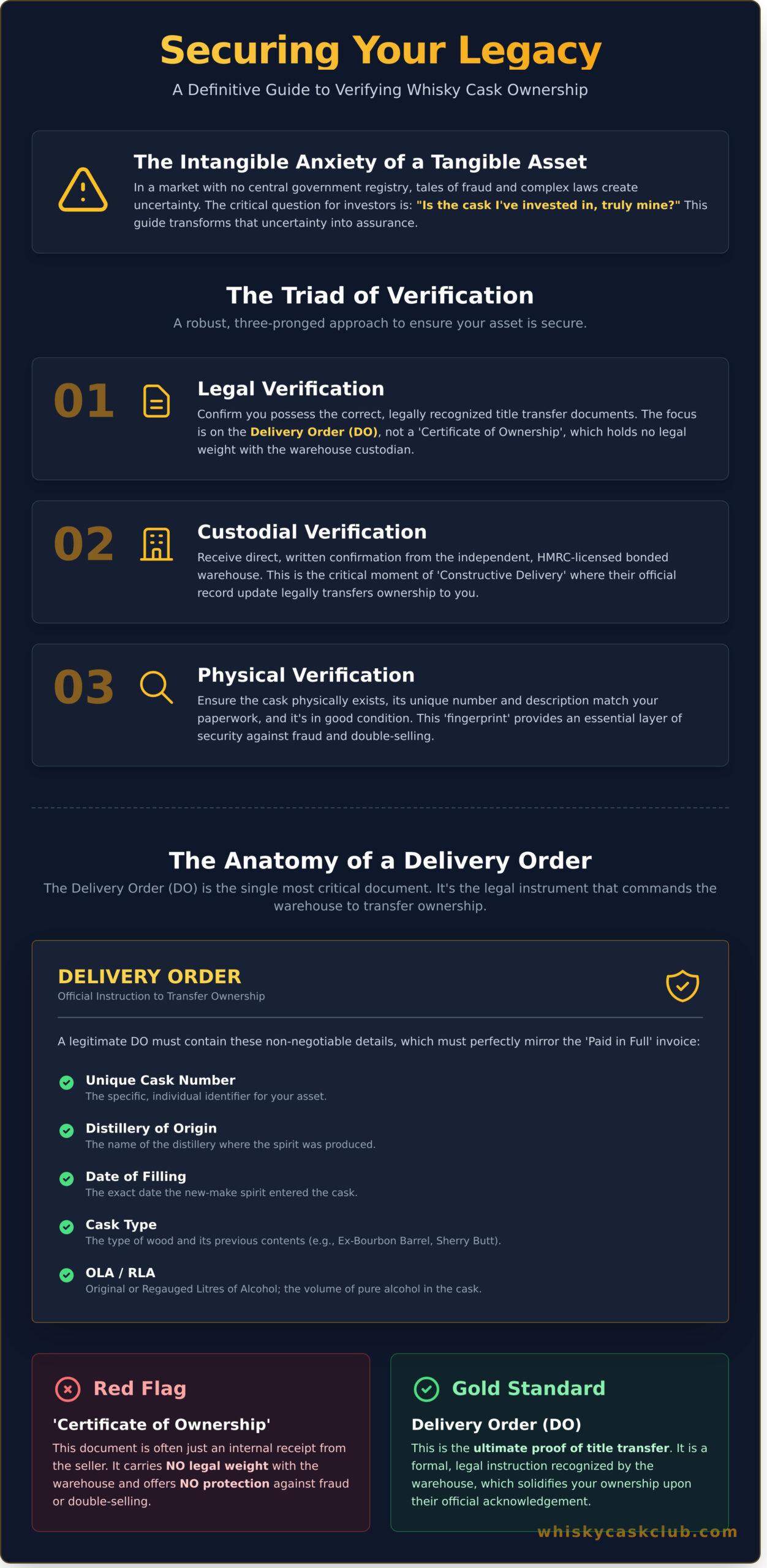
We call this the ‘Triad of Verification’-a comprehensive method for ensuring your legacy asset is secure:
- Legal Verification: Confirming you have the correct title transfer documents recognised by the warehouse.
- Custodial Verification: Receiving direct, written confirmation from the warehouse that you are the registered owner.
- Physical Verification: Ensuring the cask exists, matches its description, and is in good condition.
The Essential Paperwork: Delivery Orders and Invoices
In the world of tangible assets, provenance is paramount. When you invest in a rare whisky cask, you are not merely purchasing a spirit; you are acquiring a piece of heritage. The integrity of this investment rests upon meticulous and legally binding documentation. Understanding this paperwork is the most critical step in learning how to verify whisky cask ownership and secure your legacy.
The cornerstone of this process is the Delivery Order (DO). This is not a simple receipt, but the ultimate proof of title transfer. It is the formal, legal instrument that commands a bonded warehouse to change the ownership of a specific cask in their records from the seller to you, the new owner. Alongside the DO, a corresponding ‘Paid in Full’ invoice confirms the financial transaction is complete. These two documents must be perfect mirrors of each other, creating an unbroken chain of ownership.
A legitimate Delivery Order must contain precise, non-negotiable details:
- Unique Cask Number: The specific identifier for your cask.
- Distillery of Origin: The name of the distillery where the spirit was produced.
- Date of Filling: The exact date the new-make spirit entered the cask.
- Cask Type: The type of wood and previous contents (e.g., Ex-Bourbon Barrel).
- Original Litres of Alcohol (OLA) / Regauged Litres of Alcohol (RLA): The volume of pure alcohol at the time of filling or a more recent measurement.
How a Delivery Order (DO) Actually Works
Think of the DO as a direct, written instruction from the seller to the warehouse manager. Once you receive it, you must present it to the bonded warehouse holding your asset. The warehouse then formally acknowledges this instruction, cancels the seller’s account for that cask, and opens a new account in your name. This acknowledgement is the final, legally binding act that solidifies your ownership. It is far more robust than a simple ‘Transfer of Title’ letter, which lacks the same legal standing and direct operational authority.
Spotting Red Flags in Ownership Documents
A discerning investor knows that diligence is the best defence. When examining your paperwork, be vigilant for warning signs such as missing cask numbers, absent signatures, or vague warehouse locations. A particularly dangerous red flag is an ‘all-inclusive’ storage fee that conveniently hides the warehouse’s identity. You must always know the exact name and address of the HMRC-regulated bonded warehouse. This transparency is crucial for verifying the cask’s existence and ensuring it complies with the government’s Spirit Drink Verification Scheme, a key part of responsible ownership.
Direct Verification: How to Confirm Title with the Bonded Warehouse
While documentation from your broker is the first step, the ultimate proof of your legacy asset lies with its independent custodian: the bonded warehouse. Engaging directly with the warehouse provides an irrefutable, third-party confirmation of your title. This direct approach is the most definitive method for how to verify whisky cask ownership and secure your investment.
Follow this meticulous five-step process to confirm your holding:
- Identify the Warehouse: Your purchase agreement or certificate of ownership must explicitly name the specific, HMRC-licensed bonded warehouse where your cask is stored. This is non-negotiable information.
- Obtain the Reference Number: Request the unique warehouse reference or rotation number for your cask. This is the internal identifier used by the warehouse itself, distinct from any broker-assigned number.
- Draft a Letter of Authority (LOA): For data protection, a warehouse manager cannot legally discuss your asset without your express permission. You must provide your broker with a formal, signed LOA granting the warehouse consent to communicate with you directly.
- Request a Stock Statement: Once communication is established, ask the warehouse for an official Stock Statement or Cask Extract. This document details the cask’s vital statistics as held in their secure records.
- Compare and Confirm: Meticulously compare the warehouse’s statement with the details provided by your broker. Key data points-cask number, distillery of origin, wood type, and Regauged Litres of Alcohol (RLA)-must align perfectly.
Bypassing the Broker: Your Right to Information
As the legal owner, you have an inherent right to verify your tangible asset with its custodian. A transparent, reputable broker will actively facilitate this process. If a broker refuses to disclose the warehouse location or creates barriers to communication, consider it a significant red flag. Under WOWGR (Warehousekeepers and Owners of Warehoused Goods Regulations), warehousekeepers have a duty of care, and confirming the provenance and ownership of assets is central to this responsibility.
What to Ask the Warehouse Manager
When you connect with the warehouse, your objective is to gain complete clarity. Use these key questions to guide your conversation:
- Ownership Status: Ask, “Is this cask registered directly in my name, or is it held in a consolidated account under the broker’s name?” Direct ownership in your name is the most secure position.
- Liquid Health: Request, “Could you provide the most recent regauging report?” This confirms the cask’s current volume and alcoholic strength (ABV), ensuring its maturation is proceeding as expected.
- Storage & Insurance: Enquire, “Can you confirm that all storage fees are paid to date and that my cask is fully covered under your facility’s insurance policy?”
Physical Provenance and Modern Authentication Technologies
While robust documentation is the cornerstone of cask ownership, a discerning investor must look beyond paper records. True security lies in the convergence of physical proof and modern digital verification. Every cask possesses a unique ‘visual fingerprint,’ an identity forged in wood and steel that cannot be perfectly replicated. This tangible identity is the first layer of authentication in building your legacy.
This physical uniqueness is defined by several key characteristics:
- Wood Grain and Staves: The specific pattern and construction of the oak staves.
- Hoop Markings: Scuffs, placement, and patina on the metal hoops.
- Distillery Stencils: The unique cask number, date, and distillery markings painted on the cask end.
Independent registries use these details, often alongside unique identifiers like a ‘CaskID,’ to create a definitive record, preventing the fraudulent double-selling of a single asset. Understanding these layers is fundamental to knowing how to verify whisky cask ownership in the modern era.
The Power of a Physical Sample
Requesting a 10cl sample is the ultimate ‘sanity check’ for any investor. It is the definitive, tangible proof that your cask exists and contains the spirit described. The sample’s label provides critical data-cask number, ABV, and date of drawing-which must align perfectly with your ownership documents. It also allows you to track the maturation journey, ensuring the quality of your tangible asset meets your expectations.
Blockchain: The Future of Provenance
The whisky industry is embracing blockchain technology to create an immutable digital history for each cask. This digital ledger records every transaction and ownership change in a way that cannot be altered or deleted. Asset-backed tokens, or NFTs, are now being used to represent ownership, creating a ‘Digital Twin’ of the physical cask. This move towards transparent, real-time tracking provides an unprecedented level of security compared to traditional paper records.
By combining physical inspection with cutting-edge digital verification, you secure your investment with absolute confidence. For expert guidance on navigating the authentication process, explore the curated opportunities at the Whisky Cask Club.
Building a Secure Legacy: The Whisky Cask Club Approach
At the Whisky Cask Club, we believe that verifying your asset should not be a complex chore, but the seamless foundation of your investment journey. True ownership is built on a bedrock of transparency and trust. We have structured our entire service around this principle, acting as your discreet advisor to ensure every cask’s provenance is impeccable long before it enters your portfolio. Our philosophy is simple: the question of how to verify whisky cask ownership should be answered with absolute certainty from day one.
We ensure every client has a direct, unencumbered relationship with their asset. This is not a fund or a fractional scheme; you own the cask and the liquid within it. This is guaranteed by providing you with the full, official Delivery Order (DO) transferred into your name, along with complete transparency regarding the HMRC-regulated warehouse where your cask is securely stored. This direct line of ownership is non-negotiable and central to building a tangible, lasting legacy.
Our Sourcing and Verification Process
Our commitment to security begins with a meticulous due diligence process. We vet every distillery and bonded warehouse partner, ensuring they meet our exacting standards for quality, compliance, and reputation. Only casks with unimpeachable provenance are considered for our clients. This proactive verification is complemented by our ongoing services, including periodic regauging to monitor maturation and volume, providing you with updated reports on your asset’s progress. This is a core part of our Portfolio Strategy & Management service.
Your Journey to Ownership
Joining our exclusive club of investors is a curated and personal experience. From the initial consultation to cask selection and the final transfer of title, our specialists guide you at every step. We provide the expertise and access needed to build a premium portfolio, and when the time is right, we assist with tailored exit strategies-whether that involves selling the cask on the private market or arranging for its eventual bottling. Your journey is our priority, from acquisition to legacy realisation.
Ready to build your own whisky legacy on a foundation of verified ownership?
Speak with a Cask Specialist Today
Securing Your Legacy: The Final Word on Cask Verification
Mastering the art of cask investment begins with meticulous due diligence. As we’ve explored, true ownership is confirmed not by a simple promise, but by a trinity of proof: essential paperwork like the Delivery Order, direct verification with the bonded warehouse, and an unimpeachable provenance. Understanding how to verify whisky cask ownership is the foundational step in transforming a passion for Scotch into a tangible, secure asset.
While this diligence is paramount, you do not have to navigate this complex landscape alone. The Whisky Cask Club was founded on the principle of absolute transparency and security. We provide our members with expert guidance on secure bonded storage and ensure full transparency with legally binding Delivery Orders for every acquisition. Our exclusive access to rare casks from Scotland’s most revered distilleries means your investment is not only secure but also truly exceptional.
Secure Your Legacy: Explore Investment-Grade Casks and discover the confidence that comes with a professionally curated portfolio. Your journey into the world of premium cask ownership awaits.
Frequently Asked Questions About Cask Ownership Verification
Is a ‘Certificate of Ownership’ a legally binding document in Scotland?
While a Certificate of Ownership is a handsome document marking your acquisition, it is not, by itself, a legally binding title deed under Scots law. It serves as a receipt from the seller but does not prove your title to the cask against third parties. True, verifiable ownership is established through official records held at the bonded warehouse, which is why securing a Delivery Order in your name is a non-negotiable step in the process of building your liquid legacy.
What happens to my cask if the broker goes out of business?
Your tangible asset is secure, provided your ownership is correctly registered with the bonded warehouse. If a broker ceases trading, your cask remains your property, entirely separate from their business assets. This is precisely why we insist on immediate title transfer into your name. Your cask, identified by its unique number and resting under your account at the warehouse, is insulated from the broker’s financial standing. It is your legacy, protected and accounted for.
Can I physically visit my whisky cask in the warehouse?
We believe that connecting with your investment is a profound part of the ownership journey. Visiting your cask is an exclusive privilege we are pleased to arrange for our members. Due to strict HMRC regulations and security protocols at bonded warehouses, all visits must be scheduled in advance. This ensures the integrity and safety of every cask under maturation. We will coordinate with the warehouse to provide you with a personal and memorable viewing of your maturing asset.
What is a ‘Delivery Order’ and why is it more important than an invoice?
A Delivery Order (DO) is the paramount document in cask ownership. It is a formal, legal instruction from the current owner to the warehouse keeper, directing them to transfer the title of a specific cask to you. While an invoice is merely a record of a financial transaction, the DO is the instrument that legally enacts the change of ownership. It is the definitive proof that the cask is held under your name and account, securing your asset completely.
How often should I verify the status of my whisky cask?
Prudent management of your legacy asset involves regular verification. We recommend a formal status check, including a re-gauging for maturation progress and an updated valuation, on an annual basis. This ensures you have a clear picture of your cask’s development and market value. For discerning investors wondering how to verify whisky cask ownership on an ongoing basis, this yearly review provides both peace of mind and essential data for future decisions regarding your portfolio.
Are whisky casks regulated by the FCA or other financial bodies?
Whisky casks are classified as a tangible, physical asset, much like fine art or classic cars, rather than a financial instrument. Consequently, they do not fall under the regulation of the Financial Conduct Authority (FCA) or similar bodies. This distinction underscores the importance of conducting thorough due diligence and partnering with a reputable, transparent advisor. Your protection comes from verifiable ownership documentation and the intrinsic value of the spirit itself, not from financial regulatory oversight.
What is ‘double-selling’ and how can I protect myself from it?
‘Double-selling’ is a fraudulent practice where a single cask is sold to multiple buyers. The ultimate protection against this is to ensure you receive a Delivery Order and, crucially, to contact the bonded warehouse directly to confirm that the cask’s title has been successfully transferred into your name. This independent verification is a cornerstone of our secure acquisition process, providing absolute certainty that you, and only you, are the registered owner of your unique cask.
What does ‘constructive delivery’ mean for a whisky investor?
‘Constructive delivery’ is the legal principle that allows for the transfer of ownership without the physical relocation of the asset. For a whisky investor, this means your cask remains undisturbed in its bonded warehouse, yet the legal title is transferred to you. This is achieved through documentation, specifically the Delivery Order, which acts as the key. The warehouse acknowledges you as the new owner, completing the transfer and giving you full control over the asset.