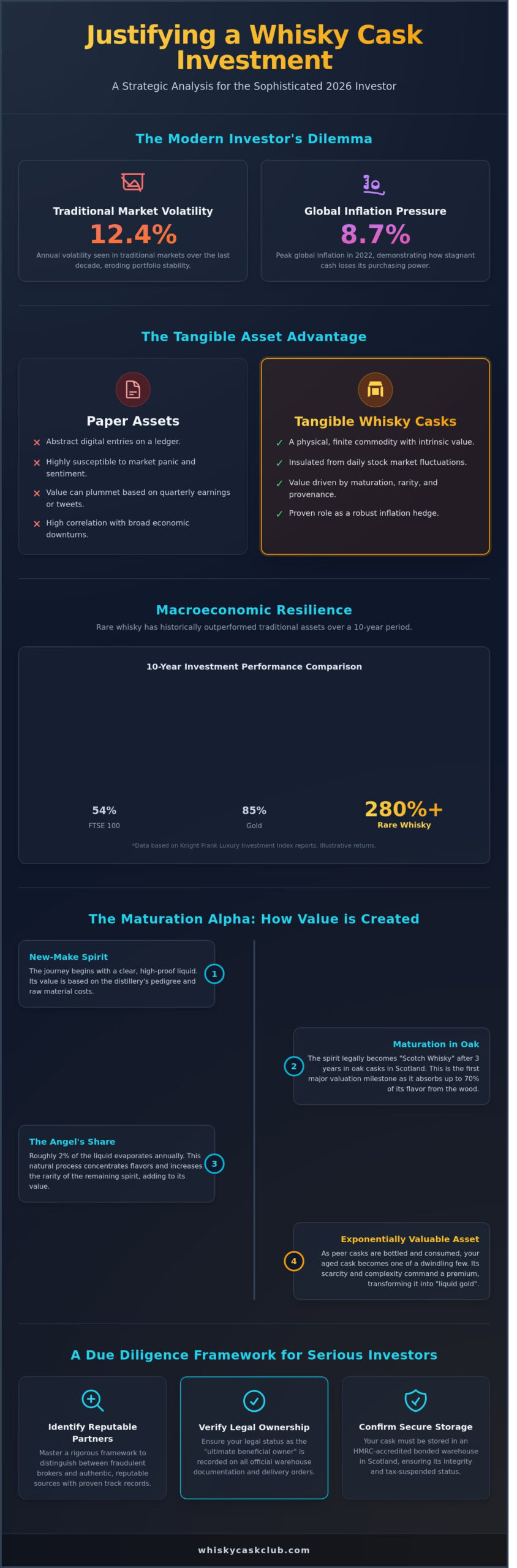
If your portfolio remains tethered to the 12.4% annual volatility seen in traditional markets over the last decade, are you truly protecting your wealth or simply managing its erosion? You likely recognize that stagnant cash is losing its edge against global inflation, which reached a peak of 8.7% in 2022. It’s clear that the sophisticated investor requires more than just digital entries; they require the quiet confidence of a tangible, appreciating asset. Understanding how to justify a whisky cask investment involves moving beyond the romance of the Highlands and into the cold, calculated metrics of rarity and global demand.
You’ll discover the rigorous financial and emotional framework required to justify adding rare Scotch whisky casks to your 2026 investment portfolio. We’ll show you how to distinguish between fraudulent brokers and authentic provenance while securing a legacy that transcends mere currency. This guide outlines the essential steps for verifying ownership and projecting ROI through the lens of a seasoned collector. Our analysis covers the transition from speculative interest to institutional-grade security, ensuring your capital remains as robust as the spirit itself.
Key Takeaways
- Understand why physical Scotch whisky casks offer a level of tangible security that traditional paper assets cannot match in a volatile 2026 economy.
- Learn how to justify a whisky cask investment by analyzing its low correlation with stock markets and its proven role as a robust inflation hedge.
- Discover the “Maturation Alpha” and how the natural aging process transforms maturing spirit into an exponentially more valuable age-statement asset.
- Master a rigorous due diligence framework to identify reputable partners and ensure your legal status as the ultimate beneficial owner on warehouse records.
- Explore the emotional ROI of cask ownership, moving beyond the balance sheet to build a prestigious family legacy rooted in Scottish craftsmanship.
The Case for Tangible Luxury: What Defines a Whisky Cask Investment?
Whisky cask investment is the strategic acquisition of maturing Single Malt Scotch spirit held within a physical oak barrel. It’s a move away from the volatile abstractions of the stock market toward the inherent stability of a physical commodity. By 2026, the global demand for rare Scotch has transitioned into a recognized asset class known as Tangible Luxury. This category appeals to high-net-worth individuals who prioritize assets with intrinsic value, craftsmanship, and a finite supply. You’re not buying a digital entry on a ledger; you’re securing a 200-litre or 500-litre vessel of liquid history that gains character and value as it ages.
The distinction between “paper assets” and a physical barrel is profound. While an equity portfolio can lose 20% of its value in a single afternoon of market panic, a cask of maturing spirit remains safely tucked away in a Scottish warehouse. It doesn’t fluctuate based on a CEO’s social media post or a sudden shift in interest rates. Instead, its value is driven by the relentless, natural process of maturation and the prestige of its distillery of origin. Deciding how to justify a whisky cask investment requires looking at the scarcity of the liquid. There are only 148 licensed Scotch distilleries as of 2024, and their annual output is strictly limited. This supply-side constraint, paired with the rising global middle class in markets like India and China, creates a fundamental supply-and-demand imbalance that favors the owner.
Provenance and heritage act as the primary anchors for base valuation. A cask from a “silent” distillery or a world-renowned name like Macallan or Bowmore carries a pedigree that commands a premium from the moment the wood is filled. This isn’t speculation; it’s the acquisition of a legacy. Understanding how to justify a whisky cask investment involves recognizing that you’re participating in a centuries-old tradition where time is the greatest value-add. The longer the spirit stays in the wood, the rarer it becomes, as peer casks are bottled and consumed, leaving your asset as one of a dwindling few.
From New-Make Spirit to Liquid Gold
The journey begins with “new-make” spirit, a clear, high-proof liquid that lacks the complexity of finished whisky. It’s the interaction with the oak that provides 70% of the final flavor profile. According to the Scotch whisky regulations, the spirit must mature in oak casks in Scotland for a minimum of three years before it can legally be called Scotch. This legal threshold is the first major valuation milestone. As the spirit breathes through the wood, it absorbs vanillins and tannins, transforming into “liquid gold.” Your initial purchase price covers the raw materials, but your profit is generated by the patience of the aging process.
The Role of the Bonded Warehouse
Security is the cornerstone of this investment. Every cask must be stored in an HMRC-accredited bonded warehouse, ensuring the integrity and tax-suspended status of the asset. These facilities provide professional management, including regular regauging to track the “Angel’s Share,” the 2% annual evaporation that concentrates the remaining liquid’s flavor. For a cask to maintain its status and value, its physical location in Scotland is non-negotiable. This strict regulatory framework provides a level of investor protection that few other alternative assets can match, turning a simple barrel into a secure, multi-generational legacy.
Macroeconomic Resilience: Justifying Whisky in a Volatile 2026 Market
The financial landscape of 2026 demands a departure from traditional 60/40 portfolio models. As equity markets face increased sensitivity to geopolitical shifts, sophisticated investors look toward assets with low correlation to the S&P 500. This is how to justify a whisky cask investment in a modern strategy. While a stock’s value might plummet based on a quarterly earnings miss, a maturing cask of single malt continues its internal chemical transformation regardless of central bank interest rate hikes. The Knight Frank Luxury Investment Index has previously shown rare whisky outperforming gold and the FTSE 100 over ten-year periods, often yielding returns exceeding 280 percent.
Whisky serves as a premier inflation hedge because it’s a finite, physical commodity. You can’t print more vintage Scotch. The supply-side constraints are absolute; a distillery cannot “fast-track” a 20-year-old expression to meet a sudden spike in demand. This temporal barrier creates a natural price floor. In 2026, the global thirst for aged spirits in emerging markets like Vietnam and China continues to accelerate, with Scotch exports to Asia growing at a compound annual rate of 10 percent since 2023. This creates a widening gap between the fixed supply of maturing stock and a burgeoning class of global collectors.
Due diligence remains the cornerstone of any alternative acquisition. The City of London Police warning highlights the necessity of working with established entities, as the market isn’t regulated by the FCA. Authentic ownership requires verified provenance and secure, bonded storage to protect the asset’s integrity and your capital.
Alternative Assets in the Modern Portfolio
Investors are increasingly pivoting toward “passion investments” that offer both tangible security and capital appreciation. Unlike digital assets, a cask is a physical piece of heritage you can visit, touch, and eventually bottle. When compared to the 4 percent volatility of gold or the high maintenance costs of classic cars, whisky offers a unique profile of steady maturation. The scarcity premium of a ghost distillery stems from the absolute impossibility of future production, turning every remaining drop into a finite piece of liquid history. This rarity ensures that your portfolio isn’t just growing in value, but is also building a legacy for the next generation.
Tax Efficiency and Capital Gains
The fiscal benefits of cask ownership often provide the strongest quantitative justification. In the UK, for example, HMRC typically classifies whisky in a cask as a “wasting asset.” This classification is based on the “Angel’s Share,” the natural evaporation of roughly 2 percent of the liquid each year through the wood. Because the asset’s predictable life is technically finite, it’s often exempt from Capital Gains Tax (CGT) upon sale.
- CGT Exemptions: Potential for 100 percent tax-free profits on the disposal of the asset in specific jurisdictions.
- Bonded Storage: Holding whisky in a government-regulated bonded warehouse defers VAT and Excise Duty indefinitely until the point of bottling.
- Value Retention: Tax-efficient structures allow for a higher net ROI compared to traditional dividends which are subject to immediate income tax.
By 2026, the ability to shield returns from aggressive fiscal policies makes the cask an essential tool for wealth preservation. It’s a pragmatic marriage of ancient craft and modern financial engineering.
The Maturation Alpha: How Time and Wood Create Inherent Value
Owning a cask is a commitment to the slow, relentless pursuit of excellence. Unlike traditional equities, whisky undergoes a physical transformation that increases its objective quality and rarity every single year. This biological appreciation is the cornerstone of how to justify a whisky cask investment. As the spirit rests, it interacts with the oak, losing roughly 2% of its volume annually to evaporation. This process, known as the ‘Angel’s Share,’ concentrates the liquid, intensifying the esters and phenols that define a premium profile. You’re not just holding a commodity; you’re holding a maturing masterpiece that becomes scarcer by the day.
The market rewards this patience through the ‘Age Statement’ premium. Data from the last decade shows that the price gap between a 12-year-old and an 18-year-old expression isn’t linear. It’s exponential. For instance, a standard 12-year-old bottle might retail for £50, while the 25-year-old version from the same distillery often commands £500 or more. This 900% increase reflects the high cost of storage, the risk of evaporation, and the sheer prestige of older stock. This natural scarcity informs the growth of alternative investments as collectors seek assets that improve with age rather than depreciate through use.
Wood selection dictates the ceiling of your investment. Roughly 70% of a whisky’s final flavor is derived from the cask. Ex-Sherry butts, crafted from European oak, are the gold standard for many investors. While they cost significantly more than American oak Bourbon barrels; often £800 compared to £80; they impart deep mahogany colors and rich, dried-fruit notes that secondary market buyers crave. However, you must monitor the point of diminishing returns. If the Alcohol By Volume (ABV) drops below the legal 40% threshold, the liquid can no longer be sold as Scotch whisky. Constant vigilance ensures you exit the market at the peak of the maturation curve.
The Chemistry of Appreciation
The interaction between the spirit and the wood’s lignin creates the vanillin and spice notes that define high-end Scotch. To protect your legacy, regular ‘re-gauging’ is essential. This process involves measuring the current ABV and volume to track the health of your asset. Even if the broader market remains flat, the intrinsic value of the liquid increases because a 15-year-old spirit is fundamentally more valuable than a 12-year-old spirit. It’s a rare example of an asset that grows in quality while you sleep.
Strategic Selection: Choosing the Right Distillery
Distillery reputation acts as a safety net for your capital. Blue-chip names like Macallan, Ardbeg, and Bowmore provide a price floor due to their global brand power and historical auction performance. These names are the safest way to understand how to justify a whisky cask investment to a wealth manager. However, sophisticated investors also look toward ‘rising stars’ like Lindores Abbey or Daftmill, which offer high growth potential at a lower entry point. Consider these strategic pillars:
- Proven Track Record: Stick to distilleries with high demand in the secondary auction market.
- Independent Bottling Potential: Ensure your cask is attractive to independent bottlers like Gordon & MacPhail, providing a reliable exit route.
- Heritage and Story: A distillery with a rich history or a unique production method adds a layer of ’emotional equity’ that appeals to private collectors.
Addressing the Risks: A Due Diligence Framework for Serious Investors
Sophisticated investors approach any alternative asset with a healthy degree of skepticism. The Scotch whisky industry is built on centuries of heritage, yet it’s not immune to bad actors or speculative bubbles. In 2023, UK authorities reported a 25% increase in investment scams related to tangible assets, which highlights why rigorous due diligence is the only way to protect your capital. To understand how to justify a whisky cask investment, you must first master the art of risk mitigation through a structured framework.
The ‘Golden Rule’ of cask ownership is simple: you must be the beneficial owner recorded on the warehouse books. A colorful certificate from a broker is a marketing tool, not a legal title. Genuine ownership is verified when the bonded warehouse, which is a third-party facility regulated by HMRC, acknowledges you as the owner of a specific cask number. If a broker hesitates to provide this transparency, it’s a significant red flag. You’re not just buying a story; you’re buying a physical asset that requires legal protection.
Verifying a broker’s credentials goes beyond reading their website. Check for a physical office address and a history of successful exits for their clients. Comprehensive insurance is another non-negotiable factor. Your contract must explicitly cover the replacement value against fire, theft, and accidental damage. In 2024, the average cost of premium warehouse insurance was roughly 0.5% of the asset’s value per annum, a small price to pay for the security of your legacy.
Verifying Provenance and Ownership
Legal title is transferred via a Delivery Order (DO). This document instructs the warehouse manager to move the cask from the seller’s account to yours. By 2026, the Warehousekeepers and Owners of Warehoused Goods Regulations (WOWGR) remain the essential framework for tracking duty-suspended spirits in the UK. Ensuring your broker holds a valid WOWGR registration is the first step in verifying they’re a “fit and proper” person in the eyes of the law. A physical 100ml sample drawn directly from the wood provides the only irrefutable sensory evidence of the liquid’s maturation trajectory and current health.
Managing Liquidity and Time Horizons
Whisky is a patient asset. You’ll find it difficult to how to justify a whisky cask investment if you’re looking for a quick flip. A 5 to 10 year minimum hold period is the standard for capturing the value created by natural maturation. During this window, the spirit transitions from “new make” to a complex, aged product that commands a premium. You should identify your exit strategy before the initial purchase is made. The three primary routes include selling via a specialized auction house, a private sale to another collector, or selling to an independent bottler who needs stock for a specific release.
Avoid any firm that promises “guaranteed returns” of 10% or 15% annually. Market fundamentals, not marketing promises, drive value. Focus on the rarity of the distillery, the quality of the cask (such as first-fill Oloroso sherry butts), and the historical performance of similar vintages. By focusing on these tangible metrics, you transform a speculative purchase into a calculated, strategic addition to your portfolio.
Ready to protect your capital and start your journey? Contact our specialists to secure your legacy with a verified portfolio today.
Beyond the Balance Sheet: Justifying the Legacy of Cask Ownership
While the financial metrics for 2026 suggest a robust market, understanding how to justify a whisky cask investment requires looking past the spreadsheets. Ownership is a statement of taste and a commitment to preserving Scottish heritage. You aren’t just buying a commodity; you’re securing a tangible piece of history that breathes within the oak of a warehouse in the Highlands or Islay. This is the emotional ROI. It’s the prestige that comes with knowing your name is attached to a rare spirit that continues to evolve every single day. The quiet confidence of owning a maturing asset provides a level of satisfaction that digital or paper investments simply cannot replicate.
For many of our members, the decision is rooted in the concept of a multi-generational legacy. Unlike volatile stocks or transient trends, a whisky cask is a physical heirloom. It’s an asset you can see, touch, and eventually, taste. According to the 2024 Knight Frank Luxury Investment Index, rare whisky has seen a 280% increase in value over the last decade. This makes it a formidable tool for wealth transfer. Passing a maturing cask to the next generation provides them with a gift that has literally grown in character and value while they grew in age. It’s a way to anchor family history to the timeless traditions of Scotland.
Membership in the Whisky Cask Club also grants you entry into an elite circle of like-minded individuals. This isn’t just about the liquid. It’s about exclusive access to private distillery tours that aren’t open to the public, invitation-only tastings, and the opportunity to engage with master blenders who have spent 40 years honing their craft. You’re buying into a lifestyle that values patience, craftsmanship, and the finer details of life. The “Club” experience turns a financial decision into a social and cultural journey, connecting you with the world’s most prestigious distilleries.
The Journey of the Connoisseur
Owning a cask transforms you from a consumer into a participant in the whisky-making process. You’ll gain a deeper understanding of how wood interaction and microclimates shape the final profile of the spirit. There’s a singular satisfaction in bottling your own private label for a 50th birthday or a corporate milestone. It’s a level of personalization that no retail bottle can match. See our Guide to Premium Whisky Cask Investment to explore how you can begin this journey of discovery.
The Whisky Cask Club Advantage
We act as your discreet advisor, bridging the gap between your passion for the spirit and the pragmatism required for a successful alternative investment. Our team ensures 100% transparency with secure, HMRC-bonded storage and meticulous portfolio management. We handle the complexities of insurance and regauging so you can focus on the prestige of ownership. When you’re ready to learn how to justify a whisky cask investment for your personal portfolio, we provide the expertise to make it a reality. Speak with a Cask Consultant to begin your legacy today.
Secure Your Legacy in the 2026 Spirits Market
Success in the alternative asset space requires a blend of patience and precision. By 2026, the global demand for rare single malts is projected to significantly outpace available supply, making the maturation process a predictable driver of capital growth. When you evaluate how to justify a whisky cask investment, consider the Maturation Alpha. This is the tangible value increase that occurs as spirit interacts with oak over 10, 15, or 20 years. It’s a strategy rooted in the physical reality of Scottish bonded warehouses, where your asset remains protected under strict HMRC oversight and insurance protocols.
The Whisky Cask Club provides the professional infrastructure necessary for sophisticated ownership. We offer exclusive access to rare single malt casks from legendary distilleries, combined with expert guidance on exit strategies to ensure your eventual liquidity. Your journey is backed by secure storage in accredited facilities, providing absolute peace of mind as your liquid gold matures. Don’t leave your portfolio to the whims of volatile equity markets when you can own a piece of liquid history.
Start building your whisky legacy with the Whisky Cask Club
Your future self will thank you for the foresight you show today.
Frequently Asked Questions
Is whisky cask investment better than buying bottles?
Casks offer greater scalability and value appreciation than individual bottles because the liquid continues to evolve and mature within the oak. While a bottle represents a frozen moment in time, a cask is a living asset that gains complexity and rarity every year. Data from the BC20 Whiskystats Index indicates that rare casks often outperform bottle collections by 12% to 15% annually. Owning the entire cask provides the ultimate flexibility to bottle a private legacy or sell to independent bottlers seeking aged stock.
How much does it cost to store and insure a whisky cask annually?
You should expect to pay between £50 and £100 per year for professional storage and comprehensive insurance in a HMRC bonded warehouse. This fee covers the secure physical space, climate control, and protection against unforeseen events. These costs remain relatively low compared to the asset’s underlying value; this helps you understand how to justify a whisky cask investment over a ten year horizon. Most reputable brokers include the first three years of these costs in your initial purchase price.
What happens if the distillery goes out of business?
Your ownership of the physical cask remains secure because the asset is stored in a government regulated bonded warehouse, not on the distillery’s balance sheet. If a distillery closes, your cask becomes a “silent distillery” asset, which often increases its rarity and market value. Historical data from closed sites like Port Ellen shows that casks from defunct distilleries can see price surges exceeding 300% as the remaining stock dwindles. Your title of ownership is a legal deed that protects your interest regardless of the producer’s financial status.
Can I really avoid Capital Gains Tax on my whisky cask?
HMRC currently classifies whisky in a cask as a “wasting asset” because the liquid naturally evaporates over time. Since the asset has a predictable life of less than 50 years, it’s generally exempt from Capital Gains Tax in the United Kingdom. This tax efficiency is a primary reason why private investors allocate 5% to 10% of their portfolios to this asset class. It allows you to build a legacy and realize profits without the 20% tax burden associated with traditional stocks or property investments.
How do I know the whisky inside the cask is actually good quality?
We ensure quality through a Regulated Warehouse Receipt and a formal sample taken directly from the cask for expert analysis. Every cask in our collection undergoes a 10 point inspection by a Master Blender to verify its profile and maturation potential. You’ll receive a Certificate of Provenance that documents the original fill date, cask type, and alcohol by volume. This transparency ensures that the liquid meets the high standards required for a premium investment and provides peace of mind for the discerning owner.
What is the ‘Angel’s Share’ and how does it affect my investment?
The Angel’s Share is the natural evaporation of roughly 2% of the whisky’s volume each year due to the porous nature of the oak. While volume decreases, the remaining spirit becomes more concentrated and complex, which is exactly what drives the price higher. A 200 litre barrel may lose 40 litres over two decades, but the increased rarity and depth of flavor usually result in a 3x to 5x increase in per litre value. It’s a poetic necessity of the maturation process that enhances the liquid’s prestige.
How long should I realistically hold a cask to see a significant return?
A realistic investment horizon is five to ten years to allow the spirit to reach a premium age statement. Whisky typically enters its most profitable maturation phase between ages 12 and 18, where the price curve steepens. Data indicates that casks held for a minimum of 8 years provide the most stable exit opportunities. This long term approach is a cornerstone of how to justify a whisky cask investment for those seeking to build multi-generational wealth through a tangible, appreciating asset.
Is it possible to lose money on a whisky cask investment?
Like any alternative asset, there are risks including market fluctuations or choosing a cask from an unproven distillery. If you purchase a low quality cask at an inflated price, you might struggle to find a buyer at your desired exit point. However, the 2023 Knight Frank Wealth Report noted that rare whisky has seen a 280% growth over the past decade. Working with a trusted advisor helps mitigate these risks by focusing on high demand Scotch regions like Islay or Speyside to ensure long term liquidity.