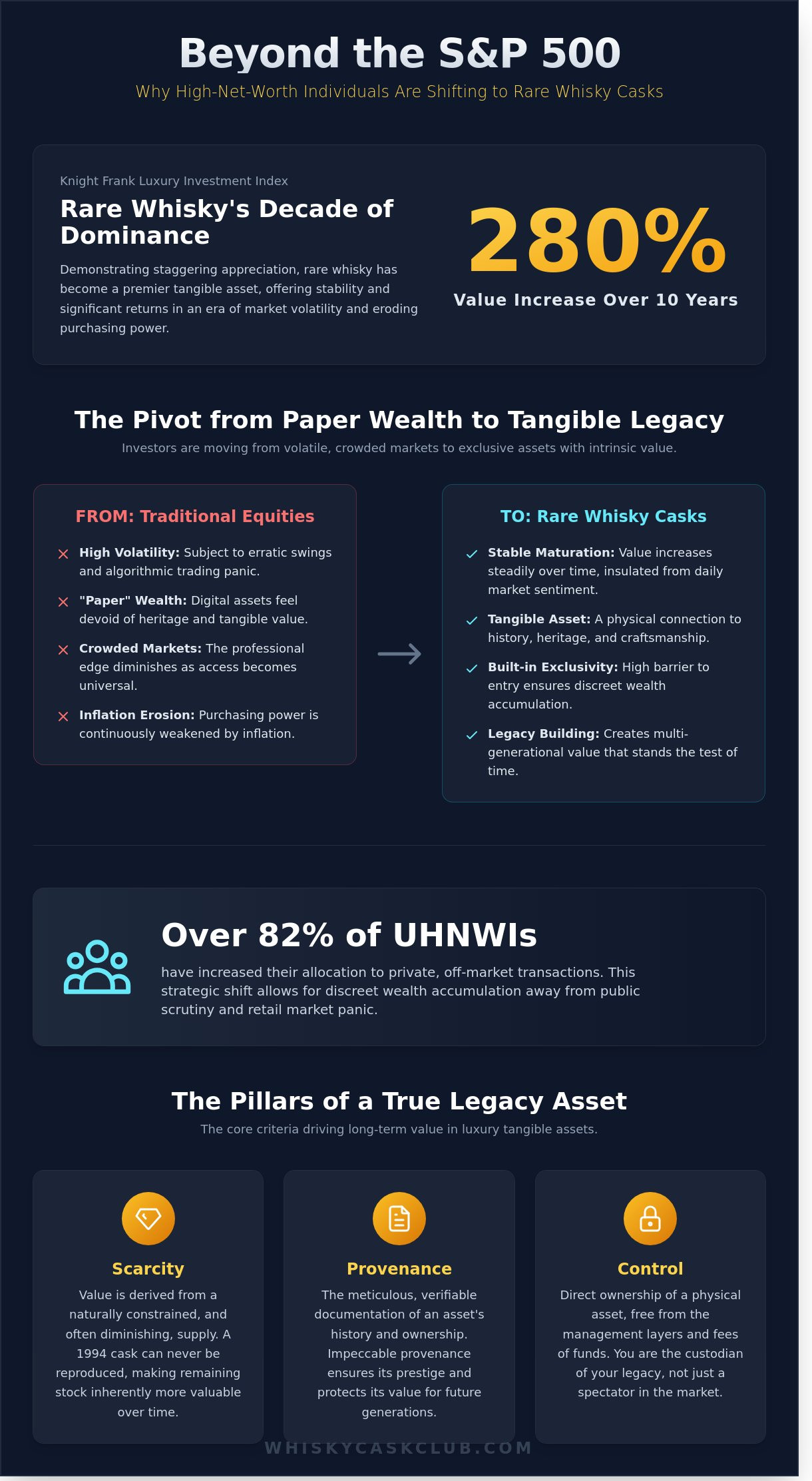
In 2024, the Knight Frank Luxury Investment Index highlighted that rare whisky has outperformed many traditional assets with a 280% value increase over the past decade. It’s a staggering figure that explains why savvy capital is moving away from the erratic swings of the S&P 500. As we look toward 2026, the search for exclusive investment opportunities for HNWIs has shifted from digital screens to the cool, damp air of bonded warehouses in Scotland. You’ve likely noticed that traditional equities no longer provide the same sense of security or the narrative depth your portfolio deserves. Inflation continues to erode purchasing power, while paper assets often feel devoid of the heritage that defines a true legacy.
We understand that your wealth represents more than just a balance sheet; it’s a testament to your hard work and a gift for future generations. This guide will show you how to pivot from volatile public markets into the discrete, high-growth world of luxury tangible assets and Scotch whisky casks. You’ll learn how to diversify your holdings with a rare piece of history that offers consistent mid-to-long term ROI. We’ll examine the specific market drivers for 2026 and provide a roadmap for acquiring casks with impeccable provenance.
Key Takeaways
- Understand why the 2026 economic landscape requires a sophisticated shift from volatile public markets toward the security and permanence of tangible luxury assets.
- Identify the critical pillars of exclusive investment opportunities for HNWIs, where scarcity and verifiable provenance act as the ultimate drivers of long-term appreciation.
- Compare the risk profiles of private equity against the steady maturation of physical assets to determine the ideal balance for your patient capital.
- Learn the strategic allocation rules for integrating alternative tangibles into a global wealth plan, ensuring stability across major financial hubs like London and Singapore.
- Discover how to build a meaningful, multi-generational legacy through a bespoke ownership model that grants direct access to the world’s most prestigious Scotch distilleries.
Beyond the S&P 500: Why HNWIs are Seeking Tangible Exclusivity in 2026
Exclusive investment opportunities for HNWIs are high-barrier-to-entry assets with non-correlated market movement. As we move through 2026, the global financial landscape has shifted away from the predictable growth patterns of the previous decade. High-net-worth individuals are no longer satisfied with the “paper wealth” found in traditional brokerage accounts. The volatility of 2025 proved that digital numbers on a screen can vanish in a single afternoon of algorithmic trading. Instead, the elite are turning toward tangible assets that offer a physical connection to value. This isn’t a mere trend; it’s a fundamental reimagining of what it means to be wealthy in an era of rapid inflation and geopolitical uncertainty.
Traditional diversification, once the gold standard of wealth management, is failing to provide the protection it once promised. When global markets are tightly interconnected, a dip in one sector often triggers a cascade across all public indices. To find true security, sophisticated investors are looking for alternative investments that exist outside the reach of daily market sentiment. There’s a profound psychological appeal in “passion investments” that carry intrinsic historical value. Owning something rare, like a pre-war vintage or a hand-crafted whisky cask, provides a sense of quiet confidence that a stock certificate simply can’t replicate. It’s about the weight of the asset in your hand or the history stored in a cellar.
The Decline of Public Market Alpha
Public markets have become increasingly crowded, leaving little room for the significant returns that ultra-wealthy investors require. When every retail trader has access to the same assets through a mobile app, the professional edge disappears. Data from early 2026 indicates that over 82% of UHNWIs have increased their allocation to private, off-market transactions. These exclusive investment opportunities for HNWIs allow for discreet wealth accumulation away from the prying eyes of the general public. Exclusivity acts as a natural hedge against retail market panic; if an asset isn’t traded on an open exchange, it isn’t subject to the irrational sell-offs that plague the S&P 500.
The Rise of the “Legacy Asset”
The focus of the world’s wealthiest families has shifted from short-term gains to the creation of multi-generational wealth. We’re seeing a surge in the acquisition of “legacy assets.” These are physical items like fine art and rare spirits that act as stable stores of value across decades. For example, rare whisky has shown a consistent 10-year growth rate of approximately 280% in recent luxury investment reports. Provenance is the key driver here. The meticulous documentation of an asset’s history ensures its prestige and value remain intact for the next generation. It’s about more than profit; it’s about building a legacy through craftsmanship and heritage that will stand the test of time.
The 2026 investor values the story as much as the spreadsheet. They want to know where their asset came from, who cared for it, and why it’s unique. This move toward curated, tangible luxury represents a return to the roots of true wealth. By moving beyond the crowded public trades, HNWIs are reclaiming their autonomy and securing their financial future with assets that offer both beauty and brawn. It’s a journey from being a mere spectator in the market to becoming a custodian of history.
Criteria for Exclusive Investment Opportunities: Scarcity, Provenance, and Control
Sophisticated investors recognize that capital preservation is only half the battle. To truly grow wealth, you must seek assets where supply is naturally constrained. This is the core of exclusive investment opportunities for HNWIs. While traditional markets fluctuate based on sentiment, exclusive assets derive value from a mathematical impossibility of oversupply. If a distillery only produced 100 casks in 1994, that number can never increase; it only diminishes as bottles are drawn, making the remaining liquid more valuable every year.
Direct ownership offers a level of security that paper assets lack. Many HNWIs are moving away from pooled funds where they’re merely a line item on a spreadsheet. They want to own the underlying asset. This desire for control is why tangible luxury items have outperformed the S&P 500 in specific decades. When you own the physical asset, you control the exit strategy. You aren’t at the mercy of a fund manager’s redemption schedule or a sudden market sell-off. It’s a pragmatic approach to building a legacy that survives economic cycles.
Identifying True Scarcity in a Global Market
Luxury is often confused with exclusivity. A high price tag doesn’t guarantee rarity. True exclusivity is defined by a barrier to entry that capital alone can’t overcome: time. In the world of aged spirits, time is the ultimate gatekeeper. According to the Knight Frank Luxury Investment Index, rare whisky saw a 373% increase in value over the ten years leading into 2023. This growth is fueled by the finite nature of aged single malt Scotch. You can’t manufacture a 30 year old whisky today; you had to start three decades ago.
Provenance and the Accredited Supply Chain
Verification is the “DNA” of a high-value asset. HNWIs must demand “Distillery to Bonded Warehouse” documentation to ensure the asset’s integrity. Without a clear paper trail, even the rarest item loses its marketability. The European Union Intellectual Property Office reported that counterfeit spirits cost the global industry approximately $3.18 billion in 2022. This makes independent audits and secure storage non-negotiable. Every cask must be registered with a Delivery Order (DO) that proves legal title, ensuring your investment is protected from the moment of purchase.
Whisky Cask Club ensures absolute transparency by sourcing directly from the most prestigious Scottish distilleries. We provide our members with full titles of ownership and certificates of authenticity for every acquisition. This meticulous approach removes the guesswork from exclusive investment opportunities for HNWIs, allowing you to focus on the long-term appreciation of your portfolio. Our process includes regular regauging and independent warehouse checks to verify the health and volume of the spirit as it matures.
Success in this space requires a partner who understands both the passion of the collector and the pragmatism of the investor. It’s about more than just buying a product; it’s about securing a piece of history. If you’re ready to move beyond traditional equities, you might consider how to build a legacy through rare spirits with a team that prioritizes asset security above all else.
Control also extends to the physical environment. We utilize government-regulated bonded warehouses in Scotland, where the climate is ideal for slow, steady maturation. This isn’t just a storage solution; it’s a value-add strategy. By maintaining the spirit in its original wood within the Scottish borders, the asset retains its “Scotch Whisky” designation, a legal protection that maintains its global premium. It’s a secure, transparent, and highly disciplined way to manage alternative wealth.
Comparing High-Yield Alternatives: Private Equity vs. Luxury Tangible Assets
Sophisticated wealth management requires a balance between aggressive growth and capital preservation. While traditional equities provide a baseline, exclusive investment opportunities for HNWIs often center on the tension between institutional private equity and the rising allure of tangible luxury assets. The risk profiles of these two worlds differ fundamentally. Venture capital and private equity rely on the power law, where a few breakout successes must compensate for a 75% failure rate among early-stage startups. In contrast, maturing physical assets like rare whisky casks or blue-chip art offer a different trajectory. Their value isn’t tied to a founder’s performance or a tech pivot, but to the relentless, predictable march of time and chemical maturation.
Patience is the price of entry for these high-yield alternatives. Private equity funds typically operate on a 10-year “patient capital” cycle, locking liquidity until a specific exit event occurs. Luxury tangibles share this long-term horizon but offer more flexible exit strategies. You aren’t waiting for an IPO; you’re waiting for a specific age statement or a market peak. This holding period is rewarded by unique tax considerations. In the UK, for instance, HMRC often classifies whisky casks as “wasting assets” because the spirit naturally evaporates over time. This classification means they’re frequently exempt from Capital Gains Tax, a significant advantage for those looking to maximize net returns on a seven-figure portfolio.
The “Enjoyment Factor” provides a dual-utility that no spreadsheet can replicate. It’s the intersection of passion and pragmatism. While a hedge fund statement is purely numerical, owning a physical asset allows for a deeper connection to the investment. Whether it’s the provenance of a rare vintage or the craftsmanship of a hand-hewn cask, these assets provide a sense of stewardship. You’re not just holding a ticker symbol; you’re building a legacy that can be tasted, displayed, and shared.
Private Equity and Hedge Funds: The Institutional Standard
Top-tier funds remain a cornerstone for many, yet they come with significant barriers. Entry requirements for elite private equity firms often start at $1 million, accompanied by the traditional “2 and 20” fee structure. This includes a 2% annual management fee and 20% of any profits. Investors also face the “Black Box” problem, where transparency is limited and you’ve little say in the underlying companies. When institutional shifts occurred in 2023, many HNWIs found their portfolios over-exposed to private tech valuations that didn’t reflect the new high-interest-rate environment.
Luxury Tangibles: The New Frontier of Wealth Preservation
Tangible assets have moved from the periphery to the center of modern portfolios. Rare whisky has been a standout performer, with the Knight Frank Luxury Investment Index reporting a 280% increase in value between 2013 and 2023. This growth outpaced the S&P 500 and gold during the same period. While fine art requires climate-controlled storage and high insurance premiums, whisky casks offer a more robust storage profile in bonded warehouses. These are some of the most compelling exclusive investment opportunities for HNWIs because the asset’s scarcity is built into its biology.
Scotch whisky’s value is driven by the “Angel’s Share,” the 2% of liquid that evaporates from the cask each year. This isn’t a loss; it’s a mechanism for rarity. As the volume of the spirit decreases, its complexity and age statement increase. By the time a cask reaches 25 or 30 years of age, the remaining liquid is a fraction of its original volume, making it an incredibly rare commodity. This natural scarcity, combined with the global demand for aged Scotch, creates a price floor that few digital or paper assets can match.
Strategic Portfolio Diversification: Integrating Alternative Assets into a Global Wealth Plan
Wealth preservation requires more than just traditional equities and bonds. Most sophisticated family offices now allocate between 10% and 20% of their total assets to tangible alternatives. This strategy protects capital from the 4.1% average annual inflation seen in major economies during 2023. For those seeking exclusive investment opportunities for HNWIs, whisky casks represent a unique intersection of heritage and hard asset security. They offer a non-correlated hedge against the volatility of public markets.
Managing these assets requires a global perspective. While your wealth management team might be based in Singapore, Hong Kong, or London, the physical asset must reside in its land of origin to maintain its legal status as Scotch. London remains the primary legal hub for these transactions; however, the actual growth happens in the Highlands or Speyside. We facilitate this cross-border management by ensuring all legal titles are clear and recognized internationally. It’s a seamless integration of Scottish tradition into a modern, global wealth plan.
A balanced portfolio shouldn’t rely on a single distillation date. We recommend building a maturation ladder. This involves acquiring a mix of “New Make” spirit for long-term growth and semi-mature casks, typically those aged 8 to 12 years, for mid-term liquidity. By staggering these dates, you create a consistent cycle of capital appreciation. You aren’t just buying whisky. You’re engineering a timeline of value. This approach ensures that your portfolio remains liquid and adaptable to changing market conditions over a 10 to 20 year horizon.
Global Storage and Insurance Standards
Security is the bedrock of any tangible investment. We utilize HMRC-regulated bonded warehouses in Scotland. These facilities are tax-neutral environments where you don’t pay VAT or excise duty while the whisky matures. Every cask is fully insured at replacement value, not just the purchase price. Our portfolio management services include regular regauging to monitor the “Angel’s Share” and ensure the spirit’s health remains optimal for its eventual exit.
Exit Strategies for the Discerning Investor
Knowing when to realize gains is as vital as the initial acquisition. The secondary market for rare malts grew by 21% in 2022, providing ample opportunity for private treaty sales. You might choose to sell your cask back to the distillery, trade it on a secondary exchange, or move to a private auction. For those focused on building a legacy, bottling a portion of your portfolio under a private label offers a bespoke way to celebrate a family milestone or a corporate achievement. It’s the ultimate transition from an investment asset to a personal liquid history.
Success in this space depends on access to the right stock and the right expertise. It’s about more than just the liquid in the wood. It’s about the provenance, the storage, and the strategic timing of your exit. If you’re ready to enhance your global wealth plan with a tangible asset that appreciates with age, it’s time to explore the potential of the warehouse.
Start building your legacy with a curated whisky cask portfolio today.
Building a Liquid Legacy: The Whisky Cask Club’s Bespoke Investment Model
The pursuit of wealth preservation often leads to crowded markets where true rarity is scarce. The Whisky Cask Club provides a different path. We grant our members direct access to the world of premium Scotch whisky, an asset class that has historically outperformed many traditional indices. By facilitating exclusive investment opportunities for HNWIs, we bridge the gap between the ancient craft of distillation and modern portfolio diversification. It’s a strategy built on time, patience, and the physical maturation of a global icon.
Our philosophy is centered on a simple, powerful directive: Own the Cask, Own the Liquid. Unlike fractional ownership schemes or opaque whisky funds, our model ensures you hold the deed to the physical asset. This grants you absolute control over the exit strategy; you decide whether to pursue a private sale, bottle the spirit for a personal label, or continue the maturation process for another decade. We act as a discreet advisor to global family offices, ensuring that every acquisition aligns with a broader legacy-building strategy. You aren’t just buying a commodity. You’re securing a piece of Scottish heritage.
Curated Sourcing and Expert Brokerage
Success in whisky investment depends entirely on the provenance of the spirit. We leverage deep-rooted industry connections to source casks from prestigious distilleries known for their exceptional quality and market appreciation, including established names like Ardmore. For example, certain unpeated Islay malts have consistently seen a steady rise in secondary market demand over the last 10 years. Our team analyzes distillation dates, wood types, and evaporation rates to identify casks with the highest potential for appreciation. We don’t just find whisky. We build bespoke portfolios tailored to your specific liquidity needs and risk profile, focusing on casks that offer both historical significance and future marketability.
The Journey from Purchase to Profit
The transition from investor to cask owner is seamless and secure. Once you select a cask, we handle the legal transfer of ownership and ensure the asset remains in an HMRC-bonded warehouse in Scotland. This environment is crucial for maintaining the spirit’s integrity and its tax-efficient status. Our members enjoy a sophisticated suite of management tools to oversee their holdings:
- Digital Management: Access our secure platform for real-time tracking of your portfolio’s age, warehouse location, and estimated value.
- Provenance Documentation: Receive official certificates of ownership and warehouse receipts that serve as your proof of title.
- Discreet Advisory: Benefit from our brokerage network when you decide the time is right to realize your gains through our global exit channels.
The global Scotch whisky market reached an export value of £5.6 billion in 2023, proving that international appetite for rare spirits remains resilient even in volatile economic climates. Joining our community means more than just adding a line item to a balance sheet. It’s an invitation to join an elite group of connoisseurs who value craftsmanship as much as capital growth. If you’re ready to explore these exclusive investment opportunities for HNWIs, the next step is a personal consultation to define your goals.
Your legacy deserves a tangible foundation. Speak with a Private Wealth Advisor at Whisky Cask Club to begin your journey into the world of rare Scotch whisky.
Securing Your Financial Legacy Through 2026 and Beyond
As we approach 2026, the global wealth landscape demands more than just paper assets. HNWIs are increasingly pivoting toward tangible exclusivity to protect capital from market volatility. By focusing on scarcity and provenance, you can move beyond the 10.2% average annual return of the S&P 500 into assets that offer both emotional and financial value. Scotch whisky has consistently outperformed traditional benchmarks, with the Knight Frank Luxury Investment Index highlighting it as a premier choice for long-term growth. This isn’t just about diversification; it’s about control. You’re securing a piece of history that matures in value while the world fluctuates.
The search for exclusive investment opportunities for HNWIs leads directly to the Highlands. At the Whisky Cask Club, we provide direct access to rare casks from world-renowned Scotch distilleries. Your investment remains protected within HMRC-accredited bonded warehouses, ensuring the highest standards of security and tax efficiency. Our seasoned wealth and whisky specialists provide the expert guidance you need to navigate this sophisticated market with confidence. It’s time to own the liquid and the legacy.
Join the Exclusive Whisky Cask Club and Build Your Legacy
The path to a resilient, multi-generational portfolio is waiting for you.
Frequently Asked Questions
What qualifies as an exclusive investment opportunity for HNWIs?
Exclusive investment opportunities for HNWIs are asset classes with high entry barriers, typically requiring a minimum capital commitment of $100,000. These opportunities include private equity, hedge funds, and rare tangible assets like Scotch whisky casks. According to the Knight Frank Luxury Investment Index 2023, rare whisky has seen a 280% increase in value over the last 10 years. This combination of scarcity and proven appreciation defines a truly elite asset.
How does whisky cask investment compare to traditional stock market returns?
Whisky casks offer a non-correlated alternative to the S&P 500, which dropped by 19.4% in 2022. During that same period, the BC20 Whisky Cask Index reported an average annual return of 14.9%. Since the value of a cask is tied to the physical maturation of the spirit, it doesn’t follow the volatile swings of public markets. This natural aging process provides a stable foundation for any sophisticated investment portfolio.
What are the primary risks associated with luxury tangible assets?
The primary risks involve market liquidity and the physical nature of the spirit. Selling a rare cask isn’t instantaneous; it usually takes 4 to 12 weeks to finalize a sale. You must also account for the “Angels’ Share,” which is the natural evaporation of roughly 2% of the liquid every year. We mitigate these risks by using secure bonded storage and comprehensive insurance to protect your capital from fire or leakage.
How is the ownership of a whisky cask legally verified and secured?
Ownership is legally verified through a Delivery Order or a warehouse receipt issued by an HMRC-regulated bonded warehouse. This document confirms you’re the beneficial owner of a specific cask number. At Whisky Cask Club, we ensure your legal title is recorded in the warehouse register. This transparent process guarantees your rights to the asset while it matures in a tax-suspended environment, providing peace of mind for international investors.
Why are family offices increasingly allocating capital to Scotch whisky?
Family offices use Scotch whisky to preserve multi-generational wealth through tangible assets that hedge against inflation. Many offices now designate 3% to 5% of their total portfolios to alternative investments. Since global demand for aged Scotch grew by 20% in emerging markets during 2023, it’s a strategic move. It allows families to build a legacy with an asset that historically gains value as it reaches the 18 or 25-year mark.
What is the typical minimum investment for a premium whisky cask portfolio?
A premium portfolio typically starts with a minimum investment of £15,000 for casks from emerging distilleries. For blue-chip names like Macallan or Dalmore, entry points often exceed £100,000 per cask. These price points maintain the market’s exclusivity and reflect the rare nature of the inventory. We recommend diversifying across different regions and ages to optimize your potential for long-term capital gains while maintaining portfolio stability.
How does the Whisky Cask Club manage storage and insurance for international clients?
We manage all logistics through a network of HMRC-approved bonded warehouses across Scotland. Each cask is fully insured at its current market value, and we review these policies annually to reflect price appreciation. You don’t need to be in the UK to manage your asset. We handle the administrative requirements, including regauging and sampling, ensuring your investment remains in peak condition while complying with all Scotch Whisky Association regulations.
What are the most common exit strategies for whisky cask investors?
Investors usually choose between three main exit strategies after a 5 to 10-year holding period. You can sell the cask back to the distillery, trade it on a private secondary market, or list it at a specialist auction. Some clients choose to bottle the liquid under a private label for corporate gifting or personal use. We provide the expertise to determine the best timing, ensuring you realize the full value of the matured spirit.