For any serious collector, it is a quiet, persistent concern. As you admire a rare, sealed bottle-a tangible piece of history and a significant asset-a crucial question can surface: does whisky spoil? While it lacks the perishable nature of wine, the belief that a spirit is eternally immune to change is a costly misconception. The life of a whisky is a tale of two distinct environments: the living, breathing oak cask where it achieves its character, and the inert glass bottle where its legacy must be preserved, not enhanced.
Understanding this fundamental difference is paramount for protecting your investment and passion. In this definitive guide, we move beyond the simple answer. We will explore the subtle forces that can degrade a bottled whisky over time and contrast them with the magic of maturation that occurs only in the cask. You will gain the knowledge to implement flawless storage strategies, identify the signs of quality degradation, and secure the enduring value of your collection for generations to come.
The Short Answer: Does Whisky Spoil, Expire, or Go Bad?
For the discerning investor and the passionate connoisseur alike, the question of a spirit’s longevity is paramount. So, does whisky spoil in the way that wine sours or beer goes flat? The direct answer is no. Thanks to its high alcohol content-typically 40% alcohol by volume (ABV) or higher-whisky is a remarkably stable spirit. This potent concentration of ethanol acts as a powerful preservative, effectively preventing the growth of bacteria and microbes that cause spoilage. An unopened bottle of whisky can remain safe to drink for centuries.
However, “safe to drink” and “at its peak value” are two entirely different propositions. While whisky does not spoil, its complex profile of aromas and flavours can certainly degrade over time if not stored correctly. The true key to understanding its longevity lies in distinguishing between its two distinct life stages: maturation in the cask and preservation in the bottle.
Spoilage vs. Degradation: A Critical Distinction for Investors
Understanding the vocabulary is fundamental to protecting your tangible asset. Spoilage implies the liquid has become contaminated and unpalatable, which is exceptionally rare for whisky. Degradation, on the other hand, refers to the slow, subtle breakdown of the desirable chemical compounds that create its signature character. For an investor, this degradation of quality directly impacts the asset’s financial value and the legacy you aim to build.
The Two Lives of Whisky: In the Cask and In the Bottle
A whisky cask is a living vessel. While maturing in oak, the spirit is in a constant state of evolution-breathing, interacting with the wood, and developing the profound complexity that defines its provenance. The entire process of Whisky production and aging is a testament to this transformative craftsmanship. Once bottled, however, this maturation journey comes to an immediate and permanent halt. The goal shifts entirely from development to preservation. This article will guide you through managing both of these critical stages to protect and enhance the value of your investment.
In the Cask: The Active Life of Maturation
When considering the question, does whisky spoil, the answer is a definitive no while it resides in the cask. In fact, the opposite is true. An oak cask is not an inert container; it is a breathable, dynamic vessel where the unaged spirit undergoes a profound transformation. This period, known as maturation, is where the whisky’s true character is forged-a meticulous process of enhancement that adds immense flavour, complexity, and value over years, even decades. Far from spoiling, the spirit is actively improving.
The Magic of Maturation: How Whisky Improves with Age
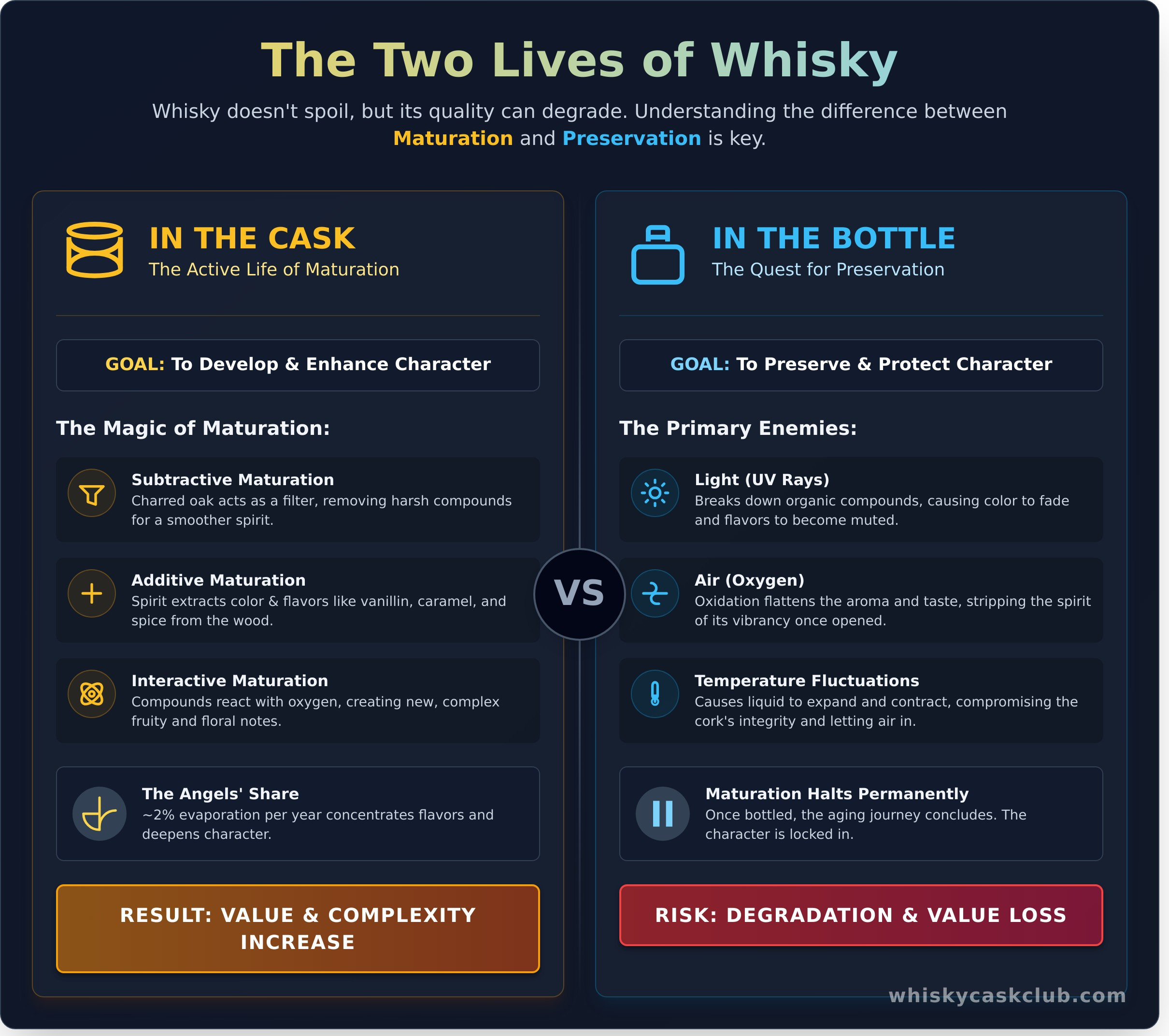
The alchemy that occurs inside the cask is a symphony of three distinct processes. This interaction with oak is so fundamental to the spirit’s provenance that legal definitions, such as the U.S. standards for whisky, mandate its use. These interactions are categorized as:
- Subtractive Maturation: The charred inner layer of the oak acts as a natural filter, removing harsh, sulphury compounds from the raw spirit, resulting in a smoother, more refined liquid.
- Additive Maturation: The spirit acts as a solvent, extracting desirable compounds directly from the wood. This imparts everything from rich colour to notes of vanillin, caramel, and spice from the oak.
- Interactive Maturation: Over time, the compounds from the spirit and the wood react with oxygen and each other, creating new, complex esters that manifest as the fruity and floral notes that define a premium whisky.
The Angels’ Share: A Necessary Loss for a Greater Gain
A clear sign of a healthy, breathing cask is the phenomenon known as the “Angels’ Share.” This is the small amount of spirit-typically around 2% per year in Scotland’s climate-that naturally evaporates through the porous oak. While this means a loss in volume and a gradual reduction in alcohol-by-volume (ABV), it is a crucial part of the maturation journey. This process concentrates the remaining liquid, intensifying its flavours and deepening its character. It is a poetic sacrifice, essential for crafting a truly exceptional spirit.
Why a Cask Will Never ‘Spoil’ in a Bonded Warehouse
A cask of whisky will not spoil because it is protected within the perfect environment: a bonded warehouse. These highly regulated facilities offer cool, dark, and stable conditions, shielding the cask from the temperature fluctuations and light that could harm it. Expert management ensures the cask’s integrity, preventing issues like leaks or excessive evaporation. This meticulous oversight guarantees that your tangible asset is not just aging, but appreciating in a secure, controlled setting. Learn how we manage and secure your cask investments.
In the Bottle: The Quest for Preservation
The moment a whisky is decanted from its cask into a glass bottle, its maturation journey concludes. It enters a state of suspended animation, a perfect snapshot of its age and character at that precise moment. Unlike the dynamic environment of the cask, the bottle is a vessel of preservation, not evolution. An unopened bottle, stored with care, can outlive its owner, its profile remaining unchanged for generations. The true challenge to its integrity begins only when the seal is broken.
The Enemies of Bottled Whisky: Light, Air, and Temperature
To preserve a whisky’s carefully crafted profile, one must guard it against three primary adversaries. A stable, cool, and dark environment is not merely a suggestion; it is a prerequisite for long-term stewardship of a fine spirits collection.
- Light: Direct sunlight is particularly destructive. Its UV rays can break down the organic compounds in the whisky, causing its colour to fade and its complex flavours to become muted over time.
- Air: Once a bottle is opened, oxygen begins its work. This process, known as oxidation, will slowly flatten the aroma and taste, stripping the spirit of its vibrancy.
- Temperature: Extreme or fluctuating temperatures cause the liquid and the air in the bottle to expand and contract. This can compromise the cork’s integrity, allowing air to seep in and accelerate degradation.
How Long Does an Opened Bottle of Whisky Last?
So, does whisky spoil once the cork is popped? Not in the way perishable goods do, but it does begin a slow, inevitable decline. The volume of air in the bottle is the critical factor. As a general rule, a half-full bottle will retain its character for about one to two years. A bottle with only a quarter of the liquid remaining may see a noticeable drop in quality within a few months as the increased oxygen exposure takes its toll.
Does Unopened Whisky Get Better with Age?
It is a common myth that whisky continues to mature in the bottle. This is unequivocally false. A 12-year-old Scotch bottled 50 years ago is still, and will always be, a 12-year-old Scotch. Its flavour profile is fixed. While its financial value may appreciate significantly due to rarity and provenance, its character does not evolve. This perfect preservation is what makes a rare bottle a coveted piece of history. It captures a legacy, whereas owning a cask is the act of building one.
Protecting Your Asset: Proper Storage for Casks and Bottles
Once whisky is secured in glass or remains maturing in wood, its journey is far from over. The method of storage becomes the primary guardian of its quality, character, and ultimately, its value. For both the passionate collector and the serious investor, the goal is the same: to mitigate risk and preserve the inherent worth of the liquid. The question is not simply does whisky spoil, but rather, how do you actively prevent the degradation of this tangible asset over time?
Best Practices for Storing Your Whisky Bottle Collection
For a bottled whisky, stability is paramount. The spirit is in its final state, and your role is to preserve its integrity. Proper storage protects both the flavour profile for enjoyment and the provenance for future resale value. Adhere to these principles:
- Store Upright: Unlike wine, whisky bottles must be stored vertically. The high alcohol content will degrade a cork over time, potentially tainting the spirit and compromising the seal.
- Maintain a Consistent, Cool Temperature: Aim for a stable temperature between 15-20°C (59-68°F). Fluctuations can cause the liquid to expand and contract, damaging the cork and accelerating evaporation.
- Avoid Direct Sunlight: UV rays are the enemy of fine whisky. They can fade the colour and break down the complex organic compounds that create its aroma and flavour. A dark cabinet, cellar, or the original box is ideal.
The Imperative of Professional Cask Storage
For a maturing cask, the requirements are far more stringent and professional management is non-negotiable. Casks must be stored in a government-regulated bonded warehouse. This is critical for several reasons: it defers tax payments, guarantees security and insurance, and provides an unbroken chain of provenance. Within these facilities, climate control is expertly managed to guide maturation and control the rate of evaporation-the “Angel’s Share.” Expert staff regularly monitor the cask’s health, preventing leaks and ensuring the integrity of your investment as it evolves into a rare and valuable spirit.
Signs of Degradation to Watch For
Understanding whether whisky can spoil involves recognising the signs of decline. In a bottle, look for a faded colour, a broken seal, or a significantly low fill level (known as ullage). On the palate, a spoiled or poorly stored whisky may taste flat, oxidised, or ‘papery.’ For a cask, the most critical metric is its strength; if the ABV drops below 40%, it can no longer legally be called Scotch whisky. This is why regular sampling and analysis by the experts at Whisky Cask Club are essential to tracking a cask’s evolution and protecting the legacy you are building.
Beyond the Bottle: Securing Your Whisky’s Future
As we’ve explored, the question of does whisky spoil has a nuanced answer. While a sealed bottle halts the aging process and preserves a moment in time, the true life, character, and appreciation of the spirit unfold within the cask. This understanding is what separates the enthusiast from the investor-it’s the recognition that real value is cultivated during maturation. Protecting this potential, whether in a bottle or a barrel, is the key to safeguarding your asset for generations.
Transforming this knowledge into a tangible legacy is the next step. At Whisky Cask Club, we provide the gateway to this exclusive world. We offer exclusive access to premium Scotch whisky casks, safeguarded in secure, accredited bonded warehouses. With our expert portfolio management and exit strategies, you can confidently turn your passion into a powerful alternative investment. Begin your legacy. Explore the world of whisky cask investment.
Frequently Asked Questions
Can bad whisky make you sick?
Due to its high alcohol content, whisky is a remarkably stable spirit that does not harbor pathogens. Drinking a whisky that has oxidized-meaning it has gone flat or developed off-flavors from prolonged air exposure-will not make you ill. While the tasting experience will be severely compromised, and the spirit’s integrity lost, it poses no health risk. A poorly stored bottle simply loses the complex character and provenance that makes it a premium spirit worth enjoying.
Should you refrigerate or freeze whisky?
We strongly advise against refrigerating or freezing premium whisky. Extreme cold can mute the intricate aromas and complex flavors that define a well-crafted spirit, diminishing the tasting experience. The ideal method for preserving your collection is to store bottles upright in a cool, dark environment with a stable temperature, away from direct sunlight. This ensures the integrity and character of the liquid are maintained, preserving its intended craftsmanship for your enjoyment.
What does it mean if my whisky is cloudy?
Cloudiness in whisky, particularly when chilled, is typically a phenomenon known as ‘chill haze.’ This occurs in non-chill-filtered (NCF) whiskies, where natural oils and fatty acids from the distillation process congeal at low temperatures. Far from being a flaw, this is often a hallmark of exceptional craftsmanship, indicating a spirit with a fuller body and richer flavor profile. The cloudiness is harmless and will usually disappear as the whisky returns to room temperature.
Does adding water or ice to whisky affect its shelf life in the glass?
Once poured, a dram of whisky is intended for immediate enjoyment, so its ‘shelf life’ in the glass is not a practical concern. Adding a drop of water or a cube of ice will not cause the whisky to spoil. The primary effect is dilution and a change in temperature, which can open up new aromatic compounds. However, excessive ice will eventually over-dilute the spirit, muting its carefully crafted profile. The choice is one of personal preference, not preservation.
Why is my old bottle of whisky not worth more money?
The value of a whisky is determined by its maturation in a cask, not its time in a bottle. Unlike fine wine, once bottled, whisky ceases to age or evolve. An 18-year-old whisky bottled 50 years ago remains an 18-year-old whisky. Its value is dictated by factors such as the distillery’s reputation, the rarity of the bottling, its provenance, and market demand. True appreciation in value-the creation of a tangible legacy-occurs during cask maturation.
Can you ‘revive’ a bottle of whisky that has gone flat?
Regrettably, once a whisky has gone flat due to oxidation, the process is irreversible. The delicate aromatic compounds that define its character have dissipated and cannot be recovered. While the question of does whisky spoil in a way that makes it unsafe is a firm no, its quality can be permanently degraded. The best course of action is prevention: ensure your bottles are properly sealed and stored to protect the spirit’s intended complexity and preserve its premium quality.
What is the difference between whisky and whiskey?
The difference in spelling is a matter of regional heritage and tradition. ‘Whisky’ (without the ‘e’) is the spelling used for spirits distilled in Scotland, Canada, and Japan, defining the world of Scotch. Conversely, ‘Whiskey’ (with an ‘e’) is the preferred spelling for spirits crafted in Ireland and the United States. While the spelling differs, both terms refer to a spirit distilled from a fermented grain mash and aged in wooden casks, each with its own unique provenance.