There it sits, a pillar of amber liquid in a beautifully crafted bottle-a rare single malt, a cherished bourbon, a testament to years of patience and provenance. For any connoisseur, such a bottle is both a pleasure and a responsibility. This brings forth a crucial question that can trouble even the most seasoned collector: does whiskey go bad? The fear of a prized possession losing its complex character, or worse, spoiling entirely, is a valid concern for anyone who values the integrity of this exceptional spirit.
This guide offers the definitive answer. We will provide the clarity and confidence you need to manage your collection, detailing the simple principles for storing both sealed and opened bottles to preserve their quality. Beyond mere preservation, however, we will illuminate the fundamental difference between a spirit that is static in the bottle and one that is alive in the cask. You will understand not only how to protect your investment but also where the true, value-appreciating transformation of whiskey occurs: within the wood, over time.
Key Takeaways
- While the direct answer to ‘does whiskey go bad’ is no, its inherent stability is only the beginning of its journey toward appreciating in value.
- Learn how to properly store your bottles to protect their complex character from the degrading effects of light, air, and temperature fluctuations.
- Discover the crucial distinction between a preserved bottle-a static snapshot in time-and a maturing cask, where true transformation and value creation occur.
- Understand why whiskey’s chemical resilience makes it a premier tangible asset, underpinning a sophisticated and legacy-focused investment strategy.
The Direct Answer: Does Whiskey Expire?
For the discerning collector and the passionate enthusiast, the question does whiskey go bad has a reassuringly simple answer: no. Unlike perishable goods, a bottle of whisky will not spoil or become unsafe to consume. Its high alcohol content acts as a natural preservative, effectively preventing the growth of bacteria that would cause it to turn rancid. This inherent stability is a hallmark of the spirit, setting it apart from more delicate beverages like wine or beer, which can easily spoil.
However, the simplicity of this answer belies a crucial distinction. While whisky does not expire in a traditional sense, its quality and character are not eternally fixed. The spirit can, and will, change over time, particularly after the seal is broken. The conversation thus shifts from one of safety to one of preserving the integrity of the spirit’s intended profile.
For Unopened Bottles: A Time Capsule
An unopened bottle of whisky, stored correctly, is a veritable time capsule. It can preserve the liquid’s exact character for decades, even generations, offering a glimpse into the craftsmanship of a bygone era. The intricate process of how whisky matures occurs exclusively within the porous oak of the cask. The moment it is transferred to an inert glass bottle, this alchemical transformation ceases. The spirit inside is in a static state, its age statement forever locked in. The only significant risk to its longevity is a failure of the cork, which can lead to evaporation and a slow loss of the precious liquid.
For Opened Bottles: The Race Against Oxidation
Once you break the seal and pour that first dram, the clock begins to tick on the whisky’s peak expression. The primary agent of change is oxygen. With each pour, more air enters the bottle, initiating a slow process of oxidation that can subtly alter the spirit. Over months and years, this exposure can dull the vibrant aromas and flatten the complex layers of flavor crafted by the distiller. A half-full bottle, with its greater volume of air, will see these changes occur far more rapidly than a bottle that is nearly full. The whisky remains perfectly safe, but its soul may begin to fade.
The Science of Stability: Why Whiskey Endures
To truly understand the question, “does whiskey go bad?”, one must first appreciate the meticulous science behind its creation. Unlike other spirits or alcoholic beverages, whiskey is engineered for endurance. This remarkable stability is no accident; it is a direct result of a production process honed over centuries. This inherent longevity is a cornerstone of its value and the very reason it can be considered a tangible asset capable of building a legacy.
The spirit’s resilience is built upon two foundational principles of chemistry and craftsmanship, which together create a liquid designed to stand the test of time.
The Power of High Alcohol Content
At its core, alcohol is a powerful natural preservative. With a minimum bottling strength of 40% Alcohol by Volume (ABV), Scotch whisky exists in an environment that is fundamentally inhospitable to the bacteria, yeast, and microbes that cause spoilage. This high-proof shield is a critical distinction from wine or beer, whose lower alcohol content leaves them vulnerable to degradation over a much shorter period. This foundational strength ensures the liquid’s integrity, safeguarding the investment and its complex flavour profile from the very moment it is created.
Purity Through Distillation
The art of distillation is a process of profound purification. During this critical stage of craftsmanship, the fermented wash is heated in copper pot stills, separating the pure ethanol and desirable flavour compounds-known as congeners-from water, proteins, and other perishable organic materials. The resulting ‘new make spirit’ is a clean, stable foundation, stripped of the volatile elements that lead to decay. This purified spirit is the pristine canvas upon which decades of maturation in a premium oak cask will paint a masterpiece of flavour and complexity.
These two pillars-high alcohol content and exceptional purity-grant whisky its legendary resilience. This inherent stability, born from the distillery’s mastery, is what allows the spirit to mature gracefully for decades and is central to its provenance and value as an alternative investment. An unopened, properly sealed bottle is a fortress of flavour preservation. However, it is not entirely immune to change over vast timescales, as even minute interactions with oxygen can alter the spirit’s character. Understanding the science of whiskey oxidation is crucial for any serious collector. So, while the answer to ‘does whiskey go bad’ is largely no, appreciating these principles is paramount to protecting your legacy asset.
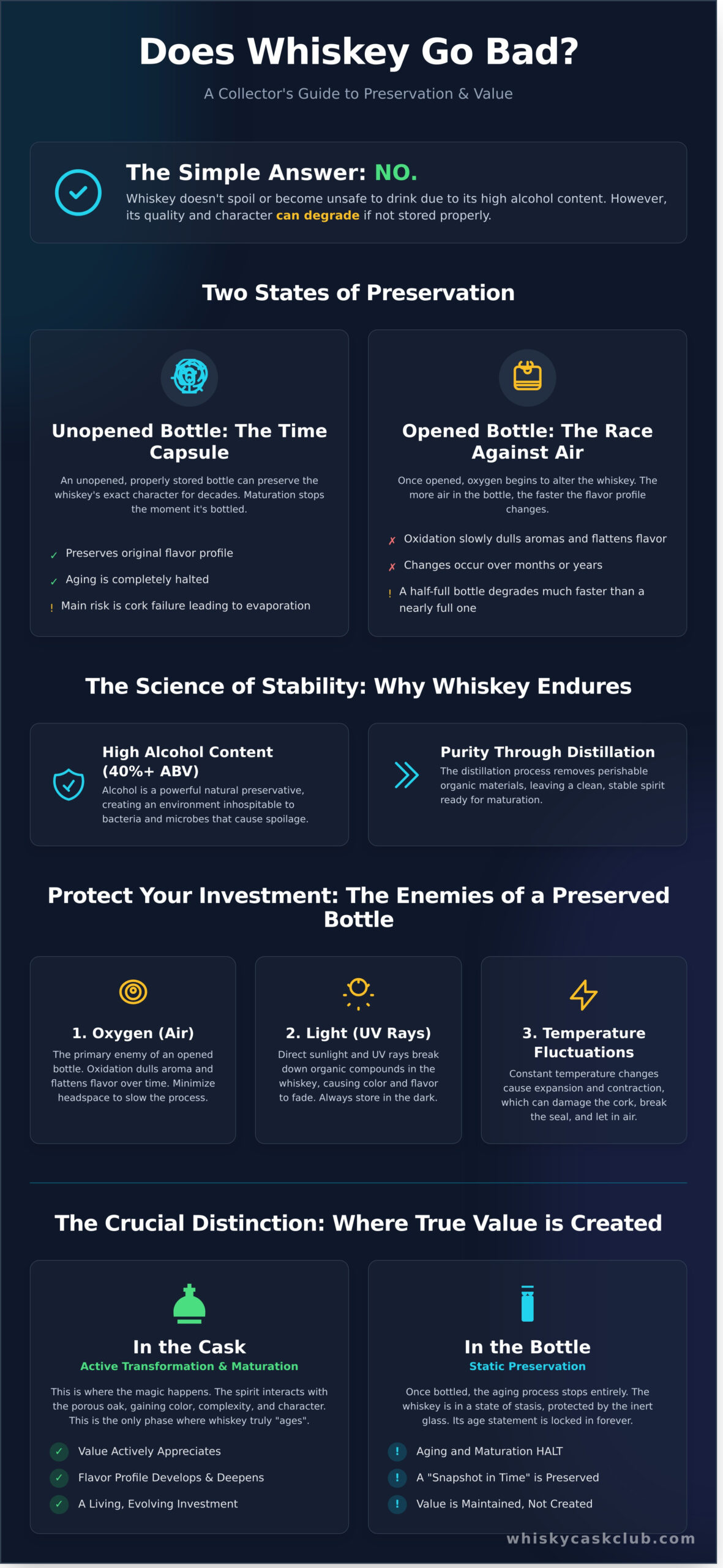
The Enemies of a Preserved Bottle: How Quality is Lost
Once bottled, a whiskey’s maturation journey concludes. It becomes a perfect snapshot of its time in the cask. While its high alcohol content makes it exceptionally shelf-stable-a core principle explained by the science of spirit stability-this resilience does not render it invincible. The question is not simply “does whiskey go bad?” but rather, “what external forces can degrade its character?” For the serious collector, protecting a bottle is about preserving the integrity of a tangible asset and safeguarding its provenance and value for the future.
Sunlight: The Silent Degradation
Direct sunlight is perhaps the most insidious threat to a fine whiskey. The sun’s ultraviolet (UV) rays act as a catalyst, breaking down the complex organic compounds, or congeners, that are responsible for the spirit’s intricate flavor and aroma profile. This chemical reaction leads to a visibly faded color and, more critically, a dull, muted palate. To preserve the spirit’s intended character, your collection demands a dark environment. Always store bottles in their original tubes or boxes, or within a dark, climate-controlled cabinet away from any natural light.
Extreme Temperatures: A Threat to the Seal
Consistency is paramount. Drastic temperature fluctuations cause the liquid and the small amount of air in the bottle to expand and contract. This repeated pressure puts immense stress on the cork, potentially compromising its seal. Once the seal is broken, two enemies are invited in: evaporation, which reduces the volume and proof, and oxidation, which can irreversibly alter the flavor. A stable, cool environment between 15-20°C (59-68°F) is ideal. Keep your collection far from radiators, air conditioners, and windows to prevent this slow, silent destruction.
Improper Storage: Why Whiskey Stands Tall
Unlike wine, which is stored on its side to keep the cork moist, whiskey bottles must always be stored upright. The reason is a matter of chemistry. A whiskey’s high alcohol by volume (ABV) is corrosive to cork over long periods. Constant contact will cause the cork to disintegrate, tainting the spirit and, more importantly, destroying the seal. A failed cork accelerates evaporation and oxidation, ensuring that a once-premium bottle loses its value and vitality. Standing the bottle tall protects the cork, the seal, and the legacy within.
The Crucial Distinction: Bottle Stasis vs. Cask Maturation
Understanding whether whiskey can spoil is one thing, but understanding how it accrues its profound character and value is another entirely. This is where the journey of a spirit diverges into two distinct paths: the static life inside a glass bottle and the dynamic, transformative process of maturation within an oak cask. For the connoisseur and investor, this distinction is fundamental.
The Bottle: A Moment Frozen in Time
Once whisky is bottled, its maturation journey comes to an abrupt halt. The age statement on a label-for instance, ’18 Year Old’-refers exclusively to the time that spirit spent developing in wood. An 18-year-old Scotch purchased today will remain an 18-year-old Scotch in fifty years. The inert glass environment preserves the liquid, effectively answering the question does whiskey go bad with a confident ‘no, if sealed properly’. However, it also means there is no further development; the bottle is merely a snapshot, a perfect preservation of the moment it was deemed ready.
The Cask: Where Legacy is Crafted
In stark contrast, a cask is a living, breathing vessel. Crafted from porous oak, it allows for a slow, magical interaction between the spirit, the wood, and the warehouse atmosphere. This is where true alchemy occurs through two key processes:
- Subtractive Maturation: The charred oak acts as a natural filter, stripping away harsh, undesirable sulphur compounds from the new-make spirit.
- Additive Maturation: The cask imparts its own soul into the liquid, bestowing it with rich colour and complex notes of vanilla, caramel, spice, and fruit.
This active process is evidenced by the ‘Angels’ Share’-the small amount of spirit that evaporates through the wood each year. This is not a loss, but a crucial part of concentration, intensifying the flavours of the whisky that remains. This is the essence of craftsmanship.
How Time in the Cask Creates Value
The longer a spirit rests in the cask, the more refined, complex, and concentrated it becomes. This patient transformation is what creates the rarity and depth prized by collectors worldwide. While a bottle preserves value, the cask is the engine that creates it. Each passing year adds layers of character that cannot be replicated, making older whiskies a finite and sought-after tangible asset.
The fundamental principle of whisky investment is owning the asset during its active, value-adding maturation phase. It is a direct participation in the creation of a future legacy. Discover the potential of owning a maturing cask.
Longevity as an Investment Principle
The science that definitively answers the question, does whiskey go bad?, is the very foundation of its power as an alternative investment. In a world of volatile markets and perishable goods, a cask of premium whisky possesses an inherent, quiet stability. This remarkable resilience against time is not merely a matter of preservation; it is the cornerstone of a sophisticated strategy for wealth creation. For the discerning investor, this chemical integrity provides a unique and powerful advantage.
A Tangible Asset That Endures
Unlike many commodities that can spoil or require complex, costly maintenance, whisky casks are a model of elegant simplicity. Secured in a government-bonded warehouse, your asset is protected while it undergoes its transformation. The maturation process follows a predictable and well-understood path, guided by centuries of distillery craftsmanship. This clarity allows for a deliberate, long-term strategy focused purely on the creation of value as the spirit gracefully evolves within the oak.
From Stable Spirit to Appreciating Asset
The very qualities that ensure whiskey does not go bad are precisely what allow it to mature into something extraordinary. Investors in whisky casks are not simply storing a product; they are capitalizing on this controlled, transformative process. With each passing year, the interaction between spirit and oak deepens the complexity and builds layers of rarity. As younger stock is bottled and consumed, older casks become scarcer by definition, driving their intrinsic and financial worth. This patient alchemy turns a stable spirit into a reliably appreciating asset, a testament to the power of time and provenance.
To own a cask of whisky is to blend the passion of a connoisseur with the pragmatism of a savvy investor. It is the creation of a tangible legacy-an asset that represents a commitment to heritage and a patient approach to building lasting value. For those looking to diversify their portfolio with an asset of genuine substance and character, the enduring nature of whisky offers a compelling proposition.
Discover the potential of this exclusive asset class. Learn how to build a legacy with whisky cask investment.
From Preservation to Provenance: The Enduring Legacy of Whisky
So, does whiskey go bad? The definitive answer is that while a sealed bottle is remarkably stable and will not spoil, its quality can certainly degrade if left unprotected from its enemies: light, air, and extreme temperatures. We’ve also uncovered the crucial distinction that true maturation-the alchemical process that deepens complexity and value-ceases the moment the spirit leaves the wood. A bottle preserves a moment in time; a cask actively cultivates a future.
This understanding elevates the conversation from mere preservation to strategic investment. While a properly stored bottle maintains its quality, a maturing cask is a living asset that appreciates over time. At Whisky Cask Club, we provide discerning individuals with access to exclusive, investment-grade Scotch whisky casks, ensuring their potential is realised through secure storage in accredited Scottish bonded warehouses and guided by expert portfolio management and exit strategy advisory. Explore the craft of whisky cask investment and start building your legacy.
Your journey into a world of tangible assets and timeless craftsmanship awaits.
Frequently Asked Questions
How long does an opened bottle of whiskey really last?
An opened bottle of whisky, if stored correctly, can maintain its character for one to two years. Once the fill level drops below half, the increased oxygen in the bottle accelerates oxidation, subtly altering the delicate flavour profile. For the discerning connoisseur, this change, while not spoilage, is a deviation from the distiller’s original intent. We recommend enjoying your premium spirits within six months of opening to experience their peak expression of craftsmanship.
Can you drink a 100-year-old bottle of whiskey?
Absolutely. An unopened, properly sealed bottle of whisky is a remarkable time capsule. Unlike wine, whisky does not mature further in the bottle, meaning its character is perfectly preserved from the day it was filled. Provided the cork has maintained its integrity and the liquid is clear, a century-old whisky is perfectly safe to consume. It offers a rare and tangible connection to the spirit’s unique provenance and the heritage of its distillery.
What about whiskey cream liqueurs? Do they go bad?
Yes, whisky cream liqueurs have a definitive shelf life due to their dairy content. An unopened bottle typically lasts for approximately two years from its production date. Once opened, it is imperative to refrigerate the liqueur and consume it within six months for optimal quality and safety. The cream will eventually spoil, leading to undesirable changes in texture and flavour. Always consult the bottle for a specific expiration date to ensure the finest experience.
My whiskey looks cloudy, has it gone bad?
Cloudiness in whisky is not a sign of spoilage but rather a phenomenon known as “chill haze.” This occurs when certain fatty acids and esters, which contribute to the spirit’s rich flavour, congeal at lower temperatures. It is most common in non-chill-filtered whiskies, often prized for their superior texture. Allowing the bottle to return to room temperature should resolve the cloudiness, restoring the spirit’s pristine clarity without any loss of quality or character.
What is the best way to preserve an opened bottle of high-end whiskey?
To preserve the integrity of a premium whisky, one must control its environment. Store the bottle upright in a cool, dark place, away from direct sunlight and significant temperature fluctuations. A tight seal is paramount to limit oxygen exposure. For exceptionally rare bottles with a low fill level, some collectors use an inert preservation gas, like private preserve, to displace the oxygen and halt oxidation. This safeguards their tangible asset and maintains its investment value.
Does putting whiskey in the freezer affect its quality?
While freezing will not spoil whisky, it is strongly discouraged for any premium spirit. The extreme cold numbs the palate and suppresses the complex aromas and nuanced flavours that define its character and craftsmanship. The answer to does whiskey go bad in the freezer is no, but it will certainly diminish the sensory experience. True appreciation of a fine whisky is best achieved at room temperature, allowing its full bouquet to unfold as the distiller intended.