What if the greatest obstacle to a 280 percent return isn’t market volatility, but the conversation happening across your dinner table? You’ve analyzed the Knight Frank Luxury Investment Index and recognize the prestige of rare spirits, yet the task of convincing your partner on alternative assets often feels like an impossible pitch. It’s common to feel misunderstood when you see the security of a tangible asset while your partner sees only risk. You likely believe that a truly sophisticated portfolio should include more than just digital numbers on a screen; it should include a legacy you can touch.
This guide helps you master the art of the investment talk by balancing cold financial facts with the emotional power of heritage. We’ll provide the professional tools to articulate why a physical cask of Scotch is a prudent, secure choice for your family’s future. You’ll learn to move past the anxiety of a potential veto and toward a shared vision of wealth. We’ll examine the data, the provenance, and the specific strategies to ensure your next portfolio move is a celebrated family milestone.
Key Takeaways
- Identify the psychological “Risk-Aversion Gap” and learn how to bridge the divide between speculative digital investments and tangible, historical assets.
- Master a strategic framework for the “investment talk,” ensuring you align on shared financial goals before presenting historical performance data.
- Discover the most effective methods for convincing your partner on alternative assets by shifting the conversation from mere speculation to building a lasting family legacy.
- Learn to professionally navigate common objections regarding liquidity and asset independence with clear, data-driven exit strategies.
- Explore why whisky casks offer a unique middle ground for couples, combining the pragmatism of a curated investment with the prestige of owning rare liquid history.
The ‘Spousal Veto’: Why Partners Hesitate on Alternative Assets
The “Spousal Veto” is a common hurdle in high-net-worth households. It often arises not from a lack of trust, but from a fundamental difference in how individuals perceive value and risk. When you consider alternative assets, you’re looking beyond the traditional triad of stocks, bonds, and cash. You’re looking at private equity, real estate, and tangible luxury goods like rare Scotch whisky casks. For many, these represent a path to legacy. For a partner, they might represent an opaque territory that lacks the daily price transparency of the S&P 500.
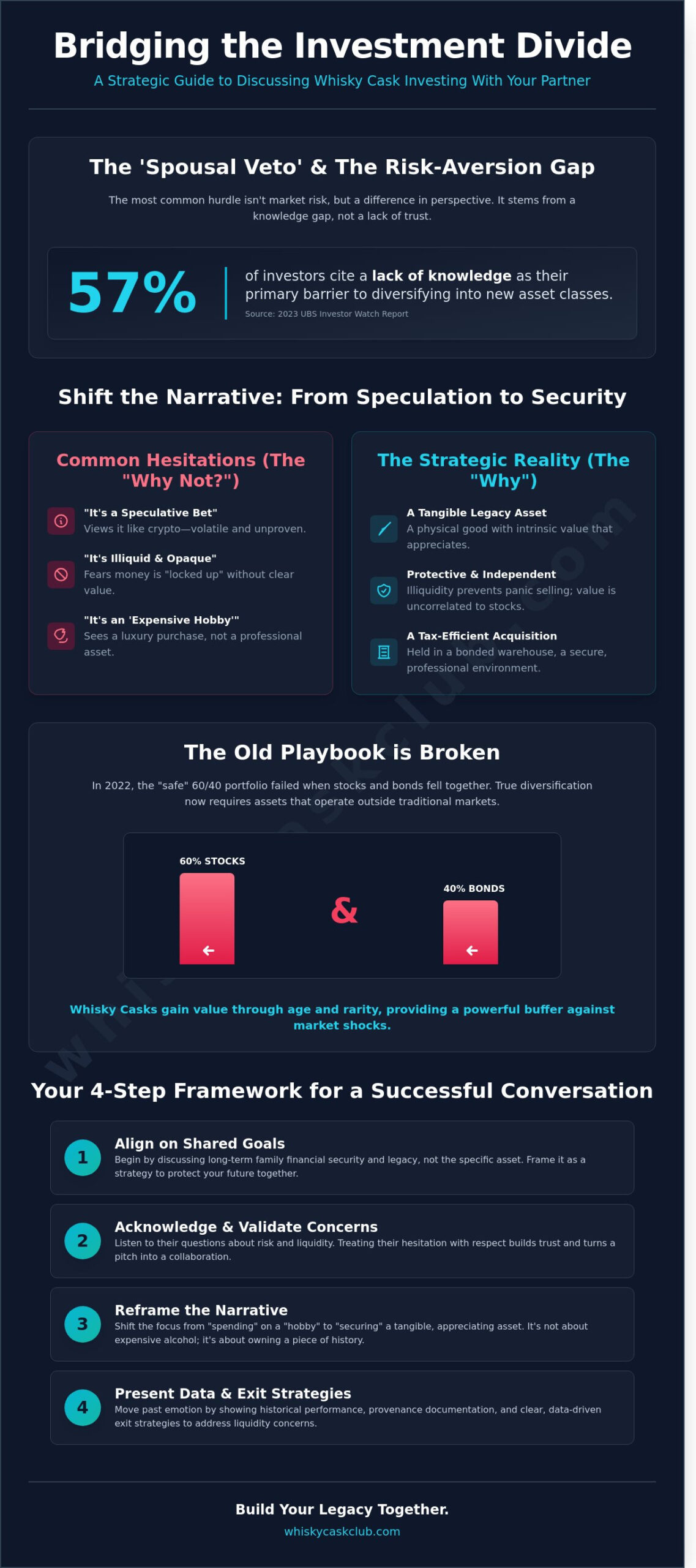
This hesitation is often rooted in the “Risk-Aversion Gap.” A 2023 UBS Investor Watch report indicated that 57% of investors cite a lack of knowledge as their primary barrier to diversifying into new asset classes. Your partner’s skepticism isn’t a barrier to your financial growth; it’s a vital part of your household’s due diligence. Validating their concerns is the first step in convincing your partner on alternative assets. Their questions force you to move past the emotional appeal of a “rare find” and into the cold, hard mathematics of provenance and market cycles.
Traditional financial education has favored “paper assets” since the 1970s. We’ve been conditioned to believe that if an asset isn’t traded on a public exchange, it’s inherently speculative. This bias ignores the historical stability of tangible goods. Acknowledging this educational gap helps reframe the conversation from a “risky bet” to a sophisticated expansion of your family’s balance sheet.
The Fear of the Unknown vs. The Desire for Security
Most investors confuse volatility with risk. Stocks are volatile; their prices swing daily. Alternative assets are often illiquid, meaning they can’t be sold in seconds. This illiquidity is actually a protective feature for a legacy portfolio. It prevents panic selling during market dips. However, your partner might see a whisky cask merely as “expensive booze” rather than “tax-efficient bonded inventory.” It’s vital to address the “hobbyist” stigma. You aren’t buying a bottle for the cabinet; you’re acquiring a maturing asset held in an HMRC-regulated warehouse. This distinction transforms the purchase from a personal whim into a professional acquisition.
Why Traditional Diversification is No Longer Enough in 2026
The classic 60/40 portfolio, once the gold standard of safety, failed spectacularly in 2022 when both stocks and bonds fell simultaneously. As we navigate the 2026 market, the need for truly uncorrelated assets has never been higher. Convincing your partner on alternative assets requires showing them that “safe” traditional investments are now more exposed to global geopolitical shifts than ever before. Tangible assets like whisky casks don’t move in tandem with interest rate hikes or tech sector bubbles. They age. They gain rarity. They provide a form of family insurance that paper assets simply cannot match. Framing this as a proactive move for your family’s financial future shifts the narrative from “spending” to “securing.”
- Tangibility: Unlike digital digits, these assets exist in physical form, providing a floor for their intrinsic value.
- Market Independence: Alternative investments often show a low correlation with public equity markets, reducing overall portfolio “drag.”
- Legacy Building: These assets are frequently easier to pass down through generations with clear provenance and historical significance.
By treating your partner’s hesitation with the same respect you’d give a professional auditor, you turn a potential conflict into a collaborative strategy session. It’s about building a legacy together, one curated asset at a time.
Shifting the Narrative: From ‘Speculation’ to ‘Tangible Legacy’
When you begin the process of convincing your partner on alternative assets, the first hurdle is often the perception of risk. Many people equate “alternative” with “speculative,” conjuring images of volatile crypto charts or unproven startups. You can change this conversation by focusing on the power of the physical. Unlike a digital share or a line of code on a screen, a whisky cask is a heavy, breathing asset. It exists in three dimensions. Holding the deed to a specific cask of Scotch feels fundamentally different than owning abstract corporate debt. It’s a shift from betting on a company’s quarterly earnings to owning a piece of history that gains value through the simple, unstoppable passage of time.
The historical context of Scotch whisky provides a level of reassurance that few other assets can match. This industry has survived the 1920s Prohibition, two World Wars, and the 2008 financial crisis. According to the Knight Frank Luxury Investment Index 2023, rare whisky has seen a 280% increase in value over the last decade. This isn’t a trend; it’s a centuries-old tradition of craftsmanship. By framing the discussion around “Building a Legacy,” you move the goalposts from short-term gains to long-term family security. This asset class is unique because it balances a “Passion and Pragmatism” duality. It appeals to the investor’s mind through its steady growth and to the collector’s heart through its deep cultural roots.
The Security of a Bonded Warehouse
Security is a primary concern for any household. In Scotland, every cask is stored in a government-regulated bonded warehouse, protected by strict legal frameworks and physical security. You aren’t just buying a promise; you own the physical liquid. If a brokerage firm fails, your digital assets might be tied up in litigation for years. In contrast, your cask remains safely aging in a stone warehouse in the Highlands. Provenance represents the verified chronological record of a cask’s distillery origin and storage history, acting as the primary safeguard for its long-term market value.
Whisky as a Generational Asset
The natural aging process acts as a built-in protection against impulsive selling. You can’t rush a 12-year-old spirit into becoming a 25-year-old masterpiece. This forced investment horizon makes it an ideal tool for building a legacy that spans generations. Casks can be passed down to children or bottled to celebrate major family milestones like a wedding or a 50th anniversary. There’s a profound emotional appeal in knowing your family owns a piece of Scottish heritage that is literally maturing and improving while you sleep. It’s a way of convincing your partner on alternative assets by showing them that the value isn’t just in the exit strategy, but in the story you’re creating together.
The market doesn’t wait. But the whisky does. While global equity markets saw significant volatility in 2022, the demand for rare, aged spirits remained robust due to physical scarcity. There are only a finite number of casks filled by top-tier distilleries each year. This scarcity creates a supply-and-demand imbalance that favors the patient owner. By focusing on these concrete facts, you transform the investment from a “maybe” into a cornerstone of a sophisticated portfolio.
A Strategic Framework for the ‘Investment Talk’
Approaching the topic of diversifying your wealth requires more than a casual mention during a commute. It demands a structured presentation that honors your shared financial future. When you’re convincing your partner on alternative assets, you aren’t just selling an investment; you’re proposing a legacy. Follow this five-step framework to ensure your proposal is met with curiosity rather than skepticism.
- Step 1: Alignment on Goals. Begin with the “Why” before the “What.” Are you looking for a hedge against inflation or a way to fund a specific milestone, like a 20th anniversary or a child’s university fees? Establishing a shared vision makes the asset a tool for your mutual success.
- Step 2: The Data Dump. Present hard evidence. Rare whisky has historically outperformed many traditional markets. For instance, the Knight Frank Luxury Investment Index 2023 reported that rare whisky saw a 373% increase in value over a ten-year period. Use these figures to show this isn’t a whim; it’s a calculated move.
- Step 3: The Risk Mitigation Plan. Address the “What-ifs” head-on. Explain how your liquid gold is protected. Discuss the security of government-bonded warehouses and the comprehensive insurance policies that cover the cask from the moment of purchase.
- Step 4: The Professional Partner. Introduce the expertise of the Whisky Cask Club. Showing that you’ve aligned with a seasoned advisor who manages the sourcing, storage, and eventual exit strategy removes the burden of management from your partner’s shoulders.
- Step 5: The Pilot Program. Propose a “proof of concept.” Instead of a massive portfolio overhaul, suggest starting with a single premium cask. This allows both of you to experience the process and watch the asset mature without over-extending your capital.
Communication Styles: Data vs. Narrative
Tailor your delivery to how your partner processes information. If they love spreadsheets, focus on the 12.8% average annual returns seen in recent whisky indices. If they’re a storyteller, talk about the heritage of the Macallan or Dalmore distilleries. Use “We” language to ensure they feel like a co-owner of this venture. Avoid alienating them with jargon. Instead of saying “hogshead,” call it a 250-liter cask. Instead of “Angel’s Share,” explain it as the natural 2% evaporation that occurs as the spirit breathes in the wood.
Setting the Right Environment
Timing is everything when convincing your partner on alternative assets. Don’t bring this up on a stressful Tuesday evening or during a rushed dinner. Schedule a formal “Portfolio Review” session on a Saturday morning when you’re both relaxed. Use third-party resources, such as the market reports provided by the Whisky Cask Club, to provide an unbiased, professional perspective. This shifts the dynamic from you “convincing” them to both of you “evaluating” a prestigious opportunity together.
Overcoming the 3 Most Common Objections
Skepticism is the natural gatekeeper of any sound financial plan. When you’re convincing your partner on alternative assets, you’ll likely face three primary hurdles. These aren’t signs of rejection. They’re requests for more information. By providing clear, data-driven answers, you transform a potentially tense debate into a collaborative strategy for building a family legacy.
The Liquidity Question
The most frequent concern involves the exit strategy. Partners often worry that a cask is “dead money” because you can’t sell it with a single click. However, the market for rare spirits is more robust than many realize. Owners can utilize private auctions or the thriving secondary market where demand for aged stock remains high. If a traditional sale isn’t the goal, the “Bottling Exit” offers a unique fallback. You can choose to bottle the liquid under your own private label for personal use or gifting. This flexibility stands in stark contrast to the rigid 10 year lock-in periods common in private equity or venture capital funds. You own a tangible asset with multiple paths to realization.
Security and Insurance
Partners often ask what happens if the distillery itself faces financial trouble. It’s a valid worry, but the answer lies in asset independence. Your cask is a physical piece of property. It’s stored in a government-regulated bonded warehouse, separate from the distillery’s corporate balance sheet. If a producer fails, your ownership of the liquid remains untouched. Every cask is protected by comprehensive insurance protocols covering fire, theft, and accidental damage. The Whisky Cask Club handles the heavy lifting of management, from warehouse inspections to insurance renewals. This security is backed by a thriving industry; Scotch whisky exports reached a record high of £6.2 billion in 2022. Your investment sits within a global powerhouse of trade.
The Expertise Gap
You don’t need to be a connoisseur to succeed here. Many investors worry that a lack of industry knowledge will lead to poor choices. This is where managed portfolios change the equation. At the Whisky Cask Club, we focus on provenance and rarity, selecting casks based on historical performance data and distillery reputation. We do the research so you don’t have to. convincing your partner on alternative assets becomes much easier when you show them that professional curation replaces guesswork. You aren’t just buying a barrel; you’re accessing a sophisticated system designed to preserve and grow your wealth over generations. We provide the expertise by selecting casks with impeccable provenance and high demand. Our team manages the technical aspects, from regauging to maturation monitoring. This approach removes the burden of “knowing everything” from your shoulders. It transforms a complex market into a streamlined, professional investment experience for you and your partner.
Ready to secure your family’s financial future with a tangible legacy? Explore our curated cask selections and start your journey today.
Why Whisky Casks are the Ultimate Middle Ground for Couples
Finding common ground in a family portfolio doesn’t have to be a battle of spreadsheets versus intuition. Whisky casks represent a unique intersection of heritage and financial prudence, offering a narrative that digital assets simply cannot match. When you’re focused on convincing your partner on alternative assets, the primary hurdle is often a lack of tangibility. A cask isn’t a line of code or a speculative promise; it’s a physical piece of Scottish history maturing in a bonded warehouse. This physical presence provides a sense of security that resonates with partners who prefer traditional, “brick and mortar” styles of ownership.
The story of a cask begins decades before it reaches its peak value. Each barrel carries the DNA of its distillery, the specific oak of its wood, and the environmental character of the Highlands or Islay. This provenance transforms an investment into a legacy. You aren’t just buying a commodity. You’re participating in a centuries old craft. For couples, this provides a shared journey of discovery where you can track the maturation of your liquid gold together, making the financial growth feel like a personal achievement rather than a detached market fluctuation.
The barrier to entry for this market has historically been high, often reserved for industry insiders or those with direct distillery connections. However, the process is now professionalized through the Whisky Cask Club. We’ve removed the logistical headaches of sourcing, insurance, and storage. By providing a transparent framework, we make the transition into alternative markets feel controlled and sophisticated. It’s an intelligent way to diversify without the volatility seen in the 2024 equity markets, where sudden shifts can cause domestic friction.
Physical assets like whisky offer a distinct psychological advantage. While the Knight Frank Luxury Investment Index 2023 report highlighted that rare whisky has seen a 280% increase in value over the last ten years, the prestige of the asset remains its most attractive quality. It combines the stability of a hard asset with the social standing of luxury collecting. It’s a pragmatic choice that feels like a reward.
The Lifestyle Benefit
Ownership opens doors to a world of exclusive experiences that go beyond the balance sheet. Members of our club gain access to private tastings and curated distillery visits that aren’t available to the general public. In 2024, these experiences have become a cornerstone of our community, turning a financial decision into a vibrant shared interest. You’ll join a network of discerning investors who value craftsmanship as much as capital growth, attending events where the conversation is as refined as the spirit.
Starting Your Journey Together
The first step in convincing your partner on alternative assets is demonstrating a clear, risk managed path forward. We provide a curated portfolio proposal tailored to your specific goals, whether you’re looking at a five year or twenty year horizon. Our Exit Strategy Advisory ensures peace of mind by outlining exactly how and when you can realize your gains, whether through private sale, auction, or bottling. This clarity is essential for long term family planning. Join the Whisky Cask Club and begin building your legacy today.
Secure Your Shared Financial Legacy
Successful wealth management requires more than just a spreadsheet; it demands a shared vision for your family’s future. By reframing the discussion around heritage and stability, convincing your partner on alternative assets becomes a collaborative journey rather than a financial hurdle. Shifting the focus from “speculation” to a “tangible legacy” effectively dismantles the spousal veto. Rare whisky casks represent this shift perfectly, offering a blend of historical prestige and physical security. According to the Knight Frank Luxury Investment Index 2023, rare whisky has seen a 373% increase in value over the last decade, making it a robust addition to any sophisticated portfolio.
Whisky Cask Club provides the professional infrastructure to make this transition seamless. We offer exclusive access to rare casks from 20+ world-renowned distilleries and ensure your investment is protected with fully insured storage in accredited Scottish warehouses. Our advisors, many with 15+ years of industry experience, provide expert guidance on exit strategies to ensure your liquidity remains a priority. You don’t need to navigate these complex markets alone. Book a private consultation with a Whisky Cask Club advisor to begin crafting your own liquid legacy today. Your shared future deserves an investment that’s as enduring as the spirit itself.
Frequently Asked Questions
Is convincing your partner on alternative assets like whisky actually safe?
Convincing your partner on alternative assets like whisky is a move toward security because you’re acquiring a physical, tangible commodity. Unlike digital stocks, these casks are stored in government-bonded warehouses and fully insured against loss. Data from the BC20 Whisky Cask Index indicates that the market saw average annual returns of 14.9% over the decade ending in 2020. This historical stability provides a pragmatic foundation for your family’s future wealth.
How do I explain ‘cask maturation’ to someone who doesn’t drink whisky?
Explain that cask maturation is a natural value-added process where the spirit rests in oak wood for years. During this time, the liquid interacts with the barrel to develop its character and color. Industry experts at the Scotch Whisky Association confirm that at least 70% of a whisky’s final flavor profile is derived from the cask. As the whisky ages and becomes rarer, its market price typically increases; time is your most valuable ally.
What is the minimum investment required to start a whisky cask portfolio?
You can begin building your legacy with an initial investment of approximately £2,500 for a new-make cask from an emerging distillery. For those seeking more established names, premium casks often range from £10,000 to £50,000. This entry level allows you to diversify your holdings without overextending your current capital. It’s a scalable path that lets you add more casks as your confidence and portfolio grow over the coming years.
Can we lose all our money in a whisky cask investment?
Losing your entire investment is virtually impossible because you own a physical commodity with intrinsic market value. Every cask is stored in a secure, HMRC-bonded facility and is covered by insurance at 100% of its current market replacement value. Even if a distillery closes, the liquid inside your barrel continues to age and gain rarity. This physical ownership offers a level of protection that paper-based assets simply can’t match.
How long do we have to hold the cask before we can see a return?
You should plan for a holding period of at least 5 to 10 years to see the most significant appreciation. Whisky is a patient asset that rewards those who respect the natural aging process. By the 10-year mark, many casks reach a maturity peak that attracts high-end independent bottlers and private collectors. This timeline aligns perfectly with long-term goals like university funds or retirement planning for your family estate.
What happens if we want to get our money out early?
If you need to liquidate your asset early, you can sell your cask through private auctions or our exclusive secondary market network. While this process typically takes 4 to 8 weeks to finalize the transfer of ownership and funds, it provides a clear exit strategy. We assist in finding a buyer who appreciates the provenance of your stock. Keep in mind that exiting before the 5-year mark may limit your total capital gains.
Are there tax benefits to owning physical whisky casks in 2026?
In 2026, whisky casks remain a highly tax-efficient vehicle because HMRC currently classifies them as a “wasting asset.” This classification means that any profits you realize from the sale of your cask are generally exempt from Capital Gains Tax. For a high-net-worth couple, this 0% tax rate on gains is a powerful incentive. It allows you to keep more of your wealth within your family rather than losing it to the treasury.
How do I show my partner that this isn’t just a ‘fad’ investment?
You can demonstrate stability by highlighting that Scotch whisky has been a global trade staple for over 500 years. It isn’t a modern trend; it’s a global industry that exports 1.3 billion bottles annually to 180 different markets. When convincing your partner on alternative assets, show them the consistent growth in global luxury spirits consumption. This long-standing heritage proves that you’re investing in a timeless tradition rather than a passing financial whim.