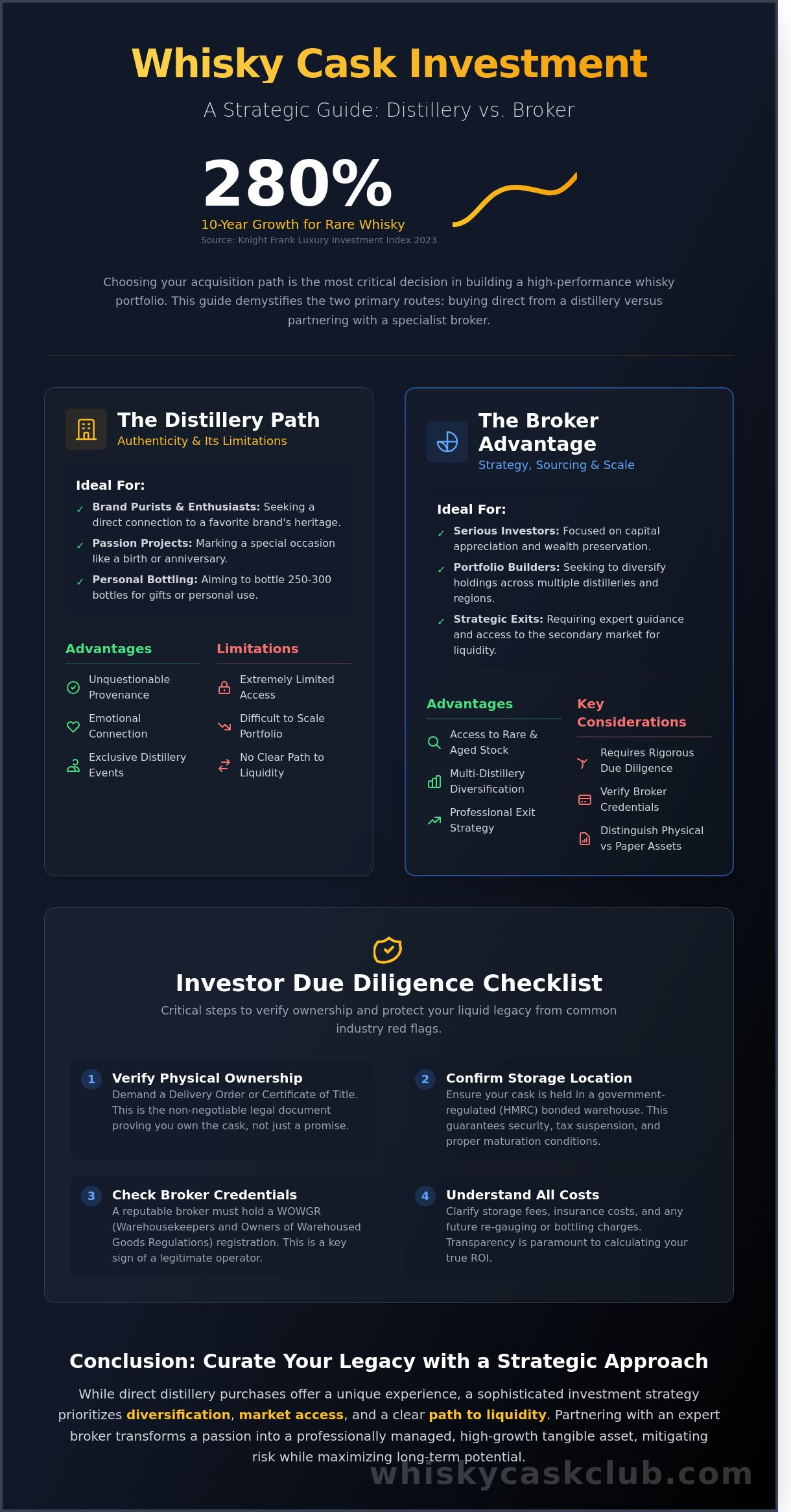
The prestige of acquiring spirit directly from a legendary distillery gate might seem like the ultimate mark of provenance, but the most lucrative collections often begin in the private offices of a specialized broker. While the 2023 Knight Frank Luxury Investment Index highlighted a 280% ten year growth for rare whisky, many investors still struggle to navigate the legal nuances of buying casks from distillery vs broker. You recognize that true wealth preservation requires more than just a famous name on a barrel; it demands ironclad legal title and a clear path to liquidity.
This strategic guide demystifies the structural differences between these two paths. You’ll learn how to secure a tangible asset with absolute confidence. We’ll analyze the critical role of the Delivery Order in establishing ownership, the logistical advantages of independent bonded warehouses, and how professional portfolio management ensures your investment remains a source of prestige rather than a bureaucratic burden.
Key Takeaways
- Understand how whisky has evolved from a hobbyist’s interest into a sophisticated, institutional-grade asset class for the modern investor.
- Master the nuances of buying casks from distillery vs broker to determine which path best aligns with your financial goals and desire for rarity.
- Discover how professional brokerage provides exclusive access to the secondary market and aged casks typically unavailable through direct distillery channels.
- Learn the essential due diligence steps to verify physical ownership and protect your liquid legacy from common industry red flags.
- Explore how a curated, multi-distillery portfolio can mitigate risk while maximizing the long-term growth potential of your tangible assets.
The Cask Acquisition Dilemma: Distilleries vs. Brokers in 2026
The landscape of whisky investment has undergone a profound transformation. What was once a niche hobby for enthusiasts has matured into a sophisticated, institutional-grade asset class. By 2026, the global rare whisky market has solidified its position as a premier alternative investment, with benchmarks showing a ten-year growth trajectory that consistently outperforms traditional equities. When you’re weighing the options of buying casks from distillery vs broker, you aren’t just choosing a supplier; you’re selecting a financial strategy for building a legacy.
The market in 2026 demands a higher level of transparency than ever before. With the Scotch Whisky Association reporting a 12.8% increase in global demand for aged stock over the last fiscal year, the competition for quality wood is fierce. Your choice between these two paths depends entirely on your ultimate objective. Are you seeking the personal prestige of brand directness, or are you focused on the pragmatism of capital appreciation? Both avenues offer distinct advantages, yet they serve very different masters. Success in this arena requires a blend of passion for the spirit and a cold, analytical eye for the numbers.
Distillery Direct: The Traditional Path
Purchasing directly from a distillery represents the primary market in its purest form. It’s an opportunity to secure provenance directly from the source, ensuring brand purity from day one. This path appeals to those who value the craftsmanship and the romanticism of a single-estate heritage. However, availability is often a bottleneck. In 2025, three major Speyside distilleries restricted private cask programs to an invite-only list of just 40 clients. For the discerning investor, this scarcity can limit the ability to scale a portfolio with speed or diversify across different regions.
The Professional Broker: The Strategic Intermediary
A specialist broker functions as a discreet advisor, sourcing “under-the-radar” stock that remains hidden from public price lists. They provide the essential infrastructure that distilleries often lack for private individuals, such as exit strategy mapping and secondary market access. It’s vital to distinguish between “paper brokers” and firms with physical stock access. In 2026, a reputable broker must demonstrate a verified WOWGR status and provide clear evidence of the liquid’s location within a government-bonded warehouse. They turn a passion for spirits into a managed, tangible asset. This route is often the most efficient way of buying casks from distillery vs broker when the goal is a diversified, high-yield portfolio.
- Direct Access: Ideal for brand purists and those seeking a specific distillery connection.
- Brokerage Expertise: Essential for sourcing rare, aged spirits and managing the logistics of a future exit.
- Market Regulation: The 2026 environment requires rigorous due diligence and verified ownership documentation.
Buying Direct from a Distillery: Authenticity and Its Limitations
Owning a piece of history from a legendary name like Glenfiddich or Ardbeg carries undeniable prestige. It’s a tangible connection to the soil, the water, and the copper stills. For many, this is the ultimate entry point into the world of spirits. However, when evaluating the nuances of buying casks from distillery vs broker, one must distinguish between a passion project and a professional investment strategy. Most distilleries design their private cask programs for “enthusiasts” rather than those seeking an optimized portfolio. They prioritize the visitor experience and brand loyalty over the aggressive capital growth an investor might expect.
Distilleries usually offer these casks as part of a “founder” or “friends” program. These initiatives are often capped at a specific number of casks per year, such as the 50 to 100 casks typically released by smaller boutique operations. While the provenance is ironclad, the terms are frequently tailored to protect the distillery’s interests above all else. This path is ideal for the individual marking a 2024 birth or a significant anniversary, but it requires a clear understanding of the contractual boundaries.
The Emotional Appeal of Provenance
Direct access is the primary draw for the romantic buyer. You aren’t just purchasing liquid; you’re joining a lineage. Owners often receive invitations to exclusive warehouse tastings or annual “distillery family” events. This provides the security of knowing exactly where your spirit is maturing, perhaps in a specific corner of Warehouse No. 4. It’s the most straightforward route if your goal is to eventually bottle 250 to 300 unique bottles for personal use, gifts, or a private club. You’re buying the story as much as the scotch.
Why Distilleries May Limit Your ROI
The financial reality of buying casks from distillery vs broker is often more restrictive than it appears. Distilleries frequently charge a 20% to 30% premium over wholesale market rates to account for the “brand experience” they provide. You’re also locked into a single style. If that specific distillery’s profile falls out of favor over a 10 to 12 year maturation cycle, your asset lacks the protection of diversification.
Restrictive “exit” clauses are the most significant hurdle. Many distillery contracts include “buy-back” mandates where the producer has the first right of refusal to reclaim the cask at a fixed price. This often caps your potential gains at a modest 4% or 5% annual return, regardless of how the market has performed. Additionally, you may be forbidden from using the distillery’s trademarked name on your own labels if you choose to bottle independently. If you want to build a legacy that balances this passion with professional asset management, these constraints require careful scrutiny before you commit your capital.
The Broker Advantage: Strategy, Sourcing, and Scale
Choosing a broker transforms the experience from a simple purchase into a curated investment strategy. When you’re weighing the decision of buying casks from distillery vs broker, the broker’s value lies in their role as a neutral advisor. Unlike a distillery, which only sells its own production, a broker isn’t tethered to a single brand. They’re incentivized to find the right asset for your specific financial goals, offering a bird’s eye view of the entire Scotch industry. This independence ensures you receive objective data rather than a marketing pitch.
Infrastructure remains a cornerstone of the broker model. They manage the logistical burden of HMRC-approved bonded storage and specialized insurance. Professional brokers also facilitate regauging, which is the periodic measurement of alcohol by volume (ABV) and literage. This data is vital for maintaining the provenance and value of your tangible asset. Most brokers schedule these checks every 3 to 5 years to ensure the spirit is maturing at the expected rate.
Portfolio Diversification and Rare Sourcing
A sophisticated portfolio shouldn’t rely on a single flavor profile or region. Brokers enable you to spread risk across Speyside, Islay, and the Highlands in one transaction. They often hold stock from “ghost distilleries” like Rosebank or Caperdonich, sites that ceased production decades ago. These rare casks aren’t available through standard distillery sales channels. Because brokers buy in bulk, they often secure institutional pricing. This means an individual investor can access entry prices that were previously reserved for industry insiders. The choice of buying casks from distillery vs broker often comes down to whether you want a single brand or a diversified collection.
Exit Strategies and Secondary Market Liquidity
The true test of an investment is the exit. While a distillery might sell you a cask, they rarely offer a path to sell it back. Brokers provide the necessary liquidity by connecting you with a network of independent bottlers, private collectors, and global auction houses. This ecosystem is essential for realizing gains. Experts at Whisky Investment: The Definitive Guide highlight that exit planning should begin the moment you acquire the cask.
A broker acts as your representative in these negotiations. They understand the nuances of the secondary market, where a well-aged cask can command a significant premium. Whether you’re seeking a private sale or a public auction, their established relationships provide a clear path to liquidity that a retail buyer simply cannot replicate alone.
Avoiding Red Flags: Due Diligence for the Discerning Investor
Securing a rare spirit requires a level of scrutiny that matches the prestige of the asset. While the digital age offers convenience, it also creates a veil for opportunistic “cold-call” operations. Authentic stewardship of a cask is a physical reality, not just a line on a screen. When evaluating the merits of buying casks from distillery vs broker, your first defense is a demand for absolute transparency. Legitimate professionals never hide behind vague promises. They provide verifiable paper trails linked to HMRC regulated facilities.
The Scotch Whisky Association issued specific warnings in 2023 regarding firms promising “guaranteed returns.” High-yield claims of 12% to 15% annually are the most prominent red flags in this industry. Whisky is a long-term alternative investment; its value matures alongside the liquid. Any broker offering a fixed exit price or a guaranteed profit is likely operating outside the bounds of professional ethics. Genuine investment relies on market demand and the increasing rarity of the aged stock. It’s a journey of patience, not a get-rich-quick scheme.
- Verify WOWGR Status: Ensure the broker or warehouse holds a valid Warehousekeepers and Owners of Warehoused Goods Regulations license.
- Check the HMRC Excise ID: Every bonded warehouse in the UK has a unique identifier that you can verify directly through official channels.
- Analyze the Paperwork: A “Certificate of Ownership” issued by a broker has no legal standing without a corresponding Delivery Order.
The Delivery Order (DO) and Legal Title
The Delivery Order is the gold standard of ownership. It’s the only document that instructs a warehouse manager to transfer the legal title of a specific cask to your name. You must be the owner of record in the warehouse’s own ledgers. Avoid structures where you’re merely a “beneficiary” of a broker’s master account. This distinction ensures your asset remains protected even if the broker ceases operations. Direct ownership is the foundation of your legacy. It guarantees that you, and only you, control the liquid’s future.
Bonded Warehouse Verification
Your cask resides in a bonded warehouse, a secure facility where taxes are suspended until the whisky is bottled. These facilities must be pristine. Request a regauge report every 36 months to monitor the “Angels’ Share,” which is the natural evaporation of roughly 2% of the volume each year. This health check confirms the ABV remains above the legal 40% threshold. Ensure your insurance policy covers the current market value, protecting your tangible asset against fire, theft, or unforeseen leakage. Professionalism in storage is just as vital as the quality of the spirit itself.
Whisky Cask Club: Curating Legacies Through Expert Brokerage
The decision of buying casks from distillery vs broker often feels like a choice between heritage and flexibility. Whisky Cask Club eliminates this compromise by combining the storied distillery legacy with the strategic agility of a private brokerage. We leverage deep-rooted relationships with Scotland’s premier producers to secure stock that is frequently unavailable to the general public. Our meticulous selection process filters for the top 5% of available inventory, focusing exclusively on investment-grade casks that demonstrate high growth potential based on historical market data and liquid rarity.
We don’t just facilitate a purchase; we manage a tangible asset through its entire maturation lifecycle. Our team provides bespoke exit advisory services, ensuring that when the time comes to realize your gains, you have a clear path to market. This comprehensive approach transforms a complex acquisition into a seamless experience for the discerning investor. You’re not just buying whisky. You’re securing a piece of Scottish history that appreciates as it breathes.
Transparency and Security at Our Core
Security remains our highest priority in every transaction. We ensure every client receives full legal title via a Delivery Order, which serves as the only recognized proof of ownership within the Scotch industry. This document confirms your legal right to the specific cask number and its contents. To maintain the integrity of your investment, we partner with Scotland’s most respected HMRC-accredited bonded warehouses. These facilities provide the climate-controlled environment necessary for optimal aging.
- Full Legal Title: Direct ownership confirmed through official Delivery Orders.
- Secure Storage: All casks stay in government-regulated bonded warehouses.
- Portfolio Analysis: We provide bi-annual reporting to track your asset’s maturation and market valuation.
- Comprehensive Insurance: Every cask is fully insured against fire, theft, and accidental damage.
Building Your Liquid Legacy Today
Starting your journey involves more than a simple transaction; it’s an entry into an elite circle of alternative asset investors. Our Whiskey Club model offers a structured path to long-term wealth, providing access to rare private bottlings and exclusive market insights. We help you build a portfolio that reflects your personal tastes and financial goals, whether you’re looking for a ten-year hold or a multi-generational legacy.
Our specialists guide you through a curated selection of premium Scotch casks, from iconic Islay malts to hidden gems in the Highlands. We believe that transparency and expertise are the foundations of a successful investment. By choosing Whisky Cask Club, you gain a trusted advisor who understands both the passion of the connoisseur and the pragmatism of the investor. Your liquid legacy begins with a single, well-chosen cask.
Securing Your Liquid Legacy in 2026 and Beyond
Navigating the global whisky market in 2026 requires more than just a passion for the spirit; it demands a strategic approach to asset acquisition. While distilleries provide undeniable provenance, they often lack the diversified inventory and secondary market access essential for a robust portfolio. A professional brokerage bridges this gap by offering a curated selection of investment-grade stock that isn’t available to the general public. The choice of buying casks from distillery vs broker centers on your need for scale and a clear path to liquidity.
Smart investors prioritize security by ensuring every acquisition includes a guaranteed Delivery Order to confirm full legal title. By 2030, the demand for rare Scotch is projected to reach new heights, making the selection of a trusted partner today a vital step in protecting your wealth. We specialize in managing these complexities, providing the expert exit strategy and portfolio management needed to turn liquid gold into a lasting family legacy.
Begin your journey into premium cask ownership with Whisky Cask Club
Your future in the world of fine spirits starts with a single, well-placed investment that reflects your discerning taste and long-term vision.
Frequently Asked Questions
Is it cheaper to buy a cask directly from a distillery or a broker?
Buying new make directly from a distillery often carries a lower entry price, typically starting around £2,000 for a 200-liter barrel. However, brokers provide access to mature liquid that’s already gained value over 10 or 20 years. When buying casks from distillery vs broker, you’ll find broker prices often include insurance and storage for the first 5 years. Distilleries may charge these as annual extras, which can erode your margins over a decade.
What is a Delivery Order and why is it essential for cask ownership?
A Delivery Order is the vital legal document that transfers the title of the whisky from the seller to your name within a bonded warehouse. It’s the only gold standard for proof of ownership recognized under HMRC Excise Notice 197. Without a Delivery Order stamped by the warehouse manager, you don’t legally own the tangible asset. Private certificates don’t provide the same security as this official warehouse ledger entry that guarantees your legal rights.
Do distilleries allow you to bottle a cask you bought through a broker?
Most distilleries permit bottling, but they strictly forbid using their official trademarked brand logo on the label. About 95% of Scottish distilleries require you to bottle the liquid as an Independent Bottling. This means your label might state “Distilled at Macallan” rather than “The Macallan.” You’ll need to work with a specialist bottling plant like Young Spirits in Edinburgh to manage the 20% VAT and excise duty payments before the bottles leave the bond.
How do I know if a whisky broker is legitimate and not a scam?
Legitimate brokers must hold a Warehousekeepers and Owners of Warehoused Goods Regulations certificate or a valid HMRC trade facility. You should ask for their 15-digit WOWGR number and verify it directly with HMRC. Avoid companies that only offer “Certificates of Ownership” without a corresponding Delivery Order. These private papers offer zero legal protection if the firm disappears, whereas a warehouse-sanctioned transfer ensures your legacy is protected by UK law.
Can I visit my cask if I buy it through a broker like Whisky Cask Club?
You can certainly visit your cask by arranging a private viewing at the bonded warehouse where it’s maturing. Most facilities, such as those in Speyside or the Highlands, require at least 48 hours of notice to comply with HMRC security protocols. We facilitate these visits so you can draw a sample and witness the 2% annual evaporation firsthand. It’s a vital part of the journey for any discerning investor building a legacy of rare spirits.
What happens to my cask if the brokerage company goes out of business?
Your investment remains secure if you hold a valid Delivery Order because the cask is legally your property, not the broker’s. The warehouse records will show you as the owner of that specific cask number. This legal separation ensures that even if a firm ceases operations, your tangible asset stays safely in the bond under your name. Your ownership isn’t tied to the broker’s balance sheet, providing a secure, long-term hedge against market volatility.
Are there tax advantages to buying casks from a distillery vs. a broker?
The tax benefits remain identical whether you’re buying casks from distillery vs broker because HMRC classifies whisky as a wasting asset. Under Section 45 of the Taxation of Chargeable Gains Act 1992, profits from the sale of individual casks are generally exempt from Capital Gains Tax. Since the liquid is held in bond, you also defer 20% VAT and excise duty until the moment of bottling, which preserves your capital for further growth and maturation.
How long should I expect to hold a cask before seeing a return on investment?
You should prepare for a minimum hold period of 5 to 10 years to see a meaningful return on investment. Whisky is a patient asset that gains value as the spirit interacts with the oak and the age statement increases. Data from the 2023 Knight Frank Luxury Investment Index suggests that rare whisky has seen a 373% increase in value over the last decade. This rewards those who respect the natural timeline of the craft.