What if the most secure path to wealth in 2026 isn’t hidden behind a digital key, but stored within the seasoned oak of a physical masterpiece? Many investors now realize that while tokens offer speed, they often lack the soul and stability required for a multi-generational legacy. You’ve likely felt the sting of a 15% market dip overnight or the persistent anxiety of a potential exchange hack. Seeking a sophisticated alternative to cryptocurrency investment has become a necessity for those who value peace of mind as much as profit.
It’s understandable to crave an asset you can actually touch; one with intrinsic value that matures regardless of global regulatory whims. This guide will show you how to transition from the chaotic swings of the blockchain toward tangible, high-growth assets that command respect in any private club. We’ll explore five elite avenues, including rare whisky casks and blue-chip collectibles, that offer the capital appreciation you desire with the permanence your family’s future deserves.
Key Takeaways
- Understand why the 2026 market demands a strategic shift from algorithmic scarcity to physical assets with proven historical performance.
- Discover five curated assets that serve as a sophisticated alternative to cryptocurrency investment, prioritizing long-term stability and genuine provenance.
- Learn to apply the “Barbell Strategy” to safeguard your wealth by balancing high-risk digital tokens with secure, tangible growth assets.
- Explore how rare whisky casks provide a unique mechanism for building a multi-generational legacy through the fusion of heritage and financial pragmatism.
The Case for Diversification: Why Look for Alternatives to Cryptocurrency?
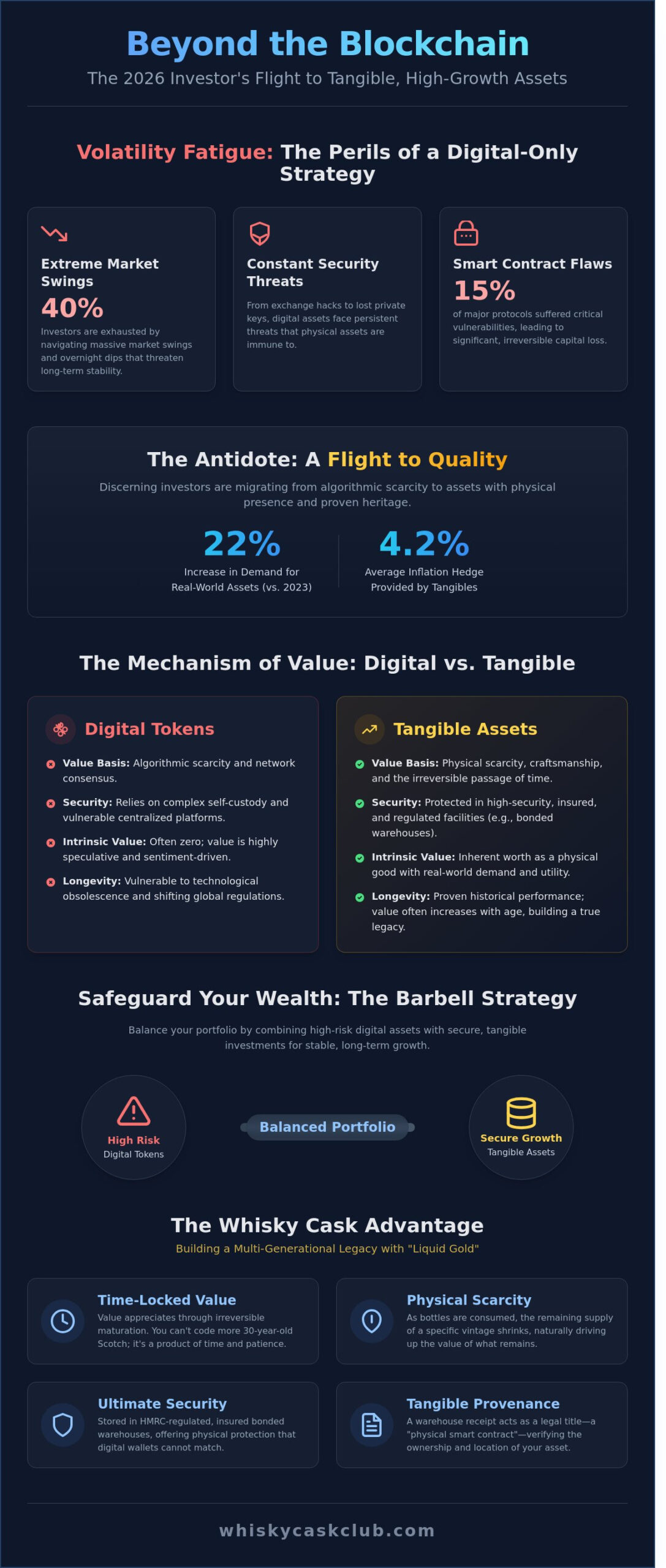
By the second quarter of 2026, the global investment landscape has reached a turning point. The frantic energy that once fueled the digital asset market has matured into what analysts call “volatility fatigue.” Investors who navigated the 40% market swings of previous years are now seeking a sense of permanence. This year marks a definitive “Flight to Quality.” Capital is migrating away from speculative tokens and toward assets with documented heritage and physical presence. Finding a stable alternative to cryptocurrency investment is no longer a niche pursuit; it’s a strategic necessity for those protecting a multi-generational legacy.
The shift is palpable. Sophisticated investors are redefining what it means to hold an alternative investment by looking beyond the traditional constraints of stocks and bonds. There’s a profound psychological benefit to owning a tangible asset. In an era of deepfakes and algorithmic uncertainty, the ability to see and touch your wealth provides a level of security that code cannot replicate. True diversification in 2026 requires more than just a different ticker symbol. It requires an asset that exists independently of a power grid.
The Limitations of Digital-Only Portfolios
Digital-only portfolios remain uniquely vulnerable to systemic tech failures and shifting global regulations. Data from late 2025 showed that 15% of major decentralized protocols suffered from critical smart contract vulnerabilities, which resulted in significant capital loss. The “zero-intrinsic-value” argument remains a hurdle for long-term trust. When market stress peaks, digital scarcity often fails to provide the expected cushion. Instead of acting as a hedge, these assets frequently correlate with high-risk tech indices, leaving investors exposed during downturns. This lack of a physical floor makes a tangible alternative to cryptocurrency investment vital for wealth preservation.
The Rise of the Tangible Asset Class
We’re witnessing a 22% increase in demand for “real-world” assets compared to 2023. In our hyper-digitalized economy, rarity is the ultimate currency. Tangible assets serve as a natural hedge against inflation, which averaged 4.2% across major economies in the last fiscal year. The focus has moved from the screen to the cellar and the vault. Investors are trading the exhaustion of day-trading for the patient rewards of legacy building. They’re choosing assets defined by provenance and craftsmanship, ensuring their wealth is anchored in history rather than just a temporary trend.
Tangible Assets vs. Digital Tokens: The Mechanism of Value
Digital tokens rely on mathematical protocols to enforce scarcity. While a capped supply of 21 million coins creates a predictable framework, it lacks the visceral reality of physical limits. A 1992 vintage cask from a legendary distillery is finite not because of an algorithm, but because the liquid was distilled in a specific window of history that can’t be reopened. This fundamental difference makes tangible goods a compelling alternative to cryptocurrency investment for those seeking stability over speculation.
Security protocols also diverge sharply between these two worlds. Crypto investors often worry about lost private keys, exchange hacks, or the evolving threat of quantum computing. In contrast, luxury assets like Scotch whisky are stored in HMRC-regulated bonded warehouses. These high-security facilities offer a level of physical protection, climate control, and comprehensive insurance that cold wallets simply cannot provide. Owners hold a warehouse receipt, which serves as a legal title identifying the exact location and contents of their asset.
- Digital Scarcity: Controlled by code and consensus.
- Physical Scarcity: Dictated by natural resources, production limits, and the passage of time.
- Storage: Cold wallets require technical self-custody; bonded warehouses offer professional management.
Physical Scarcity and the Time Factor
You can’t mine more 30-year-old Scotch whisky. It’s a product of patience, requiring exactly three decades of interaction between spirit and oak. As enthusiasts open and consume bottles from a specific year, the remaining supply shrinks, creating an inverse relationship between time and availability. In this context, time-locked value is the appreciation generated by the irreversible maturation of a spirit combined with the steady depletion of its peer group.
Provenance: The Digital Ledger of the Physical World
A warehouse receipt acts as a physical smart contract. It documents the journey of the liquid from the still to the cask with absolute transparency. Heritage is the primary driver of value here. Names like Springbank or Glenfiddich carry centuries of prestige that no new token can replicate. Understanding the enduring legacy of Scotch distilleries reveals why history is a more reliable predictor of future price than social media hype. If you’re ready to move beyond digital volatility, you can build a legacy through cask ownership today.
Top 5 Alternative Investments for the Post-Crypto Era
Investors are moving away from the 24/7 noise of digital exchanges. They want assets they can touch, see, and verify through centuries of tradition. A viable alternative to cryptocurrency investment must meet three benchmarks: absolute scarcity, a 10-year track record of outperforming inflation, and a clear path to exit. High-net-worth individuals (HNWIs) prioritize these assets because they offer a “Store of Value” that isn’t tied to a software protocol or a social media trend. They seek stability. They seek a legacy.
Luxury Spirits and Whisky Casks
Whisky is often called “liquid gold” for a reason. The Knight Frank Luxury Investment Index reported that rare whisky saw 373% growth over the last decade. This outperforms the S&P 500 and many 2024 crypto portfolios. Owning a whole cask offers a unique advantage over individual bottles; the spirit continues to age and improve in value inside the wood. You’re not just buying a product. You’re building a legacy through A Guide to Premium Whisky Cask Investment. It’s a tangible asset with inherent provenance and a story that matures with time.
Fine Art and Rare Collectibles
Blue-chip art remains a cornerstone for sophisticated portfolios. According to the 2023 Art Basel Report, the global art market reached $67.8 billion. While liquidity can be slower than a digital trade, the stability is unmatched. Authentication remains a hurdle, but the rise of fractional ownership platforms has lowered the entry point from $1 million to $15,000 for many investors. This allows you to own a piece of a Banksy or a Picasso without the burden of private storage costs. It is a long-term play for those who value cultural significance as much as capital gains.
Private Equity and Venture Capital
Smart money is pivoting toward the “builders” behind the technology. Instead of speculating on a token’s price, HNWIs are taking direct equity in startups. These investments usually require a 7 to 10-year lock-up period. This isn’t a drawback. It’s a feature that prevents panic selling during market dips. You get direct exposure to innovation in AI or green energy. It provides a level of professional oversight and due diligence that the unregulated crypto market lacks. It’s a calculated alternative to cryptocurrency investment that rewards patience over hype.
Risk Management: How to Transition from Volatile to Stable Growth
Sophisticated investors entering 2026 recognize that digital assets alone cannot sustain a multi-generational legacy. The Barbell Strategy provides a refined framework for this transition. By balancing high-volatility holdings with low-risk tangible assets, you protect your capital from systemic shocks. In the current 2026 fiscal landscape, a 15% to 20% allocation to a physical alternative to cryptocurrency investment acts as a vital stabilizer. This approach ensures that while a portion of your portfolio pursues aggressive growth, the core is anchored by assets with intrinsic, historical value.
Due diligence in this space requires a shift from analyzing code to auditing physical provenance. You aren’t just buying a ticker symbol; you’re acquiring a piece of history. Successful risk management depends on your ability to verify the existence and condition of the asset. This transition from “proof of work” to “proof of physical possession” is what separates the speculative amateur from the serious collector.
Vetting Your Investment Partner
Security in the physical market rests on accredited storage and insurance. Ensure your provider utilizes HMRC-approved bonded warehouses, specifically those with a WOWGR (Warehousekeepers and Owners of Warehoused Goods Regulations) certificate. This 1999 regulation ensures the government tracks the movement and ownership of every cask. Avoid unregulated brokers who cannot provide a clear paper trail or title transfer document. A significant red flag in the 2026 market is any provider promising “guaranteed” returns above 15% without explaining the underlying maturation process. True ownership means your name is on the deed of the cask, not just a digital ledger.
Planning the Exit
Liquidity in tangible markets doesn’t involve a simple “sell” button; it requires a curated strategy. The secondary market for rare whisky and fine art has matured significantly, with auction houses reporting a 12% increase in private sales since 2023. You have three primary paths: selling the cask to a private collector, utilizing a dedicated secondary marketplace, or bottling the spirit under your own label. Each path offers different timelines and potential returns. For a detailed breakdown of these options, consult Your Exit Strategy: Realizing Cask Investment Gains.
Ready to secure your portfolio with a tangible legacy? Explore exclusive cask ownership opportunities today.
The Whisky Cask Advantage: Building a Legacy with Liquid Gold
Transitioning from the high-velocity world of digital assets to the patient maturation of Scotch whisky represents a profound shift in investment philosophy. While digital tokens exist in the ephemeral cloud, a cask of single malt offers a tangible, historical anchor for your wealth. For many sophisticated individuals, this is the ultimate alternative to cryptocurrency investment. It replaces volatile code with a physical asset that possesses intrinsic value, maturing quietly in a bonded warehouse while the digital markets churn. You aren’t just buying a commodity; you’re acquiring a piece of Scottish heritage that appreciates as the spirit interacts with the oak over decades.
The Whisky Cask Club approach bridges the gap between modern financial strategy and centuries-old tradition. We don’t just facilitate a purchase; we curate a portfolio designed for longevity. As an alternative to cryptocurrency investment, whisky offers a hedge against the inflation and systemic risks of the 2026 financial environment. By moving capital from digital wallets into physical casks, you secure a legacy that your grandchildren can eventually inherit. It’s a strategic move from speculation to provenance.
Exclusive Access to Rare Casks
Success in this market depends on the pedigree of the spirit. Our brokers maintain deep-rooted relationships with top-tier distilleries like Ardmore and Linkwood, ensuring our members access “Investment-Grade” casks that never reach the open market. These selections are based on rigorous data regarding distillery reputation and historical price appreciation. To understand the nuances of these assets, explore our Whiskey Casks for Sale: An Investors Guide for a detailed breakdown of selection criteria and market trends.
Secure, Managed Growth
We manage the complexities of ownership so you can focus on the prestige. Our team handles every technical detail, including fully insured storage in HMRC-regulated bonded warehouses and strict compliance with UK tax laws. This structure provides a level of security that digital exchanges often lack. Beyond the financial mechanics, owning a cask offers a sophisticated lifestyle. You aren’t just watching a ticker; you’re part of an elite circle of connoisseurs. It’s time to trade the stress of the blockchain for the quiet confidence of the warehouse. Join the Whisky Cask Club and begin building your legacy today.
Secure Your Financial Legacy Beyond the Digital Horizon
The investment landscape of 2026 requires a decisive move away from digital volatility toward assets with proven, intrinsic value. You’ve explored how diversifying into tangible goods provides a vital buffer against the 15% market fluctuations often seen in speculative sectors. Transitioning to a sophisticated alternative to cryptocurrency investment isn’t just about seeking safety; it’s about acquiring a piece of history that matures as the liquid ages. By securing exclusive access to single malt Scotch casks, you’re placing your capital into a market that has demonstrated steady growth for over 100 years.
Whisky Cask Club ensures your peace of mind with secure storage in HMRC-accredited bonded warehouses and dedicated expert portfolio management. We don’t just help you buy. Our exit advisory services are specifically designed to maximize your returns when the time’s right to realize your gains. It’s a journey of quiet confidence where rarity and craftsmanship define your financial success. You’re ready to move from the ephemeral to the enduring.
Download our 2026 Alternative Investment Guide and start building your liquid legacy today.
Frequently Asked Questions
Is whisky a better investment than cryptocurrency in 2026?
Rare whisky offers superior stability compared to digital assets, with the Knight Frank Luxury Investment Index reporting 373% growth over the last decade. While crypto provides rapid gains, whisky serves as a sophisticated alternative to cryptocurrency investment for those seeking a tangible legacy. It’s a strategic hedge against the 80% drawdowns often seen in digital markets. You’re trading screen-based volatility for the quiet, reliable maturation of premium Scotch.
How liquid are whisky cask investments compared to crypto?
Whisky is a medium to long-term asset that takes significantly longer to liquidate than cryptocurrency. While you can trade Bitcoin in seconds, selling a cask typically requires 4 to 12 weeks to finalize through private auctions or specialized brokers. This deliberate pace protects the asset’s prestige. It ensures you don’t make impulsive decisions based on temporary market fluctuations, maintaining the integrity of your investment portfolio.
What are the risks of investing in physical assets like whisky?
The primary physical risks include the “Angels’ Share” and potential cask leakage. Approximately 2% of the liquid evaporates naturally each year, which is a standard part of the maturation process. If the wood fails, you could lose volume. We mitigate this through meticulous sourcing and regular health checks at HMRC-bonded facilities. These inspections ensure your tangible asset remains secure and continues to develop its unique character.
Can I lose money in whisky cask investment?
You can lose money if you exit the market too early or ignore the provenance of the distillery. Investors who sell within 24 months often find that storage fees and insurance costs outweigh the short-term appreciation. Success in this alternative to cryptocurrency investment requires a horizon of at least 5 to 10 years. Choosing a low-demand brand or a poor-quality cask also limits your eventual resale potential.
How much do I need to start investing in alternative assets?
Entry-level positions for premium casks usually start at £2,500 for new-make spirit from emerging distilleries. If you’re looking for blue-chip names like Macallan or Bowmore, initial capital can exceed £50,000 per cask. This range allows you to build a diversified portfolio tailored to your specific financial goals. Most of our club members begin with a curated selection of three casks to spread their risk effectively across different ages.
Do I need a special warehouse to store my investment casks?
You don’t need your own storage because casks must remain in a government-bonded warehouse to maintain their legal status as Scotch. These facilities are strictly regulated by HMRC to ensure the spirit ages in optimal conditions. Your ownership is protected by a certificate of title while the warehouse manager handles the physical security. It’s a completely hands-off process that guarantees the provenance and quality of your liquid gold.
How is the value of a whisky cask determined over time?
Value is primarily driven by the age of the liquid, the reputation of the distillery, and the remaining Alcohol by Volume (ABV). A cask must maintain an ABV of at least 40% to be legally classified as whisky. As the spirit reaches milestone ages like 18 or 25 years, its scarcity increases significantly. This rarity, combined with the heritage of the original distillation, dictates the final market price for collectors.
What happens if the distillery goes out of business?
Your investment is safe because you own the physical cask, not shares in the distillery company. If a distillery closes, your cask remains your property within the bonded warehouse. In fact, “silent distillery” casks often skyrocket in value because the total supply is permanently capped. You can simply move the cask to a different bonded facility or sell it to a private collector who prizes rare, extinct labels.