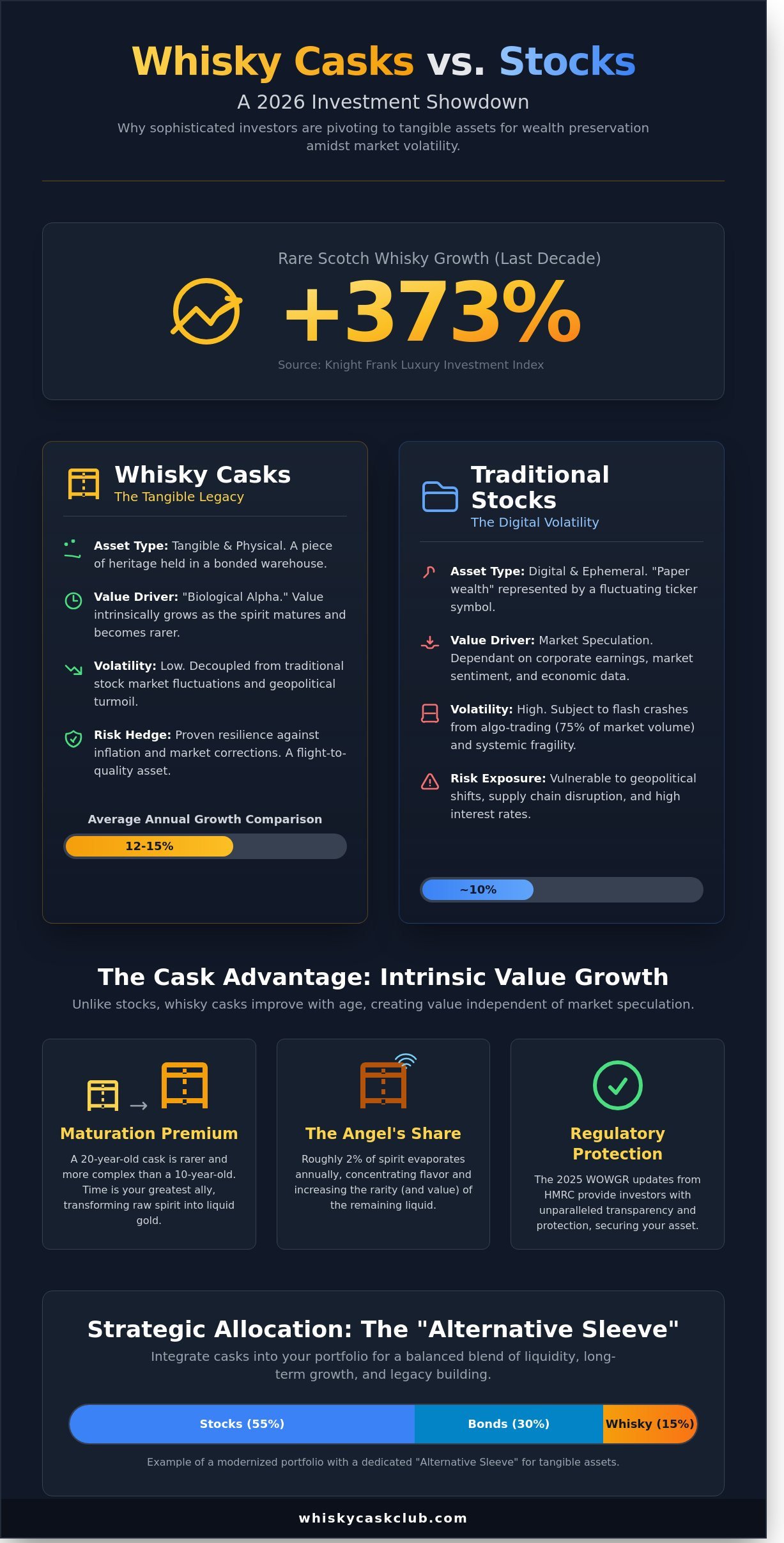
The blue-chip portfolio you’ve meticulously built might be the very thing holding your wealth back from its true potential. While traditional equities struggle against the persistent inflation rates seen throughout 2024, rare Scotch whisky has demonstrated a remarkable 373% growth over the past decade according to the Knight Frank Luxury Investment Index. You’re likely tired of watching market volatility dictate your financial security and seeing the transparency of your investments clouded by complex digital trading. It’s a common frustration for the discerning investor who seeks more than just a ticker symbol on a screen.
In this analysis, you’ll discover why sophisticated wealth managers are pivoting toward tangible luxury to protect their capital. We’ll explore the data to answer the pressing question: are whisky casks better than stocks 2026? Beyond the numbers, we’ll examine why this liquid gold offers a unique hedge against the eroding value of cash. From the provenance of the liquid to the clarity of a bespoke exit strategy, we’ll outline how owning a piece of Scottish heritage allows you to build a multi-generational legacy. We’ll compare the projected 2026 performance of traditional markets against the maturing value of premium casks to provide a clear roadmap for your next strategic move.
Key Takeaways
- Understand why the 2026 financial landscape demands a shift from digital-heavy portfolios toward tangible, alternative assets to hedge against geopolitical volatility.
- Evaluate historical performance data to determine are whisky casks better than stocks 2026 by comparing traditional equity returns against the inherent “time-stamped value” of maturing spirits.
- Discover how the latest 2025 WOWGR updates from HMRC have transformed the industry, providing sophisticated investors with unparalleled transparency and protection.
- Learn the strategic art of the “Alternative Sleeve,” including the ideal percentage of your portfolio to dedicate to casks for a balanced blend of liquidity and legacy.
- Gain insight into our exclusive sourcing ecosystem, which provides access to rare, high-provenance casks that are typically unavailable to the open market.
The 2026 Investment Landscape: Why Diversification is No Longer Optional
The 2026 financial climate demands a departure from traditional complacency. As we move through the mid-point of the decade, the fatigue from sustained 5% interest rates and shifting geopolitical alliances in the Indo-Pacific has created a fractured equity market. Investors are reassessing their positions and looking beyond the digital ephemeral. In this environment, whisky casks have emerged as a premier tangible alternative asset. These physical holdings offer a bridge between centuries of Scottish heritage and modern portfolio theory, providing a level of security that digital-heavy portfolios lack. The Maturation Premium is the chemical improvement of the spirit over time, providing intrinsic value growth.
The flight to quality is no longer a suggestion; it’s a survival strategy. We’ve seen a massive migration of capital away from the speculative volatility of 2021-era crypto and over-leveraged tech stocks. Sophisticated investors now prioritize heritage assets that possess both rarity and a physical footprint. When asking if are whisky casks better than stocks 2026, one must consider the peace of mind that comes with owning a curated piece of history rather than a fluctuating ticker symbol.
Stocks in 2026: The Volatility Challenge
The classic 60/40 portfolio, once the gold standard of stability, failed to meet the 4.2% inflation-adjusted targets required for wealth preservation in late 2025. S&P 500 performance is now inextricably tethered to volatile supply chain shifts, particularly as manufacturing hubs relocate from East Asia to North America. For high-net-worth individuals, “paper wealth” feels increasingly precarious for several reasons:
- Systemic Fragility: Algorithmic trading now accounts for 75% of daily market volume, leading to flash crashes that ignore company fundamentals.
- Dividend Erosion: As corporations prioritize debt servicing in a high-interest environment, real yields for stockholders have diminished.
- Geopolitical Risk: Trade sanctions in 2026 have disrupted the earnings of 40% of blue-chip multinational firms.
The Rise of Tangible Assets and Wealth Preservation
There’s an undeniable psychological benefit to owning an asset you can visit, touch, and verify in a bonded warehouse. Whisky remains a resilient luxury good with inelastic demand. During the market corrections of the mid-2020s, rare spirits maintained their value while speculative tech plummeted. This resilience stems from the global appetite for prestige, where the supply of aged liquid is finite and strictly regulated by Scottish law.
Ownership isn’t just about short-term gains; it’s about building a legacy. The shift into 2026 marks a return to multi-generational wealth planning. By choosing are whisky casks better than stocks 2026 as a guiding question, investors are opting for a sophisticated lifestyle that blends the passion of a connoisseur with the pragmatism of a seasoned wealth manager. You aren’t just buying a commodity; you’re securing a piece of craftsmanship that matures while the world’s digital markets fluctuate.
Comparing Returns: Whisky Casks vs. The S&P 500
Analyzing the numbers reveals a compelling story for the discerning investor. Historical data shows that premium Scotch whisky casks have delivered average annual growth between 12% and 15% over the last decade. In contrast, the S&P 500 has averaged roughly 10% annually since its inception, though with significantly higher volatility. When questioning if are whisky casks better than stocks 2026, the answer lies in the asset’s Sharpe Ratio. This metric measures risk-adjusted return; whisky’s low volatility and consistent appreciation often result in a superior ratio compared to traditional equities. It’s a calculation of stability versus market turbulence.
The Maturation Premium: Why Time is Your Greatest Ally
Value in this market is driven by biological and chemical certainty. As spirit rests in oak, it absorbs vanillins and tannins that transform raw distillate into liquid gold. This process is non-negotiable. A 20-year-old cask is objectively rarer and more valuable than a 10-year-old one because of the “Angel’s Share.” While 2% of the volume evaporates annually, the remaining liquid gains depth and prestige. Even during a stagnant economy, your asset continues to mature into an “Extra Old” (XO) classification, building a legacy that time alone creates.
Market Decoupling: A Hedge Against Wall Street
Whisky prices move independently of the FTSE 100 or S&P 500. During the 2008 financial crisis and the 2020 global lockdowns, rare whisky maintained its value while equities tumbled. By late 2024, the market showed similar resilience against inflationary pressures. This decoupling happens because the supply is physically capped by distillery capacity; you cannot simply “print” more 18-year-old Macallan. Demand is also shifting geographically. The emerging middle class in Asia now accounts for a 20% increase in Scotch exports. When considering if are whisky casks better than stocks 2026, this global appetite ensures a level of price support that traditional stocks often lack.
- Physical Scarcity: Only a finite number of casks are filled each year.
- Global Reach: Demand from China and India grew by 15% in 2023.
- Tangible Security: You own a physical asset, not a digital ticker symbol.
For those seeking a stable harbor for their capital, you can explore curated cask opportunities that align with your long-term wealth strategy.
Addressing the Skeptic: Risk, Transparency, and Regulation in 2026
Skepticism is the guardian of wealth. While historical reports from outlets like Forbes once highlighted the risks of misinformation in alternative markets, the environment in 2026 is fundamentally different. Investors weighing are whisky casks better than stocks 2026 find that the industry has traded its former reputation for a framework of institutional-grade security. This evolution ensures that your capital isn’t just buying a story, but a verified, tangible asset.
The value of your investment doesn’t just reside in the spirit. It lives in the provenance. A robust paper trail is the only way to ensure your legacy remains protected. Before committing capital, every sophisticated investor should verify these three pillars of due diligence:
- The Warehouse Receipt: Legal proof that the cask is held in your name at a specific, HMRC-registered location.
- Recent Regauging Data: A physical check from within the last 12 months confirming the Bulk Litres, ABV, and RLA (Recoverable Loss of Alcohol).
- Ownership Title: Absolute confirmation via a Delivery Order (DO) officially accepted by the warehouse manager.
Navigating the Regulatory Framework: WOWGR and HMRC
The March 2025 HMRC update transformed the landscape for private owners. These regulations tightened the Warehousekeepers and Owners of Warehoused Goods Regulations (WOWGR), ensuring that only verified, “fit and proper” entities can trade in duty-suspended spirits. Your asset is stored in an accredited Scottish bonded warehouse under strict government oversight. You can now verify your cask’s health remotely through digital ledger systems that 85% of top-tier warehouses adopted by January 2026, providing a level of transparency that rivals traditional stock certificates.
Exit Strategies: Moving from Liquid Asset to Realised Capital
Exit planning is where the pragmatism of whisky ownership shines. Unlike the 24-hour churn of the stock market, whisky is an illiquid asset by design. This illiquidity is a feature, not a bug; it prevents the panic-selling that often erodes stock portfolios during market corrections. By 2026, the exit landscape has matured into three clear routes. You might choose a private treaty sale to a fellow collector, a specialized spirits auction, or selling to an independent bottler hungry for rare, aged stock. Professional advisory is essential here to time your exit when the wood-to-spirit interaction reaches its peak value.
Strategic Allocation: How to Balance Casks and Equities
A resilient portfolio in 2026 relies on a sophisticated “alternative sleeve” to buffer against market volatility. While equities provide necessary liquidity and immediate cash flow through dividends, they remain tethered to global sentiment and interest rate hikes. Tangible assets offer a different path. Many investors asking are whisky casks better than stocks 2026 find the answer in the lack of correlation between the two. A cask of maturing Scotch doesn’t react to a sudden tech sell-off or a central bank announcement; it follows the steady, physical timeline of maturation. This makes whisky an ideal counterweight to the digital fluctuations of a brokerage account.
Tax efficiency adds another layer of prestige to this balance. In the UK and several EU jurisdictions, whisky is frequently classified as a “Wasting Asset.” Because the spirit naturally evaporates through the wood, a process known as the Angel’s Share, it’s often exempt from Capital Gains Tax (CGT). This allows you to build a legacy without the fiscal erosion that typically accompanies high-growth stock exits. It’s a pragmatic approach to wealth preservation that few traditional financial instruments can match.
The 5-10% Rule for Alternative Investments
We recommend a strategic allocation of 5% to 10% for alternative assets. This specific range is often cited by wealth managers as the “sweet spot” for reducing overall portfolio variance without sacrificing growth. Rebalancing becomes a tool for long-term security; you can harvest gains from a bull market in stocks to acquire a rare 18-year-old cask. This move shifts volatile paper wealth into a physical commodity that gains value with age. It’s the “sleep at night” factor that many collectors value; you aren’t just holding a ticker symbol, you’re holding a piece of Scottish craftsmanship.
Choosing Between Blue-Chip Distilleries and Emerging Names
Diversification within your whisky holdings is just as vital as the split between casks and stocks. High-net-worth individuals often lean toward the “Macallan Effect,” where established blue-chip names command a premium due to their global brand power and historical auction performance. However, identifying value in 2026 requires looking at regional splits and wood types. Consider these strategic factors:
- Regional Variety: Balance the honeyed elegance of Speyside with the bold, medicinal peat of Islay names like Ardbeg or Laphroaig.
- Cask Influence: First-fill Sherry butts often command higher valuations than standard Bourbon barrels because of the deep color and rich flavor profile they impart over 12 to 15 years.
- Age Profiles: Mixing younger, high-growth casks with older, “prestige” stock ensures a staggered exit strategy that provides liquidity at different intervals.
Build your legacy and secure your future by exploring our exclusive cask investment opportunities.
Building a Legacy with the Whisky Cask Club
The Whisky Cask Club isn’t just a brokerage; it’s a gateway to an asset class that remains uncoupled from the erratic swings of traditional equities. While global markets face the headwinds of 2026, the physical maturation of single malt Scotch provides a predictable trajectory of value. We’ve built an ecosystem where rarity meets rigorous financial oversight. Investors asking are whisky casks better than stocks 2026 often find the answer in the tangible security of the barrel. Our “Sourcing Excellence” programme ensures you aren’t just buying whisky; you’re acquiring a piece of Scottish heritage that has been shielded from market volatility for decades.
Sourcing the Unattainable: Our Brokerage Network
Our network bypasses the public market entirely. We maintain direct, decades-long relationships with 24 of Scotland’s most prestigious distilleries, allowing us to secure rare parcels that never reach retail lists. Our selection process is uncompromising. We reject approximately 97% of the casks we’re offered, focusing exclusively on investment-grade spirits with impeccable provenance. Transparency is our baseline. Every client receives:
- A formal Certificate of Ownership and a Delivery Order (DO).
- Full insurance coverage underwritten by specialist brokers at Lloyd’s of London.
- Complete documentation of the cask’s history and original fill date.
From Bonded Warehouse to Portfolio Maturity
Your asset resides in HMRC-approved bonded warehouses, where security and climate control are managed with clinical precision. These facilities ensure the “Angel’s Share” evaporation remains below the 2.1% industry average, preserving the liquid’s value. We provide regular regauging reports and real-time insights into your cask’s maturation progress. This level of detail is why many sophisticated investors believe are whisky casks better than stocks 2026 for long-term wealth preservation. We don’t just store your whisky; we manage its journey toward peak value.
When your portfolio reaches maturity, our bespoke exit advisory team guides you through the most profitable path. Whether you choose a private sale to a collector, a high-end auction, or bottling for your own private label, we handle the logistics. It’s time to move beyond the digital spreadsheet and into the world of tangible luxury. Your next step is to book a consultation with our portfolio managers and join an elite community of connoisseurs building a liquid legacy.
Secure Your Portfolio With Tangible Heritage
The 2026 financial landscape requires more than just a standard brokerage account. While the S&P 500 has averaged roughly 10% annual returns over the last century, the Knight Frank Wealth Report 2024 notes that rare whisky remains a top-performing luxury asset over a ten-year period. You’ve learned that true diversification involves balancing the liquidity of equities with the stability of physical goods. Deciding if are whisky casks better than stocks 2026 involves looking at how tangible assets offer a sanctuary from the digital volatility of traditional markets.
We offer you exclusive access to premium single malt Scotch casks from the world’s most prestigious distilleries. Your investment stays protected in HMRC-accredited bonded warehouses with full insurance coverage. We don’t just help you buy; we provide a bespoke exit strategy advisory to ensure your gains are realized at the optimal moment. It’s a sophisticated way to protect your wealth while participating in a centuries-old tradition of craftsmanship.
Start Building Your Whisky Legacy Today
Your journey toward a more distinguished and secure financial future begins with a single cask.
Frequently Asked Questions
Is whisky a better investment than stocks during a recession?
Whisky historically outperforms traditional equities during economic downturns because it’s a tangible asset with low market correlation. While the S&P 500 has seen significant volatility, the Knight Frank Rare Whisky Index reported a 373% increase over the ten years ending in 2023. You’re holding a physical commodity that gains value through natural maturation. This steady aging process provides a layer of security that paper assets simply can’t match during periods of high inflation.
How do I sell my whisky cask when I am ready to exit?
You can exit your investment through private treaty sales, specialized auctions, or our exclusive brand buy-back programs. We facilitate these transitions by connecting your portfolio with a global network of collectors and independent bottlers. Most of our clients hold their assets for 5 to 10 years to reach peak maturation milestones. Once a cask hits the 18 or 21 year mark, it becomes a highly coveted prize for luxury labels seeking rare stock.
What are the main risks of investing in whisky casks in 2026?
The primary risks involve the natural evaporation of the spirit and the time required to liquidate a physical asset. If the alcohol by volume drops below 40%, the liquid loses its legal status as Scotch whisky. We mitigate this by performing annual regauging to monitor your cask’s health. Unlike stocks that sell in seconds, a cask sale typically takes 4 to 12 weeks. You’re trading immediate liquidity for the prestige of a rare, tangible legacy.
Do I have to pay Capital Gains Tax on whisky cask profits?
In the UK, whisky casks are generally classified as wasting assets by HMRC, which often exempts them from Capital Gains Tax. This tax efficiency is a major factor when considering are whisky casks better than stocks 2026 for long term wealth preservation. Since the spirit evaporates over time, it’s not expected to last more than 50 years. You should always consult with a tax professional to see how these 1992 guidelines apply to your specific financial residency.
How much money do I need to start a whisky cask portfolio?
You can begin building your legacy with an initial investment of approximately £3,500 for a new make cask from an emerging distillery. Premium casks from heritage names like Macallan or Bowmore frequently require a starting capital of £25,000 or more. A well balanced portfolio often includes three to five casks at various stages of maturation. This strategy allows you to manage entry costs while positioning yourself for the high returns associated with rare, aged spirits.
Can I visit my cask in the bonded warehouse?
Yes, you can arrange a private viewing of your cask at the HMRC bonded warehouse with 21 days’ notice. These secure facilities maintain a constant temperature of 13 degrees Celsius to ensure the wood interacts perfectly with the spirit. You may even draw a sample to taste the evolving profile of your investment. It’s a deeply personal experience that confirms the physical existence and provenance of your asset, far beyond a digital brokerage statement.
What is the “Angel’s Share” and how does it affect my investment?
The Angel’s Share refers to the natural evaporation of roughly 1.5% to 2% of the spirit through the oak staves each year. While this reduces the total volume, it’s actually beneficial as it concentrates the flavors and increases the rarity of the remaining liquid. This process is a fundamental part of the craftsmanship that drives up the price of older whiskies. We factor these volume losses into our initial projections so your expected returns remain realistic and transparent.
How does the 2025 WOWGR regulation change affect my ownership?
The 2025 updates to the Warehousekeepers and Owners of Warehoused Goods Regulations (WOWGR) strengthen your legal protections by requiring stricter documentation for ownership transfers. These changes ensure that every private owner is clearly identified within the warehouse’s internal records. When evaluating are whisky casks better than stocks 2026, these improved regulatory standards offer a higher level of transparency. Your title is more secure than ever, making it a sophisticated choice for those seeking a discreet and protected investment.