If the institution managing your capital vanished tomorrow, would your wealth remain intact or simply dissolve into a digital ledger? For those building a multi-generational legacy through alternative assets, the concern of what happens if my whisky broker goes bankrupt is a valid consideration during a 10 to 20 year maturation cycle. It’s natural to feel uneasy about the nuances of unregulated markets or the critical distinction between a paper share and a physical cask resting in a Scottish warehouse. You aren’t just looking for a return; you’re seeking the quiet confidence that comes with absolute legal certainty.
You already know that true security stems from tangible assets with verifiable provenance. This guide explains why physical whisky ownership provides a robust safety net that traditional financial instruments often lack, even during broker insolvency. We’ll examine the legal protections afforded by the Scotch Whisky Regulations 2009 and the vital role of government-regulated bonded warehouses. You’ll discover a clear, transparent path to maintaining your liquid legacy and securing your exit strategy, ensuring your prestige remains protected regardless of any firm’s future.
Key Takeaways
- Distinguish between traditional paper investments and the inherent security of owning a tangible, physical asset that exists outside the volatile financial markets.
- Understand exactly what happens if my whisky broker goes bankrupt by learning how legal title ensures your casks are never listed on a broker’s balance sheet.
- Gain insight into the HMRC-regulated bonded warehouse system, which provides a layer of institutional security entirely independent of your brokerage.
- Identify the specific documentation, such as Delivery Orders and Certificates of Ownership, required to verify your assets and protect your private collection.
- Learn how a transparent, ring-fenced structural approach safeguards your investment, allowing you to build a lasting liquid legacy with total peace of mind.
The Investor’s Safety Net: Securities vs. Tangible Whisky Assets
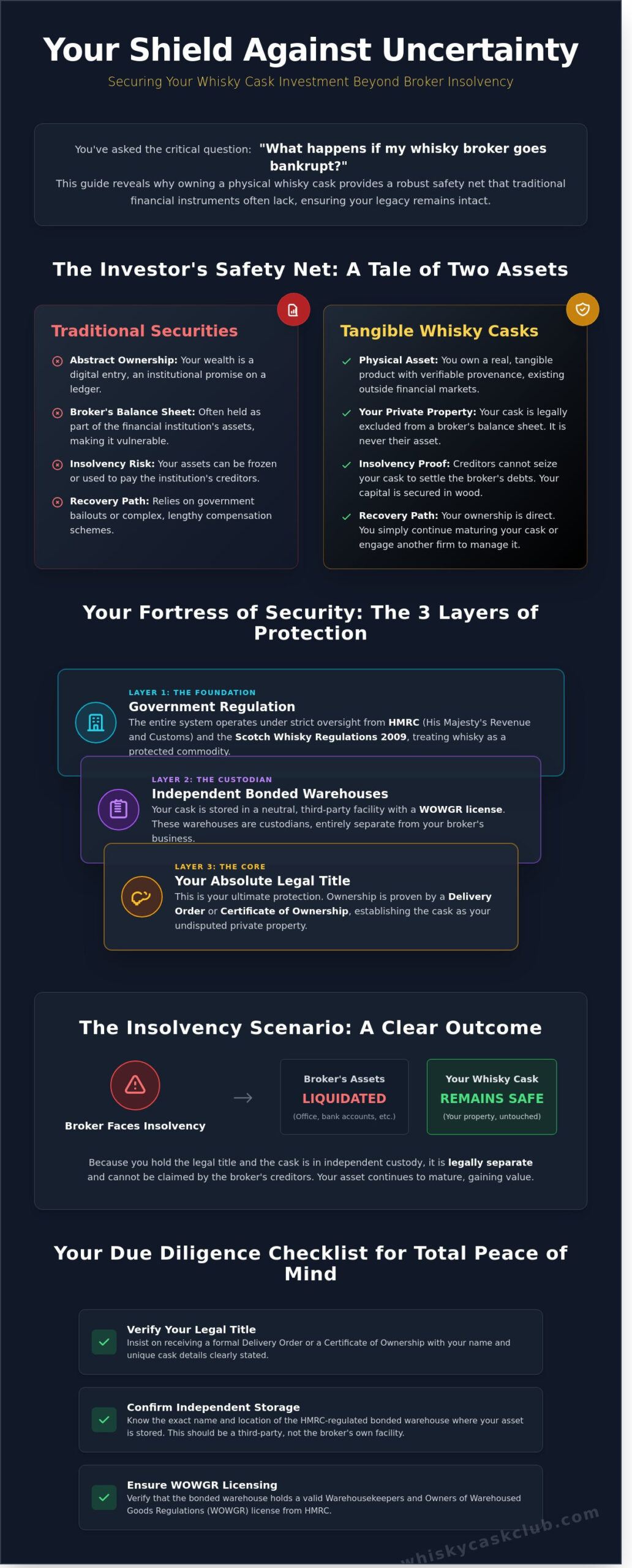
Traditional stock market investments rely on digital entries and institutional promises. If a bank collapses, you hope for a government bailout or a compensation scheme to trigger. Whisky cask ownership provides a more robust foundation because it’s a tangible asset. You aren’t buying a piece of a company or a derivative of a market index. You’re acquiring a physical product that exists independently of any broker’s balance sheet. This distinction is the bedrock of your security.
Many new entrants ask what happens if my whisky broker goes bankrupt, fearing their capital will vanish into a cloud of litigation. In the world of premium spirits, the broker serves as a facilitator and advisor rather than a traditional financial intermediary. They source the rare liquid and manage the logistics, but they don’t own the asset once the transaction is finalized. You’re moving from the volatile world of paper wealth to the stable sanctuary of physical provenance. This shift requires a psychological adjustment. You’re no longer a mere participant in a financial entity; you’re a steward of a liquid legacy.
Why Whisky is Not a Financial Security
Under the Scotch Whisky Regulations 2009, whisky is treated as a commodity. This classification is vital for your protection. When you purchase a cask through a reputable partner, you should receive a Delivery Order or a certificate of ownership. This document establishes your Title of Goods. Because the cask is your private property, it’s legally excluded from a broker’s liquidation pool. If a firm faces insolvency, creditors cannot seize your maturing spirit to settle the broker’s debts. Your capital remains secured in the wood, protected by centuries of property law.
Common Misconceptions About Broker Failure
A common myth suggests that the broker’s survival is tied to the asset’s safety. This ignores the reality of the bonded warehouse system which governs the industry. Most brokers don’t store whisky in their own facilities. They use third-party, HMRC-regulated warehouses. These facilities act as neutral custodians. They are strictly monitored by government authorities to ensure every drop is accounted for. The real risk isn’t insolvency; it’s a lack of transparency regarding where your cask is held. As long as your ownership is correctly recorded with a warehouse holding a WOWGR (Warehousekeepers and Owners of Warehoused Goods Regulations) license, the broker’s business status is secondary. Understanding this helps you realize that while you may wonder what happens if my whisky broker goes bankrupt, the physical cask remains maturing in its warehouse, gaining value with every passing year.
- Asset Independence: Your whisky exists outside the broker’s financial ecosystem.
- Legal Title: Ownership is proven through physical documentation, not just a digital login.
- Custodial Neutrality: Bonded warehouses are independent of the brokerage firm.
Title vs. Custody: Why Your Cask Isn’t on the Broker’s Balance Sheet
Owning a cask of rare Scotch is a tangible investment in heritage. It’s not a digital entry or a financial derivative. When you acquire a cask, you’re purchasing a physical asset that exists independently of the firm that sourced it. This distinction is vital for understanding what happens if my whisky broker goes bankrupt. Under Scottish law and HMRC Excise Notice 197, the spirit must be stored in a licensed bonded warehouse. These facilities operate under strict regulatory oversight, ensuring the liquid remains a separate entity from the broker’s corporate finances.
Your investment is protected because it never sits on the broker’s balance sheet. In the eyes of a liquidator, a broker’s assets include their office equipment, bank accounts, and company-owned stock. Your cask, however, is held in your name or on your behalf as a segregated asset. It can’t be used to settle the broker’s debts because the legal title belongs to you. This structure provides a layer of security that traditional financial instruments often lack, providing peace of mind for those looking to secure their capital in a physical medium.
The Anatomy of a Cask Purchase
The transition from distillery to investor involves a precise legal sequence. Once payment is settled, the broker issues a Stock Transfer Note or a Delivery Order. This document is the definitive proof of your claim. It instructs the warehouse manager to record the change in Beneficial Ownership. While the broker may act as the custodian, you hold the legal right to the liquid, the wood, and the eventual profit. This clear chain of provenance is what allows you to build a legacy that survives market fluctuations or corporate changes.
What Happens to the Paperwork During Insolvency?
If a brokerage firm ceases operations, investors often worry about losing access to digital records. The true record of your ownership isn’t stored on a broker’s website; it’s held within the warehouse’s own internal ledgers. These records are permanent and subject to independent audits by HMRC. Even if a broker’s portal goes offline, the warehouse remains the ultimate source of truth. What happens if my whisky broker goes bankrupt is that the administrative duty shifts, but the asset remains exactly where it was: maturing safely in its cask. You can prove ownership by presenting your signed Delivery Order or Certificate of Ownership directly to the warehouse keeper.
The Role of HMRC and Bonded Warehouses in Asset Protection
The security of a whisky investment doesn’t rest on the balance sheet of a brokerage. It resides within the strict, centuries-old framework of the United Kingdom’s bonded warehouse system. When you acquire a premium cask, the liquid is stored in a facility regulated by HM Revenue & Customs (HMRC). These warehouses operate under a “Duty Suspended” status. This means the government maintains a vested interest in the exact location and volume of every drop of spirit to ensure future tax collection. The warehouse is a fortress for your wealth.
If you are concerned about what happens if my whisky broker goes bankrupt, the answer lies in this physical and legal separation. Your asset is a tangible piece of Scottish heritage. It’s held in a third-party facility that remains unaffected by the financial health of the firm that facilitated the purchase. The broker provides the access; the warehouse provides the protection.
HMRC and the WOWGR Regulation
The Warehousekeepers and Owners of Warehoused Goods Regulations (WOWGR) 1999 is the cornerstone of investor security. To trade or own whisky in bulk within the bonded system, entities must undergo rigorous vetting by HMRC. Every cask has a unique identification number and a documented paper trail. HMRC tracks every litre of alcohol in maturation through strict reporting requirements. This level of government oversight ensures your provenance is documented. It makes your ownership verifiable regardless of the broker’s status. It’s a system built on transparency and precision.
The Warehouse as an Independent Custodian
A professional warehouse keeper is an independent entity. They aren’t a subsidiary of the investment firm. Their duty is to the spirit and the regulations, not the broker’s creditors. Since the warehouse is the physical custodian, a broker’s insolvency doesn’t lead to the liquidation of your cask. You own the liquid. You own the wood. You retain the legal right to move your asset or appoint a new manager to oversee its maturation.
To protect your legacy, ensure your casks are stored in facilities that provide comprehensive insurance. Standard industry protocols cover risks such as fire, theft, or accidental damage at market value. If you ever need to know what happens if my whisky broker goes bankrupt, remember that you can communicate directly with the warehouse. By using your unique cask numbers and ownership certificates, you can transfer management to another reputable firm. This ensures your portfolio remains a secure, long-term investment. Your journey as a connoisseur continues uninterrupted.
- Warehouses are audited by HMRC to ensure 100% stock accuracy.
- Insurance is typically held at the warehouse level, covering the replacement value of the maturing spirit.
- Direct communication with warehouse keepers is a standard right for cask owners.
This structural independence creates a safety net. It allows the investor to focus on the craft and the potential of the spirit. You aren’t just buying a product; you’re securing a tangible asset within a highly regulated environment.
Due Diligence Checklist: Verifying Your Ownership Security
Safeguarding your liquid legacy requires more than just a passion for fine spirits; it demands a rigorous verification of your legal standing. To understand what happens if my whisky broker goes bankrupt, you must first ensure that your connection to the asset is direct and indisputable. True ownership isn’t found in a simple invoice. It’s established through the structural integrity of your contract and the documentation that follows.
- Verify Warehouse Credentials: Ensure your broker maintains active relationships with HMRC-bonded facilities. These warehouses operate under strict government oversight. This provides a layer of security that independent, unbonded storage simply cannot match.
- Secure Your Title: Demand a physical or digital Certificate of Ownership for every cask. This document must clearly state your name or your private trust as the legal owner. Without this, you’re merely a creditor rather than an asset holder.
- Review Insurance Policies: Confirm that the storage facility carries independent insurance. Specifically, check for “Force Majeure” clauses. This protects your investment against extraordinary circumstances beyond human control.
- Establish Succession Plans: A professional broker will assist you in drafting a Letter of Wishes. This ensures your rare holdings are managed according to your intentions for future generations, keeping your legacy intact.
Red Flags to Watch For in Broker Contracts
Vague language is the enemy of a secure investment. Be wary of contracts that use ambiguous terms regarding the Title of Goods. A legitimate agreement must include the specific cask number and the Original Litres of Alcohol (OLA) data. If a broker refuses to disclose the exact name and location of the storage facility, it’s a sign they may not have the direct access they claim. Transparency is a non-negotiable trait of a trusted advisor. You shouldn’t settle for less when your capital is at stake.
The Importance of Independent Valuation
Relying solely on a broker’s internal pricing can lead to inflated entry points. Utilizing third-party data to verify the provenance of your Highland or Speyside holdings ensures you’re paying fair market value. Expert cask stock valuation serves as a vital safeguard against market volatility. It prevents you from overextending on assets with artificial premiums.
Regular regauging reports are also essential. These documents prove the health of your asset by measuring the current alcohol strength and volume. Without these reports, you’re essentially investing in a ghost. Knowing exactly what happens if my whisky broker goes bankrupt means knowing you have the paperwork to move your cask to another facility if needed. Secure your future by choosing a partner who values transparency as much as you value the spirit.
Whisky Cask Club: A Legacy Built on Transparency and Security
Protecting your capital requires more than just picking a high-performing distillery. It demands a structural fortress. Many investors understandably worry about what happens if my whisky broker goes bankrupt, especially when dealing with high-value tangible assets. At Whisky Cask Club, we’ve removed this risk by ensuring that your ownership is legally distinct from our corporate balance sheet. We don’t just facilitate a purchase; we secure a heritage.
The Whisky Cask Club Security Model
Our framework relies on absolute transparency and strict adherence to HMRC’s Warehousekeepers and Owners of Warehoused Goods Regulations (WOWGR). We facilitate direct title for every client. This means your name is recorded in the official warehouse registers in Scotland. If any intermediary faces financial distress, your asset remains untouched and under your control. This structural ring-fencing is the foundation for building a liquid legacy that survives market volatility.
We operate through global offices in key financial hubs, including Singapore and London. This physical presence allows us to provide local, face-to-face support for international investors. We manage the complexities of storage, insurance, and annual regauging, but the underlying ownership stays with you. It’s a sophisticated approach to alternative assets that prioritizes peace of mind alongside capital growth.
Liquidity is the other pillar of our security model. Our ‘Exit Strategy Advisory’ service isn’t an afterthought. It’s a proactive roadmap. We monitor market shifts to identify the optimal time for bottling or private resale. By maintaining deep connections within the industry, we ensure you have multiple paths to realize your gains. You aren’t just buying a cask; you’re gaining a partner dedicated to your portfolio’s long-term health.
Starting Your Journey with Confidence
Transitioning from a casual enthusiast to a serious cask owner is a significant step. It requires moving beyond the “whiskey club” mentality and embracing the pragmatism of a wealth manager. If you’re concerned about what happens if my whisky broker goes bankrupt with your current holdings, we can help. Our team provides portfolio verification services to ensure your existing assets are properly titled and secured.
The path to a multi-generational legacy begins with a single, informed decision. We invite you to schedule a private consultation with our portfolio managers. We’ll discuss your financial goals, explain our security protocols in detail, and help you select rare casks that align with your vision. Own the liquid. Own the legacy. Secure your future with the authority in Scotch whisky investment.
Securing Your Liquid Legacy for the Long Term
Investing in Scotch is about more than just numbers on a screen; it’s about owning a tangible piece of history. Unlike paper securities, a physical cask rests in an HMRC-regulated bonded warehouse, shielded from the liabilities of any middleman. When you hold the full legal title, your asset remains yours regardless of market shifts or corporate changes. You aren’t just another creditor. You’re a proprietor with a tangible asset that appreciates through craftsmanship and time.
Many sophisticated investors rightfully ask what happens if my whisky broker goes bankrupt before their spirit reaches its peak. The answer lies in the strict separation of title and custody. By ensuring your name is on the ownership documents, you secure a legacy that outlasts any single institution. Our team provides the expert guidance needed to navigate maturation and exit strategies with absolute transparency. It’s time to move beyond volatile markets and into the quiet confidence of the warehouse.
Secure your liquid legacy with a private consultation at Whisky Cask Club
Your journey into the world of rare spirits deserves the highest level of protection and prestige.
Frequently Asked Questions
Is my whisky investment protected by the FSCS or SIPC?
No, whisky investments aren’t protected by the Financial Services Compensation Scheme (FSCS) or the Securities Investor Protection Corporation (SIPC). These bodies safeguard cash deposits and regulated financial instruments. Because a cask is a physical, tangible asset, it falls outside the remit of these financial authorities. You rely on the legal title and the physical security of the bonded warehouse instead.
Can creditors of a bankrupt broker seize my physical casks?
Creditors cannot seize your casks if you hold a valid Delivery Order or a Warehouse Receipt in your name. Under the UK Sale of Goods Act 1979, once a contract of sale is completed and the asset is identified, the legal title passes to you. The broker acts as a facilitator, not the owner. If the firm fails, these assets are excluded from the broker’s liquidation estate.
How do I prove I own a cask if the brokerage firm shuts down?
You prove ownership through a stamped Delivery Order or a certificate of ownership issued by the bonded warehouse. To understand what happens if my whisky broker goes bankrupt, look at the warehouse ledger. The Excise Warehousing and Spirits Regulations 1991 require warehouses to maintain accurate records of every cask’s owner. Your name or unique client ID must be linked to the specific cask number in their system.
What is a Warehouse Receipt and why is it vital for my security?
A Warehouse Receipt is a legal document issued by the HMRC licensed facility that confirms they’re holding the specific cask for you. It’s vital because it creates a direct relationship between you and the warehouse, bypassing the broker. This document lists the cask number, distillery, and original litre of alcohol. It ensures your legacy remains secure even if your original brokerage ceases to exist.
What happens if the distillery, rather than the broker, goes bankrupt?
Your investment remains safe if a distillery fails because most casks are stored in third party bonded warehouses. Even if the whisky is maturing at the distillery’s own site, the liquid is your private property. Liquidators for the distillery cannot claim your stock to pay debts. You’d simply arrange to transport your barrels to a different HMRC approved facility to continue the aging process.
Can I move my cask to a different warehouse if I am unhappy with my broker?
You can move your cask to any HMRC approved bonded warehouse if you’re dissatisfied with your current arrangement. This process requires a Warehousekeepers and Owners of Warehoused Goods Regulations (WOWGR) holder to facilitate the transfer. Most investors move stock to independent facilities like Vinotheque or Octavian to ensure neutral management. This flexibility is a core benefit of owning a tangible, mobile asset.
Is the whisky in the barrel insured against fire or theft if the broker fails?
Most casks are insured against fire, theft, and accidental damage through the warehouse’s master policy. You should confirm that your specific cask is listed on a schedule of insurance. If a broker fails, the warehouse’s obligation to protect the physical goods continues. Ensure your contract specifies that the replacement value is covered at current market rates, not just the original purchase price you paid.
How does the ‘Duty Suspended’ status affect my legal ownership?
Duty Suspended status means the UK government hasn’t yet collected excise duty or VAT on the spirit. This status doesn’t weaken your legal ownership. It actually strengthens your security. It ensures the cask remains within the strictly regulated HMRC bonded system. Knowing what happens if my whisky broker goes bankrupt becomes clearer when you realize the government tracks every barrel movement through the EMCS system.