While the ASX 200 experienced a 12% volatility swing in the first half of 2024, the world’s most prestigious spirits continued to age quietly in oak, indifferent to market noise. For Australian whisky cask investors, the appeal of a tangible asset is no longer just about the liquid. It’s about the security of owning a physical piece of history. You’ve worked hard to build your portfolio, yet the lack of transparency in alternative asset fees and concerns over international legal titles often create unnecessary barriers to entry. We agree that your wealth deserves a more stable, sophisticated home.
In this strategic guide, you’ll discover how to diversify your holdings through premium whisky casks that appreciate as they mature. We’ll show you how to identify high-growth opportunities in 2026, comparing the rising stars of the local scene with the centuries-old provenance of Scotch. You’ll learn how to manage storage logistics and secure a liquid legacy that your family can hold for generations. From understanding legal ownership to selecting casks with the highest potential, this is your roadmap to building wealth that only gets better with time.
Key Takeaways
- Understand the mechanics of “liquid gold” and how the natural maturation process transforms raw spirit into a sophisticated tangible asset for your portfolio.
- Compare the rapid maturation cycles of local distilleries with the global prestige of Scotch to determine the best strategic fit for Australian whisky cask investors.
- Gain clarity on the tax advantages of bonded storage and how “wasting assets” can provide unique capital gains benefits for Australian residents.
- Discover a curated path to building a multi-generational legacy by sourcing rare, investment-grade casks with professional guidance and absolute transparency.
The Rise of Whisky Cask Investment in Australia
Whisky cask investment is the strategic acquisition of raw spirit, often referred to as “new make,” as it begins its transformative journey within an oak barrel. Unlike traditional bottle collecting, which involves purchasing finished products, cask ownership allows Australian whisky cask investors to own the liquid during its most critical phase of value creation: maturation. As the spirit breathes through the wood over several years, it develops the color, flavor, and character that define a premium product. In 2026, this process is increasingly recognized as a sophisticated way to build a legacy while securing a tangible piece of history.
The shift toward “liquid gold” has become more pronounced as investors look beyond the volatility of the ASX 200. While equity markets often react to short-term geopolitical shifts, the value of a maturing cask is driven by the relentless passage of time and the natural evaporation known as the “angel’s share.” This creates a finite supply of aged spirit. Data from the last decade shows that rare whisky has frequently outperformed traditional asset classes, providing a stable alternative for those who value both passion and pragmatism in their portfolios.
Why Tangible Assets Matter Now
In an era of digital assets and fluctuating currencies, the appeal of a physical good is undeniable. Casks serve as a robust hedge against inflation because their value is intrinsically linked to their age and quality rather than market sentiment alone. There is a profound psychological security in owning a legacy asset that you can physically visit and inspect. For many, it’s about more than just numbers; it’s about belonging to an exclusive circle of connoisseurs who appreciate the craftsmanship behind every drop. Because whisky is a non-correlated asset, it doesn’t move in lockstep with global stock markets, offering a sanctuary of stability in a volatile economy.
The “New World” vs. The “Old World”
The global spirits market is currently witnessing a fascinating evolution. While Scotch remains the gold standard for heritage, the growth of the Australian whisky industry has introduced a new frontier for collectors. Distilleries in Tasmania and across the mainland have gained international prestige, often winning top honors at global awards. However, provenance remains the primary driver of long-term value. Whether it’s a rare Highland single malt or a bold Tasmanian release, scarcity is what dictates secondary market prices. Australian whisky cask investors who focus on casks with documented lineage and exceptional wood quality are best positioned to see the results of this growing global demand. Own the cask. Own the liquid. Own the legacy.
The Mechanics of Cask Ownership: From Spirit to Asset
Australian whisky cask investors often start with a passion for the spirit. However, the transition to successful asset management requires a technical understanding of the maturation cycle. When New Make Spirit enters a cask, it’s clear and aggressive. Over several years, the wood breathes; it filters out impurities and imparts complex vanillins or tannins. This isn’t just chemistry. It’s the primary driver of value appreciation in the secondary market.
Understanding the “Angel’s Share” is essential for any serious collector. In the cool, damp climate of Scotland, roughly 2% of the liquid evaporates through the wood each year. While this reduces the total volume, it concentrates the remaining spirit. This natural refinement creates the depth of profile that discerning collectors demand. It’s a necessary sacrifice for the sake of quality and long term value.
Accuracy in documentation separates the amateur from the professional. Every cask begins its life with an OLA (Original Litres of Alcohol) measurement. As time passes, investors request a “regauge” to determine the RLA (Regauged Litres of Alcohol). This figure accounts for evaporation and changes in alcohol by volume (ABV). It provides the definitive data needed for an accurate valuation. Professional management is non-negotiable for Australian whisky cask investors managing a portfolio from the Southern Hemisphere. Having a dedicated partner to oversee these technical milestones ensures your legacy remains secure and your data stays current.
Bonded Warehousing Explained
A government-regulated bonded warehouse is a secure facility where excise duty is suspended until the whisky is bottled. For international owners, storing spirit in Scotland under HMRC oversight provides a gold standard of security. These facilities are built to withstand the elements and maintain the steady temperatures required for slow maturation. Every cask is insured at replacement value, which safeguards your tangible asset against unforeseen events.
Quality and Provenance
The choice of wood defines the final character. Bourbon barrels often provide sweetness and vanilla, while Sherry hogsheads offer rich, dried fruit notes. Choosing casks from “blue-chip” distilleries ensures a baseline of prestige. The region also plays a critical role in the narrative. For instance, Highland Single Malt Scotch Whisky is renowned for its robust and diverse profiles. It often commands a premium on the secondary market due to its historic provenance. If you’re ready to secure your financial future through liquid gold, you can explore our curated cask selections to find the right fit for your portfolio.
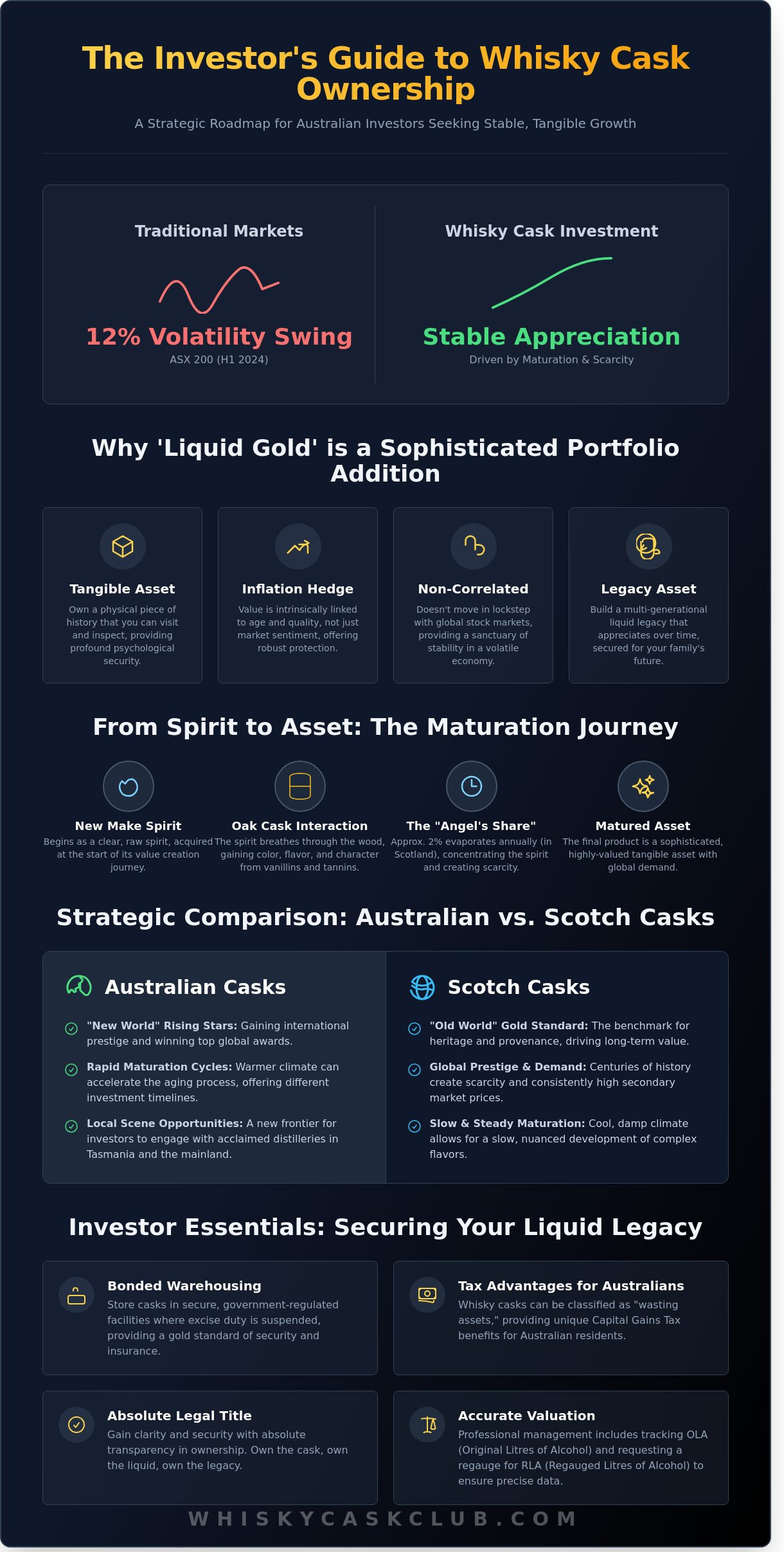
Australian Casks vs. Scotch Casks: A Strategic Comparison
Australian whisky cask investors often weigh the explosive potential of a younger market against the established prestige of the Highlands. It’s a choice between the “Grange” of spirits and the blue-chip assets of Scotland. While both regions offer tangible luxury, they operate on different timelines and biological rules. In Tasmania and Victoria, high diurnal temperature swings drive the spirit deep into the oak. This creates a mature, complex profile in five to eight years. Conversely, the cool, damp Scottish climate allows for a slow, graceful evolution over decades. A Scotch cask can sit for thirty years, gaining value through extreme rarity and age statements that Australian climates don’t permit due to annual evaporation rates of 4% to 6%.
Historical ROI reflects these geographic realities. Scotch offers a track record of steady, predictable growth, supported by centuries of provenance. Australian casks have seen sharper appreciation spikes following international accolades. Sullivans Cove’s 2014 win at the World Whiskies Awards, for instance, transformed the domestic market into a global contender overnight. Price entry points for Australian casks are often more accessible for boutique distilleries, whereas premium Scotch casks from “ghost” distilleries or iconic names like Macallan require a more substantial initial outlay.
The Global Liquidity Factor
Liquidity defines the ease of your exit strategy. Scotland’s ecosystem is vast, supported by thousands of independent bottlers like Gordon & MacPhail who constantly seek aged stock. This infrastructure provides a consistent floor for the market. The Scottish industry exported 1.6 billion bottles in 2022, ensuring a global buyer pool. The Australian market is more concentrated, relying on domestic collectors and a growing network of international enthusiasts. Scotch remains easier to trade on the international stage because its brand recognition is universal, making it a highly liquid alternative investment.
Risk Mitigation Through Diversification
Building a legacy requires a balanced portfolio that hedges against regional market shifts. Sophisticated investors mix undervalued Speyside distilleries with high-growth Tasmanian producers to secure both stability and upside. You might pair a 12-year-old Scotch intended for long-term holding with a 3-year-old Australian cask nearing its peak maturation. Accessing these rare opportunities is often the greatest challenge. Joining an exclusive whiskey club provides the necessary gateway to private allocations and curated casks that aren’t available to the general public. This strategic approach ensures your portfolio benefits from:
- Varied Age Statements: Balancing immediate maturity with long-term heritage.
- Geographic Spreading: Protecting assets from local economic or regulatory changes.
- Brand Tiering: Mixing established icons with emerging “cult” distilleries.
Legal and Tax Considerations for Australian Residents
Owning a rare spirit is a pursuit of passion, but the financial architecture must be as robust as the oak itself. For Australian whisky cask investors, the primary advantage lies in the bonded storage system. While your liquid matures in Scotland, it remains in a duty-suspended state. You don’t pay UK Value Added Tax (VAT) or Excise duty as long as the cask stays in a government-bonded warehouse. These significant costs only trigger if you decide to bottle the whisky and remove it from the bond, allowing your capital to grow unburdened by immediate tax leakage.
Proving ownership is the cornerstone of a secure investment. You must ensure you hold the legal title through a Cask Transfer Document or a formal Delivery Order. This document is your definitive proof of provenance; it confirms the cask is registered in your name within the warehouse’s stock system. Beware of “unregulated” schemes that offer fractional units or “guaranteed” 15% annual returns. Real cask ownership is a tangible asset investment, not a financial derivative. If a broker can’t provide a warehouse receipt or a certificate of title in your name, the risk to your capital is substantial.
Taxation requires a nuanced approach. In the UK, whisky is often classified as a “wasting asset” because the wood breathes and the liquid evaporates over time, a process known as the Angels’ Share. This classification typically exempts the asset from UK Capital Gains Tax (CGT). However, Australian residents must consider ATO regulations. The ATO generally views high-value casks as “collectables,” meaning CGT may apply if the acquisition cost was $500 or more. Because tax laws shift, we always recommend consulting a specialist who understands international alternative assets.
Secure your financial future and explore exclusive cask opportunities with our expert team today.
International Ownership Logistics
Managing a portfolio from Sydney or Perth requires a trusted partner. Since you can’t personally visit the Highlands every month, your cask broker acts as your “boots on the ground.” They coordinate essential maintenance like regauging, which measures the Alcohol by Volume (ABV) and the liters of bulk spirit. You’ll receive annual health reports and updated valuations, ensuring you can track your liquid wealth with the same precision as a traditional stock portfolio.
Planning Your Exit
A sophisticated investor always looks toward the horizon. When the time comes to realize your gains, you have several elegant paths. You might sell the cask back to the broker or list it via a specialist private auction. For those seeking a more personal touch, the bottling option allows you to create a private label, turning your investment into a tangible legacy. Many of our members also choose legacy planning, passing these appreciating assets to the next generation as a unique family heirloom.
Building Your Legacy with Whisky Cask Club
Whisky Cask Club acts as a sophisticated bridge between the historic warehouses of Scotland and the private portfolios of discerning Australian whisky cask investors. We don’t simply facilitate transactions; we curate tangible assets. Our approach centers on sourcing investment-grade Scotch with impeccable provenance and verified growth potential. By focusing on the Whisky Cask Club difference, we provide a level of expertise, exclusivity, and transparency that is rare in the alternative asset space. We understand that our clients seek both prestige and security. That’s why we manage every logistical detail from the moment of purchase.
Our comprehensive management service removes the traditional barriers to entry. We oversee the following for every member:
- Secure Storage: All casks remain in government-regulated bonded warehouses in Scotland, ensuring the liquid matures in its native climate.
- Full Insurance: Every asset is covered by comprehensive insurance policies, protecting your capital against unforeseen events.
- Professional Oversight: We monitor the maturation process, providing regular updates and expert advice on the optimal time to exit.
Ownership is simplified through our end-to-end management suite. You retain full legal title to the cask while we handle the heavy lifting. This hands-off approach ensures your asset matures in ideal conditions while you enjoy the peace of mind that comes with professional stewardship. It is a transparent process designed for those who value both liquid excellence and financial clarity.
Exclusive Access to Premium Distilleries
Securing a cask from top-tier scotch distilleries is often impossible for individual buyers. These institutions prioritize long-standing industry relationships over public inquiries. We leverage our deep-rooted connections to secure allocations that are rarely, if ever, available to the general public. This allows our members to acquire spirit at wholesale pricing. By entering the market at this level, you bypass the retail premiums that often dilute initial returns. It’s an intelligent way to ensure your capital is working for you from day one.
Start Your Journey Today
A successful whisky investment requires a patient, long-term perspective. While markets may fluctuate, the steady maturation of premium spirit remains a constant. For Australian whisky cask investors, this represents a unique opportunity to diversify into a tangible, high-prestige asset class. The process is straightforward. We begin with an initial consultation to understand your financial goals and time horizons. From there, we tailor a portfolio that reflects your personal tastes and investment objectives. Don’t wait to secure your piece of distilling history. Join the elite group of investors building a liquid legacy and own a truly unique asset today.
Secure Your Liquid Legacy in 2026
The roadmap for Australian whisky cask investors in 2026 is defined by a shift toward tangible, high-provenance assets that transcend traditional market volatility. You’ve explored how the intersection of Australian craft innovation and established Scotch heritage offers a unique dual-path for growth. By transitioning from a mere consumer to a cask owner, you secure a stake in a market where value is intrinsically linked to the passage of time. We provide the infrastructure to make this journey seamless. Every cask resides in HMRC-approved bonded warehouses; this ensures rigorous regulatory oversight and tax-efficient maturation. We safeguard your holdings with full insurance at replacement value, providing peace of mind as the spirit develops its character. When you’re ready to capitalize on your patience, our specialists offer expert exit strategy advisory to navigate the global secondary market. The opportunity to own a piece of distilling history is rare, but the rewards of a well-timed entry are enduring.
Begin your legacy: Consult with our Whisky Cask Specialists
Your journey into the world of rare spirits starts with a single, sophisticated choice.
Frequently Asked Questions
Is whisky cask investment legal for Australians?
Yes, it’s perfectly legal for Australians to invest in whisky casks both domestically and internationally. Australian whisky cask investors must comply with the Australian Securities and Investments Commission (ASIC) guidelines if the investment is structured as a managed investment scheme. Most direct ownership models, where you hold the title to a specific tangible asset, fall under standard property law. This clear legal framework provides the security needed to build a multi-generational legacy through rare spirits.
How much does it cost to start investing in whisky casks?
Entry points vary significantly based on the distillery’s prestige and the age of the spirit. According to the Knight Frank Luxury Investment Index 2023, rare whisky has seen a 10 year growth of 373 percent. While new-make casks are more accessible, you’ll also need to account for annual storage and insurance fees. These typically range from 50 to 150 pounds per year depending on the specific warehouse facility and the value of the insurance coverage.
What are the risks of investing in whisky casks?
The primary risks include market volatility, evaporation, and liquidity challenges. The Angels’ Share typically reduces the volume of liquid by 2 percent annually in Scotland, which can affect your total yield over several decades. Because whisky is a tangible asset, it’s not as liquid as stocks; it can take 3 to 6 months to find the right buyer who appreciates the provenance and heritage of your specific rare cask. Professional management helps mitigate these factors.
Do I have to pay Australian tax on my whisky investment?
Yes, Australian residents are generally liable for Capital Gains Tax (CGT) on the profit made from selling a whisky cask. The Australian Taxation Office (ATO) treats whisky casks as collectables if they cost more than 500 dollars. If you hold the asset for more than 12 months, you may be eligible for a 50 percent CGT discount. Always consult a qualified tax professional to discuss your specific financial legacy and ensure full compliance with current tax codes.
How long should I hold a whisky cask before selling?
A minimum holding period of 5 to 10 years is recommended to allow the spirit to develop its complex character and value. Data from the BC20 Whisky Cask Index suggests that the most significant value appreciation occurs as the whisky reaches milestone ages like 12, 15, or 18 years. This patient approach allows the craftsmanship of the wood to transform the liquid into a rare, high-demand premium asset that appeals to serious global collectors.
Can I visit my cask in Scotland or Australia?
Most bonded warehouses allow owners to visit their casks by prior appointment, typically requiring 14 to 30 days of notice. For Australian whisky cask investors, visiting a warehouse in Tasmania or the Highlands of Scotland offers a profound connection to their investment. During these visits, you can often request a regauge to check the volume and strength of your spirit. This ensures the integrity of your tangible asset remains intact throughout its maturation.
What happens if the distillery goes out of business?
Your ownership remains secure because the cask is your private property, held in a third-party bonded warehouse. In the event of a distillery closure, your title of ownership and the warehouse receipt prove you own the liquid, not the distillery. History shows that silent distillery casks, such as those from Port Ellen which closed in 1983, often become more valuable due to their extreme rarity. Your investment is protected by legal title and physical possession in secure storage.
How is the value of my cask determined over time?
Value is determined by the distillery’s reputation, the age of the whisky, and the quality of the wood. Independent valuations use auction data and private sale records to track market trends. A 2022 report indicated that Scotch whisky exports reached 6.2 billion pounds, showing the immense global demand that drives prices. As the spirit matures and the supply of aged stock diminishes, the rarity of your legacy increases. Own the cask. Own the liquid.