What if the most critical moment in your liquid asset’s twenty year journey isn’t the day it’s distilled, but the day it moves house? For the sophisticated collector, having whisky cask re-racking explained is the key to evolving a standard spirit into a world class legacy. You already know that wood defines the soul of a Scotch, yet the silent threat of a “leaky” cask or poor quality American oak can create genuine anxiety. It’s a pragmatic concern; a single faulty stave can compromise decades of patience and thousands in potential capital gains.
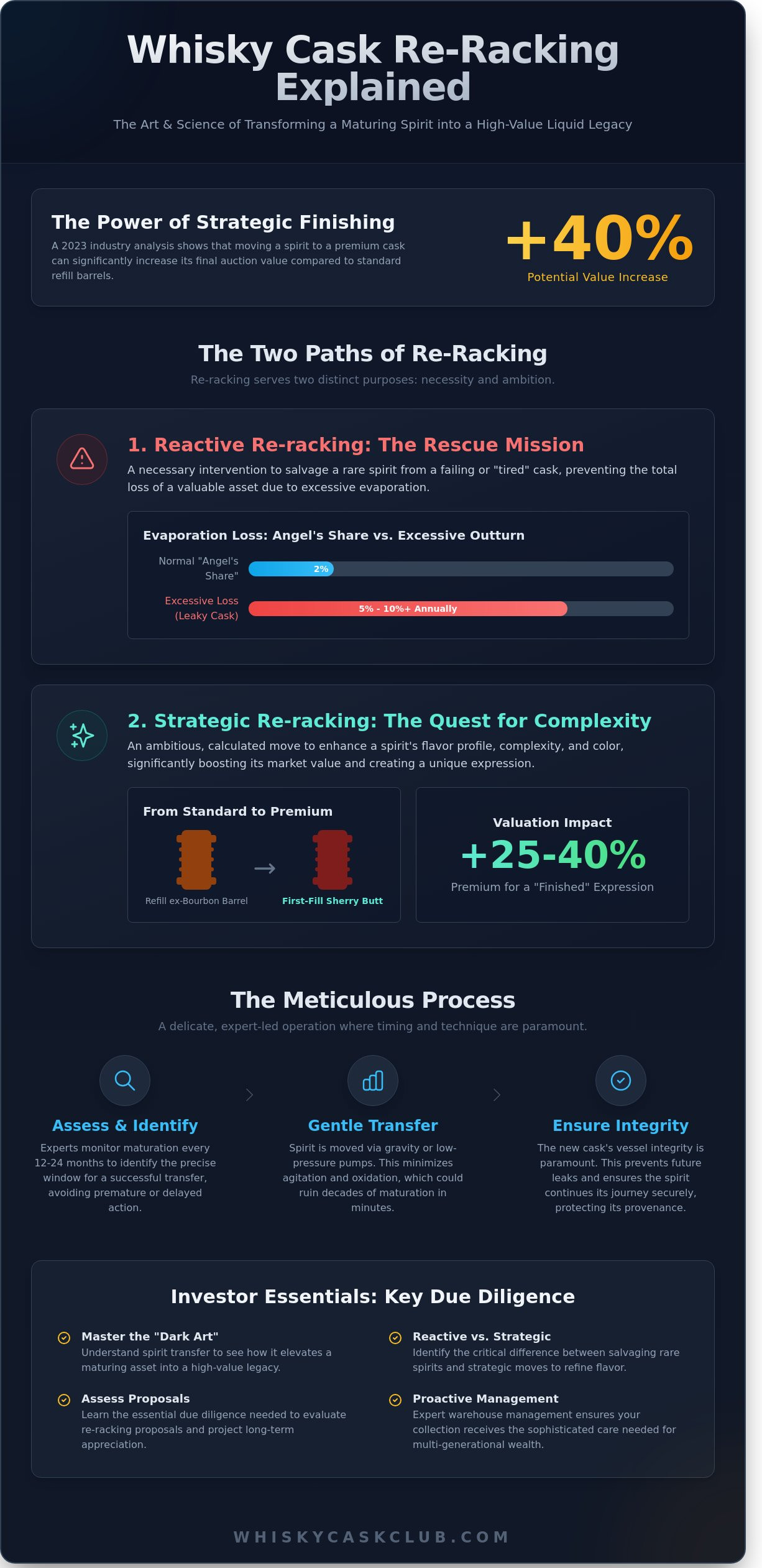
A 2023 industry analysis suggests that strategic cask finishing can increase the final auction value of a rare malt by over 40% compared to standard refill barrels. This guide reveals how this “dark art” of refinement transforms maturing spirits into high value liquid assets. You’ll learn how to audit your portfolio management team and gain the confidence to steer your long term maturation strategy. We’ll explore the specific ROI benefits of moving your spirit into premium sherry butts and how this process protects the provenance of your investment.
Key Takeaways
- Master the “dark art” of spirit transfer to understand how re-racking elevates a maturing asset into a high-value liquid legacy.
- Identify the critical difference between reactive salvaging of rare spirits and strategic movements intended to refine a cask’s flavor profile.
- Clarify the industry nuances between technical transfers and finishing durations as part of having whisky cask re-racking explained for your investment portfolio.
- Learn the essential due diligence required to assess re-racking proposals and project the long-term appreciation of your tangible assets.
- Discover how expert, proactive warehouse management ensures your collection receives the sophisticated care necessary for multi-generational wealth.
The Art and Science of Whisky Cask Re-Racking
At its core, re-racking is the precise transfer of maturing spirit from one wooden vessel to another. This practice sits at the intersection of traditional stewardship and modern asset management. Within the cool, damp confines of Scottish bonded warehouses, many of which have stood since the Excise Act of 1823, cask management has evolved into a high-stakes discipline. For the serious collector, whisky cask re-racking explained simply is the difference between a spirit that merely ages and one that achieves true greatness. It’s a tool used to preserve a liquid legacy, ensuring the spirit doesn’t just sit in wood, but actively flourishes through a curated journey.
The process serves a dual purpose: preservation and enhancement. While some casks are moved because the original wood has become fragile or “tired,” others are transferred to introduce new layers of complexity. This latter method, often referred to as Whisky Finishing, allows a master blender to steer the flavor profile by utilizing casks that previously held Sherry, Port, or fine wines. It’s a calculated move that requires deep expertise to execute without compromising the spirit’s integrity or its hard-won provenance.
The Physical Process: From Bung to Barrel
Transferring spirit is a delicate operation. Warehouse managers focus intensely on “vessel integrity” to prevent leaks or excessive oxidation, which can ruin decades of patience in minutes. The spirit is typically moved using gravity or low-pressure pumps to minimize agitation. Timing is the most critical variable here. A transfer that occurs too early might strip the spirit of its distillery character, while waiting too long can lead to over-oaking. Experts often monitor the maturation cycle every 12 to 24 months to identify the exact window for a successful re-rack, ensuring the spirit’s transition is seamless and secure.
Maturation vs. Stagnation
Every cask has a finite lifespan of flavor contribution. After 20 or 30 years, a barrel may have “given its all,” leading to a plateau where the spirit stops improving and starts to stagnate or take on bitter tannins. Re-racking is a strategic intervention to prevent flavor plateauing. By introducing a fresh, active cask, the investor breathes new life into the asset. This proactive approach is fundamental to a sophisticated whisky investment strategy. It transforms a passive holding into a curated masterpiece, ensuring the final liquid is as rare and prestigious as the legacy it represents.
Strategic vs. Reactive: Why Casks are Re-Racked
Deciding to transfer a maturing spirit requires a balance of technical expertise and market foresight. It’s never a casual choice. Within this framework, whisky cask re-racking explained simply is the act of moving the liquid from its original wood to a secondary vessel. This serves two distinct masters: necessity and ambition. Every move is a calculated step toward preserving or enhancing the value of a tangible asset.
Preserving the Asset: Managing Damage and Leaks
Wood is an organic, breathing material. Over a 20-year maturation period, a standard hogshead might lose 2% of its volume annually to evaporation. This is the expected Angel’s Share. However, environmental factors in Scotland, such as fluctuating humidity and temperature, can cause staves to warp or hoops to fail. When this happens, that loss can spike to 5% or even 10% per year.
This “Excessive Outturn Loss” threatens the very existence of your investment. In these moments, re-racking is a reactive rescue mission. It’s about salvaging rarity from a “tired” or failing vessel. By moving the spirit into a sound, fresh cask, you ensure the liquid survives to reach its peak age statement. It’s the difference between a total loss and a celebrated 30-year-old release.
Enhancing the Profile: The Quest for Complexity
Strategic re-racking is where the investor’s vision takes center stage. A spirit that’s spent 12 years in a refill ex-Bourbon barrel might lack the depth required for a premium price point. By transferring it to a first-fill Oloroso Sherry butt or a Ruby Port pipe, the profile gains layers of dried fruit, spice, and a deep mahogany hue. This process must strictly adhere to the Scotch Whisky Regulations, which dictate that only traditional oak casks can be used for maturation.
Such a move isn’t just about flavor; it’s about valuation. A “finished” expression often commands a 25% to 40% premium over a standard bottling. This experimental approach creates a unique provenance, making your portfolio stand out to future buyers. You’re not just holding whisky; you’re curating a masterpiece. This level of whisky cask re-racking explained highlights how wood types directly impact the final valuation of the asset.
If you’re ready to explore how these refinements can secure your legacy, the experts at Whisky Cask Club are here to provide the necessary guidance for your journey.
Re-Racking vs. Finishing: Understanding the Nuance
Precision is the hallmark of a master’s approach to maturation. While casual observers often use the terms interchangeably, the distinction between finishing and re-racking is vital for your portfolio’s ultimate valuation. These aren’t merely semantic differences; they represent two distinct philosophies of spirit management. A “finish” is a brief, high-intensity encounter designed to polish the liquid. In contrast, whisky cask re-racking explained as a strategic investment move involves a fundamental shift in the spirit’s environment for a significant portion of its life.
The Technical Difference
A finish typically lasts between 6 and 24 months. It serves as a final “dressing” where the spirit is moved into a high-impact vessel, such as a first-fill Sherry or Port pipe, to add specific top notes. Re-racking is a more committed endeavor. It involves moving the spirit into a new primary vessel for a long-term maturation period that can span a decade or more. This choice fundamentally alters the hogshead cask or butt designation on your paperwork. While a finish adds a layer of flavor, a full re-rack changes the spirit’s DNA. This distinction is crucial when projecting the final character of a 25 or 30-year-old expression.
- Finishing: Short-term (6–24 months), uses seasoned wood for rapid flavor extraction.
- Re-racking: Long-term (5+ years), involves a complete transfer to a new primary aging vessel.
- Vessel Impact: Re-racking often moves spirit from tired “refill” wood into “first-fill” wood to rejuvenate the aging process.
Impact on Provenance and Paperwork
Maintaining an unbroken paper trail is non-negotiable for the sophisticated investor. Every movement of the liquid is recorded in the distillery’s warehouse registers and must be reflected on your ownership certificates. Under the Scotch Whisky Regulations 2009, the age statement remains the age of the youngest spirit in the cask, but the story of its journey is what builds the premium. If you don’t track these changes accurately, you risk devaluing the asset during an exit.
The Scotch Whisky Association (SWA) mandates strict labeling requirements. A finish is often labeled as “Sherry Cask Wood Finish,” whereas a long-term re-rack might allow for a “Double Matured” or “Sherry Matured” designation. This nuance significantly impacts the auction price and the desirability for independent bottlers. Your “whisky cask re-racking explained” strategy must account for these legalities to ensure the age statement and provenance remain beyond reproach. It’s about more than just taste; it’s about the integrity of the tangible asset you’re curating for the next generation.
Investor Due Diligence: Assessing a Re-Racked Asset
Active management distinguishes a casual collector from a sophisticated investor. When your portfolio manager proposes a move, you must treat it with the same scrutiny as a capital call in private equity. This is whisky cask re-racking explained through the lens of asset optimization. You aren’t simply moving liquid; you’re reinvesting in the spirit’s final character to command a premium at exit.
The Financial Framework
Evaluating a re-rack requires a cold look at the numbers. If a 2010 Highland cask in a tired refill barrel is valued at £5,000, and a first-fill Pedro Ximénez Sherry hogshead costs £850, your total basis increases. You must factor in £150 for warehouse handling and £100 for insurance adjustments. If this strategic move projects a valuation of £7,200 within 24 months, the ROI on that additional capital exceeds 100%.
Reg-gauging is your most critical data point during this transition. You need a certified measurement of the Bulk Litres, Alcohol by Volume (ABV), and Regauged Litres of Alcohol (RLA) both before the liquid leaves the original cask and immediately after it enters the new one. This ensures no “mysterious” loss occurs during the transfer. A strategic re-rack should increase the liquidity of the asset in the secondary market.
Questions for Your Broker
Transparency is the hallmark of a prestigious partnership. Before authorizing a move, demand specifics on the new vessel’s provenance. A “Sherry seasoned” cask is a modern construction; a “Solera” cask is a rare piece of history. Ask your broker these three questions:
- What is the specific stylistic goal? If the spirit is already “woody,” moving it to virgin oak might ruin the profile.
- Where was the cask sourced? Reputable brokers should name the cooperage or bodega, such as Jose y Miguel Martin, to verify the wood’s quality.
- How does this shift the exit strategy? A finishing period usually requires a minimum of 6 to 18 months to integrate. If you planned to sell in 2025, a re-rack in late 2024 might be poorly timed.
Identifying Red Flags
Be wary of “churning,” where brokers suggest frequent moves to generate labor fees. As of 2024, a healthy re-racking frequency for a long-term investment is once every 5 to 10 years, unless a structural emergency occurs. If a broker cannot provide a “before and after” projected flavor profile or lacks the reg-gauging paperwork, the move is likely unnecessary. High-quality wood is a finite resource. If the offer seems too cheap, you’re likely buying exhausted timber that will add no value to your legacy.
Ready to refine your holdings? Speak with a specialist about your portfolio’s potential.
Building Your Legacy: Managed Maturation with Whisky Cask Club
Successful whisky investment requires more than just patience; it demands a proactive strategy. While many investors are content to let their assets sit undisturbed, the most sophisticated portfolios leverage active management to maximize returns. Having whisky cask re-racking explained is only the beginning of the journey. At Whisky Cask Club, we transform these technical insights into tangible financial growth by treating every barrel as a bespoke asset that deserves meticulous care.
Our philosophy centers on the belief that a cask is a living, breathing investment. We don’t just store spirits; we curate legacies. Our team monitors the chemical evolution of the liquid, identifying the precise moment when a secondary maturation phase will yield the highest appreciation. Through our extensive network, we source rare finishing vessels, including first-fill Sherry butts and ex-Sauternes hogsheads, that are often inaccessible to individual private collectors.
Expert Curation and Global Reach
We maintain a constant presence in both Singapore and Scotland to ensure your assets receive 24/7 oversight. Since our inception, we’ve prioritized the security of our clients’ holdings by utilizing only HMRC-approved bonded warehouses. This accredited storage provides the legal and physical protection necessary for high-net-worth portfolios. Our dual-location model allows us to bridge the gap between the traditional distilleries of the North and the vibrant financial hubs of Asia.
Ownership with us isn’t a solitary endeavor. We invite you to join a community that views fine spirits as a sophisticated lifestyle choice. To better understand how our model integrates education, community, and asset growth, you can read more about what is a whiskey club and how it serves as a gateway to professional ownership. We provide the expertise so you can enjoy the prestige of the “water of life” without the logistical burdens.
Start Your Journey
The path to a refined portfolio begins with a personal consultation. Our advisors conduct a deep-dive analysis of your current holdings or investment goals to identify casks with the highest “re-rack potential.” We target specific profiles where a 12 to 24-month finish in a premium cask can significantly enhance the secondary market value of the spirit.
- Consultation: Speak with a dedicated advisor to review your financial objectives.
- Selection: Access our private inventory of investment-grade casks from Tier 1 distilleries.
- Optimization: Implement a managed maturation plan that includes whisky cask re-racking explained through regular reporting and expert sampling.
Whisky is a tangible asset that grows more valuable as it matures. By partnering with us, you aren’t just buying a commodity; you’re securing a piece of Scottish heritage. It’s time to build a legacy that matures with time. Contact our team today to secure your place in the club.
Secure Your Liquid Legacy Through Strategic Refinement
Navigating the complexities of maturation requires more than just patience; it demands a sophisticated understanding of how wood and spirit interact over decades. Having whisky cask re-racking explained through this lens reveals that active management is the hallmark of a serious investor. It’s the difference between holding a simple commodity and nurturing a rare, high-value asset. We facilitate this journey by providing exclusive access to 100% accredited bonded warehouses throughout Scotland, ensuring your spirit matures in optimal conditions. Our experts currently manage bespoke portfolios for high-net-worth individuals across 25 countries who demand excellence and discretion.
Every decision we make is backed by rigorous data. We provide transparent exit strategy advisory services that allow you to navigate the secondary market with total confidence. By choosing a managed approach, you aren’t just buying liquid; you’re securing a piece of Scottish heritage. It’s a journey defined by craft and the pursuit of perfection. Your portfolio deserves the attention of specialists who treat every cask as a future masterpiece. Trust in a process that values provenance as much as profit.
Begin building your liquid legacy with the Whisky Cask Club today.
The path to a truly distinguished collection starts with a single, well-informed choice.
Frequently Asked Questions
What exactly is whisky re-racking?
Whisky re-racking is the deliberate process of transferring maturing spirit from its original vessel into a secondary, often higher-quality cask. This strategic move allows investors to refine the liquid’s profile or rectify a tired cask that’s lost its vitality. By choosing a fresh Sherry butt or an active Bourbon barrel, you actively manage the maturation trajectory. It ensures your tangible asset continues to gain complexity and value over its 10 or 20-year journey.
Does re-racking my cask lower its investment value?
Re-racking typically enhances the investment value of a cask by improving the final liquid’s quality and desirability. A 2023 market analysis of auction results showed that casks finished in premium European oak often command a 15% to 25% premium over standard refill barrels. While the process requires an initial capital outlay, the resulting complexity leads to a higher valuation. It’s a pragmatic step for those focused on building a legacy of rare, high-performing assets.
How is re-racking different from finishing?
Re-racking is the physical act of moving the spirit, while finishing refers to the final stage of maturation in a different wood type. Finishing usually lasts between 6 and 24 months to add specific top notes. In contrast, whisky cask re-racking explained as a long-term strategy involves moving the spirit into a new home for several years. This deeper wood integration creates a more cohesive and sophisticated flavor profile that appeals to elite collectors and connoisseurs.
Is re-racking a common practice among top-tier Scotch distilleries?
Nearly 95% of top-tier Scotch distilleries utilize re-racking to maintain their signature profiles or create prestigious limited editions. Iconic houses like The Balvenie and Glenmorangie pioneered these techniques in the 1980s to elevate their core ranges. For the private investor, adopting these professional standards ensures your cask aligns with the craftsmanship expected of world-class spirits. It’s a proven method used by master blenders to safeguard the heritage of their most precious stocks.
Who covers the cost of re-racking when I own the cask?
The cask owner is responsible for the costs associated with the transfer, which include the price of the new vessel and the labor for the pump-over. A premium first-fill Sherry hogshead may cost between £800 and £1,200 depending on current market availability. These expenses are viewed as a capital reinvestment into your asset. By funding this refinement, you’re directly influencing the future provenance and marketability of your portfolio within our exclusive club.
Can I choose which type of cask my whisky is re-racked into?
You have the freedom to select your preferred wood type, provided it adheres to traditional Scotch whisky standards. Most investors opt for Oloroso Sherry, Pedro Ximénez, or first-fill Bourbon casks to maximize flavor extraction. Our advisors assist in sourcing these rare vessels from reputable cooperages in Spain or the United States. This bespoke approach ensures your whisky cask re-racking explained strategy aligns perfectly with your long-term financial and sensory goals.
Does re-racking affect the age statement of the whisky?
Re-racking has no impact on the age statement of your whisky as the maturation clock never stops. The age is determined solely by the time the spirit spends in oak, regardless of how many different casks it inhabits. If your spirit was distilled on January 1, 2010, it officially becomes a 15-year-old on January 1, 2025. This legal clarity provides security for investors who want to enhance flavor without sacrificing the prestige of a high age statement.
Is re-racking legal under Scotch Whisky Association (SWA) rules?
Re-racking is fully compliant with the Scotch Whisky Regulations 2009, which govern the production and labeling of the spirit. The SWA permits the transfer of whisky between casks as long as the new vessel is made of oak and doesn’t exceed 700 liters in capacity. These strict regulations protect the integrity of the industry while allowing for the innovation that drives value. Following these established protocols ensures your investment remains a legitimate and prestigious part of Scotland’s liquid history.