A single misinterpretation of Regauged Litres of Alcohol (RLA) can misrepresent the real-world value of your maturing asset by as much as 12%. For the serious collector, understanding a whisky portfolio report isn’t just an administrative task; it’s the foundation of a sophisticated wealth strategy. You’ve likely felt the quiet pride of owning a rare piece of Scottish heritage, yet found that technical jargon like OLA and ABV creates an unnecessary barrier between you and your investment’s true potential. It’s natural to feel a sense of hesitation when the data doesn’t immediately reflect the prestige of the liquid resting in the wood.
We’ll transform that uncertainty into a position of absolute authority. You’ll master the art of interpreting your cask data to make informed, high-value decisions for your liquid legacy. This guide decodes every critical metric, benchmarks your casks against 2024 market standards, and pinpoints exactly how to align peak maturation with your most profitable exit window.
Key Takeaways
- Learn why consistent reporting is a vital requirement for managing tangible assets and maintaining compliance within HMRC-regulated bonded warehouses.
- Master the art of understanding a whisky portfolio report to accurately track the maturation and projected health of your cask assets over time.
- Discover how distillery demand and historical auction data are used to benchmark performance and identify the intrinsic value of rare provenance.
- Identify the precise maturation peak where liquid quality meets maximum market demand, ensuring you make high-value decisions for your liquid legacy.
- Explore how bespoke management simplifies complex data points into actionable insights, providing the discreet guidance required for sophisticated cask ownership.
The Strategic Importance of Your Whisky Portfolio Report
A whisky portfolio report is far more than a simple inventory list. It’s the primary tool for tracking a tangible, maturing asset that evolves in character and value every day it remains in the wood. While a casual collector might rely on a basic spreadsheet to track individual bottles, a sophisticated investor requires a professional cask management report to navigate the complexities of the secondary market. Understanding a whisky portfolio report is the first step in moving from a hobbyist to a serious participant in this exclusive asset class. It transforms your holdings from a list of names into a structured financial strategy.
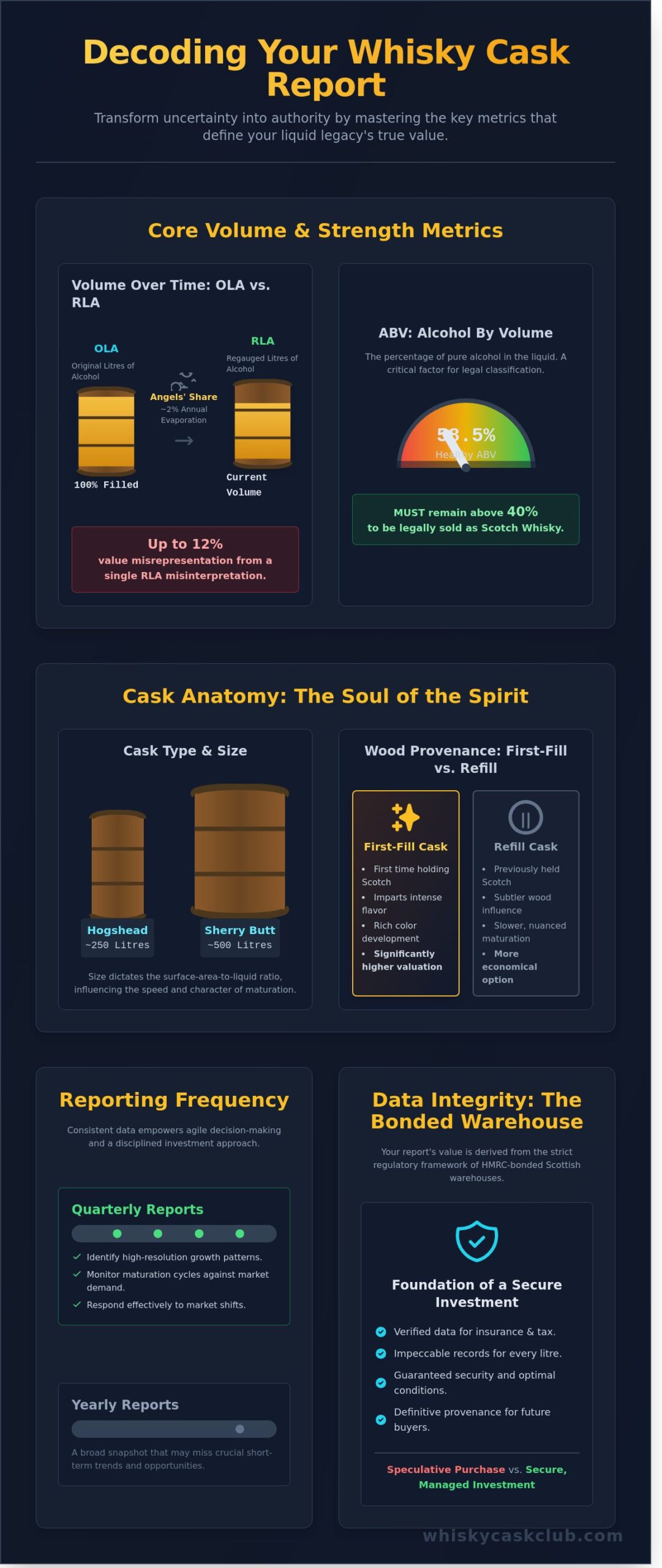
Regular reporting is a logistical necessity within the 420 plus HMRC-regulated bonded warehouses currently operating in Scotland. These reports provide the verified data required for insurance valuations and tax compliance, ensuring your investment is protected against unforeseen events. While you might understand the basics of whisky production, the report focuses on the commercial reality of that production. It serves as the definitive foundation for your eventual exit strategy, providing the provenance and data history that future buyers or auction houses will demand when you decide to realize your gains or pass on your legacy to the next generation.
Why Quarterly vs. Yearly Reports Matter
Frequency dictates your ability to respond to market shifts. While whisky is a patient, long-term play, quarterly reports allow you to identify growth patterns that a yearly snapshot might miss. Consistent data points every 90 days help you monitor how maturation cycles correlate with current market demand for specific vintages. This regular cadence reinforces the concept of whisky investment as a disciplined financial endeavor. It allows you to see the steady 10 percent to 15 percent historical annual appreciation in high-resolution, helping you stay committed to your long-term wealth goals without being swayed by short-term noise.
The Role of the Bonded Warehouse in Reporting
The integrity of your report depends entirely on the provenance of its data. In professional circles, this information comes directly from the accredited Scottish warehouses where your casks are matured under government supervision. These facilities are legally required to maintain impeccable records for every liter of alcohol. A professional report reflects this legal accuracy, verifying that your cask is secure, insured at its current market replacement value, and aging under optimal conditions. This verification process is what separates a speculative purchase from a secure, managed investment. The foundation of understanding a whisky portfolio report lies in recognizing that every figure is backed by the strict regulatory framework of the Scotch whisky industry.
Key Metrics: Decoding the Data in Your Cask Report
A professional report isn’t just a list of numbers; it’s a blueprint of your liquid legacy. When you’re understanding a whisky portfolio report, you must look beyond the surface to see how these variables dictate future returns. Every data point represents a physical reality inside the warehouse, and the interaction between these metrics determines the overall health of your investment. A report that reveals a high-performing cask is the result of careful curation and the relentless passage of time.
Understanding RLA vs. OLA and ABV
OLA, or Original Litres of Alcohol, records the volume of pure spirit at the moment of filling. Over time, porous oak allows for the “Angels’ Share,” a natural evaporation that typically claims 2% of the cask’s volume annually. This process is essential for flavor development but reduces the total volume. RLA is the current volume of pure alcohol remaining in the cask after maturation losses. A report showing an unexpected drop in RLA might indicate a “leaker” or poor warehouse conditions, whereas steady, predictable figures suggest a healthy, maturing asset. Your Alcohol by Volume (ABV) must also remain above 40% for the liquid to legally be sold as Scotch whisky.
Cask Type and Wood Provenance
The vessel determines the destiny of the spirit. A hogshead cask holds approximately 250 litres, while a Sherry Butt can hold up to 500 litres. Size matters because the surface area-to-liquid ratio dictates how quickly the wood influences the whisky. First-fill casks, which haven’t held Scotch before, offer intense flavor profiles and significantly higher valuations than “refill” casks that have been used multiple times. Wood provenance is the silent partner in your investment’s growth, and your report should clearly state whether the oak is American (Quercus alba) or European (Quercus robur).
Distillation Date and Maturation Age
The distillation date establishes the vintage, but the “Age Statement” is what collectors crave most. Scarcity increases exponentially as whisky hits the 18, 21, and 25-year milestones. These “sweet spots” often represent the peak of a distillery’s profile before the wood begins to dominate the spirit’s character. Your report tracks this progression, showing how time transforms a raw commodity into a rare luxury. While you’re understanding a whisky portfolio report, remember that the age is calculated from the distillation date to the date it’s bottled, not the current calendar year.
Every report includes a valuation, but you must distinguish between “paper value,” which is an estimated appraisal, and “realisable market value,” which is what a buyer will actually pay at auction or private sale. Given the recent regulatory scrutiny of whisky investment, it’s vital to ensure your report’s figures are backed by transparent market data rather than optimistic projections. Brand equity remains the strongest hedge; a cask from a “Top 10” distillery like Macallan or Bowmore will always command a premium over lesser-known names. If you’re looking to refine your strategy, consider how a curated selection of rare casks can strengthen your overall holdings.
Valuing the Liquid: How Performance is Benchmarked
A whisky portfolio report isn’t just a list of names; it’s a financial snapshot of maturing heritage. When you’re understanding a whisky portfolio report, the valuation reflects three core pillars: historical auction results from houses like Sotheby’s, current distillery demand, and rigorous independent audits. We analyze data from the last 24 months of secondary market sales to ensure your asset’s value isn’t based on speculation, but on realized transactions.
Investors often ask how a valuation remains objective. The process is a meticulous blend of science and market sentiment. We look at the Remaining Litres of Alcohol (RLA) and the Alcohol by Volume (ABV), which are the “hard science” metrics of cask stock valuation. These figures are then weighed against the “sentiment” of the brand’s global prestige. It’s this dual-layered approach that provides a realistic exit price rather than an inflated estimate based on retail bottle prices alone.
Benchmarking Against Industry Indices
Your report might show a 12% annual growth, but context is everything. We compare your holdings against the Knight Frank Rare Whisky Index, which reported a 373% increase over the decade ending in 2023. While bottle indices like the Apex 1000 track retail trends, cask growth is often more stable. Casks gain value through natural maturation, meaning they don’t suffer the same volatility as rare bottles. Outperformance is defined by beating these baseline averages through strategic distillery selection.
The Impact of Distillery Status (Silent vs. Active)
Scarcity is the primary driver of value. A deep dive into understanding a whisky portfolio report reveals that a “Silent Distillery” like Port Ellen or Brora carries an automatic premium because the supply is finite. Conversely, active distilleries use global marketing to elevate your cask’s worth. For instance, the Springbank Distillery maintains a legendary status due to its traditional floor maltings and limited output. When Springbank’s brand equity rises through a new 30-year-old release, the value of your younger cask in the warehouse rises in tandem.
- Historical Auction Data: Real-world pricing from the last 2 years of secondary sales.
- Independent Valuation: Third-party audits to ensure transparency and trust.
- Rarity Premium: Extra value assigned to silent distilleries or limited production runs.
From Data to Decision: Using Your Report to Refine Your Strategy
A portfolio report is far more than a simple receipt of ownership. It’s a sophisticated diagnostic tool designed to guide your next move. Mastery in understanding a whisky portfolio report allows you to distinguish between a passive holding and an actively managed legacy. You’re looking for the maturation peak. This is the precise moment where the spirit’s quality reaches its zenith and aligns with peak market demand. Your report provides the data; your strategy provides the direction.
Step 1: Assessing Maturation Health
The ABV (Alcohol by Volume) is your most critical metric. If your cask approaches the 40% danger zone, it risks losing its legal status as Scotch whisky. You should monitor the Regauged Litres of Alcohol (RLA) closely. A drop exceeding 2% per year suggests a thirsty “Angels’ Share” or a potential cask leak. If the report shows a significant RLA decrease since your 2023 assessment, schedule a physical sample immediately to evaluate the wood influence and spirit quality.
Step 2: Evaluating Exit Windows
Your report reveals if your asset is meeting its projected 10% to 15% annual ROI targets. Analyze the specific distillery trends mentioned in your quarterly update. While a 12-year-old cask might be attractive to independent bottlers for immediate release, holding for a 25-year milestone often unlocks a different tier of prestige buyers. Use the valuation data to decide if the current market price justifies a sale or if the liquid requires another decade of quiet slumber to reach its full financial potential.
Step 3: Rebalancing for Diversification
Effective wealth management requires avoiding over-concentration. If your report indicates that 65% of your holdings are peated Islay malts, you’re over-indexed in a single flavor profile. Identify the gaps in your collection. A robust portfolio needs the elegance and structural longevity of a Highland Single Malt to balance the intense smoke of the islands. Diversification protects your capital against shifts in consumer palate and regional distillery output fluctuations.
The report doesn’t just summarize the past; it dictates your future acquisitions. Use these insights to build a collection that reflects both your passion for the craft and your pragmatic financial goals. Every data point is a stepping stone toward a more refined and resilient investment journey.
Ready to optimize your holdings? Speak with a Portfolio Manager to refine your investment strategy based on your latest report.
The Whisky Cask Club Advantage: Bespoke Management and Reporting
Understanding a whisky portfolio report shouldn’t feel like deciphering a cryptic manuscript. At Whisky Cask Club, we distill the intricacies of OLA (Original Litres of Alcohol) and RLA (Regauged Litres of Alcohol) into clear, actionable intelligence. Our team acts as your discreet advisor, translating cold warehouse data into a narrative of growth and potential. We maintain a steadfast commitment to transparency, overseeing everything from HMRC-regulated bonded storage to the final exit advisory. Owning a rare cask is a prestigious journey; consider your portfolio report the map that guides you toward a successful realization of value.
Exclusive Access and Expert Guidance
We source casks with meticulous care, prioritizing spirit from distilleries that have shown historical price appreciation between 10% and 15% annually. Our role involves managing the technical health of your assets, including the vital re-gauging process that tracks the “angels’ share” evaporation. By keeping this rate near the standard 2% per year, we protect the integrity of your investment. You aren’t just an investor here; you’re a member of an elite community with access to private stock that rarely reaches the open market. We handle the logistical heavy lifting so you can enjoy the prestige of ownership without the administrative burden.
Building Your Liquid Legacy
A well-managed portfolio is a multi-generational asset. We use detailed reporting to help you build a legacy that transcends traditional market volatility. Whether you’re targeting a 10-year maturation cycle or a 30-year heirloom cask, the data provides the foundation for your family’s future wealth. Getting started is a seamless process. Once you’ve selected your first cask from our curated list, you’ll receive your initial report, establishing a baseline for your liquid gold. If you are ready to secure a tangible piece of Scottish heritage, speak with our experts to start your portfolio today. Your journey into the world of rare spirits begins with a single, well-documented cask.
Mastering Your Path to a Liquid Legacy
Sophisticated investors recognize that true wealth is built through precision and patience. By understanding a whisky portfolio report, you transform raw data into a strategic roadmap for long term growth. You’ve learned how to decode key metrics within your cask report and benchmark performance against global indices to ensure your assets remain on a steady upward trajectory. This isn’t just about owning spirits; it’s about managing a tangible asset with the same rigor as a traditional private equity fund.
Expertise is the defining factor between a simple purchase and a curated heritage. We provide 100% secure storage in HMRC-accredited Scottish bonded warehouses to protect your investment’s provenance. Our advisors offer bespoke guidance on exit strategies and the bottling of rare single malt casks from legendary distilleries. You gain exclusive access to the top tier of the market, ensuring your portfolio reflects your discerning standards. The journey toward a refined alternative investment starts with a single, informed decision.
Begin building your liquid legacy with the Whisky Cask Club and secure your place among an elite group of global connoisseurs.
Frequently Asked Questions
What is the most important metric in a whisky portfolio report?
The most important metric is the Regauged Litres of Alcohol (RLA) because it dictates the actual volume of spirit you own. While the age of the cask adds prestige, the RLA accounts for evaporation and determines the final bottle yield. If your RLA drops by 2% annually, your total volume decreases. This figure is the foundation for any accurate valuation when understanding a whisky portfolio report.
How often should I request a re-gauge for my whisky cask?
You should request a re-gauge for your whisky cask every 3 years for spirit aged over 15 years. For younger casks, a 5 year interval is standard practice. Regular re-gauging ensures your records reflect the 2% average annual loss from evaporation. Without these updates, your portfolio valuation relies on outdated estimates rather than the physical reality of the liquid in the warehouse.
What happens if the ABV in my report falls below 40%?
If the Alcohol by Volume (ABV) in your report falls below 40%, the liquid can no longer be legally sold as Scotch Whisky. It becomes “Spirit Drink” and loses 50% or more of its market value instantly. Expert managers monitor casks approaching 42% ABV closely. They’ll recommend bottling the cask immediately to preserve its legal status and your financial return.
Are the valuations in my portfolio report guaranteed sale prices?
Portfolio valuations represent a professional estimate based on current market data rather than a guaranteed sale price. A report might value a 20 year old Macallan cask at £50,000 based on recent private sales. However, the final price depends on the buyer’s demand and the specific bottling potential at that moment. Treat these figures as a high fidelity guide for your long term strategy.
How does the “Angels’ Share” impact my investment value over time?
The Angels’ Share reduces your liquid volume by approximately 2% every year. While this means you have fewer litres of alcohol, the remaining spirit often gains complexity and value as it matures. A cask that loses 20% of its volume over 10 years often doubles in value because the liquid’s rarity and age profile command a premium price from collectors and connoisseurs.
Can I use my portfolio report for tax and inheritance planning?
You can use your portfolio report as a formal record for inheritance and tax planning. In the UK, whisky casks are often classified as “wasting assets” by HMRC, which means they’re generally exempt from Capital Gains Tax. Providing a detailed report to your financial advisor ensures your legacy is documented accurately. It allows for the seamless transfer of this tangible luxury to the next generation.
What is the difference between OLA and RLA in simple terms?
Original Litres of Alcohol (OLA) is the volume recorded when the cask was first filled; Regauged Litres of Alcohol (RLA) is the current volume after evaporation. If a cask started with 250 OLA in 2010, the 2024 RLA might be 190. Understanding a whisky portfolio report requires focusing on the RLA to calculate the current market value of your investment accurately.
Why does my report show a different value than auction sites?
Your report shows the wholesale value of the bulk liquid, while auction sites reflect the retail price of individual bottles. Bottling a cask involves 20% VAT, bottling fees, and labeling costs that auction prices already include. A cask valued at £15,000 might produce 250 bottles that sell for £100 each at auction. This price gap accounts for the logistical costs and the premium paid for accessible bottles.