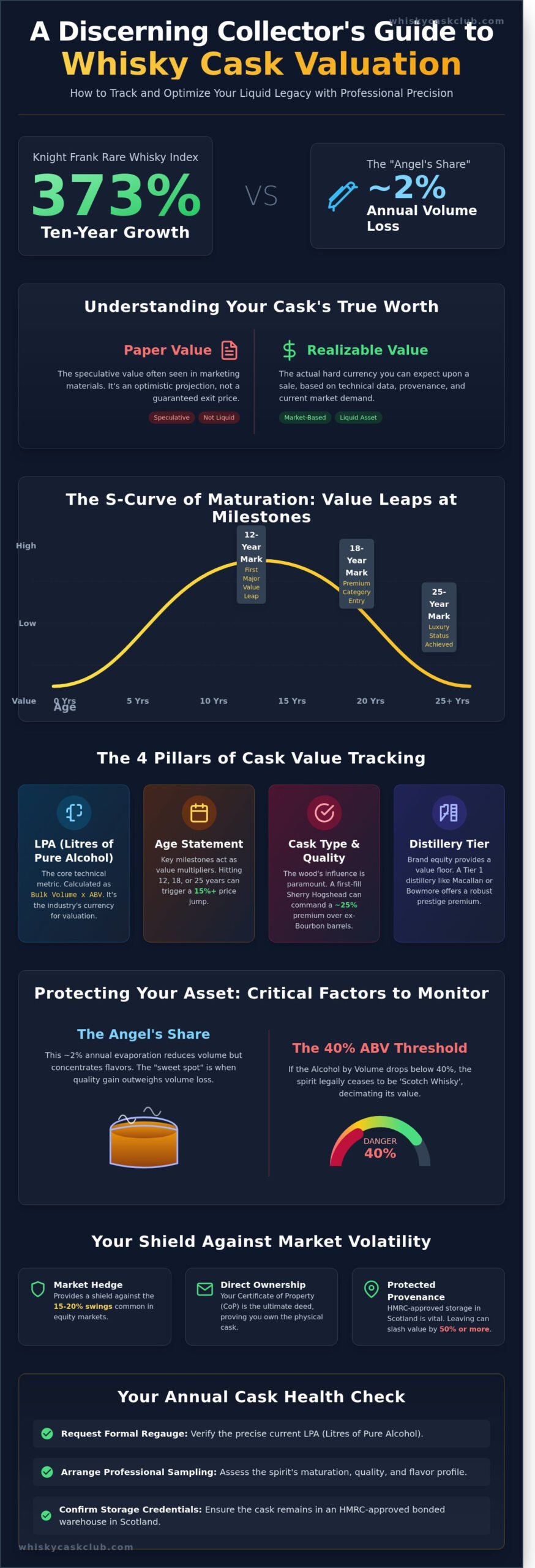
What if the most significant appreciation in your portfolio is currently breathing through seasoned oak in a Highland warehouse, yet you lack the precise tools to measure its heartbeat? You already recognize that a rare single malt is a sophisticated legacy asset that gains character and rarity with every passing season. However, the secondary market’s inherent opaqueness can make it difficult to determine how the “Angel’s Share”, that 2% annual volume loss, interacts with the 373% ten-year growth tracked by the Knight Frank Rare Whisky Index. Finding a reliable benchmark shouldn’t feel like a guessing game for a discerning collector.
This guide provides an expert framework on how to track my whisky cask value with the same rigor used by the industry’s leading spirits appraisers. You’ll master the art of valuing your liquid legacy by understanding the distinctive S-curve of maturation and the critical impact of ABV drops on final bottling potential. We’ll provide a pragmatic DIY checklist for your annual portfolio health check and reveal the specific market signals that indicate when to hold your position or execute a prestigious exit strategy. It’s time to bring professional transparency to your private cellar.
Key Takeaways
- Distinguish between speculative “paper value” and true realizable market value to understand the actual liquidity of your maturing spirit.
- Learn exactly how to track my whisky cask value by monitoring technical metrics like Litres of Pure Alcohol (LPA) and critical age milestones.
- Master the annual appraisal process, from requesting a formal warehouse regauge to assessing the wood’s influence through professional sampling.
- Discover strategic re-racking techniques that utilize finishing casks to elevate the rarity and premium status of your liquid legacy.
- Ensure the long-term security of your investment by leveraging HMRC-approved storage solutions that preserve both provenance and tax efficiency.
The Fundamentals of Whisky Cask Valuation: Why Tracking is Unique
Whisky isn’t a static entry on a digital ledger or a piece of gold locked in a vault. It’s a biological asset. Every year, the spirit interacts with the oak staves, losing roughly 2% of its volume to the “Angels’ Share” while gaining complexity from the wood. This physical transformation means tracking value involves more than just watching a ticker symbol. You’re monitoring a slow, chemical evolution that requires a sophisticated approach. Understanding what is single malt whisky and how its maturation profile develops is the first step in mastering how to track my whisky cask value effectively.
You must distinguish between paper value and realizable market value. Paper value represents the optimistic projections often found in marketing brochures or annual reports. Realizable value is the hard currency you receive upon exit. In 2023, the Knight Frank Luxury Investment Index highlighted a 10 year growth of 280% for rare whisky, yet individual cask performance varies based on the “exit gate” chosen. The bonded warehouse system serves as your primary source of truth. These government regulated facilities provide the only legal record of your asset’s health, volume, and alcohol by volume (ABV), ensuring the provenance remains impeccable.
Maturation vs. Market Sentiment
Whisky appreciation follows a distinct S-Curve. Value doesn’t rise linearly; it leaps at specific milestones like the 12, 18, and 25 year marks. As your cask’s siblings are bottled and consumed, your remaining liquid becomes mathematically rarer. This scarcity often drives price more than the liquid’s taste alone. Brand equity acts as your value floor. A cask from a Tier 1 distillery like Macallan or Bowmore maintains a prestige premium regardless of broader market shifts, as the distillery’s global marketing spend indirectly inflates your asset’s worth.
The Tangible Asset Advantage
Physical ownership provides a shield against the 15% to 20% swings often seen in equity markets. Your Certificate of Property (CoP) is the ultimate deed of your legacy, proving you own the specific cask, not just a share in a fund. Secure storage in HMRC approved warehouses in Scotland ensures the provenance remains untarnished. This geographic lock-in is vital. If a cask leaves Scotland before bottling, it loses its legal status, which can slash its market value by 50% or more instantly. Knowing how to track my whisky cask value means verifying these storage credentials and ABV levels at least once every two years.
The 4 Pillars of Cask Value Tracking
Understanding how to track my whisky cask value requires a grasp of four fundamental variables. These pillars transform a liquid asset into a quantifiable financial instrument. The process is a blend of chemistry and market sentiment, where technical data meets the prestige of Scotch heritage.
- LPA (Litres of Pure Alcohol): This is the technical currency of your investment. It’s calculated by multiplying the total bulk volume of the liquid by its Alcohol by Volume (ABV). As the whisky matures, both volume and ABV fluctuate, making the LPA the only stable metric for professional appraisal.
- Age Statement: In the world of Scotch, certain milestones act as value multipliers. Casks often see a price jump of 15% or more the moment they hit the 10, 12, 18, or 25-year marks. These psychological barriers are critical because they dictate the final bottling’s retail category.
- Cask Type and Quality: The vessel is as important as the spirit. A first-fill Sherry Hogshead typically commands a 25% premium over a standard ex-Bourbon barrel. The wood’s ability to impart flavor determines the liquid’s ultimate desirability to blenders and independent bottlers.
- Distillery Tier: Not all spirit is created equal. Investment-grade potential is often tied to the distillery’s regional ranking. A Tier 1 Speyside or a rare Islay malt provides a more robust foundation for building a legacy than a generic grain distillery.
The Impact of the Angel’s Share
Every year, roughly 2% of your whisky evaporates through the porous oak staves. This natural phenomenon, known as the Angel’s Share, reduces your bulk volume but concentrates the flavor compounds. The “Sweet Spot” for tracking value occurs when this concentration of quality outweighs the loss in volume. It’s a delicate balance. You must ensure the ABV remains above the legal 40% threshold. If the spirit drops below this level, it can no longer be sold as Scotch whisky, which would decimate its market value. Maintaining a high ABV provides more flexibility for future finishing and bottling options.
Provenance and Brand Heritage
The name on the cask certificate dictates the asset’s price ceiling. Investing in a distillery with global recognition, such as Ardmore or the prestigious Glenfiddich, ensures a built-in secondary market demand. However, tracking value also means being aware of the risks in cask investment, particularly regarding the verification of ownership and the authenticity of the paperwork. Since 2021, the market has seen a surge in interest for “Lost Distilleries,” where casks from closed sites command massive premiums due to their finite supply. Monitoring the distillery’s recent awards and its parent company’s performance since 2020 can provide early signals of a value spike. If you’re ready to secure your own tangible asset, you can explore our curated selection of premium casks.
DIY Tracking vs. Professional Appraisal
Determining the worth of a maturing asset requires more than a casual glance at retail shelves. While a simple spreadsheet helps record your initial purchase price and age, it often fails to capture the nuanced appreciation of a tangible asset. Many owners wonder how to track my whisky cask value effectively without overestimating their holdings based on retail bottle prices. A bottle of 25-year-old single malt includes costs for marketing, glass, bottling, and retail margins that don’t apply to your bulk liquid. Relying on these figures creates a false sense of equity; your cask is a wholesale asset, not a retail product.
Professional appraisal becomes necessary when the complexity of the portfolio exceeds basic record-keeping. You should consider the following factors when evaluating your tracking methods:
- The Angel’s Share: A spreadsheet cannot account for the 2% annual evaporation rate or the fluctuating Alcohol by Volume (ABV) without physical regauging.
- Market Fluidity: Auction results from houses like Sotheby’s or Bonhams provide prestige benchmarks, but they represent a “hammer price” that includes significant buyer premiums.
- Operational Costs: Real value must subtract future bottling fees, labeling, and duty payments, which currently sit at £28.74 per litre of pure alcohol in the UK as of August 2023.
Benchmarking Against the Market
To understand how to track my whisky cask value with precision, you must look beyond the distillery name. Investors utilize the Apex 1000 Index to monitor the top-performing bottles, which often serves as a bellwether for cask demand. According to the Knight Frank Luxury Investment Index, rare whisky saw a 373% increase in value over the ten years leading into 2023. This significantly outperformed traditional asset classes like gold or the S&P 500, which averaged roughly 9.2% annual returns in the same period. Distinguishing between short-term market noise, such as a single record-breaking auction, and long-term heritage trends is vital for maintaining a stable portfolio and building a legacy.
The Role of Professional Brokers
Expertise bridges the gap between speculation and realization. Whisky Cask Club provides members with exclusive access to private sale data, which is often more indicative of true value than public auction results. We recommend a comprehensive “Health Check” for your portfolio every 3 to 5 years to assess wood quality and spirit maturation. This professional oversight ensures your investment remains on a growth trajectory. Expert guidance is especially essential when you are ready to execute complex exit strategies. Brokers understand the specific tax implications and logistical hurdles that DIY trackers often overlook, ensuring that the transition from cask to capital is seamless and profitable.
Step-by-Step: How to Track Your Cask Value Annually
Managing a premium portfolio requires more than passive observation; it demands a structured annual audit. To understand how to track my whisky cask value with precision, you must treat your liquid gold as a live financial instrument. This process ensures your legacy remains secure and your exit strategy stays on course.
- Step 1: Request a Regauge. Contact your bonded warehouse to obtain the most recent Litres of Pure Alcohol (LPA) and Alcohol by Volume (ABV) figures.
- Step 2: Obtain a Sample. Draw a 100ml or 200ml sample to assess the maturation progress. This physical check confirms the wood influence is enhancing, not overpowering, the spirit.
- Step 3: Analyze Comparable Sales. Review 2023 and 2024 auction data or private trade records for casks of similar age and provenance from the same distillery.
- Step 4: Update Portfolio Management Software. Accurate accounting must include the £50 to £90 annual storage fees and insurance premiums to calculate your true net asset value.
- Step 5: Consult Your Advisor. Discuss the results with a specialist to determine if your cask is within its “Peak Maturity” window or if it requires further years in the dunnage warehouse.
Understanding the Regauge Report
Regauging is the official measurement of a cask’s liquid content by a warehouse. Your report will list the Original Litres of Alcohol (OLA) alongside the Regauged Litres of Alcohol (RLA). A standard “Angels’ Share” loss is roughly 2% per year. If your RLA shows a sharper decline, you might have a “leaker.” Identifying these structural issues early protects your tangible asset from significant volume loss before it impacts the total valuation.
The Art of Sampling
While numbers provide the framework, sensory assessment adds “Quality Value” that a spreadsheet cannot capture. A sample allows you to verify the spirit’s character and color. High-quality samples are essential tools if you plan to pre-sell a cask to independent bottlers, as they prioritize flavor profile over raw data. Budget approximately £40 to £60 for drawing and shipping samples; it’s a small price to pay for verifying your investment’s integrity.
Consistent tracking is the hallmark of a sophisticated investor. By following these steps, you ensure that your journey in whisky ownership is both profitable and prestigious. If you’re ready to professionalize your portfolio, start building your legacy with our expert guidance today.
Optimizing Your Portfolio for Maximum Legacy Value
Active management separates the casual collector from the serious investor. Once you understand how to track my whisky cask value through regular regauging and market analysis, you can begin the process of value enhancement. Strategic re-racking is one of the most effective methods for this. By moving a spirit from a standard refill barrel into a first-fill Sherry or Port “finishing” cask, you can add layers of complexity that often command a 20% to 30% premium at the point of sale. This process usually takes between 6 and 24 months; it transforms a standard asset into a highly sought-after boutique bottling.
Maintaining your casks in HMRC-approved bonded warehouses is non-negotiable for preserving provenance and tax efficiency. In the UK, Scotch whisky is generally classified as a “wasting asset” because the spirit naturally evaporates over time. This classification means that capital gains are often not subject to tax, provided the spirit remains under bond. Proper storage ensures the liquid ages in a climate-controlled environment, which protects the physical integrity of the wood and the liquid inside. Without the paperwork from a bonded facility, the provenance is broken, and the value can plummet by 50% or more instantly.
- Diversification Strategy: Balance your portfolio by holding 65% in “blue-chip” aged stocks (18+ years) for stability and 35% in younger, high-growth casks from rising distilleries.
- Exit Planning: Decide whether your goal is capital appreciation through a private sale or the prestige of a private bottling for your family estate.
Building a Liquid Legacy
A sophisticated whisky investment serves as a powerful multi-generational wealth tool. Unlike volatile digital assets, a cask is a physical piece of Scotch history that gains character and value as it matures. Many investors now integrate these assets into their wider estate planning. They view the cask as a tangible heirloom that can be passed down to heirs, who then choose whether to continue the aging process or bottle it to mark a significant family milestone. Owning a 1990s vintage from a renowned distillery provides a level of prestige that few other asset classes can match.
Your Next Steps with Whisky Cask Club
Our bespoke management services remove the complexity of valuation. We provide the data you need when you’re looking at how to track my whisky cask value, offering transparent insights into current market trends. Our global network of buyers and independent bottlers ensures that when you’re ready to exit, the process is seamless and profitable. We handle the logistics, from regauging to warehouse transfers, allowing you to focus on the growth of your liquid assets. Ready to see your portfolio’s potential? Contact our expert advisors today and begin your journey toward owning a piece of Scotland’s heritage.
Mastering Your Liquid Portfolio
Understanding the precise trajectory of your investment requires more than a simple spreadsheet. You must account for the 2% annual volume loss known as the angel’s share and the shifting global demand for 18 to 30 year age statements. While learning how to track my whisky cask value through annual re-gauging is a vital first step, true portfolio optimization relies on professional market intelligence. Relying on data from over 130 active Scottish distilleries ensures your appraisal reflects current auction realities rather than outdated estimates.
Expert management provides the necessary framework for a successful exit, whether through private sale or bespoke bottling. By keeping your assets in accredited Scottish bonded warehouses, you protect the provenance that defines investment-grade spirits. Our members gain exclusive access to rare single malt casks that have historically provided a tangible hedge against market volatility. Secure your liquid legacy with a professional portfolio review from the Whisky Cask Club.
Your journey toward a sophisticated whisky portfolio is just beginning. With the right data and a disciplined approach to appraisal, you’re well-positioned to turn rare spirit into a lasting family legacy.
Frequently Asked Questions
How often should I value my whisky cask?
You should value your whisky cask once every 12 months to maintain an accurate record of your portfolio’s growth. While the spirit matures slowly over a 10 or 20 year period, annual appraisals allow you to track market shifts and adjust your insurance coverage accordingly. This consistent schedule ensures you’re never caught off guard by a sudden surge in distillery demand or a change in secondary market prices.
Can I track my cask value using an app?
You can track your cask value through dedicated portfolio management portals provided by specialist firms. These digital dashboards offer real-time insights into your holdings, much like a traditional stock market app. By logging into your secure account, you can see how to track my whisky cask value alongside historical data and current market trends. This technology provides the transparency required for a modern alternative investment.
What is a regauge and why is it necessary for valuation?
A regauge is a physical audit that measures the current volume and alcohol by volume (ABV) of your spirit. It’s essential because it calculates the Regauged Litres of Alcohol (RLA), which is the primary metric buyers use to determine a cask’s purchase price. Without a regauge certificate from a bonded warehouse, you can’t accurately prove the remaining volume or the quality of the aging liquid to a prospective connoisseur.
Does the value of my cask drop if the ABV falls below 40%?
Your cask’s value will drop by 80% or more if the ABV falls below the legal 40% threshold. According to the Scotch Whisky Regulations 2009, any spirit under this strength cannot be labeled as Scotch. This means it can’t be bottled as a premium single malt, which removes the primary exit strategy for most investors. Monitoring your ABV during annual health checks is vital to protecting your legacy.
How much does it cost to get a professional whisky cask appraisal?
A professional appraisal typically costs between £150 and £500 depending on the depth of the market analysis required. This fee often includes a regauge report and a formal valuation certificate based on recent auction data from the last 6 months. Investing in these documented valuations is a small price to pay for the security and peace of mind they provide for your high-value tangible asset.
Why is my cask worth more than the equivalent number of bottles?
Casks often command a 20% to 30% premium over the equivalent bottle count because they represent a living, evolving asset. A buyer isn’t just purchasing liquid; they’re acquiring the rights to choose the exact bottling date and the artistic design of the label. This exclusivity and the potential for the whisky to improve in the wood for another 5 years adds a layer of value that static glass bottles cannot match.
How do I know if the distillery’s reputation is increasing my cask’s value?
You can measure a distillery’s influence by tracking its performance in the Knight Frank Rare Whisky Index, which monitors the top 100 bottles of Scotch. If a distillery consistently sees a 10% year-over-year increase in auction hammer prices, your cask’s value will likely follow that upward trajectory. Understanding how to track my whisky cask value involves staying informed about these brand-specific market indicators and the prestige of the distillery’s heritage.
Is the “Angel’s Share” always a bad thing for my investment?
The Angel’s Share is actually a positive indicator of a healthy, maturing spirit despite the 2% average annual loss in volume. This evaporation concentrates the esters and phenols within the liquid, creating the complex flavor profile that connoisseurs demand. While you lose a small amount of volume over a 12 year cycle, the resulting increase in quality and rarity far outweighs the physical loss. It’s the price of creating a masterpiece.