If a single line of code could erase your life’s work, is it truly an investment or just a temporary digital footprint? You’ve likely felt the sting of modern market volatility, perhaps watching the total crypto market capitalization plummet by $2.1 trillion in 2022 alone. It’s unsettling to realize that your wealth might depend on a platform that could collapse or a digital key that could be stolen. When comparing tangible assets vs digital assets, the choice often comes down to the permanence you can actually touch. You deserve a legacy built on craftsmanship and provenance rather than a flickering screen.
We believe that true security comes from owning something real. This article helps you discover the critical differences between physical and virtual investments to determine which class best secures your long-term wealth. You’ll learn how to balance your portfolio with assets that offer both financial returns and the prestige of ownership. We’ll show you how to move beyond digital spreadsheets to build a foundation that remains as solid as a rare cask of maturing Scotch whisky.
Key Takeaways
- Discern the fundamental differences between physical substance and digital code to build a portfolio that reflects your long-term financial aspirations.
- Analyze the mechanics of value by comparing the volatility of tangible assets vs digital assets, focusing on how biological maturation and rarity drive sustainable growth.
- Evaluate the security protocols required to protect your wealth, from mitigating cyber threats to securing physical assets in sovereign-controlled bonded warehouses.
- Master the art of multi-generational wealth transfer by choosing assets with the heritage and provenance necessary to anchor a lasting family legacy.
- Explore why premium Scotch whisky casks provide the ultimate safeguard, offering a rare combination of historical market performance and intrinsic luxury utility.
Defining the Investment Landscape: Tangible vs Digital Assets
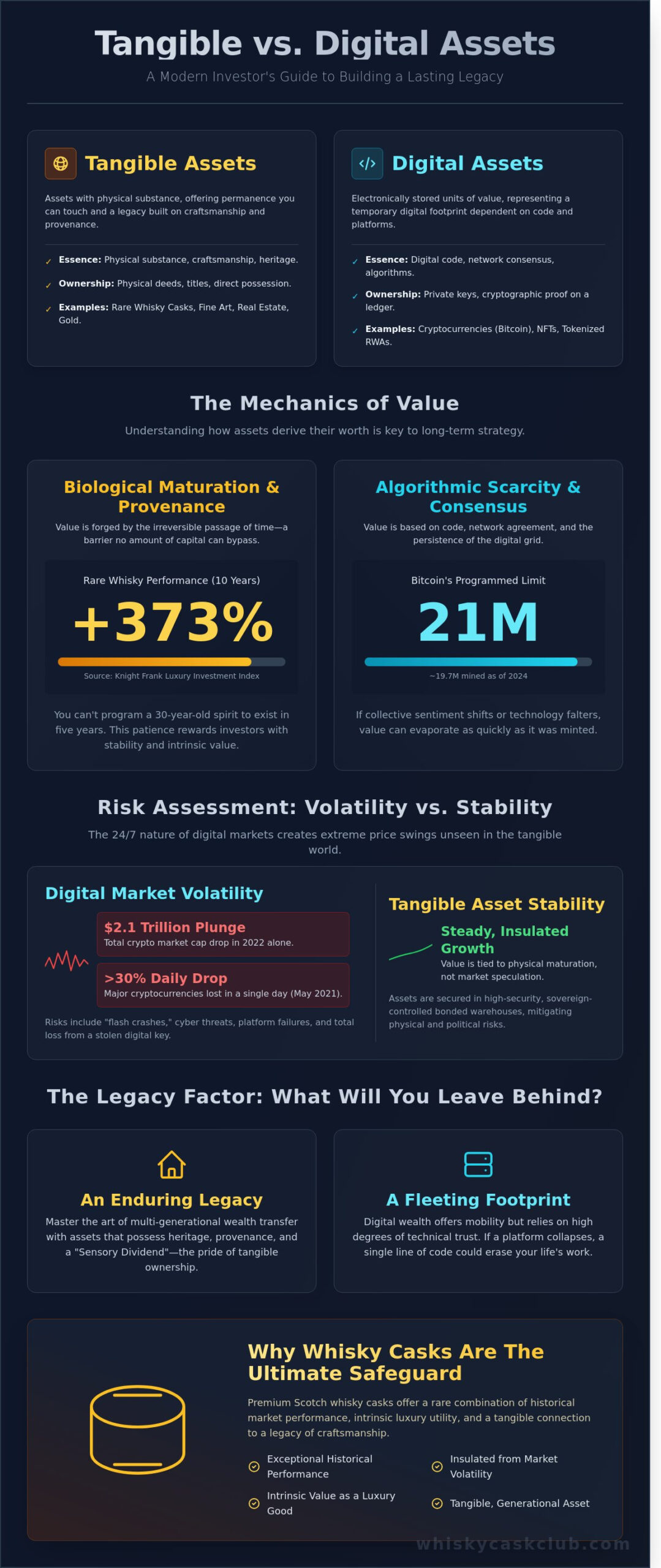
The investment world has fractured into two distinct territories. On one side, we have tangible assets with physical substance; on the other, electronically stored units of value. The debate of tangible assets vs digital assets is no longer academic. It’s a fundamental choice about how you preserve wealth in an era of rapid change. Bitcoin reached a $1 trillion market cap in February 2021, proving that intangible code can carry massive weight. Yet, the world’s wealthiest families, such as the House of Liechtenstein, continue to anchor their portfolios in physical goods. They understand that while code can be revolutionary, it doesn’t possess the inherent permanence of the physical world.
Ownership structures define the primary divide. You hold a digital asset through private keys and cryptographic proof on a ledger. You hold a tangible asset through physical deeds, titles, or direct possession. This distinction isn’t merely technical; it’s about the nature of control. Digital wealth offers borderless mobility, but it lacks the tactile security that has defined elite wealth management for centuries. True sophistication lies in balancing the two, pairing the high-speed potential of the digital with the enduring legacy of the real.
What Qualifies as a Digital Asset in 2026?
By 2026, the digital asset class has matured beyond speculative tokens. It now encompasses ‘native’ digital value like Bitcoin and Ethereum, alongside Tokenised Real-World Assets (RWAs). Boston Consulting Group (BCG) projected the tokenisation of global illiquid assets to be a $16 trillion opportunity by 2030. While this technology offers fractional ownership of skyscrapers or fine art, it introduces platform risk. If the underlying blockchain or the issuing platform fails, your utility tokens may lose their function. Digital assets offer efficiency, but they require a high degree of technical trust.
The Spectrum of Tangible Assets
Traditional portfolios rely on staples like real estate and gold, but alternative tangibles offer a different kind of prestige. Fine art, classic cars, and investment-grade whisky casks represent the pinnacle of this category. According to the Knight Frank Luxury Investment Index, rare whisky saw a 373% growth over a ten-year period, outperforming many traditional markets. These assets provide a ‘Sensory Dividend.’ This is the pride of owning something you can see, touch, and taste. It’s the intersection of passion and pragmatism. When you invest in a physical cask, you aren’t just buying a number on a screen; you’re building a legacy rooted in craftsmanship and heritage.
The Mechanics of Value: Maturation vs Algorithmic Scarcity
The fundamental divergence between tangible assets vs digital assets lies in the source of their scarcity. Digital assets rely on “proof of work” or “proof of stake” protocols to enforce limits. For example, Bitcoin’s supply is capped at 21 million coins, with the April 2024 halving event further tightening new issuance. This code-based rarity depends entirely on network consensus and the persistence of the digital grid. If the collective sentiment shifts or the underlying technology falters, the asset’s value can evaporate as quickly as it was minted.
Tangible assets, however, are governed by the physical world. Their value stems from historical provenance and biological maturation. While digital assets gain value through network effects, a physical asset like a rare scotch cask gains value through the literal passage of time. This time component acts as a reliable filter; it’s a barrier to entry that no amount of capital or computing power can bypass. You can’t program a 30-year-old spirit to exist in five years. This inherent patience often rewards investors with a stability that digital markets simply can’t replicate. When the market goes quiet, the intrinsic value of a physical asset remains because it exists as a finished, usable luxury product regardless of a ticker price.
Digital Volatility and the Speed of Speculation
Investors often prize digital assets for their high liquidity. You can exit a position at 3:00 AM on a Sunday with a single tap. This 24/7 accessibility is a double-edged sword that leads to emotional exhaustion and extreme volatility. We saw this in May 2021 when major cryptocurrencies lost over 30% of their market capitalization in a single day. In this environment, digital asset risks are mathematical certainty meeting human irrationality. The speed of the market creates a “flash crash” risk that doesn’t exist in the slower, more deliberate world of physical trade.
Physical Maturation: The Case for Single Malt Scotch
The aging process in a bonded warehouse is the ultimate hedge against inflation. Each year, roughly 2% of a cask’s volume evaporates; this is a phenomenon known as the “Angel’s Share.” This natural reduction makes the remaining liquid more concentrated and exponentially rarer over the decades. A 30-year-old cask isn’t just older than a 10-year-old one; it’s a different asset class entirely because so few casks survive the full maturation cycle without being bottled. By focusing on whisky investment, you’re acquiring an asset that improves while it waits. For those looking to secure a multi-generational future, you can explore exclusive cask opportunities that bridge the gap between passion and pragmatism.
Risk Assessment: Security, Storage, and Sovereign Control
Choosing between tangible assets vs digital assets requires a sober evaluation of how your wealth is protected from theft, loss, and state intervention. Digital wealth relies on cryptographic perfection. A single line of flawed code in a smart contract led to the loss of $3.8 billion in crypto-theft during 2022 alone. Conversely, physical security for premium tangible goods relies on high-security perimeters, biometric access, and centuries of established property law.
The “key” problem represents a fundamental divide in risk management. Chainalysis estimated in 2021 that roughly 20% of all Bitcoin is trapped in “zombie” wallets because owners lost their private keys. There’s no “forgot password” button for a decentralized ledger. In the world of physical trade, losing a document doesn’t mean losing the asset. If a warehouse receipt is misplaced, a legal process verifies your identity and restores your claim to the property. Ownership is anchored in the physical world, not just a digital string of characters.
Insurance structures also differ wildly. While some digital custodians offer “cold storage” insurance, it rarely covers the full value of a portfolio during a market-wide liquidity crisis. Physical assets held in HMRC-regulated bonded warehouses are fully insured against fire, theft, and accidental damage at their replacement value. This provides a level of financial indemnity that the volatile digital market hasn’t yet matched.
Digital Asset Risks: Beyond the Price Chart
Digital portfolios face “platform risk” that can materialize overnight. The 2022 collapse of FTX demonstrated that even the largest exchanges can vanish, taking billions in client funds with them. Beyond theft, there’s the threat of obsolescence. Data from 2023 shows that 95% of NFT collections launched during the 2021 boom now have a market cap of zero. Digital assets lack intrinsic utility; if the community moves on, the value evaporates.
Tangible Asset Protection: The Bonded Warehouse Model
Investors seeking a legacy often turn to the Scottish bonded warehouse system. These facilities protect the whisky barrel under strict government supervision, ensuring the liquid matures in optimal conditions. Scotland’s legal framework offers a level of geopolitical safety that “borderless” assets lack. While digital assets face shifting regulations from the SEC or EU, physical property rights in stable jurisdictions have remained consistent for over 300 years. This permanence is the hallmark of a sophisticated investment strategy.
The Legacy Factor: Investing for the Next Generation
Transferring wealth involves more than just moving capital. It’s the transition of values. When comparing tangible assets vs digital assets, the primary distinction lies in the hand-off. Passing down a digital wallet requires a private key and a technical tutorial. In contrast, passing down a physical asset involves a narrative. A maturing cask from a legendary distillery carries the weight of history, craftsmanship, and patience. It’s a physical manifestation of a family’s foresight.
Tangibility provides a psychological anchor for the next generation. In a world of instant gratification, a physical asset that requires 10 to 20 years to reach its peak serves as a masterclass in “slow wealth.” It teaches heirs that some rewards cannot be rushed by an algorithm. While digital assets offer efficiency, they lack the “heritage factor” that binds a family to its financial history. Investors should choose digital when seeking high-frequency growth, but pivot to tangible assets when the goal is to anchor a family’s identity in something permanent.
Portfolio Allocation: The ‘Core and Satellite’ Approach
Smart investors often utilize a “Core and Satellite” strategy to balance the scales of tangible assets vs digital assets. In this framework, digital assets act as tactical satellites, capturing short-term market volatility and rapid growth. Meanwhile, tangible assets form the strategic core, providing a foundation of stability. Many sophisticated family offices now recommend a “Tangibility Ratio” where 15% to 25% of the portfolio is held in physical alternatives. This balance ensures you’re participating in the “new” economy without losing your grip on the “timeless” value of the old world.
Building a Liquid Legacy
The ritual of ownership is what transforms an investment into an heirloom. There’s a profound difference between refreshing a screen to see a balance and the experience of visiting a bonded warehouse to sample your own liquid history. Joining a whiskey club provides the community and expertise needed to navigate this journey, turning a solitary financial decision into a shared social experience. It’s about more than just the Knight Frank 10-year growth figures of 373%. Legacy is the intersection of financial wisdom and personal heritage. By bottling a portion of your portfolio, you ensure that your descendants inherit not just your money, but your taste and your story.
Ready to secure your family’s future with a physical legacy? Explore premium cask ownership with Whisky Cask Club today.
Why Whisky Casks Represent the Ultimate Tangible Investment
In the ongoing discussion surrounding tangible assets vs digital assets, Scotch whisky casks stand as a testament to the enduring power of physical scarcity. Over the last decade, the Knight Frank Luxury Investment Index highlighted rare whisky as a premier performer, showing a 373% increase in value as of 2023. This level of growth frequently outpaces traditional stock indices and provides a hedge against the volatility often found in digital markets.
The true strength of a cask lies in its intrinsic utility. If a digital market shifts, an investor is left with code; if a whisky market fluctuates, you still own a world-class luxury product that improves with age. Scotland’s elite distilleries operate under strict production caps. They cannot simply mint more 30-year-old liquid to meet rising global demand. This biological and legal limit ensures your investment remains rare by its very nature. By choosing the Whisky Cask Club, you leverage professional management that simplifies the complexities of ownership, from insurance to tax-efficient storage.
From Sourcing to Exit: The Managed Journey
You don’t need a personal cellar to participate in this market. Professional brokerage services handle the logistics of storage in HMRC-approved bonded warehouses, where the spirit matures in climate-controlled conditions. When you’re ready to realize your gains, multiple exit strategies exist. You might sell the cask to another private investor or choose the independent bottling route to capitalize on the retail market. Unlike the often-opaque nature of digital tokens, every cask features a rigorous paper trail and a certificate of ownership that guarantees provenance.
Joining the Elite: Your First Step into Cask Ownership
When weighing tangible assets vs digital assets, the security of a physical, bonded product offers a level of prestige that digital ledgers cannot replicate. Starting your journey requires a curated approach to ensure your portfolio reflects your financial goals and your appreciation for craftsmanship. Expert guidance is vital in alternative markets to navigate distillery reputations and maturation cycles. You aren’t just purchasing a commodity; you’re securing a piece of Scottish heritage that grows more valuable as the clock ticks.
Secure Your Multi-Generational Wealth Today
Choosing between tangible assets vs digital assets isn’t just about diversification; it’s about deciding what you’ll leave behind. While digital tokens rely on algorithmic scarcity, a cask of single malt matures through physical interaction with oak and time. Rare whisky has demonstrated its resilience as a premier luxury asset, with the Knight Frank 2023 Wealth Report noting a 10-year growth of 373% for the category. This performance outpaces many traditional and digital alternatives, offering a hedge against market volatility that code simply can’t match.
We provide the sophisticated tools you need to transition from speculative digital plays to a heritage-rich portfolio. Our members gain access to rare casks from top-tier distilleries, all held under fully insured storage in Scottish bonded warehouses. You’ll receive expert guidance on exit strategies to ensure your investment remains as liquid as the spirit itself. It’s time to move beyond the screen and own something with true provenance and history.
Build your liquid legacy with our exclusive cask brokerage services
Your journey toward a more prestigious and secure financial future starts with a single, well-chosen cask.
Frequently Asked Questions
Are digital assets safer than tangible assets?
Digital assets aren’t inherently safer as they face unique risks like cyber-theft and platform insolvency. According to Chainalysis, hackers stole 3.8 billion dollars from crypto businesses in 2022 alone. Tangible assets provide a physical layer of security that code cannot replicate. You own a physical object of rarity that exists outside a digital ledger, ensuring your wealth isn’t vulnerable to a single server failure or a forgotten password.
What are the biggest risks of investing in physical assets?
Illiquidity and storage maintenance represent the primary challenges for physical investors. Selling a premium asset like a rare whisky cask often requires 4 to 12 weeks to secure a buyer who recognizes its true provenance. You also need to account for insurance and climate-controlled storage costs. These expenses typically range from 0.5% to 2% of the asset’s value annually, depending on the facility’s prestige and security level.
How do I pass my digital assets to my heirs?
You must provide your heirs with private keys or utilize a specialized digital inheritance service to ensure access. Research from Chainalysis suggests that 20% of all existing Bitcoin is lost forever because owners didn’t secure a legacy plan. Unlike a physical cask that’s easily identified in a will, digital holdings require technical preparation. You’ll need to document your hardware wallet locations and recovery phrases in a secure, physical vault for your family.
Why is whisky considered a recession-proof tangible asset?
Whisky maintains value because its quality improves with age regardless of global economic cycles. The Knight Frank Luxury Investment Index reported that rare whisky grew by 373% over the ten-year period ending in 2023. This performance shows a low correlation with traditional stock markets. Investors view it as a safe haven because the supply of aged, premium spirit is finite. Demand for 25-year-old Scotch remains high even when financial markets are volatile.
Can I have both digital and tangible assets in the same portfolio?
Yes, a sophisticated portfolio often balances the high-speed growth of digital tokens with the steady appreciation of physical goods. Modern wealth management strategies for ultra-high-net-worth individuals frequently include a 10% to 20% allocation to alternative investments. When weighing tangible assets vs digital assets, remember that they serve different roles. Digital holdings offer rapid liquidity. Tangible assets like whisky casks provide a stable foundation for building a legacy that lasts for generations.
Do tangible assets like whisky casks expire or go bad?
Whisky doesn’t expire and actually gains complexity the longer it rests in the wood. As long as the spirit stays in the cask and the alcohol by volume remains above 40%, it will continue to mature for 50 years or more. It’s a living investment that gains value through natural chemistry. Unlike many consumer goods, time is the greatest ally of the whisky investor, turning a young spirit into a rare, high-value masterpiece.
How liquid are tangible assets compared to digital ones?
Digital assets offer 24/7 liquidity with near-instant settlement, while tangible assets require a more patient approach. You can trade Bitcoin in seconds, but a curated exit for a premium cask usually takes 30 to 90 days to finalize. This difference is central to the tangible assets vs digital assets debate. Tangible investments reward those who value long-term stability over the ability to exit a position at a moment’s notice.
What are the tax implications of tangible vs digital assets?
Tax treatment depends on your jurisdiction, but certain tangible assets offer significant advantages. In the United Kingdom, HMRC often classifies whisky as a wasting asset, which means it’s exempt from Capital Gains Tax for most private investors. Digital assets are typically taxed as property, with rates reaching up to 20% or 37% depending on your income bracket and location. Always consult a professional advisor to understand how these rules apply to your specific financial legacy.