What if the most secure path to a multi-generational legacy isn’t found in a digital portfolio, but inside a single, slumbering barrel of rare oak? You likely agree that true wealth is about more than just numbers on a screen; it’s about the security of a physical asset with a proven heritage. When weighing the merits of cask ownership vs whisky fund structures, you’re likely seeking a balance between effortless management and the prestige of a tangible holding. While the 2023 Knight Frank Luxury Investment Index shows whisky remains a powerhouse, the specific structure of your investment determines who truly controls that value.
This guide explores the critical nuances between these two paths to help you secure your financial future. We’ll examine the potential for 0% Capital Gains Tax through direct ownership, demystify the transparency of managed funds, and provide a clear roadmap to building a heritage your family can hold for decades. You’ll gain the confidence to choose a model that reflects your status. Own the cask. Own the liquid. Ensure your capital is protected by the intrinsic value of the spirit itself.
Key Takeaways
- Understand why whisky has ascended as a premier alternative asset and how to distinguish between owning physical barrels and holding shares in a pooled fund.
- Explore the exclusive benefits of direct cask ownership, including the transparency of a Delivery Order and the prestige of having your name on the warehouse books.
- Navigate the complexities of cask ownership vs whisky fund structures by comparing tax advantages, such as “wasting asset” status, against traditional financial instruments.
- Evaluate the total cost of your investment by analyzing the difference between passive management fees and the direct costs of secure, expert-led warehouse storage.
- Determine which path best secures your financial legacy, balancing the desire for a tangible, rare asset with the requirement for sophisticated, expert-managed growth.
The Evolution of Whisky Investment: Ownership vs. Funds
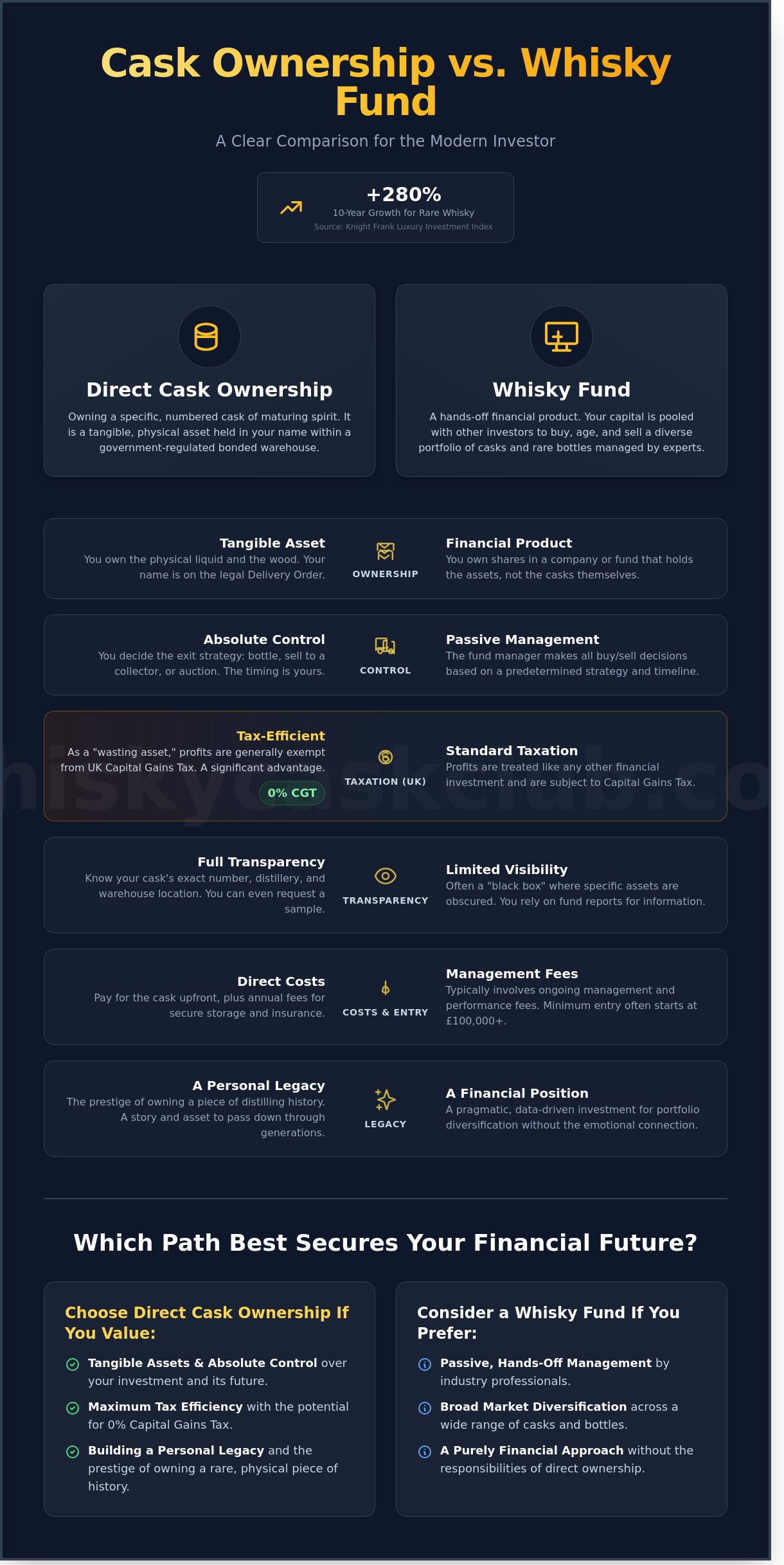
By 2026, rare Scotch has matured into a cornerstone of the sophisticated investment portfolio. Data from the Knight Frank Luxury Investment Index 2024 highlighted a 280% ten-year growth for rare whisky. This outperforms traditional assets like gold or fine art. Investors are increasingly abandoning volatile equity markets for tangible luxury goods that offer both security and prestige. The core of this market rests on two distinct paths: cask ownership vs whisky fund models. While both leverage the scarcity of aged spirit, the experience and financial structures differ significantly.
Provenance and rarity dictate value in this exclusive arena. A cask’s history, its distillery of origin, and its unique wood profile create a value proposition that is difficult to find in standard financial instruments. Whether you choose the direct path or a collective vehicle, the goal remains the same. You’re seeking to capture the appreciation of a finite, globally desired resource. It’s about securing a position in a market where demand for 18-year-old and 30-year-old expressions consistently outstrips the dwindling supply.
What is Direct Cask Ownership?
Direct ownership involves purchasing a specific, numbered cask held in a government-regulated bonded warehouse in Scotland. You hold the title to the physical liquid and the wood. It’s a deeply personal investment. Because the spirit evaporates at a rate of roughly 2% per year, HMRC classifies it as a wasting asset. This status is a significant advantage; it generally means profits are exempt from Capital Gains Tax. It’s a way to own a tangible piece of distillery history while building a tax-efficient legacy for your family.
What is a Whisky Fund?
A whisky fund operates as a private equity or mutual fund structure. A professional manager uses pooled capital to buy, age, and sell a diverse range of casks and bottles. This is a hands-off financial product designed for the pragmatic investor who prefers a diversified approach. Minimum entry requirements often begin at £100,000. It offers broad market exposure and professional management without the emotional connection of owning a specific barrel. It’s about the data, the diversification, and the eventual exit strategy managed by experts.
Direct Cask Ownership: The Appeal of a Tangible Legacy
Direct cask ownership transforms a financial decision into the acquisition of a tangible piece of Scottish heritage. When you weigh the merits of cask ownership vs whisky fund, the primary distinction lies in the physical possession of a maturing asset. You aren’t holding a digital certificate or a fractional share in a diversified pool; you own the wood, the spirit, and the ticking clock of maturation. This path allows you to build a legacy that spans generations, providing a narrative that a ledger of stocks simply cannot match. It’s a sophisticated pursuit for those who value the intersection of craft and capital.
Absolute Transparency and Control
Your ownership is cemented through a Delivery Order (DO), the vital legal document that ensures your name is recorded in the official warehouse registers. This level of transparency eliminates the “black box” risks often associated with managed funds where the specific assets are obscured by layers of administration. You retain the right to request a 100ml sample directly from your cask, allowing you to monitor the spirit’s evolution as it interacts with the oak. It’s a level of intimacy and security that defines the intelligent investor’s approach to wealth preservation. Knowing the exact warehouse location and cask number provides a peace of mind that no spreadsheet can replicate.
The Prestige of the Single Malt
Securing a cask from a “cult” distillery like Springbank or Macallan is a feat of access and patience. There’s an undeniable pride in visiting your cask in a dunnage warehouse in Speyside or Campbeltown, standing among the barrels and smelling the evaporating spirit. As older stocks dwindle through bottling and the natural 2% annual evaporation known as the “Angels’ Share,” your remaining liquid becomes mathematically rarer with every passing year. This inherent scarcity drives long-term value, yet the true reward is the flexibility of your exit strategy.
You aren’t locked into a fund’s predetermined liquidation date. Instead, you choose the moment of maturity. You might choose to:
- Bottle the liquid under a private label for a significant family milestone or anniversary.
- Sell the cask to a private collector or a specialized broker for a capital gain.
- Liquidate the asset at a premium auction house like Sotheby’s or Bonhams.
Ownership is about the quiet confidence of holding a finite resource that grows more prestigious as it ages. If you’re ready to explore these exclusive opportunities, you can view our curated cask list to see which legends are currently available for acquisition. This is the pragmatism of a tangible asset blended with the passion of a connoisseur.
Whisky Funds: Diversification via Passive Participation
Investors seeking exposure to the spirits market without the logistical responsibilities of physical storage often turn to whisky funds. These vehicles offer a streamlined, hands-off approach to the asset class. You aren’t purchasing a specific, numbered barrel from a Highland distillery; you’re buying a share in a collective portfolio. When weighing cask ownership vs whisky fund options, the primary draw is the removal of the daily management burden. The fund handles insurance premiums, warehouse inspections, and eventual bottling logistics. It’s a purely financial decision designed for those who prefer spreadsheets over cellars.
Professional Management and Curation
Fund managers use deep industry ties to secure stock at scale, often accessing parcels of spirit unavailable to private individuals. A typical fund might hold 500 to 1,200 casks across 25 different distilleries, including prestigious names like Macallan or Bowmore. This spreads risk across various regions and age statements. However, you lose the emotional resonance of the asset. There’s no physical cask to visit or pass down as a family heirloom. You trade the “legacy” aspect for a mathematical target. Most funds charge a 2% annual management fee, plus a 20% performance carry on profits. These costs can significantly impact your final net returns compared to direct ownership.
Liquidity and Redemption Terms
Whisky funds are not liquid assets in the traditional sense. Most institutional-grade funds mandate a 5 to 7 year lock-up period. You can’t simply sell your share on an open market overnight. If you need to exit early, you might face redemption penalties reaching 5% of your total investment. There’s also a distinct gap between the “unit value” reported by the fund and the actual market value of the underlying liquid. The fund’s valuation is an estimate based on internal models. In the cask ownership vs whisky fund debate, the fund offers simplicity, but it lacks the immediate, tangible control of owning the physical wood and spirit yourself. Owners of physical casks can choose to bottle, sell, or hold their asset indefinitely, whereas fund participants are bound by the manager’s exit timeline.
- Passive Participation: No need to manage storage or insurance.
- Expert Sourcing: Access to rare stock through institutional connections.
- Risk Mitigation: Diversification across multiple distilleries.
- Cost Structure: Management fees and performance carries apply.
Direct Comparison: Control, Costs, and Taxation
Comparing the cask ownership vs whisky fund models reveals a stark difference in how your capital is treated by authorities and institutions. While a fund provides a digital entry in a ledger, physical ownership grants you a tangible asset with distinct legal protections. This choice isn’t just about where you put your money; it’s about how much of the eventual profit you actually keep.
Tax Efficiency: The Wasting Asset Advantage
The most compelling financial argument for physical casks lies in their classification as a “wasting asset.” In jurisdictions like the United Kingdom, HMRC recognizes that whisky evaporates through the wood over time, a process known as the Angel’s Share. Because the liquid has a predictable lifespan, it’s generally exempt from Capital Gains Tax (CGT). This allows your investment to appreciate in value without the 20% to 28% tax hit typically associated with traditional financial instruments.
Contrast this with a whisky fund. These are treated as regulated investment products. When the fund sells its holdings or you redeem your shares, any profit is usually subject to capital gains or income tax. Tax efficiency makes physical casks a superior vehicle for building and protecting intergenerational wealth, ensuring the full value of the appreciation stays within your family legacy.
Ongoing Costs and Maintenance
Operational costs can quietly erode your returns if you aren’t careful. A whisky fund typically charges a 1.5% to 2% annual management fee, plus a performance fee that often reaches 20% of your total profits. On a £250,000 portfolio, you could be paying £5,000 every year just for the privilege of someone else holding the keys. Physical ownership is surprisingly more economical. Annual storage and insurance for a 250-liter Hogshead generally costs between £60 and £100. Even with a diverse portfolio of ten casks, your overhead remains a fraction of what a fund manager extracts.
A common objection for global investors is the perceived workload of managing physical barrels. You don’t need to visit a warehouse in the Highlands to secure your investment. Professional partners handle the logistics, from sourcing the spirit to managing the warehouse receipts and insurance. We ensure the provenance is documented and the liquid is protected, giving you the security of a tangible asset without the administrative burden. Avoid any provider offering “guaranteed returns” of 15% or more; the market’s strength lies in its historical 10-year growth of 280%, as noted in the 2023 Knight Frank Luxury Investment Index, not in hollow promises.
Secure your position in the market by choosing a path that prioritizes your control. Explore our curated cask selections and start building your tangible legacy today.
Choosing Your Path with The Whisky Cask Club
The decision between cask ownership vs whisky fund ultimately rests on your desire for transparency and personal connection. While a fund treats Scotch as a mere line item on a spreadsheet, the Whisky Cask Club transforms it into a tangible legacy. We position our members as the rightful owners of physical assets, providing a level of control that a managed fund simply cannot replicate. You aren’t just purchasing a share of a pool; you’re acquiring a specific, numbered cask filled with premium spirit. Our concierge-level service removes the friction of physical ownership by managing every logistical detail, from insurance to HMRC-regulated storage.
Direct ownership wins for the investor who values the story behind the liquid. It’s about the security of the wood and the heritage of the distillery. We invite you to join an exclusive community where the quiet confidence of a secure investment meets the prestige of a world-class collection. Our members enjoy the dual benefit of expert management and the pride of owning a rare piece of Scottish history.
A Bespoke Portfolio Strategy
The Club identifies casks with high growth potential by analyzing decades of auction data and distillery production cycles. We focus on assets with verified provenance and historical significance, ensuring your portfolio contains only “blue-chip” spirits. Every acquisition is stored in secure, accredited bonded warehouses in Scotland, maintaining the liquid’s integrity under strict legal oversight. This professional Portfolio Strategy & Management ensures that your asset matures in the same conditions that have produced the world’s most expensive whiskies for over 100 years.
Securing Your Legacy Today
Choosing the right path requires a balance of pragmatism and passion. While the financial case for Scotch is robust, with rare malts showing significant capital appreciation over 10-year cycles, the emotional value of building a legacy is immeasurable. It’s a sophisticated lifestyle choice that rewards patience and discernment. To begin, you only need to request a private consultation. We’ll guide you through the selection process, matching your financial objectives with casks that reflect your personal tastes. Speak with a Cask Specialist to start your journey into the world of elite whisky investment.
Secure Your Multi-Generational Legacy Today
Choosing between cask ownership vs whisky fund represents a pivotal decision for your alternative investment portfolio. While funds offer a hands-off approach, direct ownership grants you title to a tangible asset that appreciates in both character and value. You aren’t just buying a financial product; you’re acquiring a piece of Scottish history that remains under your total control. This path offers unique tax advantages and the prestige of owning the liquid itself, rather than a mere share in a collective vehicle.
The Whisky Cask Club simplifies this journey by offering exclusive access to rare stocks from legendary distilleries like Springbank, Macallan, and Highland Park. Your investment is protected by full insurance and stored securely in HMRC-accredited warehouses, ensuring the provenance of every drop. We don’t just help you buy; we provide expert exit strategy advisory to ensure you achieve the highest possible ROI when you’re ready to sell. It’s an intelligent way to diversify while building a sophisticated heritage for your family.
Ready to take the next step? Download Our Exclusive Guide to Cask Ownership and begin your journey into the world of rare spirits. Your legacy is waiting to be written in oak and time.
Frequently Asked Questions
Is a whisky fund safer than direct cask ownership?
Direct cask ownership is generally more secure because you hold the title to a tangible asset rather than a share in a collective vehicle. While a whisky fund provides diversification across 50 to 100 different casks, you’re reliant on the fund manager’s performance. In direct ownership, the spirit remains your legal property even if the brokerage fails. This provides a level of sovereign control that paper-based investments simply can’t match.
How do I prove I own a physical whisky cask?
You prove your ownership through a legal document called a Delivery Order or a Certificate of Ownership issued by the bonded warehouse. This document identifies your specific cask by its unique number and the year it was distilled. Under the Spirit Drinks Regulations 2008, these records must be meticulously maintained. When you purchase through an exclusive club, we ensure the warehouse register reflects your name as the ultimate beneficial owner.
Do I have to pay Capital Gains Tax on whisky cask profits?
Most private investors in the UK don’t pay Capital Gains Tax on profits because whisky is classified as a wasting asset by HMRC. Since the spirit naturally evaporates over time, it’s expected to have a predictable life of less than 50 years. This tax-exempt status makes the cask ownership vs whisky fund debate clear for many; funds are often subject to different corporation or capital gains rules depending on their structure.
Can I bottle my own cask if I choose direct ownership?
You have the absolute right to bottle your liquid once it reaches maturity. Most owners choose to bottle their casks after 10, 18, or 25 years to realize the highest value or create a private legacy. You’ll need to pay the alcohol duty, which is currently £28.22 per litre of pure alcohol as of August 2023, plus VAT. Our team manages this entire transition from wood to glass for our members.
What are the typical management fees for a whisky fund?
Typical whisky funds charge an annual management fee of 1.5% to 2% of the total assets under management. They also frequently implement a performance fee of 20% on any profits generated above a certain hurdle rate. In contrast, direct cask ownership involves storage and insurance costs that usually range from £50 to £100 per year. For a £10,000 investment, direct ownership often proves more cost-effective over a decade.
How long should I hold a whisky cask vs a fund investment?
You should plan for a minimum holding period of 5 to 10 years to see meaningful appreciation. While some funds have fixed terms of 5 years, the most significant value increases occur as the whisky moves from a young spirit to a mature 18 or 21-year-old expression. Data from the Knight Frank Rare Whisky Index shows that long-term patience is rewarded; the index grew by 373% over the last decade.
What happens if a whisky fund or brokerage goes bust?
If a brokerage fails, your ownership remains secure because the cask is held in a third-party bonded warehouse under your name. You simply appoint a new manager to oversee your asset. However, if a whisky fund goes bust, the liquidator must sell the entire portfolio to pay creditors, which might result in a lower return for shareholders. This distinction is vital when weighing cask ownership vs whisky fund options for long-term security.
Can I visit my cask in a bonded warehouse?
You can certainly visit your cask by arranging an appointment with the warehouse manager. These facilities are highly regulated by HMRC, so you’ll need to provide identification and follow strict safety protocols. Many of our members find that standing in a warehouse in the Scottish Highlands, surrounded by thousands of maturing barrels, is the moment their investment feels like a legacy. It’s a sensory experience no fund can replicate.