What if your most resilient asset required no maintenance, ignored the 2026 interest rate hikes, and gained character while you slept? You’ve likely noticed that the traditional real estate market feels increasingly heavy. With UK stamp duty surcharges remaining at 5% and average property management costs siphoning off 15% of gross yields, the era of the easy buy-to-let is over. The comparison of whisky casks vs property investment has become a priority for those seeking to escape landlord fatigue without sacrificing growth.
We understand that you value both pragmatism and prestige in your portfolio. This comparative analysis demonstrates how rare Scotch casks offer a sophisticated alternative to property, focusing on their unique status as a wasting asset for tax purposes and their 12.8% average annual capital growth recorded over the last decade. You’ll discover a clear ROI breakdown, the specific tax advantages of spirit over stone, and a streamlined way to build a tangible legacy that survives market volatility. We’ll explore why moving from title deeds to cask ownership is the definitive strategy for the modern high-net-worth investor.
Key Takeaways
- Understand why the 2026 economic climate is shifting interest away from volatile digital markets toward high-growth, tangible luxury assets.
- Compare the passive nature of professional bonded storage against the intensive management burdens and high entry costs of being a modern landlord.
- Evaluate the “Wasting Asset” status and natural appreciation of whisky casks vs property investment to maximize your portfolio’s tax efficiency.
- Discover how to verify provenance and leverage HMRC-regulated security to ensure your liquid holdings are as secure as a traditional title deed.
- Explore the unique rewards of building a multi-generational legacy through exclusive access to rare Scotch whisky heritage that retail investors cannot reach.
The 2026 Investment Landscape: Why Tangible Assets Still Reign
Wealth preservation has entered a new era of pragmatism. The digital volatility of the early 2020s pushed High-Net-Worth Individuals back toward assets with undeniable physical provenance. You can’t delete a cask of maturing spirit. You can’t ignore the physical presence of a prime estate. However, the debate regarding whisky casks vs property investment has shifted from “which is better” to “which serves your legacy.” As we move through 2026, the focus is on assets that offer a psychological anchor in an increasingly automated world.
The Cooling of the Global Property Market
By mid-2026, the traditional property “gold rush” has met a stark reality. Regulatory changes enacted in early 2025 increased stamp duty for additional dwellings by 3% in several major financial hubs, directly impacting net returns. When you factor in management fees that now average 15% of gross rental income, the friction costs of real estate become a significant weight. Investors are tired of the maintenance. They’re looking for tangible assets that don’t require a call to a plumber at midnight. Property remains a cornerstone of wealth, but its status as the default growth engine is under scrutiny.
The Rise of Alternative Investment Comparison
Alternative assets now command 24% of the average private portfolio, up from 16% in 2023. Within this space, Scotch whisky casks offer a unique “uncorrelated” growth trajectory. This is what we call Maturation Alpha. Unlike a rental property that relies on local economic sentiment, a cask of single malt gains value through the simple, chemical passage of time. A 12-year-old spirit becomes an 18-year-old spirit regardless of interest rate hikes or stock market corrections. When comparing whisky casks vs property investment, the distinction lies in this effortless appreciation. It’s a sophisticated way to build a legacy that grows in silence and security.
Choosing between these two heavyweights requires more than a look at a balance sheet. It demands an understanding of your long-term goals. Are you seeking the steady, albeit high-maintenance, income of the old guard? Or are you ready to embrace a curated, rare asset that offers both prestige and a historical hedge against inflation? This analysis will help you determine which path fits the specific architecture of your 2026 portfolio.
Comparative Analysis: Entry Barriers, Maintenance, and Management
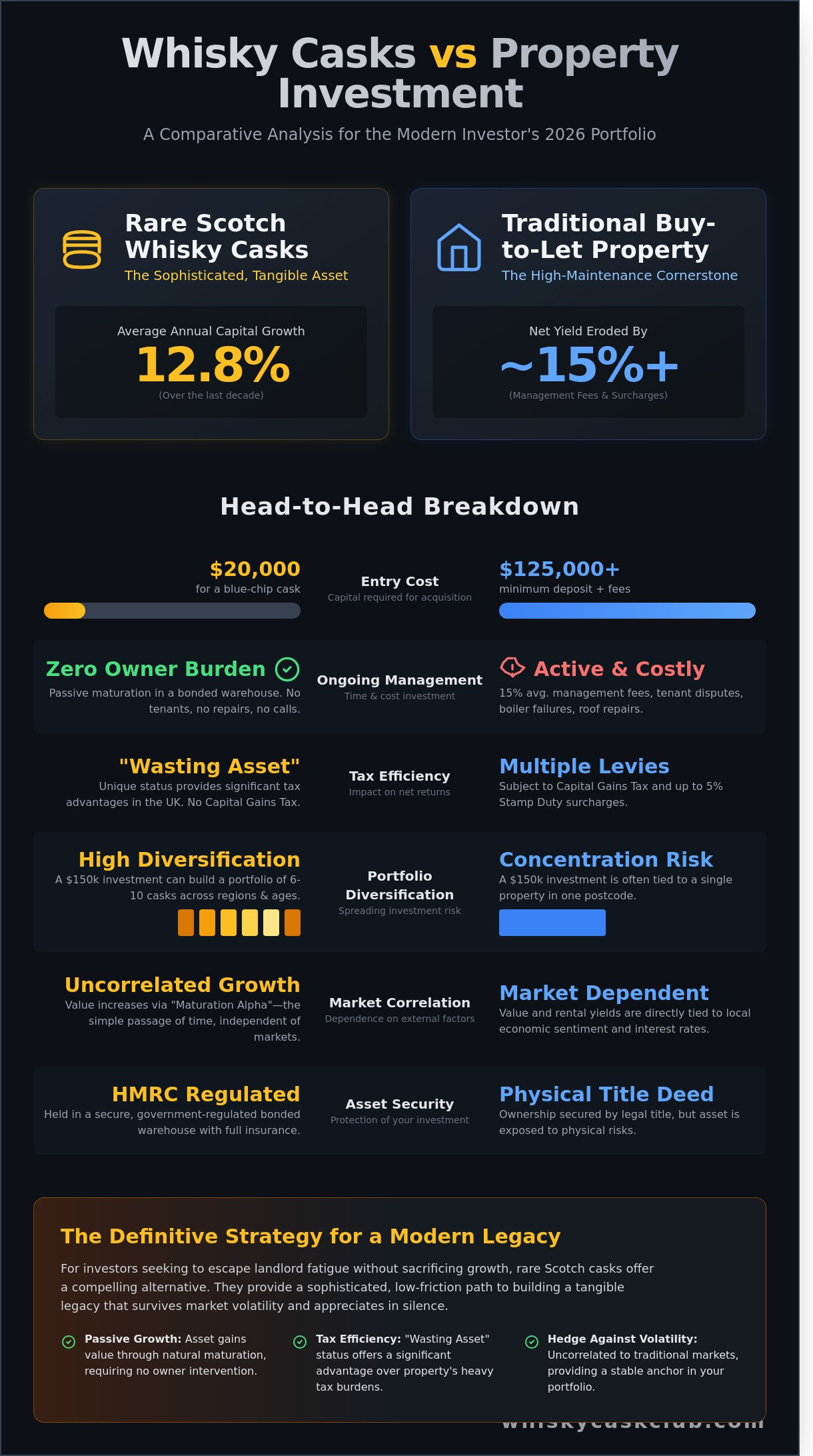
When evaluating whisky casks vs property investment, the most immediate distinction lies in the financial and emotional labor required to maintain the asset. A prime residential property in a Tier-1 city typically demands a minimum deposit of $125,000, and that’s before accounting for the 3% to 5% lost to stamp duty and legal fees. Conversely, a rare, blue-chip cask from a distillery with global prestige can be acquired for $20,000. This lower entry point doesn’t just lower the barrier; it allows for a more agile deployment of capital across a wider range of high-performing assets.
The management intensity of these two asset classes couldn’t be more different. Property ownership is an active pursuit. You’re responsible for tenant disputes, gas safety certificates, and the inevitable $5,000 roof repair or boiler failure. These “leakages” erode your net yield, often reducing a 6% gross return to a 3.5% net gain. Casks don’t leak capital in this manner. There are no tenants to manage and no structural repairs to fund. Your asset remains in a secure, climate-controlled environment where its only job is to improve with age.
The Frictionless Nature of Cask Ownership
Cask ownership operates on a plane of efficiency that real estate cannot match. Once you’ve secured your spirit, it’s held in a government-regulated bonded warehouse. The distillery’s warehouse manager oversees insurance and environmental conditions, removing the management headaches associated with physical assets. Passive maturation is the process where a spirit gains value and complexity through time in wood, serving as a low-friction wealth generator that requires no intervention from the owner. It’s the ultimate “buy and hold” strategy for those who value their time as much as their returns.
Capital Commitment and Diversification
Concentration risk is the silent killer of many private portfolios. A $150,000 investment in real estate usually ties you to a single postcode and a single set of walls. That same $150,000 can be used to curate a sophisticated portfolio of six to ten casks across different regions, ages, and wood types. You might hold a peated Islay cask alongside a Sherry-aged Speyside, spreading your risk across multiple market segments and distillery brands. To understand the breadth of these opportunities, consult A Guide to Premium Whisky Cask Investment to see how variety protects your capital. If you’re ready to move beyond the burdens of traditional landlording, you can explore our curated cask selections to start your journey today.
Addressing the Skepticism: Security, Provenance, and Exit Strategies
Skeptics often point to the lack of a centralized financial regulator like the FCA as a reason to hesitate. They’re usually referencing the “Forbes Objection,” which warns of the risks in unregulated alternative markets. However, this perspective overlooks the robust, centuries-old legal framework governing Scotch. Comparing whisky casks vs property investment reveals that security isn’t found in a physical land registry alone, but in the rigorous oversight of HMRC. Casks aren’t stored in a private garage; they reside in government-regulated bonded warehouses where every drop is tracked via a paper trail that would satisfy any institutional auditor.
Ownership isn’t a vague promise. It’s codified through a Delivery Order (DO). This document acts as the “Title Deed” of the whisky world. When you acquire a cask through a structured “Club” model, you move beyond the risks of DIY investing. You aren’t just buying liquid; you’re securing a verified asset with a guaranteed provenance that distilleries respect. This collective approach provides a safety net, ensuring that every cask in your portfolio is authenticated, insured at market value, and physically present.
HMRC and the Bonded Warehouse System
Every cask we manage sits in “Duty Suspended” status within an HMRC-bonded facility. This means the spirit isn’t yet taxed, keeping your initial capital focused entirely on the asset’s growth. Under HMRC Notice 700/17, these warehouses must maintain meticulous records. The Whisky Cask Club elevates this by ensuring every cask is fully insured and undergoes regular physical audits. We don’t just take the warehouseman’s word for it; we verify the wood’s integrity and the liquid’s health to protect your legacy.
Liquidity and The Exit Framework
Liquidity is where the comparison of whisky casks vs property investment becomes most stark. As of 2024, the average UK property sale takes approximately 179 days to complete. In contrast, a cask brokerage trade can often be executed in a fraction of that time. We provide our members with four distinct exit pathways:
- Private Sale: Trading your cask to another high-net-worth investor within our network.
- Auction: Leveraging global demand through specialist spirits auctions.
- Distillery Buy-back: Selling the matured spirit back to the original producer for their own premium blends.
- Bottling: Creating a bespoke private label, often the most lucrative route for rare vintages.
This agility allows for a more responsive portfolio. You can learn more about optimizing these returns in our guide on Your Exit Strategy: Realizing Cask Investment Gains. We’ve replaced the traditional, sluggish exit of real estate with a streamlined framework designed for the modern investor’s pace.
Calculating the Real ROI: Whisky Cask ROI vs. Rental Yields
Investors often mistake rental income for pure profit. It’s a common trap. When analyzing whisky casks vs property investment, the distinction lies in how the asset appreciates. Property is market-dependent; its value fluctuates based on interest rates, local infrastructure, and tenant demand. Whisky, however, benefits from natural appreciation. As the spirit interacts with the oak over ten, twenty, or thirty years, it chemically transforms into a more complex, valuable product. This internal growth engine operates independently of the housing market’s volatility.
The 2026 financial landscape has made traditional “bricks and mortar” less attractive for high-net-worth individuals. While a prime residential property might offer a gross yield of 5%, the net return often drops to 3% after maintenance, insurance, and management fees. A maturing cask requires none of these interventions. It sits quietly in a government-bonded warehouse, gaining value as the liquid reaches peak maturity.
Understanding the ‘Wasting Asset’ Advantage
Tax efficiency is where the comparison becomes stark. HMRC currently classifies whisky as a “wasting chattel” because the liquid is expected to evaporate naturally over time, a process known as the Angel’s Share. This classification means that, in many instances, profits from the sale of a cask are exempt from Capital Gains Tax (CGT). It’s a significant edge over property, where the 2026 tax environment for second homes includes reduced relief and higher surcharges. You should always verify your specific tax obligations with a local professional to ensure compliance with current regulations.
Historic Performance Data
Data from the Knight Frank Wealth Report 2025 confirms the enduring strength of rare spirits. While luxury residential property in global cities saw modest gains, rare whisky has maintained a ten-year growth trajectory exceeding 280%. Consider these figures for your portfolio:
- Net Rental Yields: Typically 4% to 6% in stable 2026 markets.
- Whisky CAGR: Historic compound annual growth rates for premium casks often range between 12% and 18%.
- Inflation Protection: Rare spirits outpaced the Consumer Price Index (CPI) by a factor of three during the inflationary spikes of the early 2020s.
The scarcity factor remains the primary driver of these returns. A developer can build a new apartment complex in eighteen months, but a distillery cannot manufacture a 25-year-old single malt on demand. This mathematical limit on supply ensures that as global demand for aged Scotch increases, your tangible asset becomes part of an ever-shrinking pool of available stock.
Ready to diversify your portfolio with a tax-efficient, high-growth asset? Explore our curated selection of premium casks and start building your legacy today.
Building Your Legacy: Why Whisky Cask Club is the Discerning Choice
Property investment often demands constant oversight, from tenant management to the rising costs of maintenance and 2026 tax legislative shifts. In contrast, owning a premium Scotch cask represents a partnership with time itself. When comparing whisky casks vs property investment, the emotional ROI of the former is unparalleled. You aren’t just holding a title deed to a brick-and-mortar structure; you’re preserving a piece of Scottish heritage that matures in character and value while you sleep. A cask of 2012 single malt from a Tier 1 distillery carries a story that a residential flat simply cannot replicate.
Our bespoke portfolio approach ensures your “liquid” legacy aligns with your family’s specific financial horizon. We don’t offer generic bundles. Instead, we curate selections based on your goals, whether that’s a five-year exit or a twenty-year gift for the next generation. This strategy treats whisky as a serious, tangible asset, providing a hedge against the volatility often seen in the 2026 real estate market.
More Than a Transaction: Joining the Club
The Whisky Cask Club operates as a discreet brokerage for high-net-worth individuals who value privacy and expertise. Retail investors typically access the market through public platforms that offer leftover stock with high markups. Our members gain entry to a private network where we source casks from the top 10% of Scottish distilleries, often before they’re even listed on the open market. This curated sourcing ensures every asset in your portfolio has the provenance required for a high-value exit. We act as your sophisticated advisor, handling the complexities of bonded storage, insurance, and HMRC compliance so you don’t have to.
Your Next Step in Diversification
The 2026 financial climate suggests a strategic pivot from tactical property holdings to strategic spirits is a prudent move for the modern collector. While property yields have seen a 3.5% compression in several major hubs over the last 18 months, rare whisky has historically shown a different trajectory of resilience. Building a legacy means looking beyond the next fiscal quarter. It’s about passing down a maturing portfolio that gains prestige every year it remains in the wood. Your journey from interest to ownership is streamlined through our four-stage process:
- Initial Consultation: We define your risk appetite and legacy goals.
- Curated Selection: Our managers present a shortlist of rare, investment-grade casks.
- Secure Acquisition: We manage all legal transfers and certificates of ownership.
- Managed Maturation: Your assets are stored in government-bonded warehouses with regular regauging reports.
It’s time to move beyond the constraints of traditional real estate. Schedule a private consultation with our portfolio managers to begin your journey into the world of fine spirit investment.
Secure Your Position in the 2026 Tangible Asset Market
The decision between whisky casks vs property investment has reached a definitive turning point for the modern portfolio. While prime real estate yields have stabilized around 3.5% according to 2025 market data, the Knight Frank Luxury Investment Index 2024 reveals that rare whisky has outperformed almost every other luxury asset class with 280% growth over ten years. You’re no longer forced to manage the complexities of tenants or maintenance. Instead, you can rely on the quiet, natural appreciation of spirit aging in a controlled environment. We provide our members with exclusive access to rare casks from top-tier Scotch distilleries, all held in fully insured, HMRC-regulated bonded warehouses. Our team offers expert exit strategy advisory for HNWIs to ensure your liquidity is managed with the same precision as the distillation itself. It’s time to claim your stake in a legacy that only improves with time.
Build Your Liquid Legacy: Explore Our Exclusive Cask Collection
Frequently Asked Questions
Is whisky cask investment safer than property in 2026?
Whisky casks offer a unique security profile because their value is tied to the physical maturation of the spirit rather than the 4.5% mortgage rate fluctuations expected in 2026. While property remains a staple, it’s currently facing higher maintenance costs and stricter EPC regulations. A rare cask from a Tier 1 distillery like Macallan or Bowmore offers a tangible asset that naturally appreciates as the liquid reaches its 18 or 25-year peak. It’s a sophisticated way to hedge against property market volatility.
What are the tax implications of whisky casks vs. rental property?
When comparing whisky casks vs property investment, the tax advantages are distinct because HMRC classifies whisky in a cask as a wasting asset. This status typically exempts you from Capital Gains Tax on your profits. In contrast, property investors face a 24% CGT on residential gains and must pay income tax on rental yields, which can exceed 40% for high earners. Owning a cask allows you to grow your wealth without the heavy tax burden associated with traditional real estate.
How do I verify the ownership of my whisky cask?
You verify ownership through a Delivery Order or a Certificate of Ownership issued by the bonded warehouse where the cask is stored. Legal ownership is confirmed when the warehouse keeper records your name against the specific cask head number in their ledger. All premium casks are stored in HMRC-regulated bonded warehouses. This ensures a transparent paper trail and protects your provenance, which is vital for maintaining the asset’s secondary market value and building a legacy.
Can I lose money on a whisky cask investment?
Yes, losses can occur if you purchase low-quality fillings or fail to account for the 2% annual “Angels’ Share” evaporation. While rare spirits have shown a 280% return over the last decade according to the Knight Frank Wealth Report, risks remain. You’ll pay annual storage and insurance fees, typically around £60 per cask. We mitigate this by only sourcing casks from heritage distilleries with proven demand, ensuring your capital is protected by brand prestige and pragmatism.
What is the minimum investment for a whisky cask compared to property?
Entry-level whisky casks start at approximately £5,000, whereas a buy-to-let property in a prime UK city requires a minimum deposit of £50,000 to £70,000. The barrier to entry for whisky casks vs property investment is significantly lower, allowing for easier portfolio diversification. You can secure a premium New Make Spirit cask without the burden of high-interest commercial debt. This accessibility makes it an attractive alternative investment for those looking to own a piece of Scottish history.
How long should I hold a whisky cask to see a significant ROI?
A holding period of 5 to 10 years is recommended to allow the spirit to move from a young filling to a premium aged statement. Patience is the foundation of building a legacy. Whisky isn’t a short-term flip; it’s a slow-maturing asset that gains value as it hits key milestones like 12, 18, or 25 years. Data from the BC20 Index shows that casks often see their most substantial price appreciation after the 10-year mark when the wood has imparted complex flavors.
What happens to my cask if the distillery goes out of business?
Your ownership remains secure because the cask is your private property and is stored in an independent bonded warehouse, not on the distillery’s balance sheet. If a distillery ceases operations, your investment often becomes more valuable due to “ghost distillery” status. You retain full legal title to the liquid. Casks from closed distilleries like Port Ellen have seen values skyrocket because the supply is finite. Your asset remains safe, protected by the expertise of the warehouse managers.
How does the Whisky Cask Club help with the exit process?
We manage the entire exit strategy by connecting you with our private network of collectors, auction houses, or independent bottlers. Our experts provide a curated exit path tailored to your financial goals. We don’t just help you buy; we ensure you have a clear route to liquidity. Whether it’s selling to a private connoisseur in our exclusive club or facilitating a sale to a bottler, we handle the logistics. This professional management ensures you achieve the best possible price for your heritage asset.