While global equity markets saw a 15% volatility swing in 2023, the Knight Frank Luxury Investment Index shows rare whisky has appreciated by 280% over the last decade. You know that protecting multi-generational wealth requires more than just a standard stock portfolio. Inflation eroded 4.1% of global purchasing power last year; this makes traditional cash reserves a liability. Consequently, whisky investment for family office structures has transitioned from a niche curiosity to a core strategic asset. It’s a tangible, secure way to anchor capital in a physical product that matures alongside your long-term goals.
This guide reveals how your family office can leverage premium Scotch whisky casks as a tax-efficient hedge for wealth preservation in 2026. We’ll explore the institutional-grade security of HMRC-regulated bonded warehouses and the specific mechanics of seamless wealth transfer. You’ll learn how to source rare provenance and secure a legacy that offers both financial pragmatism and the prestige of owning a piece of Scottish heritage.
Key Takeaways
- Understand why high-age-statement Scotch casks have historically outperformed traditional indices, providing a sophisticated hedge for long-term wealth preservation.
- Discover the economics of maturation, including how the “Angel’s Share” and strategic wood management directly influence the net asset value of your spirit.
- Evaluate how a whisky investment for family office allocations serves as a tangible alternative to gold and fine wine in a modern 2026 portfolio.
- Navigate the operational logistics of cask ownership, from selecting reputable brokerages with direct distillery ties to securing official warehouse transfer documents.
- Learn how a bespoke approach to portfolio construction offers exclusive access to rare casks, enabling the creation of a tangible, multi-generational liquid legacy.
The Macro Case: Why Family Offices are Allocating to Whisky Casks
Whisky cask investment is the strategic acquisition of maturing spirit held securely in bonded warehouses. Unlike bottled spirits, these assets represent the primary state of the product. The value isn’t just in the brand; it’s in the liquid’s physical evolution within the wood. For a whisky investment for family office portfolios, this represents a shift from speculative buying to the ownership of a tangible, industrial-grade commodity that appreciates as it ages. It’s a process where time is the primary driver of capital growth.
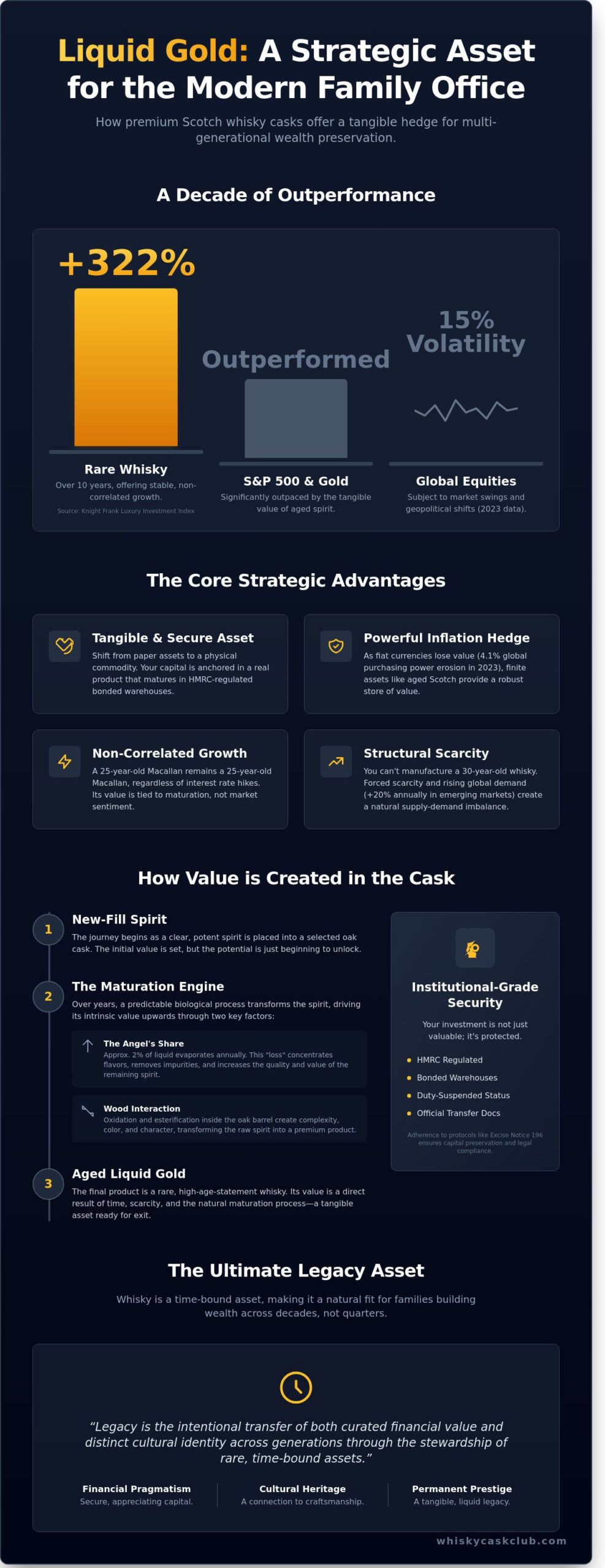
Historical data supports this allocation. The Knight Frank Luxury Investment Index shows that rare whisky has delivered returns of 322% over a ten-year period, significantly outperforming the S&P 500 and traditional gold benchmarks. These returns aren’t tied to the erratic pulse of the stock market. Instead, they’re linked to the biological maturation of the spirit. A 25-year-old Macallan remains a 25-year-old Macallan regardless of interest rate hikes or geopolitical shifts. This non-correlation makes it an essential component of a diversified, modern portfolio.
As we approach a 2026 inflationary environment, the appeal of finite assets grows. Global supply chains and currency fluctuations don’t alter the chemical process of oxidation and esterification happening inside a barrel. There are currently about 22 million casks maturing in Scotland, yet the global demand for ultra-premium, aged stock has risen by 20% annually in emerging markets like Asia and the Middle East. For a whisky investment for family office mandates, this structural supply deficit ensures that high-age-statement Scotch remains a robust hedge against the eroding purchasing power of fiat currency.
The Shift from Passion Play to Strategic Asset
The days when whisky was merely a collector’s hobby are over. Professional investors now view “Liquid Gold” through a lens of institutional-grade pragmatism. It’s a defensive position that offers a unique exit path; you’re selling to blenders, independent bottlers, or private collectors who require specific aged stock. Because the scarcity of aged Scotch is a mathematical certainty, it creates a natural supply-demand imbalance. You can’t manufacture a 30-year-old whisky in a laboratory. You have to wait thirty years. This forced scarcity protects the asset’s floor price in a way that few other alternative investments can claim.
Whisky as a Multi-Generational Legacy Asset
Family offices operate on horizons that span decades, not quarters. Whisky is the ultimate “time-bound” asset because its quality is dictated by the slow passage of years. It doesn’t rush for anyone. This makes it a natural fit for families looking to bridge the gap between financial returns and a sense of heritage. Owning a cask from a legendary distillery provides a connection to Scottish craftsmanship that a stock certificate cannot match. It’s a way to store wealth in a form that’s both prestigious and permanent.
Legacy is the intentional transfer of both curated financial value and distinct cultural identity across generations through the stewardship of rare, time-bound assets.
The Economics of Maturation: How Value is Created in the Cask
Unlike traditional equities or gold, the value of a whisky cask isn’t solely dictated by market demand. It’s driven by a predictable, biological process. As the spirit rests in the warehouse, it undergoes a transformation that increases its intrinsic worth every year. This natural appreciation makes a whisky investment for family office portfolios particularly attractive; it offers a hedge against the volatility of paper-based assets through physical, chemical improvement.
The “Angel’s Share” is a critical factor in this economic equation. Each year, roughly 2% of the liquid evaporates through the porous oak staves. While this represents a loss in volume, it facilitates a concentration of flavor and the removal of harsh impurities. This sacrifice is the price of quality. To ensure these assets are managed within the correct legal framework, all casks must be stored in bonded warehouses. Adhering to the HMRC Excise Notice 196 ensures the spirit remains in duty-suspension, which is vital for preserving capital until the point of bottling or sale.
Wood management is the primary driver of the final Net Asset Value (NAV). Approximately 70% of a whisky’s final flavor profile is derived from the cask itself. Family offices often prioritize casks with prestigious “finishes” or primary maturations:
- Ex-Bourbon Casks: These American oak barrels provide foundational notes of vanilla and caramel.
- Ex-Sherry Butts: Sourced from Spain, these are significantly more expensive, often costing ten times more than bourbon barrels. They impart deep colors and dried fruit notes that command a premium on the secondary market.
Identifying the “Sweet Spot” is essential for maximizing liquidity. While younger casks offer lower entry points, the most significant price jumps typically occur as a whisky crosses the 18, 21, and 25-year milestones. For a sophisticated whisky investment for family office strategies, the 18-year mark is often viewed as the peak for mass-market liquidity, while 30-year-plus casks are reserved for ultra-high-net-worth collectors and legacy building.
Biological Appreciation vs. Market Speculation
A 25-year-old cask is inherently more valuable than a 10-year-old cask because time cannot be manufactured. The Master Blender acts as the architect of this value, periodically sampling the spirit to determine its peak. It’s vital to monitor the Alcohol by Volume (ABV) during this time. If the ABV drops below the legal 40% threshold, the liquid can no longer be classified as Scotch whisky, which would instantly negate its investment value. Professional management ensures your asset never reaches this “danger zone.” You can consult with our portfolio managers to review the health of your existing holdings.
The Role of Rarity and Provenance
Provenance is the bedrock of whisky valuation. “Blue Chip” distilleries like Macallan or Bowmore offer stability, but “silent distilleries” provide the highest potential for scarcity-driven growth. These are “ghost” distilleries that closed during the industry downturn of 1983. Because the supply is finite and dwindling, casks from these producers are among the most coveted assets in the world. Single Cask and Cask Strength offerings are particularly prized; they represent a pure, unadulterated expression of the craft that cannot be replicated. For a deeper look at these dynamics, see our A Guide to Premium Whisky Cask Investment.
Risk Management and Portfolio Integration for Wealth Managers
Strategic wealth management requires assets that decouple from traditional equity markets. For a 2026 portfolio, the stability of Scotch whisky offers a compelling hedge against currency fluctuations and inflationary pressures. Unlike digital assets or speculative tech stocks, a whisky investment for family office portfolios provides a physical, maturing commodity that gains intrinsic value through chemical transformation. This biological appreciation ensures that the asset’s value isn’t solely dependent on market sentiment; it’s driven by the literal passage of time.
Liquidity remains a primary consideration for any sophisticated allocator. Cask ownership isn’t a day-trading venture. It’s a medium to long-term commitment with realization timeframes typically spanning 5 to 12 years. Gains are realized through private treaty sales, auctions, or bottling for internal family distributions. By integrating a alternative asset allocation for family offices, managers can balance immediate liquidity needs with the high-alpha potential of aged spirits. A balanced approach involves a “barbell” strategy; mixing high-volume “young filler” casks from established distilleries with rare, aged “trophy” casks that command premium prices from global collectors.
Whisky Casks vs. Other Alternative Assets
Whisky outperforms many traditional “passion assets” because it lacks the high maintenance and fragility of fine art or vintage automobiles. A 1960s Ferrari requires climate-controlled storage and mechanical upkeep. A whisky cask simply requires a cool, damp corner of a bonded warehouse. According to the Knight Frank Wealth Report 2023, rare whisky saw a 10-year return of 373%, significantly outstripping gold and fine wine. The Scotch Whisky Association (SWA) provides a robust regulatory framework that ensures the provenance and quality of every cask, offering a level of security seldom found in the art market.
| Asset Class | Volatility | Storage Costs | Tax Efficiency | 10yr ROI (Approx) |
|---|---|---|---|---|
| Whisky Casks | Low | Low | High (Wasting Asset) | 373% |
| Fine Wine | Medium | Low | Medium | 149% |
| Fine Art | High | High | Low | 91% |
| Gold | Medium | Low | Medium | 67% |
Mitigating Operational Risks
Professional oversight is vital to protect a whisky investment for family office structures. Every cask experiences the “Angels’ Share,” a natural evaporation of roughly 2% of the liquid per year. Wealth managers must ensure full insurance coverage is in place to protect against accidental damage or excessive leakage. We recommend annual “Cask Stock” auditing and independent regauging to verify the Alcohol by Volume (ABV) and Bulk Liters (BL) remaining in the wood.
To avoid fraudulent schemes, casks must be stored in HMRC-accredited bonded warehouses. Ownership isn’t verified by a simple invoice; it requires a legally binding Delivery Order (DO) or a warehouse receipt issued by the facility manager. This ensures the title is held in the client’s name rather than the broker’s. By maintaining these rigorous standards, family offices can build a legacy of tangible wealth that is as secure as it is prestigious. It’s about combining the passion of the connoisseur with the pragmatism of the institutional investor.
Operational Logistics: Due Diligence, Storage, and Exit Strategies
Managing a whisky investment for family office portfolios requires a transition from digital screen trading to the oversight of a physical, maturing spirit. The first step involves selecting a brokerage with established, direct distillery relationships. Without these ties, investors often pay unnecessary middleman markups that erode initial margins. A reputable partner ensures the provenance of the liquid is documented from the moment it leaves the still.
Securing legal title is the most critical phase of the acquisition. Unlike equities, ownership isn’t recorded on a centralized exchange; it’s confirmed through official warehouse transfer documents. You must receive a Delivery Order or a Warehouse Keeper’s Receipt. These documents prove that the specific cask number and its contents have been legally transferred into your name or the name of your family office entity within the warehouse register.
Ongoing management is a hands-on process that mirrors the care given to a fine art collection. We recommend a re-gauge of the cask every three years to monitor the health of the spirit. This process measures the Alcohol by Volume (ABV) and the total volume of liquid remaining. Since the “Angels’ Share”-the natural evaporation of spirit through the wood-averages 1.5% to 2% annually, consistent data is vital for accurate valuation. Annual insurance reviews are equally essential, ensuring the coverage reflects the cask’s appreciation as it nears its peak maturation window, which is often between 12 and 18 years for premium malts.
HMRC and the Bonded Warehouse System
Scotch whisky must be stored in HMRC-licensed bonded warehouses to maintain its legal status. This “In Bond” system is a significant fiscal advantage for family offices. It allows the asset to appreciate for decades without incurring the 20% UK VAT or excise duty. These taxes only become due if the whisky is removed from bond for bottling. Furthermore, Scotland-based storage is a legal requirement for the “Scotch” designation. Storing your asset at the source ensures its authenticity and protects its future resale value. For more on how we facilitate this, see our guide on Secure Storage: Protecting Your Tangible Asset.
Exit Strategy Advisory for Family Offices
The strength of a whisky investment for family office structures lies in its flexible exit routes. A Private Treaty Sale is often the preferred path for institutional investors. This involves selling the cask directly to another family office or a specialist whisky fund, often facilitated by your broker to ensure discretion. In 2023, high-age-statement casks from “ghost” distilleries-those no longer in production-commanded significant premiums in these private circles.
For families looking to create a lasting mark, the Bottling Route offers a unique opportunity. You can bottle the cask under a private family label, creating a bespoke legacy gift for heirs or a centerpiece for charitable auctions. If immediate liquidity is required, specialized secondary market platforms and auctions provide a transparent environment for competitive bidding. These auctions have seen a steady influx of global collectors, particularly from Asia and North America, who are eager to acquire rare, well-aged casks with impeccable storage histories.
Ready to secure a tangible legacy for your portfolio? You can explore our curated cask selection to find an asset that aligns with your long term wealth goals.
The Whisky Cask Club: Your Partner in Institutional Whisky Management
The Whisky Cask Club isn’t a mere brokerage; we’re a dedicated partner in capital preservation and heritage building. We understand that a whisky investment for family office portfolios requires a level of rigor that goes beyond the enthusiast’s hobby. Our bespoke approach treats every cask as a strategic component of a broader wealth strategy. We focus on the intersection of liquid rarity and market demand, ensuring that your family’s capital is anchored in an asset that matures with grace and financial resilience.
Our clients gain exclusive access to the inner sanctum of the Scotch industry. We maintain deep-rooted relationships with top-tier distilleries across the Highlands and Islay, securing casks that never reach the open market. This isn’t just about buying Scotch; it’s about joining an elite network of connoisseurs and institutional investors. By participating in the “Club,” you’re stepping into a tradition of excellence where provenance is guaranteed and the craftsmanship of the liquid is matched by the sophistication of the investment structure.
White-Glove Portfolio Management
We eliminate the administrative friction that often accompanies alternative asset classes. For a busy wealth manager, the logistics of HMRC compliance, secure bonded storage, and insurance can be a deterrent. Our team manages the entire lifecycle of the asset. We provide digital access to your portfolio, offering transparent reporting on maturation progress and market valuations. You’ll always know the status of your holdings without having to manage the minute details yourself.
Consider our 2023 performance metrics for a European multi-generational family office. They sought to diversify away from volatile tech stocks into tangible assets. We curated a portfolio of 15 first-fill Sherry Hogsheads from a Tier-1 Speyside distillery. By October 2023, the internal rate of return (IRR) on these specific casks reached 13.8%, based on independent valuation and secondary market demand. This success wasn’t accidental; it was the result of meticulous sourcing and proactive management of the maturation cycle.
Building Your Legacy Today
Whisky is an asset that rewards the patient, but it demands an early start. The maturation clock is the most powerful tool in your arsenal. Every year the spirit interacts with the wood, it gains complexity and value. Waiting to enter the market is the primary risk for any institutional investor. We invite you to schedule a private consultation with our Lead Cask Broker to discuss how a whisky investment for family office structures can provide the stability and growth your legacy requires.
Our experts will guide you through the current inventory, focusing on casks with the highest potential for long-term appreciation. Whether you’re looking to hold for a decade or a generation, the time to secure your position is now. Take the first step toward owning a piece of Scottish history and a robust financial future. Explore our current inventory of investment-grade casks and see why the world’s most discerning families trust us with their liquid assets.
Securing Your Legacy Through Liquid Assets
As we approach 2026, the strategic case for whisky investment for family office portfolios is defined by tangible value and historical resilience. Data from the Knight Frank Luxury Investment Index shows rare whisky has outperformed many traditional assets with a 280% return over a 10 year period. This growth isn’t speculative; it’s driven by the physical maturation process where spirit gains complexity and value every year it rests in wood. Managing these assets requires a sophisticated approach to operational logistics. Our clients benefit from exclusive access to non-public distillery stock that’s never listed on the open market. We ensure every cask is held in HMRC-compliant bonded storage, maintaining the provenance and tax efficiency your wealth strategy demands. With a dedicated portfolio manager to oversee your collection, you gain the expertise of a seasoned advisor who understands the nuances of the 2026 market. It’s an opportunity to diversify into a world of rare craftsmanship and enduring prestige. The path to a sophisticated alternative portfolio starts with the right partner.
Download our Family Office Guide to Bespoke Cask Portfolios
Take the first step toward owning a piece of Scotch history today.
Frequently Asked Questions
Is whisky investment suitable for a family office with a 20-year horizon?
Whisky investment for family office portfolios is exceptionally suited to a 20 year horizon because the asset appreciates as the liquid matures. Rare single malts often reach their peak value between 18 and 30 years of age. Data from the Knight Frank Luxury Investment Index shows that rare whisky has seen a 280 percent increase in value over the last decade. This long term growth aligns with the multi generational goals of a sophisticated family office looking to build a legacy.
How is the value of a whisky cask determined for annual NAV reporting?
Annual NAV reporting for whisky casks relies on current market valuations of comparable aged stocks and recent auction data. We provide an annual valuation report based on the Regulated Qualifications Framework (RQF) standards. This assessment considers the distillery’s brand equity, the remaining Litres of Pure Alcohol (LPA), and the cask’s specific wood type. For example, a first fill Sherry butt typically commands a 20 percent premium over a standard refill hogshead in today’s secondary market for whisky investment for family office clients.
What are the tax implications of owning whisky casks for non-UK residents?
Whisky casks are classified as a wasting asset by HM Revenue and Customs (HMRC) because the liquid naturally evaporates over time. This classification means they’re currently exempt from Capital Gains Tax in the United Kingdom. Non UK residents should consult local advisors, but the UK’s 0 percent CGT status on these assets remains a primary draw for international investors. It’s a pragmatic way to preserve wealth while ensuring the security of a tangible, premium asset.
How does the “Angel’s Share” impact the overall ROI of a cask?
The Angel’s Share refers to the 2 percent of liquid that evaporates from the cask annually during the maturation process. While this reduces the total volume, it’s essential for developing the flavor profile that drives the asset’s ultimate value. A cask that loses 20 percent of its volume over 10 years often triples in price because the remaining spirit is more concentrated and complex. This natural reduction is a calculated factor in our projected 8 to 12 percent annual ROI models.
Can a family office bottle their own cask for private use or gifting?
You can certainly bottle your cask for private use, which is a hallmark of exclusive ownership and craftsmanship. This process requires moving the cask from a bonded warehouse to a licensed bottling facility. You’ll need to pay UK Excise Duty, currently 28.74 GBP per litre of pure alcohol, and 20 percent VAT if the bottles leave the bonded system. It’s a sophisticated way to share your family’s heritage during milestone celebrations or as bespoke, rare gifts.
What happens to the cask if the distillery is sold or closed?
Your ownership of the liquid is legally distinct from the distillery’s corporate status or land ownership. If a distillery closes, your cask becomes silent distillery stock, which historically increases in value due to the finite, dwindling supply. For instance, Port Ellen casks saw prices rise by over 500 percent after the distillery closed in 1983. We ensure your asset stays securely stored in a government regulated bonded warehouse regardless of any changes at the production site.
How do I verify that I actually own the liquid in the bonded warehouse?
Verification of ownership is provided through a Delivery Order, which is the legal document of title in the Scotch whisky industry. This document is countersigned by the HMRC regulated warehouse manager to confirm the transfer of ownership to your specific name or entity. You’ll also receive a certificate of provenance detailing the cask number, distillation date, and original litreage. We maintain a transparent paper trail so you can be confident in the security and provenance of your investment.