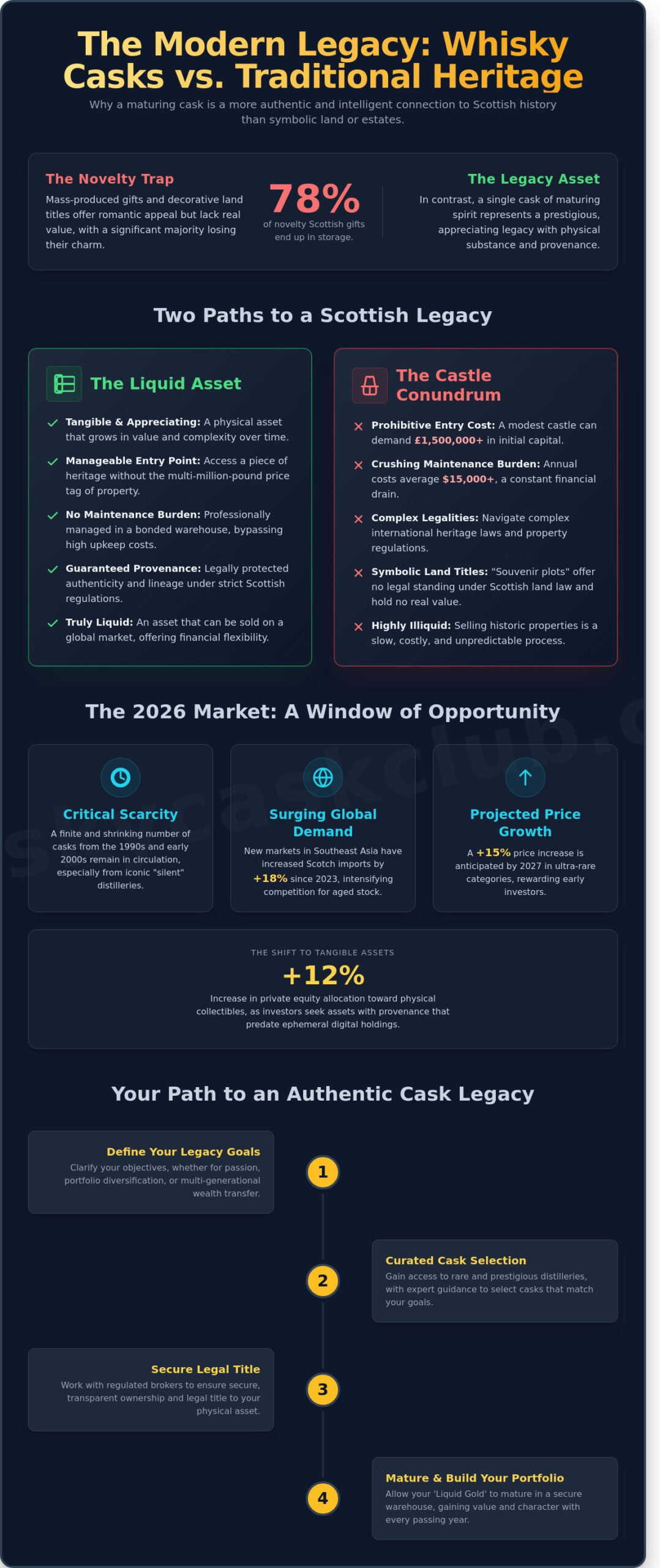
A mass-produced tartan scarf or a decorative title to a square inch of Highland mud offers no real value to a serious collector. While 78% of novelty Scottish gifts eventually lose their charm and end up in storage, a single cask of maturing spirit represents a prestigious, appreciating legacy. You likely recognize that true heritage requires more than a novelty certificate; it demands provenance, craft, and physical substance.
Discover how owning a piece of Scottish history through investment-grade whisky casks allows you to secure a tangible connection to a specific distillery’s lineage. We’ll show you how to bypass the complex international heritage laws and the $15,000 annual maintenance costs often associated with traditional Scottish estates. You’ll learn the exact process of building a rare asset portfolio that carries genuine historical weight and sophisticated prestige. This article outlines the path to securing an exclusive liquid legacy that grows more valuable with every year it spends in the warehouse.
Key Takeaways
- Discover why investment-grade whisky casks offer a more authentic and liquid connection to heritage than symbolic land titles or historic estates.
- Understand how the “Angel’s Share” and decades of oak maturation create a tangible time capsule of Scotland’s storied craftsmanship.
- Learn the professional protocols for owning a piece of Scottish history, from defining your legacy goals to securing legal title through regulated brokers.
- Explore the strategic balance between the passion for rare spirits and the pragmatism of managing a high-performing alternative asset.
- See how a curated approach to cask selection provides exclusive access to the most prestigious distilleries for building a multi-generational legacy.
The Allure of Owning a Piece of Scottish History in 2026
Heritage ownership represents a fundamental pivot in the 2026 alternative asset market. It moves beyond speculative trading into the acquisition of assets with deep chronological roots. For the sophisticated investor, owning a piece of Scottish history isn’t merely a financial play; it’s a stewardship of time. This concept of heritage ownership involves more than just a certificate of title. It’s the preservation of a cultural narrative that has survived wars, economic shifts, and the industrial revolution. Scotland’s identity is inextricably linked to its traditional crafts, where master distillers have refined their techniques over five centuries. This enduring consistency provides a level of security that digital or mass-produced goods cannot replicate.
The emotional and prestige value of a physical connection to the Highlands or the Islands is profound. Holding a cask that breathes the salt air of Islay or the heather-scented breezes of Speyside offers a prestige that transcends modern luxury. It’s a quiet authority. We refer to these casks as “Liquid Gold” because they act as living vessels, capturing the climate, the wood, and the spirit of a specific era. The history of Scotch whisky provides the foundational credibility for this investment, ensuring that every drop is backed by centuries of established law and tradition. By owning a piece of Scottish history through a curated cask, you secure a position in an elite lineage of collectors who value substance over hype.
The Shift Toward Tangible Heritage Assets
Investors are rotating capital out of ephemeral digital holdings at a rapid pace. Data from early 2025 showed a 12% increase in private equity allocation toward physical collectibles and tangible assets. There’s a deep psychological appeal in possessing an object that predates the internet and silicon chips. A cask resting in a dunnage warehouse for 20 years represents a commitment to patience and craftsmanship. It’s an asset with “provenance,” a term that carries immense weight in elite investment circles. Scottish history is globally recognized as a symbol of quality and endurance, making these casks a universal language of success. Unlike digital assets that can vanish with a server error, a whisky cask remains a physical reality, maturing and gaining complexity every single day.
Why 2026 is the Year for Legacy Building
The 2026 market is defined by a tightening supply of aged stock. Rare Scotch whisky has outperformed many traditional indices over the last decade, with the Knight Frank Luxury Investment Index frequently highlighting its resilience during periods of inflation. We’re seeing a critical scarcity of barrels from “silent” distilleries, those legendary sites that ceased production decades ago but are now being revived. For example, the 2024 reopening of iconic sites like Rosebank has only heightened the demand for original, heritage casks from that era. This year provides a unique window to secure assets before the projected 15% price increase in ultra-rare categories anticipated by 2027. Wealthy families are increasingly looking at these casks as a way to transfer value to the next generation without the volatility of the stock market.
- Scarcity: Only a finite number of casks from the 1990s and early 2000s remain in circulation.
- Global Demand: New markets in Southeast Asia have increased their Scotch imports by 18% since 2023.
- Authenticity: Stringent Scottish regulations ensure the “provenance” of every cask is legally protected.
A legacy asset is a multi-generational vehicle for wealth and story that gains character and value as it matures in the dark of a Scottish warehouse.
Beyond Castles and Titles: Why Whisky Casks Win
Owning a piece of Scottish history often conjures images of mist-shrouded battlements or archaic titles. While these options hold romantic appeal, they often fail the test of pragmatic investment. A 16th-century tower house requires millions in restoration capital and constant upkeep. Conversely, a one-square-foot “souvenir plot” offers no legal standing under Scottish land law. This is where the whisky cask emerges as a superior alternative. It’s a tangible, appreciating asset that bridges the gap between cultural heritage and financial intelligence. Unlike a static monument, a cask is a living entity that matures, evolves, and gains value through the quiet passage of time in a Highland warehouse.
The “Castle Conundrum” illustrates the barrier to entry for most heritage seekers. A modest castle in Aberdeenshire can easily command a price tag of £1,500,000, with annual maintenance costs hovering around 1% to 2% of the property value. For many, this is a heavy burden rather than a legacy. A premium whisky cask, however, provides a manageable entry point. You can secure a rare ex-bourbon or sherry hogshead from a world-class distillery for a fraction of that cost. While the castle walls crumble under the North Sea wind, your whisky sits protected in a professional, bonded facility, gaining complexity and value as the wood breathes. It’s a sophisticated way of owning a piece of Scottish history without the logistical nightmares of real estate.
Authenticity is the bedrock of any legacy asset. While novelty land plots rely on marketing fluff, the whisky industry is governed by some of the strictest legal standards on earth. Every cask must adhere to The Scotch Whisky Regulations 2009, which mandate everything from the raw materials used to the minimum three-year maturation period on Scottish soil. These regulations ensure that your asset isn’t just a gimmick; it’s a legally protected commodity recognized by HMRC and the Scotch Whisky Association (SWA). This rigorous framework provides the security that discerning investors demand when building a multi-generational portfolio.
The Problem with Novelty Scottish Titles
The Land Registration (Scotland) Act 2012 clarified that “souvenir plots” of land cannot be officially registered. This means those “Laird” or “Lady” titles sold online carry no true historical weight or legal authority. They’re gifts, not investments. Discerning collectors understand that true prestige comes from provenance and rarity. A cask of single malt is a recognized asset class, complete with a certificate of ownership and a clear paper trail from the distillery to the warehouse. It’s the difference between a novelty souvenir and a serious heritage asset.
The Practicality of Cask Ownership
Liquidity remains a primary concern for any investor. Selling a castle can take years and involves complex legal fees. Exiting a whisky cask is significantly more streamlined. Whether you choose to sell it back to the trade, auction it through specialist houses, or bottle the liquid under your own private label, the options are flexible. You don’t have to worry about roof repairs or property taxes. For a modest annual fee of approximately £50 to £100, your cask is insured, stored, and managed by experts. If you’re ready to explore these exclusive opportunities, you can view our current cask selections to find your perfect match.
There is a unique prestige in seeing your name stencilled on a cask head within a historic dunnage warehouse. It’s a quiet, confident statement of ownership. As the “Angels’ Share” evaporates, roughly 2% of the liquid is lost to the atmosphere each year, but the remaining spirit becomes more concentrated and valuable. This natural alchemy ensures your investment isn’t just sitting still; it’s actively improving. By owning a piece of Scottish history in liquid form, you’re participating in a centuries-old tradition that rewards patience and appreciates the finer details of craftsmanship.
Liquid History: How Maturation Captures a Moment in Time
Every cask of Scotch whisky is a living record of the year it was filled. When you invest, you’re owning a piece of Scottish history that breathes with the landscape. The spirit interacts with the porous oak, expanding and contracting as the seasons change. In the damp, cool warehouses of Scotland, roughly 2% of the liquid evaporates annually. Distillers call this the “Angel’s Share.” This natural reduction isn’t a loss; it’s a concentration of character. The Scottish climate dictates the speed of this evolution, ensuring no two casks ever taste identical.
Regional identity serves as a historical marker for every investor. An Islay cask carries the brine and peat smoke of the Hebrides, while a Speyside barrel offers the orchard fruits and honeyed notes of the valley. These distinct profiles are protected by the Scotch Whisky Association, which ensures that traditional methods remain unchanged. This strict adherence to craft means a spirit distilled in 2024 utilizes the same copper pot still geometry and fermentation techniques as those used in 1824. You’re buying into a craft legacy that has resisted the shortcuts of modern industrialization for over 200 years. Each region tells a story of the land, from the Highland heather to the Lowland meadows.
The Science of the Cask
The wood is the primary architect of flavor. Industry data confirms that wood interaction creates 70% of a whisky’s final flavor profile. Investors must distinguish between “First-Fill” casks, which provide intense vanilla and spice, and “Refill” casks that allow the distillery’s delicate spirit character to shine. A 30-year-old cask contains the air and wood-tannins of three decades of Scottish seasons. Casks filled in the 1990s or early 2000s act as time capsules. They reflect the specific barley harvests and water levels of those exact years, capturing a moment that can never be repeated.
Provenance and Distilleries: The Pedigree of History
Pedigree defines the value of a tangible asset. Names like Macallan or Bowmore carry immense historical weight because they’ve defined the gold standard for centuries. There’s also a haunting allure in “Silent Distilleries.” These are sites like Port Ellen or Rosebank that closed their doors decades ago. Owning a cask from a silent distillery means holding a finite resource that can’t be replicated. It’s the ultimate expression of rarity and a direct link to a lost era of production.
The Whisky Cask Club sources casks with verifiable, unbroken provenance to protect your investment. We ensure every barrel has a documented paper trail from the moment it left the still. By owning a piece of Scottish history through our curated selection, you aren’t just buying a beverage. You’re securing a legacy. We focus on distilleries with proven secondary market performance, turning your passion for the spirit into a pragmatic financial strategy. This meticulous approach guarantees that the history you own is both authentic and valuable.
Navigating the Journey: How to Acquire an Authentic Cask
Acquiring a cask is a deliberate process that transforms a simple purchase into the act of owning a piece of Scottish history. It’s a journey that requires a blend of financial pragmatism and a deep appreciation for heritage. The first step involves defining your specific goal. Data from the 2023 Knight Frank Wealth Report highlights that rare whisky has seen a 10 year price growth of 373%, yet your motivation might be more personal. Are you seeking a tangible asset for a 15 year exit strategy, or do you intend to bottle a private label for a family milestone in 2035? Your objective dictates the age, distillery, and wood type you should pursue.
Once your goal is clear, you must partner with a regulated broker. This isn’t just about finding a seller; it’s about legal security. Ensure your partner holds a valid Wholesale and Investment (W&I) status and is registered under the Alcohol Wholesaler Registration Scheme (AWRS). This ensures that the transfer of title is recognized by HMRC and follows the strict Warehousekeepers and Owners of Warehouses Regulations (WOWGR). Following this, you’ll select a distillery and vintage. A 1990s Macallan offers a different narrative and price point than a 2024 new-make spirit from a boutique Lowland distillery. Finally, the cask must remain in a government-bonded warehouse to maintain its legal status and tax-exempt growth.
The Importance of Bonded Storage
An Accredited Bonded Warehouse is a facility licensed by HMRC to store goods under “duty-suspended” status. This is a legal requirement for any cask that hasn’t yet been bottled. It’s where your investment matures in a climate-controlled environment. You don’t pay the 20% VAT or the Alcohol Duty, which stood at £28.22 per litre of pure alcohol as of August 2023, while the spirit remains in bond. The warehouse manager acts as the custodian of your liquid history, providing regular health checks and regauging to monitor the “Angel’s Share” evaporation. Proper insurance, often included in storage fees, protects against the rare event of leakage or fire, ensuring your capital remains secure.
Verifying Authenticity and Ownership
The most critical document in this journey is the Delivery Order (DO). This is the only legal proof that you own the physical cask. Many unregulated schemes in 2022 and 2023 misled investors by issuing “certificates of ownership” that held no legal weight with the warehouse. A genuine DO is a formal instruction to the warehouse manager to move the cask into your name or your broker’s account on your behalf. To verify a cask’s history, always request the original cask number and the filling date. Use this checklist before committing:
- Confirm the broker’s AWRS number on the UK government website.
- Request a recent “regauge” report to verify the current volume and ABV.
- Ensure the warehouse is a recognized HMRC facility in Scotland.
- Demand a signed Delivery Order upon completion of the sale.
By following these rigorous steps, you ensure that owning a piece of Scottish history is a secure, prestigious, and rewarding experience. You’re not just buying a barrel; you’re participating in a centuries-old tradition that demands the highest standards of transparency and care.
Ready to secure your legacy? Explore our curated selection of authentic casks and speak with a specialist today.
Building Your Legacy with The Whisky Cask Club
The Whisky Cask Club acts as a sophisticated bridge between the misty glens of the Highlands and the private portfolios of global investors. We provide exclusive access to rare casks from top-tier Scottish distilleries, often sourcing stock that never reaches the open market. By owning a piece of Scottish history, you aren’t just purchasing a commodity; you’re securing a tangible asset that gains character and value as it rests in the wood. Our “discreet advisor” approach ensures your portfolio reflects your personal heritage interests. If your family has roots in the islands, we might source a 1990s Ardbeg. If you prefer the elegance of the Lowlands, we find the perfect Rosebank. Our reach is truly international. We serve clients from our hubs in Singapore to the vibrant streets of Melbourne, yet our heart remains firmly in the Scottish Highlands. We understand that distance shouldn’t be a barrier to heritage.
Expert Guidance and Portfolio Management
We handle the technical complexities of maturation so you don’t have to manage the logistics. Every cask remains under bonded storage in HMRC-regulated warehouses, ensuring it stays in its tax-suspended state. We conduct regular health checks and regauging. This process measures the Alcohol by Volume (ABV) and the Regauged Litres of Alcohol (RLA). For instance, a 250-liter Hogshead might lose 2% of its volume annually to evaporation, a phenomenon known as the “Angels’ Share.” We track these metrics to ensure your history is aging perfectly. Transparency is our foundation. You receive full documentation, including a Certificate of Ownership and warehouse receipts, ensuring your investment is secure and verifiable at every stage. We don’t leave anything to chance when it comes to your legacy.
Join the Exclusive Circle of Cask Owners
Being part of the Club goes beyond a simple transaction. It grants you access to a community of like-minded connoisseurs and rare opportunities. You’ll receive invitations to private tastings, masterclasses, and exclusive distillery events. There is a profound emotional reward in visiting your cask in its Scottish warehouse. Touching the cool, damp oak and breathing the heavy warehouse air connects you to the spirit’s journey. Eventually, you must decide on the ultimate exit. You might choose to sell the cask back to the market for a profit, capitalizing on the 10-year growth rates; the 2023 Knight Frank Wealth Report noted that rare whisky has seen a 373% price increase over the last decade. Alternatively, you can bottle the liquid under your own family label. This creates a unique heirloom for future generations to enjoy at weddings or milestones. It’s the ultimate way to share your story and your success.
Start your journey of owning a piece of Scottish history today
Secure Your Liquid Legacy for 2026 and Beyond
Owning a piece of Scottish history isn’t just a nod to the past; it’s a sophisticated strategy for your future. By 2026, the global appetite for rare single malts is projected to reach record levels, making the acquisition of a maturing cask a timely decision. You’re securing a tangible asset that gains character and value while resting in one of our HMRC-bonded warehouses in the heart of Scotland. Our expert brokerage provides you with exclusive access to premium, non-public stock that remains hidden from the open market. With dedicated offices in Singapore, Hong Kong, and Melbourne, we offer local, discreet support for your global portfolio. Every cask is fully insured and managed with the reverence it deserves. It’s a journey that balances the pragmatism of a secure investment with the passion of fine craftsmanship. Your legacy is waiting to be written in oak and spirit.
Download our Exclusive Guide to Cask Ownership
We look forward to welcoming you into the club and helping you curate a collection that stands the test of time.
Frequently Asked Questions
Is owning a whisky cask the same as owning land in Scotland?
Ownership of a cask is the acquisition of a mobile tangible asset rather than a title to Scottish soil. While souvenir land plots often cover 1 square foot of ground, a whisky cask represents a liquid legacy matured within a government-regulated bonded facility. It’s a distinct financial instrument that grants you legal title to the maturing spirit and the wood itself.
Can I actually visit my cask of whisky in Scotland?
You can visit your cask by arranging a formal viewing at the specific bonded warehouse where it resides. Most facilities require 14 days’ notice to ensure health and safety compliance. Standing beside your maturing investment allows you to witness the craftsmanship of the dunnage warehouse first-hand. It’s a rare opportunity to touch the timber and perhaps even draw a sample from your private inventory.
What happens to the “history” if I decide to bottle the whisky?
The history of the spirit is preserved and shared when you transition from cask ownership to a private bottling. By bottling your cask, you’re owning a piece of Scottish history that can be distributed among family or colleagues. Each bottle retains the specific cask number and distillation date; this ensures the provenance remains intact for future generations. This process effectively liquidates the asset into hundreds of individual historical artifacts.
How long should I hold a cask to truly appreciate its historical value?
A holding period of 10 to 30 years is standard for those seeking to maximize both historical and financial appreciation. Statistics show that Scotch whisky often reaches its peak complexity after 18 years in the wood. Holding your cask through these decades allows the spirit to absorb the character of the oak, transforming a raw distillate into a sophisticated legacy asset. Patience is the primary driver of value in this market.
Are there specific distilleries that are better for “legacy” building?
Blue-chip distilleries like Macallan, Dalmore, or Bowmore are the gold standard for legacy building. These houses have established secondary market track records spanning over 100 years. Investing in a cask from a distillery with a high brand power rating ensures your asset carries the prestige required for a multi-generational inheritance. We focus on these top-tier producers to ensure long-term security and desirability.
Is it legal for non-UK residents to own a piece of Scottish history via a cask?
It’s perfectly legal for international investors to own a cask, as the spirit remains in a suspended tax state within the UK. Non-residents currently account for 45 percent of the global alternative asset market in Scotch whisky. By owning a piece of Scottish history, you’re participating in a regulated trade that is governed by the Scotch Whisky Regulations 2009. We manage the legal paperwork to ensure your ownership is documented via a formal Delivery Order.
What is the “Angel’s Share” and how does it affect my investment?
The Angel’s Share is the natural evaporation of roughly 2 percent of the whisky’s volume each year. This process is a vital part of maturation, as it concentrates the flavors and removes harsh impurities from the spirit. While the total volume decreases over 20 years, the quality and rarity of the remaining liquid increase. It’s a poetic cost of doing business that ultimately enhances the value of your premium asset.
How does the Whisky Cask Club verify the provenance of its casks?
We verify provenance through a rigorous audit of the Warehousekeepers and Owners of Warehoused Goods Regulations (WOWGR) documentation. Every cask in our portfolio is accompanied by a Certificate of Ownership and a recent regauge report dated within the last 6 months. These documents confirm the original distillation date, the cask type, and the current alcohol by volume. We don’t accept any cask without a verifiable paper trail back to the distillery of origin.