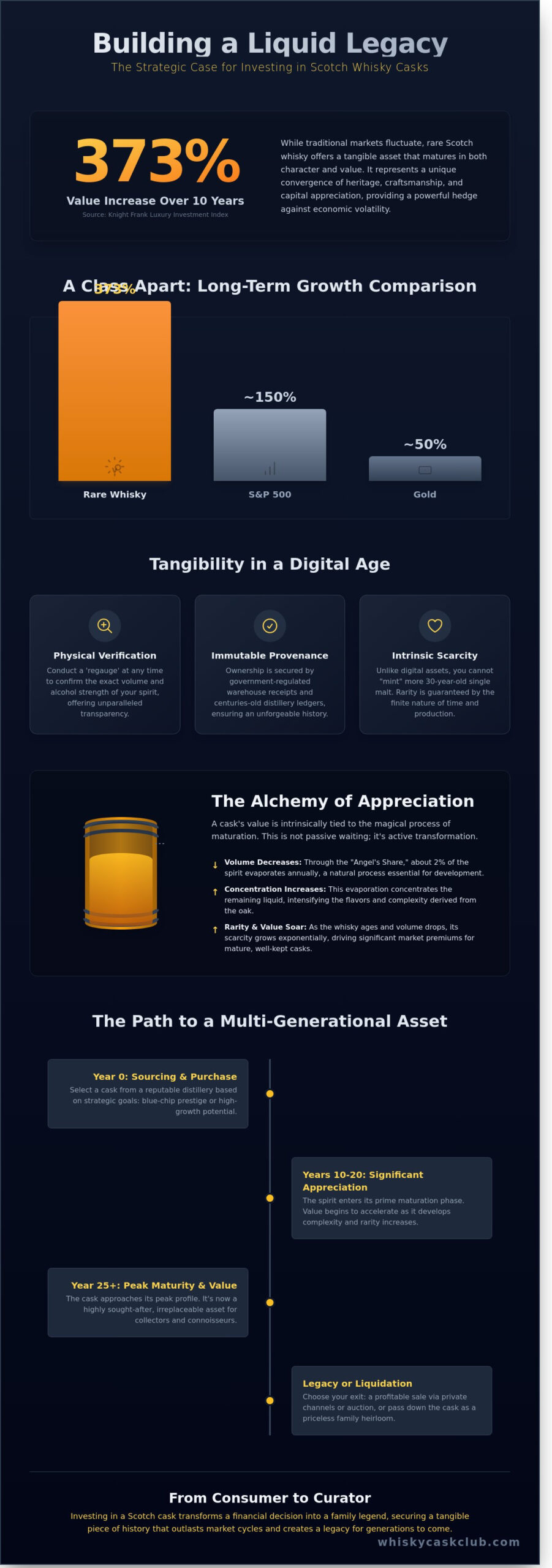
What if your most resilient investment wasn’t held in a digital wallet, but matured silently within a dunnage warehouse in Speyside? As traditional markets fluctuated through 2023, the Knight Frank Luxury Investment Index revealed that rare whisky has seen a 373% value increase over the past decade. You likely feel that true wealth requires more than just numbers on a screen; it demands a tangible connection to history and craftsmanship. Building a liquid legacy with scotch allows you to secure a physical asset that balances cold financial pragmatism with the quiet prestige of Scottish heritage.
This guide will show you how to transform rare single malt casks into a multi-generational cornerstone for your portfolio. We’ll demystify the complexities of sourcing high-provenance liquid and explain the 10 to 20 year path toward significant capital appreciation. You’ll learn how to curate a “story” asset that offers both a hedge against inflation and a legendary gift for your heirs. We’ll cover everything from distillery selection to the logistics of professional bonded storage to ensure your journey is as smooth as the spirit itself.
Key Takeaways
- Learn how to transition from a consumer to a curator by building a liquid legacy with scotch that serves as a prestigious, multi-generational tangible asset.
- Discover how natural maturation and the “Angel’s Share” create the inherent rarity and flavor concentration that drive significant market premiums.
- Analyze the financial case for rare casks by comparing their long-term growth trends and low market correlation against traditional assets like Gold and the S&P 500.
- Master the “Four Pillars” of strategic selection to balance blue-chip distillery prestige with the high-growth potential of rising stars.
- Explore professional management and exit strategies that ensure your heritage is securely stored and positioned for a profitable private or auction sale.
Defining the Liquid Legacy: Why Scotch Casks Transcend Traditional Assets
Wealth is often a collection of invisible numbers on a digital screen. While stocks and bonds provide utility, they lack the soul and sensory depth of a physical masterpiece. Building a liquid legacy with scotch transforms the concept of wealth from a static balance sheet into a living, breathing history. This asset class represents a sophisticated bridge between capital appreciation and family heritage; it’s a tangible piece of Scotland that grows in value as it evolves in the wood. It represents a shift toward assets that possess intrinsic worth, independent of the digital systems that govern modern finance.
Traditionally, collectors focused on the immediate gratification of the bottle. In 2024, we’ve seen a decisive shift toward the curation of whole casks. This isn’t just about possession. It’s about stewardship. To appreciate the gravity of this asset, one should first understand the rigorous standards defined by What is Scotch Whisky? and the heritage it protects. Because the liquid must be aged in oak for a minimum of three years in Scotland, the barrier to entry is high. The supply is naturally constrained by the physical limits of distillery production and warehouse space, ensuring that rarity is baked into the investment from day one.
The psychological transition from consumer to curator is profound. When you own a cask, you’re hedging against market volatility through the literal process of oxidation and esterification. While the S&P 500 might fluctuate based on geopolitical whims, a maturing 2012 distilled Highland malt continues to develop its profile regardless of the economic climate. The value is baked into the chemistry of the barrel. In the 2023 Knight Frank Luxury Investment Index, rare whisky showed a 10-year growth of 280%, outperforming many traditional luxury categories. You’re not just waiting for a price tick; you’re waiting for a flavor profile to reach its peak.
The Tangibility Factor in a Digital Age
Investors are increasingly wary of the ephemeral nature of digital assets. By 2026, market analysts project that ultra-high-net-worth individuals will increase their allocation to physical “passion assets” by 15% to secure their portfolios. A scotch cask offers a level of security that a crypto wallet cannot match. You can visit the bonded warehouse, see your cask, and touch the staves. Several factors drive this move toward tangibility:
- Physical Verification: The ability to conduct a regauge to confirm the volume and strength of your liquid at any time.
- Immutable Provenance: Ownership is backed by government-regulated warehouse receipts and distillery ledgers that often stretch back 200 years.
- Intrinsic Scarcity: Unlike digital tokens, you can’t “mint” more 30-year-old liquid from a closed distillery.
The prestige of owning a piece of Scottish history that continues to evolve in the barrel is unmatched in the world of alternative investments. It creates an un-copyable value proposition that thrives on the slow, deliberate passage of time.
Whisky as a Multi-Generational Heirloom
The process of building a liquid legacy with scotch is a long-term play that mirrors the patience of the master distiller. Unlike luxury cars that depreciate the moment they leave the lot, a cask of rare single malt is one of the few items that actually improves with age. It’s an emotional anchor for a family. Imagine passing down a “birth-year” cask to a child on their 25th birthday. You don’t just own the liquid; you own the timeline of its maturation. This is how a bank balance becomes a family legend that outlasts a simple statement. By the time a cask reaches its 30-year peak, it represents a unique moment in history that can’t be replicated.
The Alchemy of Appreciation: How Maturation Drives Long-Term Value
Time is the silent partner in every distillery. As the spirit rests, it undergoes a transformative process known as maturation. This isn’t just a chemical change; it’s the foundation for building a liquid legacy with scotch. The interaction between the spirit and the wood is a slow, deliberate dance that requires patience and precision. Unlike traditional financial assets, the value of a whisky cask is intrinsically tied to the biological and chemical evolution occurring within the oak staves.
Every year, roughly 2% of the liquid evaporates through the porous wood. Distillers call this the “Angel’s Share.” While this represents a loss in volume, it’s a gain in character. This natural evaporation concentrates the essential oils, esters, and phenols, creating a deeper and more complex flavor profile. This physical reduction in volume creates a mathematical certainty of rarity. A cask filled in 1994 will naturally yield fewer bottles in 2024 than one filled in 2014. This declining supply, coupled with increasing quality, is the primary engine behind the premium pricing of 25 and 30-year-old spirits.
The Science of the Barrel
The choice of wood dictates approximately 70% of the final flavor profile. Quercus alba, or American White Oak, typically imparts notes of vanilla, honey, and coconut. In contrast, Quercus robur, the European Oak used for Sherry seasoning, provides rich tannins, dried fruits, and spice. During a 10 to 20 year hold period, the spirit breaks down the wood’s lignins and hemicellulose, turning them into complex sugars. Owners must remain vigilant about the “Alcohol by Volume” (ABV). If the strength dips below the legal threshold of 40%, the liquid loses its designation as Scotch whisky. Managing this decline is part of the craft of building a liquid legacy with scotch.
Single malt remains the gold standard for appreciation because of its specific provenance. A cask from a top-tier Speyside or Islay distillery carries a heritage that cannot be manufactured or replicated. For those looking to secure their own piece of history, you might explore our current inventory of rare casks to find a legacy-grade asset that suits your portfolio.
Rarity by Design: The Finite Supply of Aged Spirit
The market for aged spirits is governed by a simple, unyielding truth: you can’t manufacture time. Distilleries cannot suddenly produce more 30-year-old whisky to meet a spike in demand. They are limited by the decisions made three decades ago. This supply squeeze is intensified by government support for the Scotch industry, which has helped propel global exports to record highs, reaching over £6 billion in 2022.
- Global Demand: Rapidly growing markets in Asia and North America are competing for a shrinking pool of mature stock.
- Lost Distilleries: Casks from “ghost” distilleries like Pittyvaich or Imperial command extreme premiums because the source no longer exists.
- Cask Finishing: Secondary maturation in exotic wood, such as Mizunara oak or Pedro Ximénez Sherry butts, adds a final layer of exclusivity and value.
The “lost distillery” phenomenon adds a layer of tragic beauty to the investment. When a distillery closes, its remaining casks become finite artifacts. As these casks are bottled and consumed, the surviving inventory becomes exponentially more valuable. This combination of chemical transformation and market scarcity ensures that a well-managed cask is more than a beverage; it’s a sophisticated, tangible piece of Scottish heritage.
Market Dynamics and the Financial Case for Rare Scotch
Rare whisky has redefined the alternative asset class over the last decade. Data from the Knight Frank Luxury Investment Index shows a 280% increase in rare whisky values between 2014 and 2024. This growth significantly outpaced the S&P 500’s 165% return and Gold’s 65% performance during the same period. Building a liquid legacy with scotch offers a hedge against traditional market volatility; the correlation between a maturing cask and the FTSE 100 remains remarkably low. Physical assets like these provide a sanctuary when digital portfolios fluctuate.
By 2026, the index predicts a “flight to quality” where provenance outweighs age alone. Investors are increasingly targeting 1980s and 1990s vintages from “ghost” distilleries that no longer produce liquid. A cask becomes transactional the moment it reaches a desirable age statement, such as 18, 21, or 25 years. It’s a tangible exit. You can choose to bottle the liquid, sell it to a private collector, or trade it at a specialist auction. Most premium casks see a 12% to 18% annual appreciation as they move toward these maturation milestones. This strategic approach is the foundation of building a liquid legacy with scotch that survives market cycles.
The supply-demand imbalance drives the financial narrative. While global demand from emerging markets in Asia increased by 22% in 2023, the supply of aged single malt remains fixed by the laws of time. You can’t manufacture a 30-year-old whisky overnight. This inherent scarcity ensures that well-sourced casks maintain their floor price even during broader economic downturns.
Performance Benchmarks: Whisky vs. Fine Wine and Cars
Whisky outpaces fine wine because it is a hardy asset. Wine is susceptible to light, heat, and cork rot; scotch is nearly indestructible within the oak. Storage costs in bonded warehouses are remarkably low, typically ranging between £0.75 and £1.50 per week. Brand power acts as a financial multiplier. Names like Macallan or Bowmore command a 30% premium on the secondary market compared to unbranded grain whiskies. This makes the selection of the distillery as vital as the age of the spirit.
Risk Mitigation and Asset Protection
Security is guaranteed through HMRC-regulated bonded warehouses in Scotland. These facilities ensure the liquid is never tampered with and maintain a clear Delivery Order that proves legal ownership. Insurance for tangible assets covers the full market value, protecting your capital from loss during the maturation phase. Professional management handles the “angel’s share” evaporation, ensuring the ABV doesn’t drop below the legal 40% limit. They remove the entry barriers, allowing you to focus on the growth of your portfolio rather than the logistics of the warehouse.
Curating Your Collection: A Strategic Framework for Cask Selection
Success in building a liquid legacy with scotch rests on four foundational pillars: Distillery Reputation, Cask Type, Spirit Age, and Rarity. These metrics determine the asset’s trajectory over decades. Distillery reputation provides the baseline value, acting as the brand equity of your investment. The cask type dictates the maturation quality, while spirit age tracks historical scarcity. Finally, rarity ensures that secondary market demand remains high when you eventually decide to exit. It’s a sophisticated balancing act that requires both patience and precision.
The Hogshead is the preferred vessel for those focused on long-term growth. Holding approximately 250 liters, it offers a lower surface-area-to-liquid ratio than the 200-liter American Standard Barrel. This allows the spirit to mature slowly over 20 or 30 years without becoming over-oaked or losing its distillery character. It’s the “goldilocks” vessel for patient investors who understand that time is the most valuable ingredient in any premium malt. Smaller barrels might age faster, but they rarely reach the same level of complexity found in a well-managed Hogshead.
Never acquire a cask without a recent Sample and Regauge (S&R) report. This document, ideally dated within the last 6 months, confirms the Bulk Liters, Alcohol by Volume (ABV), and Liters of Pure Alcohol (LPA). A 1990 vintage cask that’s dipped below 40% ABV is no longer legally whisky; it becomes a liability rather than an asset. A regauge also tracks the “Angels’ Share,” the natural evaporation that occurs in the warehouse. If a cask loses more than 2% of its volume annually, it may indicate a structural leak, making the S&R report a vital health check for your tangible asset. Meticulous documentation is the only way to protect your capital.
Blue-Chip vs. Emerging Distilleries
Blue-chip names like Macallan or Dalmore offer unparalleled stability. Macallan’s brand equity saw specific rare expressions increase in value by 400% between 2010 and 2020. Most savvy investors allocate 70% of their portfolio to these established giants while reserving 30% for high-potential “cult” distilleries. Rising stars like Ardnamurchan provide higher growth ceilings and often win industry awards, such as the Icons of Whisky 2023, which can trigger a 20% spike in cask demand. Master Blenders like Billy Walker bring a reputation that acts as a seal of quality for any portfolio.
Selecting the Right Wood Profile
The wood is your insurance policy. Sherry Butts generally command a 25% premium over Bourbon Barrels in the secondary market because of their rich color and deep flavor profile. While exotic finishes like Mizunara or Port pipes are trending, they carry higher volatility. Traditional first-fill European Oak remains the safest bet for long-term appreciation. This strategic approach ensures you’re building a liquid legacy with scotch that transcends simple market fluctuations. High-quality wood ensures the spirit develops the complex esters required for a 90-point rating from international critics, securing its future value.
Securing Your Heritage: Professional Management and Exit Strategies
Owning a cask is a commitment to the slow, deliberate passage of time. The Whisky Cask Club provides the professional framework for building a liquid legacy with scotch by managing every variable from the moment of distillation to the final sale. Our approach centers on three pillars: meticulous sourcing from top-tier distilleries, secure storage in HMRC-regulated facilities, and a bespoke strategy tailored to your personal goals. We don’t just sell whisky; we curate heritage. This journey requires a partner who understands that a 200-litre barrel is both a masterpiece of craftsmanship and a sophisticated financial instrument.
The Role of the Bonded Warehouse
Storing spirits in a “Duty Suspended” state is a strategic necessity for any serious collector. By keeping your cask in an accredited Scottish bonded warehouse, you defer the 20% VAT and excise duty until the moment the liquid is bottled. These facilities are governed by strict regulations, including the 1880 Spirits Act, ensuring the highest standards of oversight. Leading warehouses employ 24-hour CCTV and climate-controlled environments to mitigate the “Angels’ Share,” the natural evaporation that typically claims 2% of a cask’s volume annually. Our team manages the complex logistical paperwork and annual reporting required by UK customs, providing you with a seamless ownership experience regardless of your global location.
Managing a portfolio requires a deep understanding of the fiscal landscape. In the United Kingdom, scotch whisky casks are generally classified as “wasting assets” because the liquid naturally breathes and evaporates over decades. This specific classification means they’re currently exempt from Capital Gains Tax (CGT). For an investor, this can represent a 20% to 28% saving compared to traditional equities or property investments. When you transition this asset into a family heirloom, you’re passing on a tax-efficient vehicle that gains character and value with every passing year. It’s a tangible piece of Scottish history that stays protected within the bonded system, ready for the next generation.
Planning Your Exit: From Cask to Capital
The maturation curve dictates the optimal time to realize your gains. Most premium single malts reach a value plateau between 18 and 30 years of age. We monitor these milestones to help you decide between three primary exit routes. A private sale offers the fastest liquidity, often transacting within 30 days through our network. Public auctions can drive prices higher for rare labels, though they often command 10% to 15% in seller fees. Alternatively, bottling a “Legacy Edition” for private events creates a physical monument to your journey. The Whisky Cask Club facilitates these secondary market transactions, connecting members with a global community of connoisseurs.
The global demand for scotch remains robust, with the Scotch Whisky Association reporting export values of £6.75 billion in 2023. This growth supports the long-term viability of building a liquid legacy with scotch. Whether your goal is to fund a future endeavor or to toast a significant family milestone, the exit must be as carefully managed as the maturation itself. We provide the expertise to ensure your liquid gold reaches its full potential. Own the cask. Own the liquid. Own the legacy.
Secure Your Future in the Golden Spirit
Scotch whisky isn’t just a storied drink; it’s a tangible asset that has consistently outperformed many traditional markets. The Knight Frank Luxury Investment Index shows that rare whisky values rose by 373% between 2013 and 2023. By selecting casks with verified provenance and housing them in HMRC-regulated bonded warehouses, you protect both your legal title and the physical liquid. Maturation is the primary driver of this appreciation. It’s a patient process where the oak cask provides up to 80% of the spirit’s final character over 10, 20, or 30 years.
You’re doing more than diversifying a portfolio. You’re building a liquid legacy with scotch that carries the weight of Scottish history. This journey requires a sophisticated approach to selection and a clear roadmap for the future. With access to exclusive casks from Scotland’s top distilleries and expert portfolio management, you can navigate the complexities of the market with total confidence. Clear exit strategies ensure your heritage remains as fluid and valuable as the spirit itself.
Start building your liquid legacy with the Whisky Cask Club today.
Your journey into the world of rare spirits begins with a single, well-placed cask.
Frequently Asked Questions
Is building a liquid legacy with Scotch better than buying bottles?
Cask ownership offers superior scalability and value appreciation compared to individual bottles because the spirit continues to mature and improve in the wood. Bottles stop aging once they’re sealed; however, a cask develops deeper character and rarity over decades. Building a liquid legacy with scotch through casks allows you to control the bottling date and provenance. While rare bottles might appreciate by 10% annually, well-selected casks from top-tier distilleries often see higher compound growth over a 12 year period.
How long should I hold a Scotch whisky cask for maximum legacy value?
You should aim for a holding period of 10 to 20 years to capture the most significant increase in prestige and price. Scotch typically reaches its peak maturation and “sweet spot” between 12 and 18 years of age. Data from the 2023 Knight Frank Rare Whisky Index shows that older age statements command the highest market premiums. Holding a cask for two decades transforms a young spirit into a rare heritage asset, significantly increasing its appeal to private collectors.
What are the risks of investing in whisky casks in 2026?
The primary risks in 2026 include market fluctuations and the “Angels’ Share” evaporation, which removes 2% of the cask volume every year. Investors must also account for annual storage fees and insurance premiums. If the spirit’s strength drops below 40% ABV, it’s no longer legally Scotch whisky. Selecting a reputable broker ensures your asset stays in a HMRC-approved warehouse, mitigating the 5% risk associated with poorly managed or fraudulent storage facilities found in the wider market.
Do I need to pay tax on my whisky cask investment?
No, Scotch whisky casks are currently classified as a “wasting asset” by HMRC, which makes them exempt from Capital Gains Tax in the UK. This tax-efficient status exists because the spirit naturally evaporates over time. You won’t pay VAT or Excise Duty as long as the cask remains “under bond” in a licensed warehouse. If you eventually bottle the liquid, you’ll then be liable for the UK duty rate, which was £28.74 per litre of pure alcohol in 2024.
Can I visit my cask while it is maturing in Scotland?
Yes, most HMRC-bonded warehouses allow scheduled visits so you can witness your tangible asset firsthand. We arrange private tours at facilities across Speyside and Islay, where you can see the craftsmanship of the warehouse team. These visits often include a “valinch” sampling to draw 50ml of liquid directly from the wood. It’s a vital part of building a liquid legacy with scotch, as it allows you to experience the spirit’s evolution every 3 years.
What happens if the distillery goes out of business?
Your ownership remains secure because the physical cask is your personal property, held in a third-party bonded warehouse. Even if a distillery like Rosebank or Port Ellen closes, the liquid belongs to you, not the producer. In fact, “ghost” distillery casks often see a 25% price surge due to their finite nature. Your title deeds and warehouse receipts provide the legal proof of ownership required to move or sell the asset independently of the distillery’s financial health.
How do I know the whisky inside my cask is still good?
You can verify the quality through a Regauge Report and a sample draw, which we recommend performing every 3 to 5 years. A professional regauge provides precise data on the Alcohol by Volume and the total litres of alcohol remaining in the cask. Expert tasters evaluate the profile to ensure the oak hasn’t over-matured the spirit. This meticulous monitoring ensures the liquid maintains its premium status, protecting the integrity of your investment until it reaches peak maturity.
Can I pass my whisky cask to my children as part of my will?
Yes, a whisky cask is a tangible asset that’s legally transferred to heirs through a standard will or trust. Unlike cash, a cask is a multi-generational heritage piece that appreciates as it sits quietly in the warehouse. You simply need to ensure the warehouse keeper has the updated “Delivery Order” documentation to reflect the new owner. This seamless transfer makes it a sophisticated tool for legacy planning, allowing you to gift an asset that has matured alongside your family.