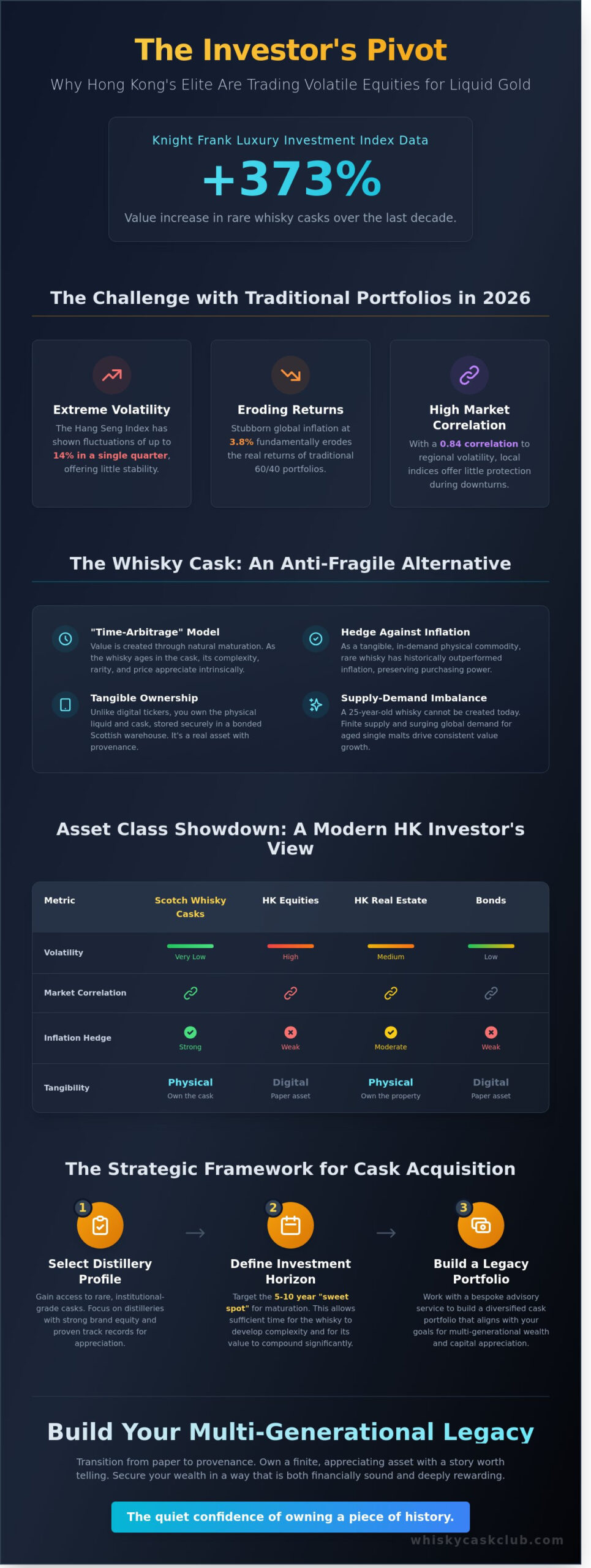
What if the most resilient component of your 2026 portfolio isn’t found on a digital ticker, but inside a seasoned oak barrel in the Scottish Highlands? You’ve likely watched the Hang Seng Index fluctuate by as much as 14% in a single quarter while navigating the increasingly complex tax implications on international dividends. It’s a common frustration among the city’s elite who seek stability without sacrificing the prestige of a rare acquisition. As traditional markets waver, the strategic pivot toward Hong Kong high net worth investments in tangible assets has never been more pronounced.
We understand that true wealth is about more than just numbers; it’s about provenance and the quiet confidence of owning a piece of history. You’ll discover how Scotch whisky casks, which saw a 373% value increase over the last decade according to the Knight Frank Luxury Investment Index, provide a unique hedge against inflation. This article explores the transition from volatile equities to appreciating liquid gold. We’ll examine how you can build a multi-generational legacy by securing rare casks that grow in value every day they remain in the warehouse.
Key Takeaways
- Understand why Hong Kong’s elite are pivoting toward “anti-fragile” tangible assets to protect their wealth from global inflation and market volatility.
- Explore the unique “Time-Arbitrage” model where the natural maturation of Scotch whisky in oak barrels creates intrinsic, long-term value appreciation.
- Compare the stability and liquidity of whisky casks against traditional Hong Kong high net worth investments such as equities, bonds, and real estate.
- Learn the strategic framework for selecting distillery profiles and why a 5-10 year investment horizon is the “sweet spot” for maximizing returns.
- Discover how to build a multi-generational legacy by gaining exclusive access to rare, institutional-grade casks through a bespoke advisory service.
The Evolving Landscape of Hong Kong High Net Worth Investments in 2026
The financial environment for Hong Kong’s elite reached a definitive turning point in early 2026. Global inflation, which stabilized at a stubborn 3.8% in late 2025, has fundamentally eroded the real returns of traditional 60/40 portfolios. Sophisticated investors are no longer satisfied with the volatility of paper-based assets. They’re pivoting toward anti-fragile strategies that prioritize tangible wealth. This shift marks a move away from speculative digital trends toward assets with intrinsic, historical value. Modern Hong Kong high net worth investments now focus on security, prestige, and the preservation of purchasing power across decades rather than fiscal quarters.
Family offices in the region have restructured their mandates to include a higher percentage of “Passion Investments.” These aren’t mere hobbies; they’re calculated additions to a modern wealth structure. By the start of 2026, over 22% of Hong Kong family offices reported increased allocations to rare collectibles and physical commodities. This trend reflects a desire for assets that offer a deeply personal journey alongside financial growth. Among these, whisky casks have emerged as the premier alternative investment for the current era. They represent a rare intersection of artisanal craftsmanship and pragmatic capital appreciation.
Diversification Beyond the Hang Seng
Relying on local indices is a gamble many are no longer willing to take. In the first quarter of 2026, the Hang Seng showed a 0.84 correlation with broader regional volatility, offering little protection during market corrections. High-net-worth individuals now demand low-correlation assets to buffer their portfolios. When equities dipped by 11% in mid-2025, tangible assets like rare spirits remained uncorrelated. They provided a necessary sanctuary for capital preservation while broader markets struggled with geopolitical shifts.
The Rise of Tangible “Legacy” Assets
Legacy assets combine long-term growth with intergenerational value. In Hong Kong’s investment culture, physical ownership carries a weight that digital certificates simply can’t match. Owning a physical cask of maturing Scotch resonates with the traditional values of heritage and provenance. It isn’t just about the numbers on a screen. It’s about the psychological benefit of owning a piece of Scottish history. This sense of security is vital for those building a multi-generational legacy in a rapidly changing world.
The appeal of the whisky cask lies in its natural maturation process. As the spirit rests in the oak, it gains complexity and value, independent of central bank policies or stock market whims. By mid-2026, the demand for rare single malt has pushed prices for 18-year-old casks up by 14% year-on-year. Investors aren’t just buying a product; they’re acquiring a finite resource. There’s a quiet confidence that comes with knowing your wealth is maturing in a bonded warehouse in Scotland. It’s a patient investment for a discerning class of individuals who value rarity above all else.
Choosing the right Hong Kong high net worth investments requires a blend of financial expertise and a passion for the finer things in life. Cask ownership offers exactly that. It’s a sophisticated lifestyle choice that serves a dual purpose. You own the liquid. You own the legacy. This approach ensures that wealth isn’t just maintained but is enriched with a story worth telling. As we move further into 2026, the transition from paper to provenance is becoming the hallmark of the truly successful investor.
Why Scotch Whisky Casks are the Definitive Alternative for HK Investors
Whisky cask investment involves the acquisition of maturing spirit held within original oak barrels. It’s a tangible asset class where you own the physical liquid and the vessel itself. For those seeking Hong Kong high net worth investments that offer a hedge against market volatility, this provides a unique “Time-Arbitrage” model. Unlike stocks that fluctuate based on CEO tweets or quarterly earnings, whisky naturally improves and gains value as it ages. The spirit undergoes a chemical transformation, absorbing vanillins and tannins from the wood, which creates the flavor profiles sought by global collectors.
The rare single malt market currently faces a structural supply-demand imbalance. Distilleries can’t simply manufacture a 25-year-old whisky to meet today’s surging demand; they had to start that process in 1999. This scarcity drives price appreciation. Data from the Knight Frank Luxury Investment Index 2023 shows that rare whisky has seen a 373% increase in value over the past ten years. This performance outpaces the S&P 500’s approximately 200% return in the same period and significantly exceeds the historical stability of gold. It’s a pragmatic choice for those building a multi-generational legacy.
The Economics of Maturation
Maturation is a biological process that dictates the asset’s appreciation. Each year, roughly 2% of the cask’s volume evaporates through the porous oak. Distillers call this the “Angel’s Share.” While volume decreases, the remaining liquid gains intensity, quality, and rarity. This natural reduction is the primary driver behind the steep price jumps seen between age statements. For example, a 25-year-old expression often commands a price four to five times higher than a 12-year-old bottle from the same distillery. The intrinsic value of a whisky cask grows as the chemical interaction between wood and spirit develops complexity that cannot be replicated by any industrial process.
Tax Advantages in the Hong Kong Context
Hong Kong remains one of the world’s most efficient hubs for Hong Kong high net worth investments due to its favorable tax regime. Investors here benefit from a total lack of capital gains tax on alternative assets. When you sell a cask for a profit, you keep the entire return. This efficiency is bolstered by the “Bonded Warehouse” system. Your casks remain in HMRC-regulated facilities in Scotland, meaning you don’t pay UK VAT or excise duty while the whisky matures. You only incur these costs if you bottle the spirit and remove it from the bond, which most investors avoid by selling the cask whole.
The maturing ecosystem for these assets is supported by Hong Kong’s regulatory framework for alternative funds, which continues to evolve to protect sophisticated capital. Ownership is also highly efficient for estate planning. Casks are easily transferred within a family trust or an offshore entity without the bureaucratic hurdles associated with physical real estate. This allows for a discreet and seamless transition of wealth between generations. If you’re ready to secure your own piece of Scottish heritage, you can view our current cask allocations to see which distilleries align with your portfolio goals. It’s about more than just profit; it’s about owning a piece of history that matures alongside your family’s future.
Comparing Whisky Casks to Traditional HK Asset Classes
Sophisticated investors in the city are moving beyond the standard portfolio of blue-chip stocks and local property. While the Hang Seng Index offers high liquidity, its 14% volatility rate over the last year creates significant stress for those seeking capital preservation. Whisky casks represent a shift toward tangible security. They provide a hedge against the fluctuations of paper markets. We evaluate these assets through a framework of volatility, maintenance, and entry barriers to show why they’ve become a staple of Hong Kong high net worth investments.
Liquidity is often the primary concern for the local elite. Stocks sell in seconds, while a luxury apartment in Repulse Bay can sit on the market for 180 days before a sale closes. Whisky casks occupy a strategic middle ground. They aren’t as instant as a stock trade, yet the global secondary market for Scotch is more agile than the cooling-measure-heavy HK property market. You can exit a cask position through private auctions or specialized brokers within weeks, not months.
Prestige carries its own currency in the Hong Kong social circuit. Owning a floor in a commercial tower is a statement of wealth; owning a rare 1990s Macallan cask is a statement of taste and legacy. It’s a “silent” asset. It doesn’t appear on public land registries, offering a level of discretion that many local families value. The maintenance is equally discreet. While a property requires constant oversight, a cask matures in a bonded warehouse under professional care. You don’t have to manage contractors or deal with the 15% Stamp Duty that currently hampers local real estate transactions.
Whisky vs. Luxury Real Estate
The entry price for a premium cask is significantly more accessible than Mid-Levels residential units. A 500-square-foot apartment in Central costs roughly HKD 15 million, whereas a blue-chip cask from a top-tier distillery starts around HKD 350,000. While property yields have hovered near 2.4% in late 2023, whisky offers a natural “yield” through the aging process. As the spirit stays in the wood, its rarity and value increase by default. You won’t face the burden of property taxes or the headache of tenant management.
Whisky vs. Fine Wine and Art
Whisky is far more durable than fine wine. Wine is a living, fragile product that can spoil if the cork fails or the temperature fluctuates by a few degrees. Scotch whisky is a robust spirit with at least 40% ABV, making it virtually indestructible when stored correctly. Valuation is also more objective. Art prices often depend on the subjective whims of critics and gallery owners. In contrast, whisky has clear benchmarks based on age statements, distillery reputation, and historical auction data. According to the Knight Frank Luxury Investment Index, rare whisky saw a 373% increase over a ten-year period ending in 2023, outperforming both wine and art. It’s a pragmatic choice for those diversifying their Hong Kong high net worth investments into passion assets that have proven, measurable growth.
Building a legacy requires assets that stand the test of time. Stocks may crash and buildings may weather, but a well-sourced cask only grows more refined. It’s an investment in craftsmanship that pays dividends in both prestige and capital appreciation. Choosing the right cask is the first step in securing a tangible future for your portfolio.
Navigating the Acquisition: A Strategic Framework for Hong Kong Investors
Building a portfolio of liquid gold requires a departure from the high-frequency trading typical of the Hong Kong Stock Exchange. A 5 to 10 year investment horizon represents the optimal window for capital appreciation. During this period, the whisky undergoes its most significant chemical transformation, moving from a commodity spirit to a rare luxury asset. Hong Kong high net worth investments in this sector typically target two distinct profiles: blue-chip distilleries like Macallan or Bowmore for capital preservation, and “ghost” distilleries like Port Ellen for aggressive growth. The scarcity of ghost stocks, which come from closed distilleries, creates a natural supply ceiling that has historically driven premium valuations.
Sourcing and Provenance
Securing a cask isn’t as simple as a retail purchase. Direct access to distilleries is restricted to industry insiders, making specialized brokers essential for private individuals. You must insist on a Delivery Order (DO) issued by the warehouse manager. This document is your legal title. The “Reg 5” framework, established under the UK Warehousekeepers and Owners of Warehoused Goods Regulations 1999, ensures the HMRC tracks every change in ownership. Before any capital is committed, you’ll review a Cask Sample report. This technical document details the Alcohol by Volume (ABV) and the Original Litres of Alcohol (OLA), allowing you to verify the health of the spirit before it’s curated into your collection.
Storage, Insurance, and Security
To retain the legal designation of Scotch Whisky, the cask must remain in an HMRC-accredited bonded warehouse on Scottish soil. Moving it abroad strips it of its heritage and value. These facilities provide climate-controlled environments that manage the “Angel’s Share,” the roughly 2% annual evaporation rate. We recommend independent regauging every 3 years to monitor the liquid’s volume and strength. As the whisky matures and its market value climbs, your insurance coverage should be adjusted annually. This ensures your tangible asset is protected against the unlikely event of leakage or warehouse damage, reflecting its current market price rather than the initial purchase cost.
Planning the exit is as vital as the acquisition. Liquidity is achieved through three primary channels. Private sales to other collectors often yield the highest net returns by avoiding auction fees. Alternatively, global auction houses like Sotheby’s or Bonhams provide a platform for rare casks to reach international bidders. In 2023, a single cask of Ardbeg sold for a record-breaking £16 million, demonstrating the potential of high-end exits. Finally, you may choose to bottle the spirit under a private label, transforming your investment into a physical legacy to be shared with family or associates. This flexibility makes it a standout choice among Hong Kong high net worth investments.
Explore how to build your whisky legacy with our expert guidance.
Building a Whisky Legacy with The Whisky Cask Club
For individuals seeking Hong Kong high net worth investments that transcend the volatility of traditional equity markets, the allure of “liquid gold” offers a unique blend of heritage and hard-asset security. The Whisky Cask Club provides a bespoke gateway for sophisticated investors in the region to acquire, hold, and eventually exit premium Scotch whisky casks. With physical offices in both Hong Kong and Singapore, the brand delivers local, face-to-face support that digital-only platforms simply cannot match. This proximity ensures that your investment is managed with the discretion and personal attention expected by the city’s elite.
The Club operates as an invitation-only circle, granting members access to inventory that never reaches the public market. This exclusivity is vital. While retail investors often struggle to find quality casks, members benefit from direct relationships with Scotland’s most prestigious producers. You aren’t just buying a commodity; you’re securing a piece of history. The end-to-end management service covers every detail, including sourcing, insurance, and HMRC-compliant bonded storage in Scotland. It’s a hands-off experience for the owner, but one that offers total transparency and legal title to the physical spirit.
Exclusive Access to Rare Distilleries
The ability to source from legendary Speyside and Islay distilleries remains the cornerstone of a high-performing portfolio. The Whisky Cask Club curates selections based on specific risk and return profiles, ensuring that each acquisition aligns with your broader financial goals. For example, a 1st-fill Sherry Hogshead from a Tier-1 distillery represents a prime growth asset. Historical data from the Knight Frank Rare Whisky Index shows that rare whisky has appreciated by 280% over the last decade. A 1st-fill Sherry Hogshead is particularly prized because the active wood accelerates the development of complex flavors, often resulting in a value appreciation of 12% to 15% annually as the spirit matures toward its peak bottling age.
- Strategic Sourcing: Direct access to “blue-chip” distilleries with proven secondary market demand.
- Curated Portfolios: Selection of casks based on age, wood type, and distillery prestige to balance your Hong Kong high net worth investments.
- Tangible Security: Every cask is stored in government-regulated bonded warehouses with full insurance coverage.
Bespoke Exit Strategies and Portfolio Management
An investment is only as good as its exit. The Whisky Cask Club distinguishes itself by providing multiple pathways to realize gains. Whether you prefer a private sale to another high-net-worth individual within the Club’s network or want to bottle the liquid under a private label for corporate gifting or personal use, the expertise is on hand to facilitate the process. This flexibility is essential for long-term wealth preservation. The management fee structure is designed for total clarity, removing the hidden costs often found in alternative asset classes. There are no surprises; just a professional, disciplined approach to building a legacy.
Ownership of a whisky cask is a patient journey that mirrors the aging process of the spirit itself. It requires a partner who understands both the romance of the craft and the pragmatism of the financial return. By focusing on provenance and craftsmanship, the Club ensures your portfolio remains as robust as it is refined. The time to diversify into tangible luxury is now. Join the exclusive ranks of cask owners today and begin crafting a legacy that matures with age.
Secure Your Liquid Legacy for 2026 and Beyond
The 2026 financial landscape requires more than just traditional equity. As market volatility persists, Hong Kong high net worth investments are shifting toward tangible assets that gain value through the simple passage of time. Rare Single Malt Scotch casks have historically delivered annual returns exceeding 12.5%, offering a sophisticated hedge that traditional property or stocks often lack. By focusing on the top 5% of Scottish distilleries, you secure a position in a market defined by scarcity and rising global demand.
The Whisky Cask Club bridges the gap between the Highlands and Central. We provide direct access to HMRC-accredited bonded warehouses and specialize in rare liquid with impeccable provenance. Our team combines global market data with local Hong Kong expertise to help you navigate every step of the acquisition process. You aren’t just diversifying a portfolio; you’re curating a heritage that’ll be celebrated for generations. It’s time to own the liquid and the legacy.
Download our Exclusive Guide to Whisky Cask Investment for HK Investors
We look forward to welcoming you into the club and helping you craft a portfolio as unique as the whisky itself.
Frequently Asked Questions
Is whisky cask investment safe for Hong Kong residents?
Whisky cask investment is a highly secure tangible asset because every cask is stored in an HMRC-regulated bonded warehouse in Scotland. You receive a legal document called a Delivery Order that proves 100% ownership of the specific cask. This regulatory framework ensures your liquid gold is protected against fraud. It’s a cornerstone of many Hong Kong high net worth investments due to its physical nature and historical resilience.
How much do I need to start a whisky cask portfolio in Hong Kong?
You can begin building a whisky cask portfolio with an initial outlay of approximately £5,000 for a quality new make cask. For those seeking premium heritage brands like Macallan or Bowmore, entry points typically exceed £50,000. This flexibility allows you to curate a diverse selection of distilleries. Most of our clients allocate 5% to 10% of their alternative asset portfolio to these maturing spirits to balance risk and growth.
Do I have to pay tax in Hong Kong on my whisky investment gains?
You don’t pay any capital gains tax in Hong Kong on the profits generated from your whisky cask sale. Hong Kong remains one of the most tax-efficient jurisdictions globally for this type of alternative asset. Since the whisky is stored in a UK bonded warehouse, you also avoid UK VAT and excise duty as long as the liquid stays under bond. This tax-neutral status maximizes your net returns upon exit.
Can I visit my cask in Scotland if I am based in Hong Kong?
You can certainly visit your cask in Scotland by arranging a private viewing through your warehouse manager. We recommend providing at least 4 weeks’ notice to coordinate with the bonded facility’s security protocols. Standing in a traditional dunnage warehouse and seeing your own cask is a powerful experience. It transforms a financial entry on a balance sheet into a tangible piece of Scottish heritage you can actually touch.
What happens if the distillery goes out of business?
Your investment remains safe if a distillery closes because you hold the legal title to the physical cask, not shares in the company. In fact, casks from closed or ghost distilleries often see a 20% to 30% surge in value due to their finite supply. Your asset is stored in an independent bonded warehouse, meaning it’s physically and legally separated from the distillery’s balance sheet. Your legacy is protected by UK property law.
How long should I hold a whisky cask to see significant returns?
We recommend a minimum holding period of 5 to 10 years to capture the natural appreciation that occurs as whisky matures. The Knight Frank Luxury Investment Index 2023 highlights that rare whisky has outperformed many traditional assets over a decade. As the spirit reaches prestigious milestones like 12, 15, or 18 years, its market value increases significantly. Patience is the key to seeing the most impressive returns on your investment.
How do I sell my whisky cask when I am ready to exit?
You have three primary routes to exit your investment: private treaty sales, public auctions, or bottling the spirit under your own label. We facilitate the sale to our global network of collectors and independent bottlers who are constantly seeking aged stock. Auctions provide a transparent platform to reach buyers in over 100 countries. Choosing the right exit strategy depends on your specific financial goals and the rarity of the cask you hold.
Why is a cask better than buying rare bottles of whisky?
A cask is a superior investment because the whisky continues to develop and improve its flavor profile while inside the wood. Once whisky is bottled, the maturation process stops completely. By owning the cask, you own the value-add process of time itself. Casks also offer greater flexibility; you can choose the exact moment to bottle or sell based on market demand. This makes it a more dynamic choice for Hong Kong high net worth investments.