In the grand tapestry of Scotch whisky, the term ‘peated Highlander’ often presents an intriguing enigma. Distinct from the briny, medicinal smoke of Islay, this profile offers a different dimension of peat-one of gentle, earthy bonfire embers. For the discerning connoisseur, understanding this distinction is key to appreciating the full spectrum of Scottish craftsmanship. At the very heart of this tradition stands the Ardmore distillery, a producer whose spirit has defined this very category for over a century, offering a unique provenance that sets it apart from its island counterparts.
Join us as we explore the complete story of this remarkable institution. We will delve into its storied founding, the unique, coal-fired production process that underpins its signature flavour, and its well-earned reputation among collectors. More than just a journey of taste, we will also analyse its standing as a tangible asset, evaluating the distillery’s potential for cask investment. This guide provides the essential knowledge for both the passionate enthusiast and the pragmatic investor, empowering you to understand Ardmore’s heritage and its potential to build a lasting legacy within your portfolio.
Key Takeaways
- Understand the founding vision of Adam Teacher and the enduring heritage that has defined Ardmore since 1898.
- Discover the traditional craftsmanship that establishes Ardmore as a rare and consistent source of peated Highland spirit.
- Learn to identify the signature “Highland smoke” flavour profile and how cask maturation elevates its complex character.
- Evaluate the unique investment potential of the ardmore distillery, prized for its quality and consistency as a tangible asset.
The Founding Legacy: Adam Teacher’s Highland Vision
In the annals of Scotch whisky heritage, few distilleries were established with such a clear and singular purpose as The Ardmore Distillery. Founded in 1898 by Adam Teacher, the son of Teacher’s Blended Scotch founder William Teacher, its creation was a strategic move to secure the future of a legacy. Adam’s vision was precise: to build a state-of-the-art distillery capable of producing a consistent, high-quality Highland single malt that would serve as the heart of the world-renowned Teacher’s Highland Cream blend. This foundational purpose is a defining chapter in the Ardmore distillery history and has shaped its character for over a century.
A Strategic Location on the ‘Road to the Isles’
The choice of Kennethmont in Aberdeenshire was a masterstroke of industrial foresight. Situated at the highest point of the Northern Railway line, the location provided unparalleled logistical access for transporting raw materials and shipping the finished spirit. This practical advantage was complemented by an abundance of natural resources essential to premium whisky craftsmanship:
- Pristine Water: A dedicated supply of pure, soft water drawn from the springs of the nearby 1,500-foot Knockandy Hill.
- Local Barley: Easy access to the fertile barley-growing regions of the Scottish Highlands.
- Abundant Peat: A ready source of local Highland peat, used to dry the malted barley and impart Ardmore’s signature gentle smokiness.
The Heart of a World-Famous Blend
A superior blended Scotch is an intricate symphony, with a ‘fingerprint’ single malt providing its core identity. For Teacher’s Highland Cream, Ardmore was meticulously designed to be that malt. This critical role demanded unwavering consistency and a robust, complex character that could anchor the blend. The responsibility shaped Ardmore’s production from day one, cementing its profile as a full-bodied, traditionally peated Highland spirit. For decades, its primary purpose was to serve the blend, making its emergence as a celebrated single malt a more recent phenomenon, and adding a layer of provenance for today’s discerning collectors.
The Art of Production: Crafting a Peated Highland Spirit
While the Highlands are not typically synonymous with heavily peated whisky, The Ardmore Distillery stands as a rare and proud exception. It maintains a steadfast commitment to traditional production methods, resulting in a spirit that is both robust and complex. This dedication to craftsmanship makes Ardmore a unique bastion of mainland peat, a legacy upheld since its inception.
Traditionally Peated Malt: The Source of the Smoke
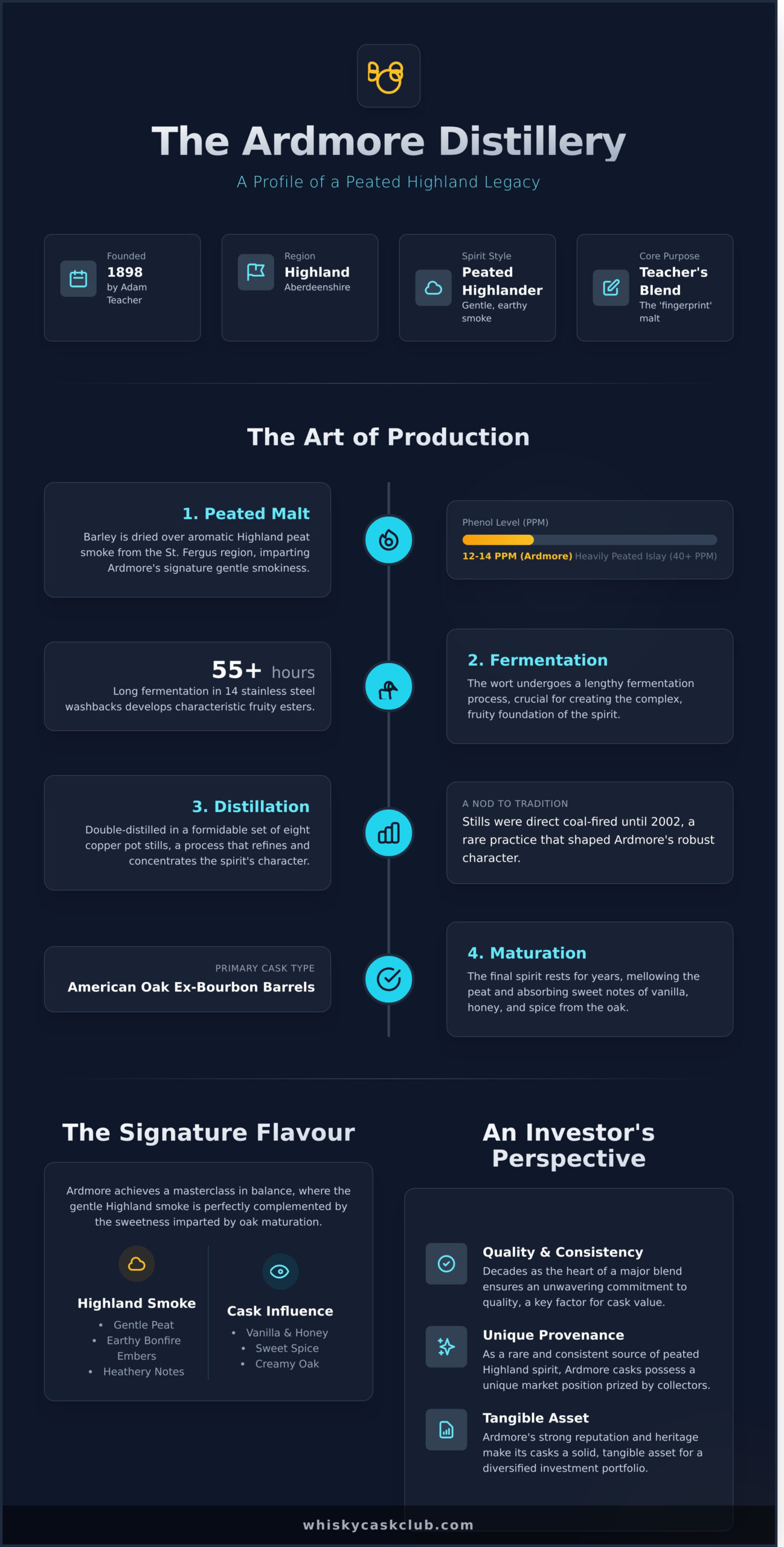
The signature smokiness of Ardmore’s spirit has a clear provenance. The distillery uses malted barley dried over aromatic peat smoke, with peat sourced from the St. Fergus region. The level is specified to a moderate 12-14 parts per million (PPM). This creates a profile distinct from the heavily phenolic whiskies of Islay, offering a gentler, heathery smoke that integrates with the spirit rather than dominating it.
Fermentation and Distillation
The production journey continues through 14 large stainless steel washbacks, where long fermentation times of over 55 hours cultivate the spirit’s characteristic fruity esters. The wash is then double-distilled in a formidable set of eight copper pot stills-four wash and four spirit. Until 2002, these stills were famously direct-fired by coal, a practice now almost entirely lost. The transition to internal steam heating was meticulously managed to preserve the robust character of Ardmore’s peated Highland spirit, a testament to the distillery’s commitment to its heritage.
Maturation and Cask Policy
The final stage of creation is maturation, a deliberate exercise in balance. The vast majority of Ardmore spirit is filled into American oak ex-bourbon barrels. This choice is fundamental to the whisky’s profile, as these casks impart classic notes of vanilla, honey, and sweet spice that beautifully complement the gentle smoke. While ex-bourbon is the cornerstone, select official bottlings showcase the spirit’s versatility through finishes in other casks, such as port pipes, adding layers of rich fruit and complexity for the discerning palate.
The Ardmore Flavour Profile: Unpacking the Highland Smoke
While many Highland distilleries champion unpeated, fruit-forward styles, The Ardmore stands as a proud exception, defined by its signature peated character. The journey begins with a robust new make spirit, rich with the smoky phenols imparted by its peat-fired kilns. This powerful spirit is then laid down in American oak casks, where a slow, patient maturation softens the smoke and weaves in layers of sweetness and complexity. The result is a masterclass in balance-a whisky that is unmistakably smoky yet elegantly Highland.
The final liquid presents a consistent and highly regarded profile, making casks from the ardmore distillery a sought-after asset for collectors and investors alike. Its character is approachable yet deeply complex.
A Symphony of Senses: Nose, Palate, and Finish
Discerning the nuances of Ardmore’s profile reveals a beautifully orchestrated tasting experience:
- Nose: An initial wave of gentle, aromatic smoke, reminiscent of a distant bonfire, which gives way to sweet heather honey, creamy vanilla, and a whisper of bright citrus peel.
- Palate: The texture is wonderfully creamy and full-bodied. Notes of sweet malted barley and toasted oak provide a classic Highland foundation, while the bonfire smoke and a subtle, warming spice build in complexity.
- Finish: Exceptionally long, warming, and satisfyingly dry. The smoky embers linger gracefully, leaving a lasting impression of refined power.
Ardmore vs. Islay: A Tale of Two Peats
To truly appreciate Ardmore’s character, it is essential to distinguish its Highland peat from the more famous Islay style. Islay whiskies are known for a maritime, medicinal peat smoke, heavy with notes of iodine and brine. In stark contrast, the ardmore distillery uses mainland peat, which imparts an earthy, heathery, and altogether gentler smoke. This distinction positions Ardmore as an exceptional gateway to the world of peated whisky, offering all the complexity without the aggressive phenolic character of its coastal cousins. Understanding this unique provenance is paramount when building a legacy portfolio of rare and distinctive casks.
Ardmore Casks: An Investor’s Perspective
While some distilleries command headlines with record-breaking auction prices, the savvy investor understands the profound value found in consistency, heritage, and industry demand. In this regard, Ardmore represents a uniquely compelling opportunity. Often described as a ‘workhorse’ of the Highlands, it produces a robust, high-quality spirit that is foundational to the Scotch whisky industry, making its casks a tangible asset with both intrinsic and strategic value.
Why Invest in an Ardmore Cask?
The value proposition for an Ardmore cask is built on a foundation of pragmatism and potential. Its spirit is famously well-made and resilient, ideal for long-term maturation. Unlike many ‘cult’ distilleries, Ardmore casks are available at a more accessible price point, offering a superb entry into premium cask ownership. Crucially, the consistent demand from blenders for its signature peated character provides a stable secondary market, ensuring liquidity for cask owners. Discover the potential of adding an Ardmore cask to your portfolio.
Maturation Potential and Flavour Development
The journey of an Ardmore cask is one of elegant transformation. The robust spirit evolves beautifully over decades, offering a dynamic profile for investors and connoisseurs alike.
- At 10 Years: The spirit retains its vibrant, smoky character, balanced by notes of honey, green apple, and vanilla from the oak.
- At 15 Years: The peat begins to soften and integrate, allowing more complex fruity esters and gentle spice to emerge, creating a richer, more rounded profile.
- At 20+ Years: The whisky achieves remarkable depth. The smokiness becomes a subtle, elegant wisp, interwoven with notes of dried fruit, leather, and sophisticated oak spice, showcasing the spirit’s exceptional capacity for aging.
The Role of Provenance in Cask Value
A distillery’s history and stability are paramount in cask investment. The long and uninterrupted heritage of the ardmore distillery provides a powerful sense of provenance that underpins the value of every cask. Its ownership by industry giant Beam Suntory adds another layer of security, guaranteeing continued production and brand stewardship. For an investor, this stability is crucial-it ensures the distillery’s legacy will endure, protecting and enhancing the value of your tangible asset for years to come.
The Ardmore Legacy: A Highland Spirit, A Tangible Asset
From Adam Teacher’s pioneering vision to its signature, lightly peated character, Ardmore stands as a unique icon in the Highlands. We’ve explored its rich history, meticulous production process, and the complex, smoky flavour that defines its spirit. This is more than just a remarkable whisky; it is a tangible piece of Scottish heritage with significant potential for the discerning investor. Understanding its provenance is the key to appreciating its enduring value.
Owning a part of this heritage is an unparalleled experience. At Whisky Cask Club, we provide exclusive access to rare and premium casks from historic producers like the ardmore distillery. Our clients benefit from expert portfolio management and advisory, ensuring their collection is perfectly curated for growth. Every investment is protected within our secure, fully insured storage facilities in Scotland, safeguarding your legacy for generations to come.
Request a consultation to begin building your whisky cask legacy. Your journey into the exclusive world of premium cask ownership begins now.
Frequently Asked Questions
Is The Ardmore Distillery an Islay distillery?
No, The Ardmore is a Highland distillery, a fact central to its unique character. Located in the village of Kennethmont, Aberdeenshire, its provenance is firmly in the Highlands. This geographical distinction is crucial, as it separates Ardmore’s style of peat from the heavily maritime and medicinal smoke characteristic of Islay whiskies. It offers a different, yet equally compelling, peated whisky experience rooted in mainland terroir and tradition.
What does ‘traditionally peated’ mean for a Highland whisky?
For Ardmore, ‘traditionally peated’ signifies its adherence to the founder’s vision of a Highland style of peat smoke. The distillery sources its peat from the mainland, which imparts a gentler, more aromatic smoke compared to the intense, iodine-rich peat of Islay. The resulting flavour is one of sweet bonfire smoke, heather, and honey, rather than medicinal notes. This unique craftsmanship defines the accessible yet complex character of Ardmore’s spirit.
Who owns The Ardmore Distillery?
Ownership of The Ardmore Distillery rests with Beam Suntory, a global leader in premium spirits. This prestigious parentage places Ardmore within a portfolio of world-renowned distilleries, ensuring its continued production and global reach. Being part of such a significant group underscores the distillery’s importance and provides the stability necessary to maintain its exceptional standards of quality and heritage for generations of connoisseurs and investors to come.
What is the main use of Ardmore’s whisky?
While increasingly celebrated for its single malt expressions, the primary role of Ardmore’s spirit is to provide the signature smoky heart of the Teacher’s Highland Cream blended Scotch whisky. This foundational purpose guarantees a consistent and high-volume demand for its make, a key factor for stability. This dual identity-as both a crucial blending component and a respected single malt-enhances its reputation and secures its place in the industry.
Is Ardmore whisky a good entry point for peated Scotch?
Ardmore is an exceptional entry point for those wishing to explore peated Scotch. Its smoke profile is significantly more gentle and less medicinal than many of its Islay counterparts. Expressions like The Ardmore Legacy balance a sweet, aromatic smokiness with classic Highland notes of honey, vanilla, and spice. This elegant integration offers a sophisticated introduction to peat, allowing a newcomer’s palate to appreciate the complexity without being overwhelmed by intensity.
What makes an Ardmore whisky cask a potentially good investment?
An Ardmore cask represents a compelling tangible asset for several key reasons. Its unique ‘Highland peat’ profile offers a point of distinction in a crowded market. Furthermore, its crucial role in the high-volume Teacher’s blend ensures consistent underlying demand for the spirit. As the single malt reputation of the Ardmore distillery grows, so does the potential for appreciation. This blend of industrial importance and rising brand prestige creates a stable yet promising investment opportunity.