Your whisky cask has matured gracefully, a testament to patience and foresight. Now, the moment has arrived to realize its value. Yet, as you consider putting your whisky in barrel for sale, this final step can feel clouded with uncertainty. Questions of true market worth, navigating the private market, and managing the intricate legalities of the transfer can transform an exciting prospect into a source of apprehension, leaving many investors unsure of how to proceed without compromising their return.
Fear of receiving an unfair price or being overwhelmed by the process should not stand in the way of a profitable outcome. This definitive guide is designed to demystify the journey. We will illuminate the expert-led process for selling your whisky cask, from securing a precise, data-driven valuation to connecting with a network of vetted buyers and executing a seamless final sale. Prepare to transform your tangible asset into realized gains, ensuring the legacy you’ve carefully cultivated achieves its full financial potential with confidence and clarity.
Key Takeaways
- Selling your cask is a strategic phase of the investment lifecycle; learn to identify the moment of peak maturation to secure the highest possible return on your asset.
- A cask’s true market value is determined by a complex blend of factors, including distillery provenance and age, requiring specialist valuation to ascertain its full worth.
- Discover the primary channels for listing your whisky in barrel for sale, from private auctions to specialist brokers, each offering distinct advantages for the private investor.
- Navigate the selling process with confidence by understanding the key logistical steps and learning how to avoid the common pitfalls that can diminish your investment’s value.
The Art of the Exit: Why and When to Sell Your Whisky Cask
Acquiring a premium whisky cask is the beginning of a legacy. Knowing when to sell is the art of realizing its full potential. This decision is not one of haste, but the calculated culmination of your investment journey. It represents the pivotal moment when your maturing, tangible asset is transformed into liquid capital, ready to fund new ventures, secure your financial future, or be enjoyed as the reward for your patience and foresight. A well-planned exit strategy ensures your investment performs precisely as intended.
Timing the Market: Is Now a Good Time to Sell?
The global appetite for rare and aged single malt Scotch has never been more robust. As discerning investors increasingly turn to alternative assets for portfolio diversification, the inherent value of a well-aged cask becomes more pronounced. Each year your whisky matures, it joins a more exclusive and finite vintage. This growing rarity is a powerful driver of value, ensuring that when you decide to offer your whisky in barrel for sale, you are meeting a market eager for provenance and quality.
Peak Maturation vs. Diminishing Returns
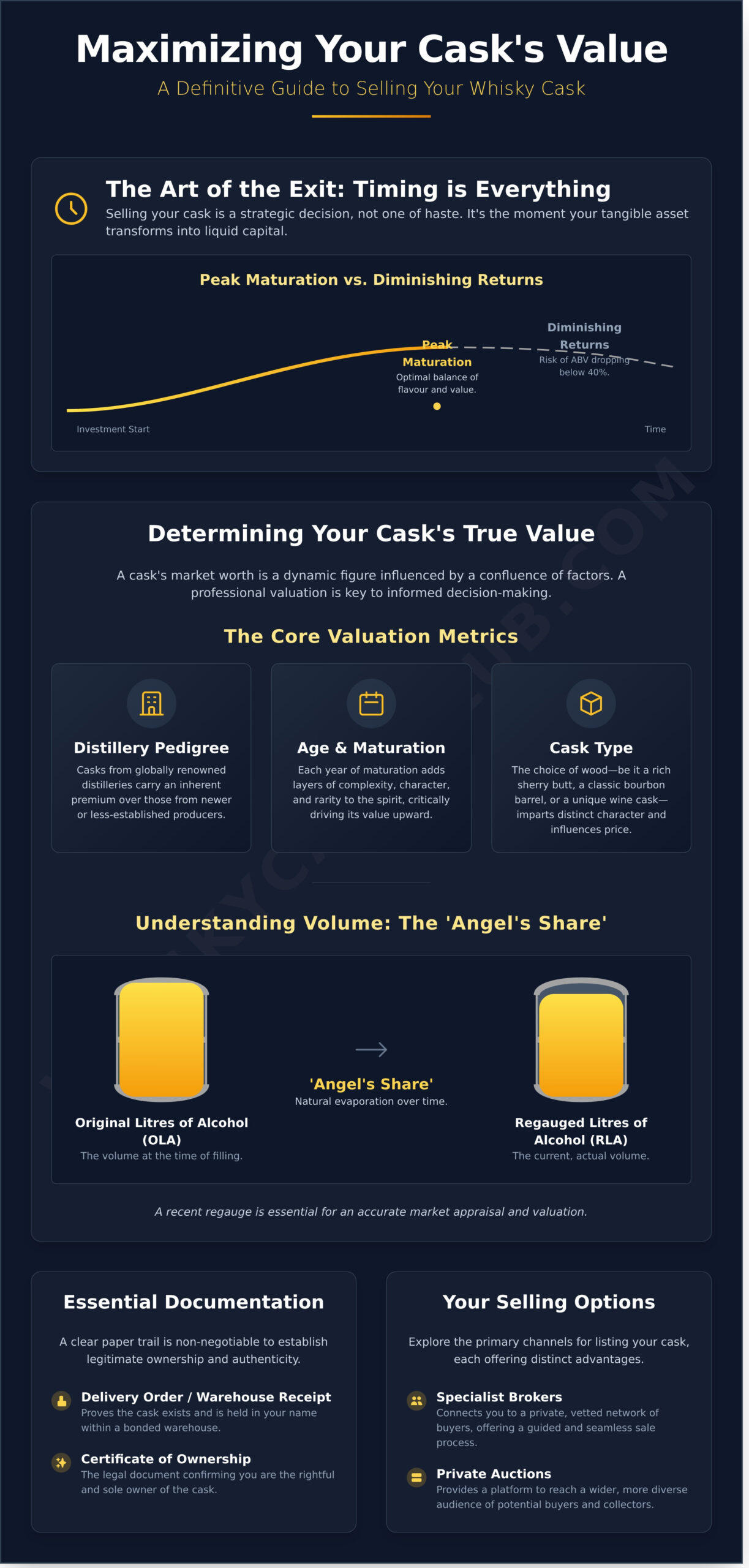
While time is a key ingredient, whisky does not improve indefinitely. The concept of ‘peak maturation’ is critical; it is the point where the spirit achieves its optimal balance of flavour, complexity, and character. Beyond this zenith, you risk diminishing returns. The magic of maturation is central to the Scotch whisky production process, but it is a finite journey. A crucial technical consideration is the Angel’s Share-the natural evaporation that can, over decades, cause the cask’s alcohol by volume (ABV) to drop below the 40% legal minimum for Scotch whisky. Regular sampling and expert assessment are therefore essential to identifying the perfect window to sell.
Ultimately, the decision to sell is a confluence of factors: the spirit reaching its peak, favourable market dynamics, and your personal financial objectives. Whether you aim to reinvest, fund a significant life event, or simply realise the gains from your passion, a strategic exit ensures your legacy is not just preserved, but maximised. Our expertise is dedicated to helping you navigate this final, crucial step with confidence and precision.
For those looking to reinvest their capital into new high-growth areas, it can be valuable to explore Investor Introduction services that connect investors with opportunities like pre-IPO placements.
Determining Your Cask’s Value: A Look Inside the Barrel
Understanding the true market worth of your cask is the foundational step in crafting a successful exit strategy. This is not a simple calculation; it is a specialist skill, blending empirical data with deep market insight. The price you originally paid for your cask is a historical data point, but its current market value is a dynamic figure, influenced by a confluence of factors that reflect its rarity, desirability, and maturity. A professional valuation provides the clarity needed to make informed decisions about the future of your tangible asset.
The Core Valuation Metrics
At the heart of any cask valuation are three pillars that dictate its potential. The distillery pedigree is paramount; a cask from a globally renowned distillery like Macallan or Springbank carries an inherent premium over one from a newer or less-established producer. Secondly, age is a critical driver of value, as each year of maturation adds layers of complexity and character to the spirit. Finally, the cask type plays a defining role. The choice of wood-be it a rich sherry butt, a classic bourbon barrel, or a unique wine cask-imparts distinct character and significantly influences the final price, a process governed by the strict UK’s Scotch Whisky Regulations.
Understanding the ‘Angel’s Share’ and Liquid Volume
As whisky matures, a small amount of spirit naturally evaporates through the oak cask-a poetic process known as the ‘Angel’s Share’. While romantic, this has a direct financial impact. Valuations depend on two key figures: the Original Litres of Alcohol (OLA) and the Regauged Litres of Alcohol (RLA), which is the current volume. A recent regauge provides the precise RLA and current Alcohol By Volume (ABV), which are essential for an accurate market appraisal. This ensures you are valuing the liquid you actually possess, not what was originally filled.
The Importance of Official Documentation
Provenance is everything in the world of premium whisky investment. A clear, unbroken paper trail is non-negotiable for establishing legitimate ownership and authenticity. Without it, finding a reputable buyer for a whisky in barrel for sale is nearly impossible. The essential documents include:
- A Delivery Order or Warehouse Receipt: This proves the cask exists and is held in your name within a bonded warehouse.
- A Certificate of Ownership: This is your title deed to the cask, a crucial document for any transfer of ownership.
These documents provide the absolute proof required by auction houses, independent bottlers, and private collectors, securing your cask’s integrity and maximising its final sale value.
Your Selling Options: Navigating the Secondary Cask Market
Once your cask has reached its peak maturation and investment potential, the final step is realizing its value. Navigating the secondary market requires the same level of diligence and expertise as the initial purchase. An owner has several avenues to liquidate their tangible asset, each with a distinct profile of risks and rewards. Understanding these options is paramount to ensuring a successful and profitable exit.
Selling via Auction Houses
Presenting your cask at a prestigious auction house like Sotheby’s or a specialist like Whisky Auctioneer can expose it to a global audience of passionate collectors. The competitive nature of bidding can sometimes drive prices to exceptional highs. However, this route comes with considerable drawbacks: seller’s commissions can be substantial, the process can be lengthy, and there is no guarantee your cask will meet its reserve price, or even sell at all.
Private Sales to other Collectors
Attempting a direct sale to another private individual may seem appealing due to the potential for lower fees and direct negotiation. Yet, this path is fraught with significant peril. Finding a vetted, credit-worthy buyer for a high-value whisky in barrel for sale is a formidable challenge. The risks of fraud are high, and the logistical complexities of ownership transfer, duty, and international shipping are immense. Navigating the stringent legal framework, as outlined by bodies like the Scotch Whisky Association (SWA), without expert guidance can lead to costly compliance failures.
The Brokerage Advantage: Partnering with an Expert
For the discerning investor, partnering with a specialist cask brokerage represents the most secure, discreet, and efficient path to market. A trusted broker removes the uncertainty and complexity from the selling process, leveraging their expertise to maximize your return. This is the preferred method for those who value their time and security.
- Unrivalled Access: We provide immediate access to a curated, global network of vetted trade buyers, independent bottlers, and high-net-worth collectors actively seeking premium casks.
- Expert Management: Our team handles every critical detail, from professional valuation and discreet marketing to expert negotiation and the secure management of all legal and financial transfers.
- Streamlined Security: By managing the entire transaction, we eliminate the risks associated with private sales, ensuring a seamless and confidential experience from start to finish.
When you decide to offer your whisky in barrel for sale, an expert partner ensures your legacy asset is treated with the respect and diligence it deserves. Request a complimentary valuation of your cask from our experts.
The Process of Selling Your Whisky Barrel with a Broker
Realizing the culmination of your investment is the final, crucial stage of your cask ownership journey. Engaging a specialist broker transforms this complex process into a seamless and secure transaction. Our role is to leverage our market expertise and extensive network on your behalf, ensuring your asset achieves its maximum potential value with complete discretion and professionalism. The following steps demystify the logistics, providing a clear and transparent path from cask to capital.
Step 1: Initial Consultation and Verification
The process begins with a confidential consultation. You will be invited to submit your cask’s details, including its original paperwork and proof of ownership. Our team then undertakes a meticulous verification process, confirming the cask’s provenance, age, and legal title. An executed Non-Disclosure Agreement is standard practice, safeguarding your privacy and ensuring absolute discretion from the very first conversation.
Step 2: Professional Valuation and Marketing
Leveraging real-time market data and our deep industry knowledge, we conduct a comprehensive valuation of your cask. We consider all critical factors-distillery reputation, age, wood type, and recent market trends-to determine an optimal sale price, which is then agreed upon with you. Your asset is then discreetly marketed as a rare whisky in barrel for sale to our curated, global network of qualified buyers, independent bottlers, and fellow collectors.
Step 3: Negotiation and Agreement
As offers are received, we act as your dedicated representative, fielding all enquiries and managing negotiations to secure the most favourable terms. We present each serious offer to you for consideration, providing expert guidance, but the final decision to accept remains entirely yours. Once an offer is accepted, a formal, legally-binding sales agreement is drafted to protect the interests of all parties.
Step 4: Secure Transfer and Payment
Upon execution of the sales agreement, we manage the entire administrative process. This includes liaising with the bonded warehouse to facilitate the official transfer of ownership to the new buyer. The buyer’s funds are held securely in a dedicated client account until the transfer is complete. Once confirmed, the proceeds of the sale are transferred directly to you, successfully completing your investment cycle. This structured process transforms a tangible asset into liquid capital, fulfilling the promise of your investment.
To discuss your personal exit strategy, we invite you to contact our team of cask specialists.
Avoiding Common Pitfalls When Selling Your Cask
The journey of cask ownership culminates in a successful exit strategy. However, realizing the full potential of your tangible asset requires prudence and expert navigation. The market for rare whisky is sophisticated, and several common pitfalls can erode the value you have patiently cultivated. As your trusted partner, we believe transparency is paramount to protecting your investment and legacy.
Unrealistic Price Expectations
The allure of a high valuation can be tempting, but promises that seem too good to be true often are. The true market value of a cask is not based on hope, but on a meticulous analysis of data: distillery provenance, age, wood type, rarity, and current market demand. An independent, data-backed appraisal is non-negotiable for a successful sale. It provides a realistic benchmark and lends credibility when presenting your premium whisky in barrel for sale to discerning buyers.
Hidden Costs and Excessive Fees
A profitable sale can be quickly diminished by unforeseen expenses. Less reputable brokers may obscure their fee structures, leaving you with unexpected costs upon closing. It is essential to demand full transparency on all charges before committing. Common hidden fees can include:
- Excessive marketing and brokerage commissions
- Undisclosed legal and title transfer fees
- Costs for drawing and sending tasting samples
- High administrative or “management” fees
At the Whisky Cask Club, our fee structure is clear and agreed upon upfront. We believe our success is intrinsically tied to yours, ensuring a partnership built on trust and mutual interest.
Neglecting Legal and Tax Obligations
Selling a cask is a significant financial transaction with corresponding legal and tax responsibilities. Profit realised from the sale of your whisky in barrel for sale may be subject to Capital Gains Tax, depending on your jurisdiction and personal circumstances. We strongly advise consulting with a qualified financial advisor to understand your specific obligations. Furthermore, ensuring a legally binding sales contract is in place is crucial to protect both seller and buyer, formalising ownership transfer and payment terms.
Navigating these complexities with diligence is the hallmark of a serious investor. Our role is to provide the expert guidance and robust framework necessary to ensure your exit is as seamless and profitable as your ownership journey. To discuss a tailored exit strategy for your cask, please contact our team of specialists.
From Liquid Asset to Tangible Return: Your Exit Strategy
Realizing the full potential of your whisky cask investment is the culmination of a patient and passionate journey. As this guide has detailed, a successful exit is an art, hinging on strategic timing and a precise, data-driven understanding of your cask’s market value. Navigating the complexities of the secondary market and avoiding common pitfalls is paramount to transforming your tangible asset into a significant return. The process of putting your whisky in barrel for sale should be handled with the same care and expertise with which it was aged, ensuring your legacy is secured.
At The Whisky Cask Club, we provide a seamless and discreet path to liquidation. Our trusted advisors offer an expert valuation based on real-time market data, granting you exclusive access to our global network of high-net-worth collectors and discerning buyers. From initial consultation to the secure, fully managed transfer of ownership, we orchestrate every detail with precision. This allows you to confidently capitalize on your investment, knowing its full value has been achieved.
Begin your exit strategy. Contact us for a confidential consultation.
Frequently Asked Questions
How long does it typically take to sell a whisky cask through a broker?
The timeline for selling a whisky cask is influenced by its provenance, age, and rarity. A highly sought-after cask from an iconic distillery may find a buyer within weeks through an exclusive network. For other premium casks, a period of one to three months is a more typical timeframe. Our role as your advisor is to position your tangible asset effectively within the market to ensure a timely and profitable sale, connecting you with discerning collectors and investors.
What are the standard commission fees for selling a whisky barrel?
Commission fees for the sale of a whisky barrel are typically structured as a percentage of the final sale price, generally ranging from 10% to 15%. This comprehensive fee covers the meticulous process of valuation, marketing to a global network of buyers, and managing all administrative and legal transfer requirements. We believe in complete transparency, ensuring you understand the full value our expertise brings to securing the optimal return on your investment.
Do I need to pay taxes on the profit from my cask sale?
The tax implications of selling a whisky cask depend on your personal circumstances and jurisdiction. In the UK, Scotch whisky is often considered a ‘wasting asset’ and may be exempt from Capital Gains Tax (CGT), but this is not guaranteed. As this is a nuanced area of financial planning, we strongly advise consulting with a qualified tax professional to understand your specific obligations and ensure full compliance before proceeding with a sale.
Can I sell a cask that is stored in any bonded warehouse in Scotland?
Yes, you can sell a cask stored in any HMRC-regulated bonded warehouse across Scotland. The specific location of your cask does not impede the sales process. Ownership is a matter of legal title, which can be transferred electronically regardless of the physical storage facility. Our team manages the entire transfer process seamlessly, liaising with the warehouse to ensure a smooth and secure transition of the asset to the new owner, providing you with complete peace of mind.
Is it possible to sell only a portion of my cask, or must I sell the whole barrel?
The industry standard is to sell the entire cask as a single, indivisible asset. When you list your whisky in barrel for sale, you are marketing the complete unit and its contents to a new owner. This ensures a clean transfer of title and maintains the integrity and provenance of the investment, which is paramount for discerning buyers in the premium market. Fractional sales are not a common or recommended practice due to regulatory complexities.
What documents do I need to have ready to prove I own the whisky barrel?
To prove ownership and establish clear provenance, the primary document required is your original Certificate of Ownership or the signed Delivery Order issued at the time of purchase. This legal document is the definitive proof of title. Additionally, having recent correspondence or storage invoices from the bonded warehouse can be beneficial. Our team will guide you in collating these documents to ensure the sales process is both efficient and secure for all parties involved.