To stand before a wall of Scotch is to face a library of liquid history, where terms like ‘Single Malt’ and ‘Blended’ can feel like a cryptic code reserved for the initiated. This perceived complexity often stands between an aspiring enthusiast and the profound enjoyment of this spirit. Yet, beneath the surface of this vast selection lies an elegant and logical system. For the discerning individual, mastering the fundamental kinds of scotch liquor is not just about learning terms; it is about appreciating the deep heritage and meticulous craftsmanship that defines each bottle. It is the foundational knowledge required to build a truly exceptional collection or simply a more rewarding personal journey.
This definitive guide was created to provide that very clarity. We will demystify the five official classifications of Scotch whisky, from the celebrated Single Malt to the artfully constructed Blended Scotch. By the end of this article, you will possess the confidence to read any label and understand its provenance, distinguish the key characteristics of each category, and begin to identify your own palate preferences. Consider this your first step toward true connoisseurship-the key to unlocking a world of rare and remarkable spirits with authority and passion.
The Foundation: What Legally Defines a Scotch Whisky?
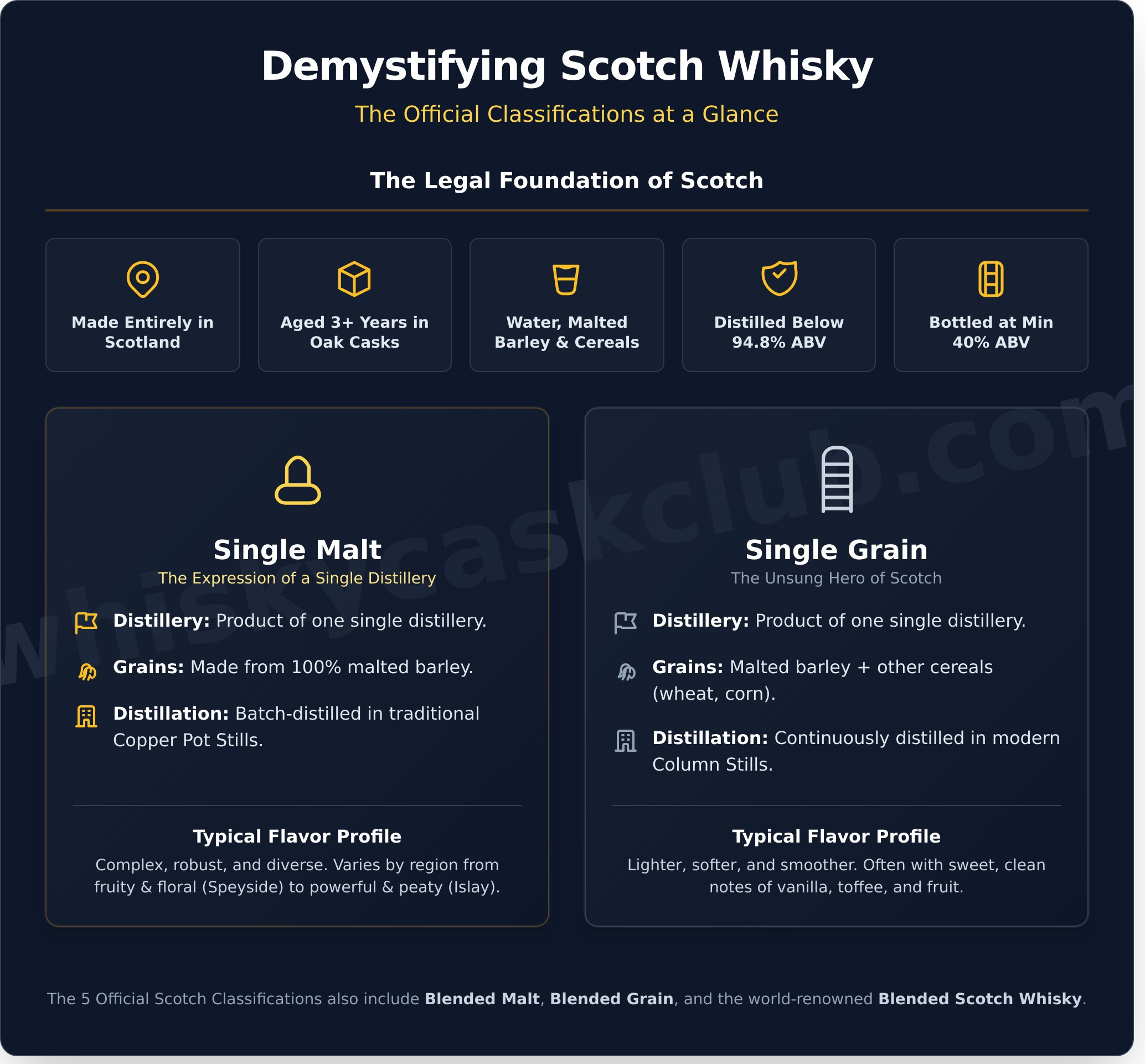
Before exploring the diverse kinds of scotch liquor, one must first understand the strict legal framework that governs its creation. This is not merely a spirit; it is a protected geographical indication with a legacy of craftsmanship. The global standard for its production is enshrined in the Scotch Whisky Regulations 2009. This legislation dictates every crucial step, from the raw materials to the maturation process, ensuring that every bottle bearing the name ‘Scotch’ meets an exacting standard of quality and provenance. To be called Scotch whisky, a spirit must adhere to a non-negotiable set of rules.
The Importance of Geography: Made in Scotland
The most fundamental rule is one of origin: all Scotch whisky must be distilled and matured entirely within Scotland. This geographical requirement is absolute. Unlike Bourbon, which ages rapidly in the fluctuating temperatures of the American South, Scotch benefits from Scotland’s cool, damp, and stable climate. This unique environment allows for a slow, graceful maturation, preventing excessive evaporation and fostering the development of deep, nuanced complexity over many years.
The Role of Oak and Time: Maturation Rules
The spirit’s transformation from a harsh, clear liquid into a complex, amber-hued whisky occurs within oak casks. The law mandates a maturation period of at least three years, during which the wood imparts color, character, and smoothness. The cask’s previous contents play a pivotal role in shaping the final flavor profile. Ex-bourbon barrels typically contribute notes of vanilla and caramel, while ex-sherry casks can bestow rich flavors of dried fruit, spice, and chocolate, directly influencing the final character of the spirit.
Beyond location and maturation, several other critical requirements complete the legal definition:
- Raw Materials: The spirit must be made from only water, malted barley, and other whole cereal grains.
- Distillation: It must be distilled to an alcoholic strength of less than 94.8% ABV to retain the flavor of its raw materials.
- Bottling Strength: Finally, it must be bottled at a minimum strength of 40% alcohol by volume (ABV).
These meticulous regulations are the foundation upon which all the different kinds of scotch liquor are built, ensuring a guarantee of quality and heritage in every glass.
Single Malt Scotch Whisky: The Expression of a Single Distillery
Among the most revered kinds of scotch liquor, the Single Malt stands as a testament to heritage and place. It is the purest expression of a single distillery’s craftsmanship. The name itself is a declaration of its provenance: ‘Single’ signifies that the whisky is the product of one individual distillery, and ‘Malt’ confirms it is made exclusively from 100% malted barley. This precise terminology is not merely tradition; it is a legal designation protected by law, as outlined in The Scotch Whisky Regulations 2009, ensuring the spirit’s integrity. Each Single Malt is batch-distilled in traditional copper pot stills, a process that allows the unique character of its home-from the local water source to the shape of the stills-to be captured in the final spirit.
The Production Process: From Barley to Spirit
The journey from barley to spirit is a meticulous art. It begins with malting, where barley is encouraged to germinate before being dried. This malted barley is then milled and mixed with hot water in a process called mashing to extract fermentable sugars. After fermentation, the resulting liquid, or ‘wash’, undergoes double distillation in copper pot stills. The unique shape of these stills-their height and curvature-profoundly influences the spirit’s character, determining its lightness or richness. It is during the second distillation that the distiller makes the crucial ‘cut,’ selecting only the heart of the run to be matured into whisky, a decision that defines the final product’s quality.
Flavor Profile: A Spectrum of Taste
No other category of whisky offers such a profound spectrum of flavor. The character of a Single Malt is intrinsically linked to its region of origin. For instance, Speyside malts are often celebrated for their fruity and floral elegance, with notes of apple, honey, and vanilla. In stark contrast, whiskies from Islay are renowned for their powerful, peaty character, delivering bold notes of smoke, brine, and iodine. This incredible diversity-from light and delicate to rich and smoky-is what makes Single Malt Scotch the ultimate pursuit for connoisseurs exploring the different kinds of scotch liquor. It offers a direct connection to the distillery’s unique heritage and house style.
Single Grain Scotch Whisky: The Unsung Hero
When exploring the different kinds of scotch liquor, the Single Grain category often remains in the shadow of its more famous Single Malt counterpart. This is a profound misunderstanding, as Single Grain whisky is not only a category of exceptional merit but also the foundational pillar upon which much of the industry is built. The term itself can be misleading; ‘Single’ does not refer to a single type of grain, but rather to a single distillery of origin.
To be precise, the definition of Single Grain Scotch Whisky is legally protected. As outlined in The Scotch Whisky Regulations 2009, it must be distilled at a single distillery from water and malted barley, but with the crucial addition of other whole malted or unmalted cereals, such as wheat or corn. This use of a mixed grain bill is what fundamentally distinguishes it from Single Malt.
Column Stills vs. Pot Stills
The production method also diverges significantly from that of Single Malts. While malts are crafted using traditional copper pot stills in a batch process, Single Grain is produced in a highly efficient continuous column still (also known as a Coffey still). This process yields a spirit at a much higher strength, resulting in a character that is lighter and softer than the robust output of a pot still. It is essential to understand that ‘grain’ refers to the ingredients’ provenance, not an indicator of inferior quality.
Typical Character and Uses
The typical flavor profile of a Single Grain whisky is one of approachable elegance-often sweet with notes of vanilla, toffee, and subtle spice. For decades, its primary role has been to provide the smooth, consistent body for Blended Scotch whiskies, acting as the canvas upon which more characterful single malts are layered. However, a new appreciation for its unique qualities has emerged. Connoisseurs are now seeking out aged, premium Single Grain bottlings, which offer a remarkably refined tasting experience, proving this unsung hero can stand proudly on its own.
Blended Scotch Whisky: The Art of Consistency
While Single Malts often capture the imagination of connoisseurs, it is Blended Scotch Whisky that reigns supreme as the world’s most popular whisky category. This spirit is a testament to the art of harmony, a precise and masterfully crafted combination of one or more Single Malt whiskies with one or more Single Grain whiskies, sourced from various distilleries across Scotland. Brands like Johnnie Walker and Chivas Regal have built global legacies upon this foundation of meticulous blending, offering a consistent and approachable experience that has introduced millions to the world of Scotch.
The Master Blender’s Craft
The soul of a Blended Scotch lies in the unparalleled expertise of the Master Blender. This role demands a remarkable palate and an encyclopedic knowledge of whisky, as they are tasked with balancing the character of dozens-sometimes over fifty-individual whiskies. Their objective is not to capture a single moment in time, but to achieve a consistent, signature flavor profile year after year. This pursuit of uniformity stands in elegant contrast to the vintage-like variations often celebrated in Single Malts, ensuring the bottle you purchase today delivers the same trusted quality as the one you enjoyed a decade ago.
Understanding the Blend
In the architecture of a blend, each component has a distinct purpose. The Single Malts are the heart, providing the complex character, depth, and signature notes-from peat smoke to floral elegance. The Single Grains, in turn, provide a smooth, often lighter-bodied canvas that binds these powerful flavors together, creating a balanced and harmonious final product. When you see an age statement on a bottle, such as ’12 Years Old,’ it signifies that the youngest whisky in that intricate mix has matured for at least that long. This meticulous process makes Blended Scotch an exceptionally accessible and valuable entry point into the diverse world of different kinds of scotch liquor.
While blends offer a masterful introduction to Scotch, the individual components-the rare and aged single malts and grains-represent a world of unique character and investment potential. Understanding the art of the blend is the first step toward appreciating the provenance of the individual casks that create them.
Ready to explore the world of rare casks? Discover our curated selection.
The Niche Categories: Blended Malt and Blended Grain
Beyond the well-trodden paths of Single Malt and standard Blended Scotch lie two officially recognized categories that signal a deeper appreciation for the craft. To understand these distinctions is to move from a casual drinker to a true connoisseur, unlocking unique expressions that offer a masterclass in the blender’s art. For the discerning enthusiast, exploring these lesser-known kinds of scotch liquor is an essential part of the journey.
These niche whiskies provide a curated experience, showcasing how different distillery characteristics can be harmonized to create something entirely new and compelling. They represent a deliberate choice by the blender to work within a specific set of parameters, either with 100% malted barley or 100% other grains.
Blended Malt Scotch Whisky
A Blended Malt is a marriage of two or more Single Malt Scotch Whiskies sourced from different distilleries. The defining characteristic is its composition: it contains absolutely no grain whisky. This category, formerly known as ‘vatted malt’ or ‘pure malt’, is designed to showcase the complexity of malt whisky, combining different regional profiles-perhaps the peat of Islay with the fruitiness of Speyside-into a single, harmonious expression. It is the art of blending without the softening influence of grain spirit.
Blended Grain Scotch Whisky
As the direct counterpart to a Blended Malt, this rare and elegant category is a blend of two or more Single Grain Scotch Whiskies from different distilleries. It is defined by what it lacks: this whisky contains no malt whisky whatsoever. Blended Grains are often celebrated for their light, sweet, and exceptionally smooth profiles, with notes of vanilla, caramel, and butterscotch. While less common, they offer a sophisticated and approachable tasting experience that stands entirely on its own merits.
Mastering these different kinds of scotch liquor is not merely academic; it is about appreciating the full spectrum of Scottish craftsmanship. For those truly dedicated to the spirit’s heritage and future, the journey often leads beyond the bottle to the source itself. Discover the profound legacy of cask ownership and take your place among the world’s most discerning whisky aficionados.
From Category to Cask: How Provenance Creates Value
Understanding the different kinds of scotch liquor is more than an academic exercise for the enthusiast; it is the foundational knowledge for the discerning investor. As you move beyond the bottle, you discover that the true value of Scotch is born long before it is poured. It is forged in the cask, where new-make spirit slowly matures into a tangible, appreciating asset. This journey from spirit to legacy asset is where passion for whisky meets the pragmatism of a premium investment.
While all Scotch has its merits, the world of cask investment overwhelmingly favors one category: Single Malt Scotch Whisky. Its singular provenance-the product of one specific distillery-provides the traceability and narrative that underpins its value. The journey from enthusiast to investor begins by recognizing that the distillery’s name on the cask is paramount.
The Importance of Distillery and Rarity
A distillery’s reputation, built over generations of craftsmanship and acclaim, directly translates into the value of its casks. Casks from iconic distilleries like Macallan, Dalmore, or Ardbeg command premium prices because their liquid is globally sought-after. Investment potential is driven by a trinity of factors: the distillery’s character, the age of the spirit, and its inherent rarity. A limited-edition cask from a celebrated distillery is not just whisky; it is a piece of history, an artifact of heritage that grows more valuable with time.
Building a Legacy Through Cask Ownership
For the true aficionado, owning a cask is the ultimate expression of appreciation. It is an opportunity to own the spirit at its source, to become a custodian of its maturation, and to build a personal legacy. Cask ownership transcends mere collection, transforming a passion into a sophisticated alternative investment. It represents a tangible asset class that blends the romance of Scottish heritage with the security of a carefully managed portfolio. This is your chance to own not just the liquid, but the legend it will become. Start your whisky cask ownership journey with us today.
Beyond the Bottle: The Next Chapter in Your Whisky Journey
From the singular expression of a Single Malt to the consistent artistry of a Blended Scotch, understanding the core categories is the first step on any enthusiast’s path. We’ve explored how each of the five main kinds of scotch liquor offers a unique window into Scotland’s rich distilling heritage. However, the true story of a whisky’s value and character is ultimately written in wood. The provenance of the cask and the patient process of maturation are what transform a fine spirit into a tangible, appreciating asset.
This deep appreciation for craftsmanship is the very foundation of whisky cask investment. It represents an opportunity to move beyond collecting bottles and own a part of the legacy itself. For those ready to explore this rewarding journey, the Whisky Cask Club offers exclusive access to premium, investment-grade casks, supported by expert portfolio management and secure storage in accredited Scottish bonded warehouses. We empower you to build a portfolio with both passion and pragmatism.
Request your complimentary guide to whisky cask investment. Your journey into the heart of Scotch whisky is just beginning.
Frequently Asked Questions
What is the difference between Scotch and other whiskies like Bourbon or Irish Whiskey?
Provenance is paramount. For a spirit to be called Scotch, it must be distilled and matured in oak casks in Scotland for a minimum of three years. It is traditionally crafted from malted barley, which imparts its signature character. In contrast, Bourbon is an American product made from at least 51% corn and aged in new charred oak barrels. Irish Whiskey, renowned for its smoothness, is often triple-distilled and must be produced on the island of Ireland.
Is older Scotch always better than younger Scotch?
While age statements signify rarity and often command a premium, they are not the sole determinant of quality. An older Scotch has spent more time interacting with the cask, which typically imparts deeper complexity and smoothness. However, the true character of a whisky is a testament to its distillation and the quality of the cask. A masterfully crafted younger expression can offer a more vibrant and distinct profile than an older, over-oaked spirit. Excellence lies in balance, not just age.
What does ‘peated’ Scotch mean and which category does it fall into?
‘Peated’ refers to a distinctive smoky character imparted during the malting process. The barley is dried over a fire fueled by peat-decomposed vegetation unique to Scotland’s landscape. This ancient technique infuses the grain with aromas of smoke, brine, and earth. While not a formal category itself, this powerful flavor profile is a hallmark of many kinds of scotch liquor, most famously those with provenance from the Islay region. It is a bold expression of Scottish heritage.
How should a beginner start tasting and exploring the different kinds of Scotch?
A curated approach is best for the aspiring connoisseur. We recommend beginning your journey with the more accessible profiles of the Speyside or Lowland regions, which often present notes of fruit, honey, and vanilla. Procuring a tasting flight from a reputable establishment allows for a direct comparison of regional character. Use a proper nosing glass, and consider adding a single drop of water to unlock the whisky’s complex bouquet of aromas and flavors.
What do the regions of Scotland (e.g., Islay, Speyside) have to do with the type of Scotch?
The regions of Scotland are the heart of a whisky’s identity, each imparting a unique character, or terroir. Speyside, for instance, is renowned for its elegant and fruity expressions, while Islay’s coastal distilleries are masters of the bold, peated, and maritime style. The Highlands offer a diverse spectrum from robust and rich to delicate and floral. This sense of provenance is not merely geographical; it is a testament to generations of regional craftsmanship and heritage.
Can any of these types of Scotch be a good investment?
Indeed. Specific kinds of scotch liquor represent a compelling alternative investment. The most sought-after are rare bottlings and, most significantly, whisky maturing in the cask. Single malts from distilleries with esteemed provenance or those that are no longer in production (“silent stills”) often appreciate considerably. By acquiring a cask, an investor owns a tangible asset whose rarity and value increase with each year of maturation, creating a powerful opportunity to build a lasting financial legacy.