To the uninitiated, the world of Scotch can seem a vast, impenetrable landscape. With hundreds of names etched into the annals of whisky history, how does one begin to distinguish the robust, peated smoke of an Islay icon from the delicate, fruity elegance of a Speyside master? The sheer number of scotch distilleries can be overwhelming, leaving both aspiring connoisseurs and savvy investors questioning what truly separates one legendary spirit from another. It is a question not just of taste, but of provenance, heritage, and the unique craftsmanship that defines a distillery’s soul.
This guide is your definitive map. We will journey through the heartlands of whisky production, demystifying the signature styles that shape the world’s most sought-after investment casks. You will discover not only the stories behind the stills but also the critical factors-from water source to wood policy-that elevate a distillery’s output from a premium spirit to a tangible, appreciating asset. For those looking to build a legacy through cask ownership, understanding this heritage is paramount. Consider this your invitation to explore the very heart of whisky’s legacy.
The Soul of Scotch: Why a Distillery’s Provenance Defines Its Value
Scotch whisky is more than a world-renowned spirit; it is the liquid embodiment of Scotland itself. Known for centuries in Gaelic as ‘uisge beatha’-the water of life-its character is inseparable from the environment that births it. In the exclusive world of premium cask investment, the concept of provenance is paramount. This term encapsulates far more than a location on a map; it is the unique alchemy of a distillery’s specific geography, its storied history, and its unwavering commitment to generations of craftsmanship. A distillery is not merely a production facility. It is the guardian of a spirit’s soul, the very source of the legacy and long-term value held within each and every cask.
From Terroir to Tangible Asset
The journey from raw ingredients to a maturing asset begins with terroir. The specific water source flowing over ancient granite or through rich peat, the coastal air or sheltered glen that defines the warehouse’s microclimate, and the choice of local barley all impart subtle, inimitable notes to the new-make spirit. This physical origin is then layered with the distillery’s unique heritage-its founding story, the lineage of its master distillers, and its signature production methods passed down through time. The distillery thus becomes the authenticated origin point of a tangible asset, where the romanticism of its story translates directly into the appreciating value of the whisky maturing within the oak.
The Global Reputation of Scotland’s Distilleries
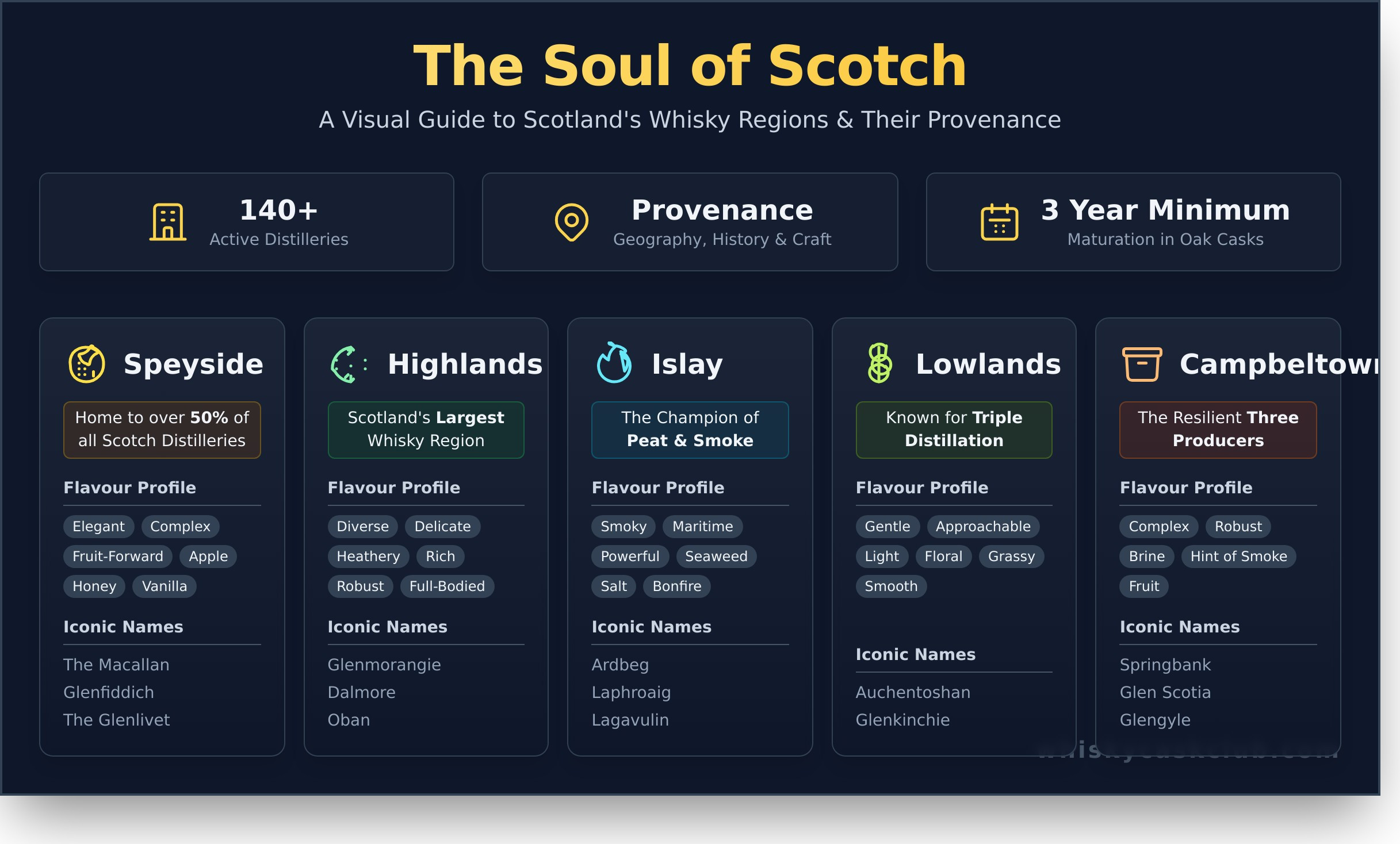
The intrinsic value of provenance is fiercely protected by law and reinforced by centuries of global admiration. To legally be called Scotch, the whisky must be distilled and matured in Scotland for a minimum of three years in oak casks, a regulation that anchors its identity and guarantees its quality. This robust legal framework-a topic covered in depth within this comprehensive overview of Scotch whisky-ensures that every bottle and cask is authentically Scottish. With over 140 active scotch distilleries thriving today, the industry stands as a powerful testament to enduring quality and global prestige. This sterling, protected reputation is the bedrock of cask investment, providing the stability and confidence required to build a lasting financial legacy.
A Journey Through the Five Whisky Regions of Scotland
Scotland’s whisky landscape is elegantly mapped across five distinct regions, each offering a unique provenance and flavour profile. While modern production can blur these historic lines, understanding these territories is essential for any serious enthusiast or investor. These regions, officially demarcated by the Scotch Whisky Association, provide a guide to a whisky’s intrinsic character, from the densely populated valleys of Speyside to the windswept shores of Islay.
Speyside: The Epicentre of Elegance and Fruit
This lush, fertile valley is the heartland of single malt production, home to over half of all scotch distilleries. Speyside whiskies are celebrated for their elegance and complexity, often presenting a fruit-forward palate with notes of apple, honey, and vanilla. It is a region of profound heritage, boasting iconic names like The Macallan, Glenfiddich, and The Glenlivet, whose casks are cornerstones of any prestigious collection.
The Highlands: A Vast and Diverse Flavour Landscape
As Scotland’s largest whisky region, the Highlands offer a breathtaking diversity of styles. The sheer scale of the geography creates a spectrum of flavour, from the delicate, heathery malts of northern distilleries like Glenmorangie to the richer, more robust spirits found further south. This variation provides a rich territory for exploration, with distilleries such as Dalmore and Oban showcasing the region’s remarkable range.
Islay: The Home of Peat, Smoke, and Maritime Power
For connoisseurs of bold, powerful flavours, Islay is the undisputed champion. The island’s identity is forged by peat, used to dry malted barley, imparting an intensely smoky and maritime character. This is liquid heritage with notes of seaweed, salt, and bonfire smoke. Legendary producers such as Ardbeg, Laphroaig, and Lagavulin define this iconic style, offering an unforgettable tasting experience.
The Lowlands: Gentle, Grassy, and Approachable Malts
Traditionally known for its gentle and approachable malts, the Lowlands produce light, floral, and often grassy whiskies. The common practice of triple distillation contributes to a smoother, more delicate spirit, exemplified by distilleries like Auchentoshan and Glenkinchie. This historic region is undergoing a quiet renaissance, with a new generation of distillers reviving its legacy and expanding its stylistic boundaries.
Campbeltown: A Historic Region with a Unique Character
Once the ‘whisky capital of the world’, Campbeltown’s story is one of dramatic heritage. Today, three resilient producers uphold its unique legacy. Campbeltown whiskies are famously complex and robust, offering a distinctive profile that combines hints of brine, smoke, and fruit. The peerless craftsmanship of Springbank, Glen Scotia, and Glengyle ensures this small region retains its mighty reputation among discerning collectors.
The Anatomy of a Distillery: Crafting a Unique Spirit
While a distillery’s location provides its sense of place, its soul is forged within its walls. The transformation from simple grain to a complex, valuable spirit is a meticulous process governed by both tradition and law. Every step, from the water source to the final cask, is a deliberate choice that defines the final product. Though all scotch distilleries adhere to the fundamental production principles laid out in documents like The Scotch Whisky Regulations 2009, it is the subtle variations in their craft that create the vast spectrum of flavours prized by connoisseurs and investors.
The Critical Role of Water, Malt, and Peat
The journey begins with three core ingredients. A distillery’s private water source, often flowing over granite or through peat bogs, is a prized asset that imparts a unique mineral character. The barley, sometimes sourced from specific local farms to ensure provenance, undergoes a malting process to convert starches into fermentable sugars. For many iconic whiskies, particularly from Islay, the malted barley is then dried over a peat fire, infusing it with the signature smoky, phenolic notes that define the spirit’s profile.
Fermentation and the Shape of Distillation
Next, the sugary liquid, or ‘wort’, is moved to large vats called washbacks for fermentation. Whether these are traditional wooden washbacks, which can contribute complex floral notes, or modern stainless steel ones, which ensure a clean and consistent fermentation, is a key stylistic choice. The resulting ‘wash’ is then distilled in magnificent copper pot stills. The shape of these stills is paramount: tall, slender stills promote more copper contact, yielding a lighter, more delicate spirit, while short, onion-shaped stills create a heavier, oilier, and more robust character.
The Art of Maturation and Wood Policy
The final, and arguably most crucial, stage is maturation. The newly made spirit, clear and fiery, is placed into oak casks where it will spend years developing its colour, character, and the majority of its flavour. A distillery’s wood policy is a cornerstone of its reputation. American oak casks typically impart notes of vanilla and coconut, while European oak, often seasoned with sherry, delivers rich flavours of dried fruit and spice. This mastery of wood is what elevates a good spirit into a legendary one, building a legacy of quality and value in every cask. Learn more about how casks shape a whisky’s value.
The Investor’s Lens: What Makes a Distillery’s Casks Desirable?
The rich heritage and meticulous craftsmanship of Scotland’s distilleries are not merely points of interest for the connoisseur; they are the very foundation of a cask’s value as a tangible asset. For the astute investor, understanding why casks from different scotch distilleries command vastly different prices is paramount. This is where passion meets pragmatism, and our experts apply a rigorous evaluation framework to identify casks with the greatest potential for appreciation.
The Power of Brand Reputation and Global Demand
Distilleries with a sterling global reputation, the ‘blue-chips’ of the whisky world such as The Macallan or Dalmore, command premium prices for a reason. Their long history of consistent, exceptional quality builds profound trust and fuels a robust secondary market. This brand power, particularly in key growth markets across Asia and North America, creates reliable demand that underpins the cask’s long-term value and provides confidence in its future liquidity.
Rarity, Production Volume, and ‘Sleeping Giants’
The fundamental economics of supply and demand are a powerful force in cask valuation. Distilleries with limited annual production or a history of ‘silent’ periods naturally produce rarer liquid, which often appreciates more significantly. Beyond the famous names, our team focuses on identifying ‘sleeping giants’-distilleries known for producing exceptional spirit primarily for blends. These casks offer a unique opportunity to acquire premium, maturing whisky before the broader market recognises their full potential, representing a cornerstone of a diversified portfolio.
The Character of the New Make Spirit
Before a single drop of whisky ever touches oak, its destiny is shaped by the character of the ‘new make’ spirit. This unaged liquid is the distillery’s unique fingerprint. A robust, complex, and often oily spirit has the structural integrity to withstand decades of maturation, developing profound depth and character over time. In contrast, a lighter spirit may peak sooner. This intrinsic quality is non-negotiable and a primary factor in our selection process, ensuring a cask is sourced for its potential to build a true legacy.
These three pillars-reputation, rarity, and the spirit’s intrinsic character-form the basis of any sound cask investment strategy. Navigating this exclusive market requires the deep expertise and access that the Whisky Cask Club provides to its members.
Silent Stills and New Ventures: The Evolving Distillery Landscape
The world of Scotch whisky is not a museum piece; it is a living, breathing entity defined by cycles of closure and creation. This dynamic landscape presents astute investors with two distinct and compelling avenues for building a legacy. At one end lies the finite, almost mythical allure of silent stills, while at the other, the vibrant promise of new ventures poised to become the icons of tomorrow. Understanding both is key to navigating the market with authority.
The Allure of Silent Stills: A Finite Legacy
A ‘silent’ or ‘ghost’ distillery is one that has ceased production, its stills forever cold. Casks from these hallowed grounds represent a closed chapter in whisky history, creating a market defined by absolute scarcity. As each cask is bottled, the world’s supply diminishes, making the remaining stock exceptionally rare and valuable. To own a cask from a legendary name like Port Ellen, Brora, or Rosebank is to possess a tangible asset of unparalleled provenance and investment potential-a finite legacy that can never be replicated.
The New Wave of Craft Distilleries
In stark contrast to the silent stills, a renaissance is sweeping across Scotland. A new generation of craft scotch distilleries is challenging convention, focusing on innovation, provenance, and radical transparency. From experimenting with heritage barley to pioneering unique maturation techniques, these ventures are crafting the future classics of the industry. For the forward-thinking investor, acquiring a cask from a carefully selected new distillery offers a ground-floor opportunity to be part of a story from its very beginning-securing a legacy as it is being made.
Whether your strategy leans towards the proven rarity of a ghost distillery or the exciting potential of a modern pioneer, the evolving distillery landscape offers extraordinary opportunities for portfolio diversification and personal passion. Navigating this terrain to identify true value requires deep industry knowledge and exclusive access. Discover rare and promising casks with our expert guidance.
Your Legacy, Distilled: The Connoisseur’s Next Step
Our journey through Scotland’s whisky heartland has revealed that a distillery’s provenance and regional character are the very soul of its spirit’s value. Understanding the intricate craftsmanship-from the anatomy of the still to the choice of wood-is what separates a simple dram from a tangible asset. As the landscape of scotch distilleries continues to evolve with silent stills being revived and new ventures emerging, the opportunity for the discerning investor has never been more compelling.
Moving from connoisseur to cask owner is the ultimate step in this journey of passion and pragmatism. At Whisky Cask Club, we provide the expertise to navigate this exclusive world. We offer our members exclusive access to casks from Scotland’s most prestigious distilleries, guided by expert portfolio management and exit strategy advisory. Your investment is secured in fully insured, accredited Scottish bonded warehouses, ensuring its protection as it matures into a legacy.
The time to transform appreciation into a lasting heritage is now. Begin your legacy in whisky cask ownership. Enquire today.
Frequently Asked Questions
How many active whisky distilleries are there in Scotland?
As of early 2024, there are over 140 active Scotch distilleries licensed to produce spirit in Scotland. This number is dynamic, reflecting the industry’s vibrant growth with new distilleries being established and older ones occasionally being revived. Each contributes to the rich tapestry of Scotland’s whisky heritage, offering a diverse landscape for both connoisseurs and investors. This continuous expansion underscores the enduring global demand for premium Scotch whisky and the legacy of its craftsmanship.
What is the difference between a distillery and a brand of Scotch?
A distillery is the physical location where the spirit is produced-the heart of craftsmanship and provenance. In contrast, a brand is the name under which the whisky is marketed and sold. While some brands, like Glenfiddich, are synonymous with their single distillery, many larger brands, such as Johnnie Walker, are blended whiskies. They expertly source mature spirit from a portfolio of different distilleries to create their signature, consistent expressions for a global audience.
Which Scotch whisky region is considered the best for investment?
No single region guarantees superior returns; investment potential is tied to the individual distillery’s reputation and the rarity of its spirit. Speyside is home to globally recognised luxury brands like The Macallan, offering proven performance. Islay distilleries, such as Ardbeg or Laphroaig, command a premium for their distinctive peated character and dedicated following. A discerning investment strategy focuses on the provenance and demand for a specific distillery’s liquid, rather than a broad regional bet.
Can you invest in casks from distilleries that are not open to the public?
Absolutely. Many of Scotland’s most esteemed Scotch distilleries are purely industrial sites, not tourist destinations, and lack public access. However, their casks represent exceptional investment opportunities. Access to these premium, private casks is typically facilitated through trusted partners and specialist cask investment firms. This exclusive route allows serious investors to acquire rare liquid assets with outstanding provenance, directly from the source, without the need for a visitor centre or public tour.
What is a ‘silent distillery’ and why are their casks so valuable?
A ‘silent distillery’ is one that has ceased production and been closed, often permanently. The existing stock of casks from these lost producers is finite, creating an inherent and ever-increasing rarity. Casks from legendary silent distilleries like Port Ellen or Rosebank are highly sought-after tangible assets. Each remaining cask is a piece of liquid history-a disappearing legacy whose value is driven by its irreplaceable nature and the unique character of its spirit.
How does a new distillery establish its reputation for cask investment?
A new distillery builds its investment reputation through a commitment to uncompromising quality and provenance from day one. This includes employing a master distiller with a proven pedigree, investing in superior production equipment, and implementing a premium wood policy with the finest casks. By offering its initial, high-quality new-make spirit for cask ownership and garnering positive industry acclaim, a new distillery establishes a foundation of trust and demonstrates its potential for creating a future legacy.